
Showing posts with label Costumes. Show all posts
Showing posts with label Costumes. Show all posts
Wednesday, January 26, 2022


Tuesday, November 16, 2021
Friday, November 12, 2021
Pablo Larrain's interview with Time Out for 'Spencer' and mentions Kristen

Pablo Larraín isn’t someone who wants his films to be announced with those grandiose ‘visionary’ labels. Whisper it quietly around him, though, but it’s a tag that fits pretty neatly on the Chilean filmmaker. No one else is making movies quite like him nor reimagining iconic lives like those of Jackie Kennedy in 2016’s Jackie and now Diana Spencer in Spencer. Haunted, sometimes harrowing, and fuelled with a kinetic energy provided by Kristen Stewart’s mesmerising portrayal of a princess trapped in a tower, it’s a vision of motherhood and of a woman surviving in a hostile environment – a baroque dream of a movie in every sense.
Perched on a Soho hotel sofa in London, Larraín tells us about casting Stewart in a now Oscar-tipped role as Princess Di and why anyone comparing his haunted version of the Royal Palace of Sandringham with the Overlook Hotel is barking up the wrong tree.
Did you feel a personal connection with Diana growing up?
‘My mum did. She used to follow her fashion and wear similar clothes to Diana, and cutting her hair like her.’
Has she seen the movie yet?
‘No, she’s been travelling but she’s seeing it soon. [Growing up] I used to see her and her friends being very into [Diana], and I was very curious. When she died, my mum was extremely moved. Then I discovered that my mum was just one of hundreds of millions around the world, but why? There’s not an easy answer to why Diana was such an interesting icon around the world – it’s a very mysterious thing. That’s why you can make a movie, because there’s something that is indescribable about her, and that’s great for cinema and for art.'
Was Kristen Stewart the only choice for you? Would you still have made the film without her?
‘I don’t know. It’s complicated, because sometimes you’re very into someone and if that person doesn’t take the role, it breaks your legs. If you go for someone else, you have to learn how to walk again. But she accepted and it was incredible. I think Kristen has an element of something indescribable, and when you have that cinema can work.’
What sort of reaction do you think the film will have in the UK?
‘I don’t know, I’m very curious. I do know that a people have a lot of respect for her and we did a movie that shows that she was loved. On set, I’d look at the kids (Jack Nielen and Freddie Spry) and see myself in them – of course, there are a million differences between them and my life – and I understood then that we were making a movie about motherhood. Whatever the reaction is, I hope people understand that we were making a movie about a woman who cared about her children and who struggled – and that it is intended to be a work of art.’
The scenes in Sandringham reminded me a little of The Shining
[Shaking his head] ‘The Shining is about madness and horror, and there are some elements in this film... It’s really funny, I have got that question and I obviously love that movie and think Stanley Kubrick is an essential figure in cinema but no matter what movie you do, there's always a Kubrick movie you can relate to. It’s funny how they use the word “visionary” on trailers about directors. I’d be very careful about that word and would leave it to Stanley Kubrick.’
So you wouldn’t use ‘visionary’ ahead of ‘Pablo Larraín’?
‘Some people have done it and it’s very embarrassing – I disagree with that. But there were two movies we discussed as a team: Barry Lyndon and A Woman Under the Influence by John Cassavetes. But of course, I understand the Overlook Hotel [comparison] and we have that but it’s a different thing: the Overlook Hotel is an empty building; this place is full of people, you just don’t see them. It’s haunted by Diana’s perception of it, more than what is really happening. It presents two types of reality: the family’s, the building, the cook, the butler, the children eventually; the other is the one that is happening inside of her, which has Jonny Greenwood’s jazz music. The one that is outside has Jonny’s baroque music. It can be mad and difficult and complicated, and it can also be very free.’
Can we talk about the costumes? Diana’s yellow sailor suit stands out.
‘We called it the "pirate dress” – it’s inspired by period fashion from servants and soldiers. It was such a ride, and working with (costumer designer) Jacqueline Durran was so much fun. We went through thousands of pictures of Diana in a London hotel and chose things from that period and then started the fittings. Of course, Diana was a fashion icon because she was breaking the rules. She had an incredible eye for colour. She realised that what she wore would become a tendency, but she stayed free. It’s another layer that builds her personality in front of an audience – what she is wearing and why. I’m not into fashion in the way I dress, but I love to work with it.’
How many outfits did you have in total?
‘The ones she wore in the movie... around 40, 50. In each scene she wears a different costume, and then we have the dancing montage where she wears around 20. If you’re going to make a movie about a fashion icon like Diana, you better deal with the fashion and you’d better do it with joy. And Kristen has an incredible eye for it – you can see how she dresses. We shot the dancing montage in pieces every day and used all the clothes we loved in the fittings but that didn’t make it into the scenes – we had them on a rack on wheels with us. We’d shoot and wear them as we went.’
Tell me about recreating the physicality of Diana.
‘You want to try to create a reality, something that feels plausible and grounded and concrete, and then find the possibility of inhabiting her internal space. What is difficult is to build that bridge so you can get in there in a way that is believable. What we tried to do was create something real and grounded and then create a reality that is basically indescribable. If you’re able to describe it, then cinema doesn’t have to do anything. If cinema were describable then it wouldn’t need to exist.’
Thursday, November 11, 2021
Jacqueline Durran's talks 'Spencer' costumes and mentions Kristen with Tatler

Jacqueline Durran is more than experienced with bringing a period to life via the medium of costume—she won an Oscar for Little Women last year. Her latest project, Spencer, is a fashion lover's dream—from the attention to detail that went into recreating memorable outfits the Princess Diana wore, to the refreshed take on these looks so they weren’t simply a copy. We spoke with the costume designer to learn more about the process.
What was the starting point of your collaboration with Pablo Larrain and how did it go through the whole project?
Pablo and I met in London and I brought boards of pictures of Diana that I had selected from the period 1988-92. I tried to show the different styles and colours that she was using in that period so I could get an idea of what Pablo was looking for in his interpretation. I used his feedback from that meeting as the starting point for the clothes that I prepared for the first fitting with Kristen Stewart.
Can you tell us about the process of working on this film? How did you choose all the Chanel pieces?
I have worked with Chanel on movies over the last 15 years and have always really enjoyed the process and of course the wonderful opportunity to use beautiful things! I looked back through pictures of Diana for images of her wearing Chanel. Most that I found were later than 1992, but there was one significant Chanel outfit that she wore when visiting Paris in 1988—the red coat that she wore on arrival in Paris. This became the red coat worn in the Christmas church scene. The blue cardigan/jacket fit very well with the style that she was wearing in our period, so I felt that it would fit in seamlessly. The Chanel costume jewellery we used was also perfect for our date, and for Diana’s style.
Which one was the most iconic according to you?
The most iconic has to be the Haute Couture dress. We had the asked if we could try some ’80s evening dresses from the Archive—mainly with the idea of using them for incidental scenes and for a scene where Diana was trying on different dresses changing her mind about what to wear.
There was also the main scene of Christmas evening where we needed an amazing dress. I had asked if there was a light coloured dress with a mermaid shape (volume at the hem), as I was already thinking of how it would look with a coat over the top, but significantly I thought that it should have sleeves.
So, all these amazing dresses arrived in London for Kristen’s first fitting. It was quite overwhelming, as most of them were dark, but amongst them was the original version of the beige dress. It was beautiful on the hanger, but once Kristen put it on, we all knew it had to have a big role in the movie!
But it didn’t end there… The dress was an original dress designed by Karl in the 1980s and was too precious to be worn repeatedly, for all the days needed for shooting including exterior night shoots—there was too great a danger of damage.
For a moment we thought we wouldn’t be able to use it, but incredibly, Chanel offered to remake the dress in the Couture workrooms—an exact replica, which meant recreating the embroidery and beading of the original. The skill of the artisans working at Chanel is incredible, and when the dress arrived it was a perfect copy. None of the beauty had been lost—we were thrilled beyond words.
How important is the costume for an actor to get into character?
I think that costume is always important for an actor creating a character, but sometimes more than others, and I think this was the kind of job where it was important for Kristen and Pablo to recognise the character from the outside and to see our interpretation of Diana come to life.
How did Kristen Stewart respond to the Chanel looks?
Kristen really loved the Chanel looks—she could see how the archive styles really fitted into the story we were telling.
Why was Chanel so important to tell this story?
Spencer was a small film, but we wanted to establish a world that in many ways was the dream world of a princess. The luxury that Chanel represents was very much part of the story we were telling—we wanted the audience to understand the privilege of the world that Princess Diana was part of, and the Chanel brand was a great way of communicating that.
What was the most memorable moment on set with Kristen in one of the CHANEL looks?
For me, although the haute couture dress is the most iconic, the red coat was the first costume we found that really created Diana for our movie. In our second fitting with Kristen in London, we put together the original red coat from the Chanel archive and the hat made for the movie by a London milliner, and suddenly there we had found the look.
It was not an exact replication of one of Diana’s Sandringham looks, but it was directly inspired and made up from different elements that worked on Kristen. This was the method throughout—we wanted to capture the spirit of Princess Diana’s style, but not slavishly copy, and the red coat was our starting point!
How would you describe Kristen’s performance as Diana?
I absolutely love Kristen's performance as Diana—it is mesmerising. I think that it is a work of art, and she technically nailed the essentials—the accent and certain movements that we recognise as Diana’s, but her performance is so much more than an impression.
For me, she has created a fully rounded character that allows us to examine an idea of Diana. The film is a proposition—what if this was Diana’s reality? Kristen has brought this to life in an amazing performance.
Wednesday, November 10, 2021
Scans: 'Making of Spencer' in THR
Scans
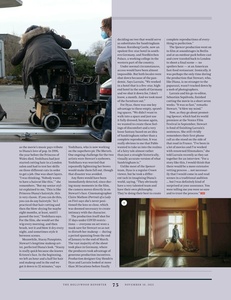
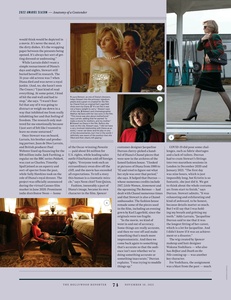
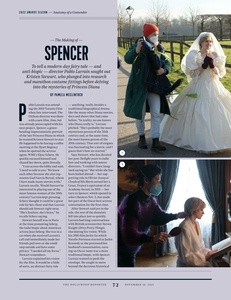
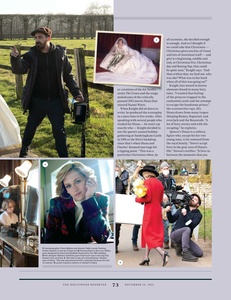
BTS Stills
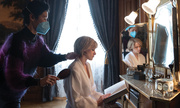

Click on images for full view.
Pablo Larraín was attending the 2019 Toronto Film when fate intervened. The Chilean director was there with a new film, Ema, but was already preoccupied with his next project, Spencer, a genre-bending impressionistic portrait of the late Princess Diana in which he wanted Kristen Stewart to star. He happened to be having a coffee meeting at the Hyatt Regency when he spotted the actress’ agent, WME’s Elyse Scherz. He quickly excused himself and chased her down, quite literally.
“I ran across the lobby and said, ‘I need to talk to you.’ We knew each other because she also represents Gael García Bernal, whom I have made many movies with,” Larraín recalls. Would Stewart be interested in playing one of the most famous women of the 20th century? Larraín kept pressing. Scherz thought it could be a great role for her client and that Larraín should ask Stewart right away. “She’s fearless, she’s brave,” he recalls Scherz saying.
Stewart herself was in Paris at the time promoting Seberg, the indie biopic about American actress Jean Seberg. She was in a car when she received Larraín’s call and immediately made her friends pull over so she could step outside and have some privacy. “I needed all my focus,” Stewart remembers.
Larraín explained his vision for the film. It would be a fable of sorts, an abstract fairy tale — anything, really, besides a traditional biographical drama like the many other Diana movies, docs and shows that had come before. “In reality, no one knows who Diana really is,” Larraín pitched. “She’s probably the most mysterious person of the 20th century and, at the same time, the most known person of the 20th century. That sort of enigma was fascinating for a movie, and I guess that’s how we started.”
Says Stewart, who has devoted her post-Twilight years to indie fare and working with auteur directors, “I couldn’t have imagined saying no.” But while she has been hailed abroad — her supporting role in Olivier Assayas’ Clouds of Sils Maria earned her a Cesar, France’s equivalent of an Academy Award, in 2015 — her turn in Spencer, which opened in select theaters Nov. 5, has made her part of the Oscar best actress conversation for the first time.
After Stewart said yes to the role, the rest of the elements fell into place just as quickly. Larraín had long conversations with British screenwriter Steven Knight (Dirty Pretty Things), elucidating his vision. While his 2016 film Jackie (in which Natalie Portman starred as Jackie Kennedy as she processed her husband’s assassination, earning an Oscar nom) was a more traditional biopic, with Spencer, Larraín wanted to push the envelope. He sought to move beyond the decorous historical re-creations of the hit Netflix series The Crown and the soapy melodrama of the critically panned 2013 movie Diana that starred Naomi Watts.
When Knight did sit down to write, he produced the screenplay in a mere four to five weeks. After speaking with several people who worked for Diana — he won’t say exactly who — Knight decided to use the queen’s annual holiday gathering at Sandringham Castle in 1991 as the film’s backdrop, since that’s when Diana and Charles’ doomed marriage hit a tipping point. “This was a particular Christmas when, by all accounts, she decided enough is enough. And so I thought if we could take that Christmas — Christmas gives you lots of visual and lots of emotional stuff — and give it a beginning, middle and end, or Christmas Eve, Christmas day and Boxing Day, that could be quite neat,” Knight says. “And then within that, we find out, who was she? What was in her head when all of this was going on?”
Knight also mixed in horror elements found in many fairy tales. “I wanted that feeling of the princess trapped in the enchanted castle and the attempt to escape the handsome prince,” the screenwriter says. His Diana draws from many tropes: Sleeping Beauty, Rapunzel, and even Jack and the Beanstalk. “A lot of fairy stories end with the escaping,” he explains.
Spencer‘s Diana is a solitary figure who, except for her two young sons, is far removed from the royal family. “Steve’s script lives in the gray area of Diana’s life,” Stewart testifies. “It lives in between the moments that you would think would be depicted in a movie. It’s never the meal, it’s the dirty dishes. It’s the wrapping paper between the presents being opened. It’s always her sort of getting dressed or undressing.”
While Larraín didn’t want a simple reenactment of Diana’s days and nights, Stewart still buried herself in research. The 31-year-old actress was 7 when Diana died and was never a royal junkie. (And, no, she hasn’t seen The Crown.) “I just kind of read everything. At some point, I kind of hit the end wall and had to stop,” she says. “I wasn’t fearful that any of it was going to distract or weigh me down in a way that inhibited me from really inhabiting her and that feeling of freedom. The research only mattered for me emotionally because I just sort of felt like I wanted to leave no stone unturned.”
Once Stewart was on board, Larraín, his brother and producing partner, Juan de Dios Larraín, and British producer Paul Webster lined up financing for the $18 million indie. Jack Farthing, a regular on the BBC series Poldark, was cast as Charles; Timothy Spall joined as an equerry and sort-of specter from the past, while Sally Hawkins took on the role of Diana’s royal dresser. The project was officially announced during the virtual Cannes film market in June 2020. Prominent indie distributor Neon — home of the Oscar-winning Parasite — paid about $4 million for U.S. rights, while leading sales outfit FilmNation sold off foreign rights. “Everyone took such an extraordinary swan dive off the cliff, and the movie has exceeded all expectations. To tell a story this human is a cinematic miracle,” says Neon chief Tom Quinn.
Fashion, inexorably a part of Diana’s image, became its own character in the film. Spencer costumer designer Jacqueline Durran cherry-picked a handful of Diana’s Chanel pieces that were now in the archives of the famed fashion house. “I looked at pictures of Diana from 1988 to ’92 and tried to figure out what her style was over that period,” she says. It helped that Durran — whose numerous credits include 1917, Little Women, Atonement and the upcoming The Batman — had dealt with Chanel numerous times and that Stewart is also a Chanel ambassador. The fashion house remade some of the pieces used in the film, including an evening gown by Karl Lagerfeld, since the originals were too fragile.
“In the movie, we kind of went in and out of accuracy. Some things are really accurate, and then we veer off and make something that’s much more impressionistic. And then we come back again to something that’s accurate so that the audience isn’t sure whether we’re doing something accurate or something inaccurate,” Durran explains. “I was trying to muddle things up.”
COVID-19 did pose some challenges, such as fabric shortages and a lack of tailors. Durran had to cram Stewart’s fittings into two marathon sessions in London in December 2020 and January 2021. “The first day was nine hours, which is just impossibly long, but Kristen is so fantastic, she just did it. We got to think about the whole costume arc from start to finish,” says Durran. Stewart admits, “It was exhausting and exhilarating and kind of awkward, to be honest, because details matter so much. But I will say that I was holding my breath and gritting my teeth.” Adds Larraín, “Jacqueline Durran said to me that it was the longest fitting of her career, which is a lot for Jacqueline. And I didn’t know if it was an achievement or a disaster.”
The wig created by Spencer makeup and hair designer Wakana Yoshihara — who also has Belfast and Death on the Nile coming up — was another key character.
For Yoshihara, the assignment was a blast from the past — much as the movie’s music pays tribute to Diana’s love of pop. In 1996, the year before the Princess of Wales died, Yoshihara had just started cutting hair in a London salon and had to test her skills on three different cuts in order to get a job. One was short layers. “I was thinking, ‘Nobody wants to have a haircut like this,’ ” she remembers. “But my senior stylist explained to me, ‘This is like Princess Diana’s hairstyle, this is very classic. If you can do this, you can do any hairstyle.’ So I practiced that hair cutting and then the blow-drying for maybe eight months, at least, until I passed the test,” Yoshihara says. For the film, she would set the wig every morning, and then brush, wet it and blow it dry every night, and sometimes style it between scenes.
Meanwhile, Stacey Panepinto, Stewart’s longtime makeup artist, perfected Diana’s look. “Stacey is really quick because she knows Kristen’s face. In the beginning, we left an hour and a half for hair and makeup and in the end we got it down to 32 minutes,” says Yoshihara, who is now working on the superhero pic The Marvels. One ongoing challenge for the two artists were Stewart’s eyebrows. Yoshihara was worried that repeatedly lightening her brows would make them fall out, though that disaster was avoided.
Any flaws would have been immediately detected, since during many moments in the film, the camera moves directly in on Stewart’s face. Cinematographer Claire Mathon (Portrait of a Lady on Fire) says she’s never positioned the lens so close, which was deemed necessary to create intimacy with the character.
The production itself shot for 37 days under COVID restrictions — everyone on set wore a mask save for Stewart so as not to disturb her makeup — during a period spanning from the end of January to the end of March. The vast majority of the shoot took place in Germany, where the producers took advantage of generous production incentives. Production designer Guy Hendrix Dyas and Larraín looked at more than 30 locations before finally deciding on two that would serve as substitutes for Sandringham House: Kornberg Castle, now an opulent five-star hotel in southern Germany, and Nordkirchen Palace, a working college in the western part of the country.
Under normal circumstances, access would have been almost impossible. But both locales were shut down because of the pandemic. Says Larraín, “We worked in a hotel that is a five-star, high-end hotel in the south of Germany and we shut it down for, I don’t know, a month. And we took most of the furniture out.”
For Dyas, there was one key advantage to these empty, sprawling spaces. “We didn’t want to walk into a space and just use it fully dressed, because again, we wanted to create these feelings of discomfort and a very loose fantasy based on an idea of Sandringham rather than a complete reproduction. It was really obvious to me that Pablo wanted to take us into the realms of a fairy tale almost rather than just a straight historically, visually accurate version of what Sandringham is.”
Unlike most of the Spencer team, Dyas is a regular Crown viewer, but he took a different tack in imagining Diana’s world, saying, “They obviously have a very talented team and have their own philosophy. They’re doing their best to create complete reproductions of everything to perfection.”
The Spencer production went on to film at soundstages in Berlin and at an outdoor park before cast and crew traveled back to London to shoot a final scene — no spoilers here — at an American fast-food restaurant. Ironically, it was perhaps the only time during the production that Stewart, who, like Diana, is no stranger to the paparazzi, wasn’t tracked down by a mob of photographers.
Larraín and his go-to editor, Sebastián Sepúlveda, finished cutting the movie in a short seven weeks. “It was so fast,” remarks Stewart, “it blew my mind.”
Now, as they go about promoting Spencer, which had its world premiere at the Venice Film Festival in September, Stewart is fond of finishing Larraín’s sentences. She still vividly remembers their first phone call as she stood on the side of that road in France. “I’ve been in a lot of movies and I’ve worked with renowned filmmakers,” she told Larraín recently as they sat together for an interview. “For a story like this, I would think that there would be a more extensive vetting process … not necessarily that I would come in and read scenes in a traditional audition … but I was definitely kind of surprised at your assurance. You were telling me you were so sure and to trust the process.”
Source Scans thanks to Gossipgyal
Friday, November 5, 2021
Kristen and Jacqueline Durran talk costumes for 'Spencer' with Vogue Magazine
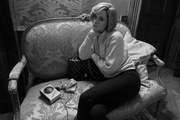
BTS via Suzie Riemer
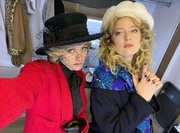
Click on images for full view.
Everyone knows Princess Diana—or they think they do. The royal, who would have turned 60 this year, remains a subject of fascination among the public and artists. After capturing Jacqueline Kennedy Onassis’s private struggles following her husband’s assassination in 2016’s Jackie, director Pablo Larraín turned his attention to Diana’s story. His new film, Spencer, offers a fictionalized account of the princess, played by Kristen Stewart, at a turning point during the queen’s annual Christmas holiday at Sandringham House in Norfolk, England. The pivotal three days from Christmas Eve to Boxing Day magnify the many problems within Diana’s personal life. Under surveillance by the Windsors’ retinue of courtiers, trapped in failing marriage, and told to keep up appearances while struggling with an eating disorder, she’s far removed from fairy tales.
Larraín frames his film as a fable, exploring the dark side of the monarchy without eschewing the fantasy and beauty that keeps the system going. Diana’s life may be falling apart, but she looks the part of a princess and is surrounded by luxury. That contrast is part of what makes the film powerful. Creating the wardrobe of the allegorical Windsor meant Larraín, costume designer Jacqueline Durran, and Stewart had to be on the same page. Thankfully, they had some help from a fashion giant: Chanel. “Every step of the way, it was a total collaboration,” shared Stewart via email. “We were all in this together: me, Pablo, Jacqueline, and Chanel. It was so intimate.”
Chanel opened its archives to the production, loaning and re-creating vintage pieces for Stewart to wear onscreen. This level of access allowed Durran to heighten the luxurious mood that Larraín and production designer Guy Hendrix Dyas created. “In terms of style and glamour, the collaboration gave the movie something we wouldn’t have had otherwise,” she says. “The Chanel pieces added to that aura Diana had as a princess, so it was an incredible match in that sense.”
There are thousands of photographs and articles about Diana to draw from, but the wealth of information was a double-edged sword. “In the beginning, it was an intimidating situation because there were just so many images of her,” says Durran, who focused her attention on photos shot between 1988 and 1992. “What I wanted to find was the logic behind her choices and the key pieces you see her wear during that period. Certain elements repeat—color blocking, gold buttons, contrasting lapels, polo-neck sweaters, and high-waist, slightly cropped jeans with flat pumps.” Figuring out Diana’s staples was crucial. “I had to establish a contrast between the formal and restrictive clothes she wears during her official life and the way she dresses when she can be herself,” says Durran. “To tell this story, you had to see a real difference between those clothes.”
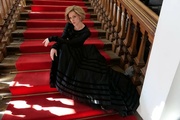
To that end Durran used a series of archival gems to achieve both types of Diana’s looks. Stewart wears a striking red tweed coat from the fall 1988 Patrimoine ready-to-wear collection as Diana is mobbed by paparazzi, black velvet dresses from the fall 1983 and 1988 collections, and a slew of vintage accessories. A few modern pieces sneak in too; in one scene, Stewart sports the skirt from look 46 from Virginie Viard’s spring 2020 haute couture collection.
Chanel had a special place in Diana’s wardrobe. A fan of its classic suits and quilted bags, she wore her collection off-duty and while performing her role as Princess of Wales. Stewart found Diana’s outfit selections evocative. “In certain photographs of [Diana], she looks as though someone else dressed her,” she says. “Even if the outfit is beautiful, she seems like a prisoner in it. While doing my research, I noticed that whenever Diana was wearing Chanel, she seemed like herself. When she looked powerful, quite often she was wearing Chanel.” Stewart incorporated the observation into her performance. “When you watch the movie, all the Chanel looks are used when Diana needs help,” she explains. “If the scene was difficult or she felt threatened, we put her in a Chanel suit to give her a bit of a support system. Even if she wasn’t feeling good on the inside, she stood tall and shined during those moments.”
Stewart has some experience wearing Chanel. A brand ambassador since 2013, she’s known for her distinctive take on the brand’s signatures. Though her style is worlds away from Diana’s, she felt the Chanel archival pieces were essential to the story. “If I didn’t have a relationship with Chanel, we would have begged the house to play with their clothes; if we weren’t allowed to, we would have probably mimicked them,” says Stewart. “The character needed them. They’re such a part of her. There is a delicacy and a vulnerability [to the clothes] that makes them even more beautiful. She’s so raw and honest that when she puts them on, you can feel she loves them.”
Unfortunately, many of Diana’s best Chanel moments came after her exit from the royal family, and Spencer’s story plays out during a period where courtiers controlled her wardrobe. “There were all these restrictions to consider,” says Durran. “She wore more Chanel later in life than during the late ’80s and early ’90s.” The royal dress code, which contains rules about everything from hem lengths to nail-polish colors, couldn’t be ignored. Still, when Durran happened upon the film’s pièce de résistance, a strapless gown from Chanel’s spring 1988 haute couture collection, she wasn’t about to change it. “Initially, I was worried we’d have to add sleeves and hide her arms because of the protocols,” she says. “When I had the fitting with Kristen and Paolo in London, she put it on and it was just so great, the perfect look for an extremely glamorous princess. We hadn’t even planned to use it for such a large chunk of the movie, but it was just too good to pass up.”
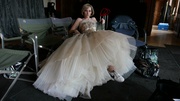
Adorned with pleated tulle ruffles, an appliqué satin belt, and a delicate frieze composed of fabric florets, the gown was appropriately opulent. Still, after more than 30 years in the archives, the original was far too fragile to function as a costume. “It was too precious—you couldn’t even take it outside,” says Durran. “Thankfully, Chanel came back to us and said they could completely replicate the piece.” It took 1,034 hours—700 devoted solely to the intricate embroidery—to duplicate the couture look. With five seamstresses in Chanel’s atelier working nonstop, they were able to turn the project around in just under a month. “We’re indebted to them,” says Durran. “They had almost no time and were able to recreate every detail. In the end, the only difference was that the new version fit Kristen even better than the first.”
Though it wasn’t the only piece recreated for the film, the couture gown features prominently in the final cut and its poster, which shows Diana crumpled on the ground, her body shrouded in layers of tulle. For Stewart, the couture reflected Diana’s privileged yet unhappy existence. “It’s heartbreaking how gorgeous it was,” she says of the look. “We went through the archives thinking, What is the dress? [And] it was so undeniably the right one. To see someone on the bathroom floor in such a dress is truly heartbreaking. You can’t imagine someone being unwell in a dress [that is] so spectacularly beautiful, unique, and one of a kind. I have such nostalgia for it. Usually, I don’t have an emotional reaction to my movie posters, but every time I see Spencer’s, it makes me want to cry.”
For Durran, helping to facilitate such powerful responses from Stewart was the costume design’s primary role. “My work is supporting her as an actress,” she says. “Watching the final movie was overwhelming because the only thing I wanted was for my work to give Kristen all she needed to achieve her performance. I believed in her so much, and she’s mesmerizing as Diana.”
Sunday, October 31, 2021
Jacqueline Durran talks 'Spencer' and mentions Kristen with The Times (UK)
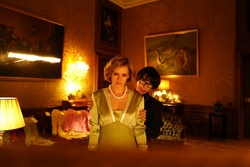
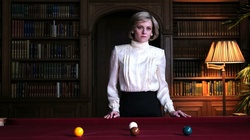
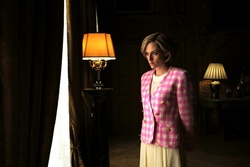
Click on images for full view.
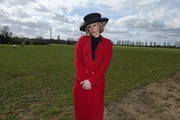
In one memorable scene in the film Spencer, Kristen Stewart, playing Diana, Princess of Wales, rages against protocol and wears a bright red Chanel coat and black netted hat to church — a look that had been reserved for Boxing Day. The choice rings alarm bells throughout the household, where her wardrobe would have been tightly managed by her personal team, and is read as rebellion. “No one is above tradition,” warns the draconian equerry Major Alistair Gregory (a fictional character played by Timothy Spall).
The film, directed by Pablo Larraín, takes place over an imagined Christmas holiday weekend in 1991, as Diana comes to terms with Charles’s infidelity, as well as the pressures of what it means to be a royal, and it is a masterclass in how our wardrobes define our sense of self — as well as how important the optics are for figures in the limelight.
Stewart is a highly believable Diana, but it is her clothes — which segue from a bold tartan trophy jacket through a demure chartreuse evening gown and a dazzling Chanel strapless evening dress to her “liberation” outfit of blazer and high-rise jeans — that set the scene and give her portrayal a halo-like aura. While the rest of the royal household are dressed in the muted greens, greys and blues of country tweeds and corduroys, Diana stands out like a symbolic firework.
The wardrobe for Spencer is the work of the costume designer Jacqueline Durran, 55, whose credits include Anna Karenina and Little Women, for which she won Academy awards. In preparation she took an almost forensic deep dive into a particular period of Diana’s life, from 1988 to 1992. “In making the film I was never under the impression that this was a documentary in any shape or form. It was about making a believable Diana,” says Durran, who pored over thousands of images of the late princess from archival picture sources, books and magazines during her research. “I tried to get a feeling of what she was wearing and why she dressed in that style at the time.”
The early Nineties was a key moment in Princess Diana’s life. “It was a period of transition, and it seemed her choices got bolder and bolder to the point of being almost confrontational,” Durran says. “Diana’s clothing was like an armour and she appeared like a great, confident woman. She wore a lot of British designers including Bruce Oldfield and Murray Arbeid, as well as Catherine Walker, who was instrumental in defining her image at the time. Beyond 1992 Diana seemed to become much more herself in her style choices.”
The focused timeline also allowed Larraín and Durran to draw a line under the depiction of Diana in The Crown, with which there are certain to be comparisons. However, Larraín’s tense emotional drama, as well as Stewart’s formidable portrayal, puts Spencer in a different league from the romanticised myth-making in The Crown. The choice of outfits helped to guide the scene-setting, and Larraín photographed the fittings with Stewart to help craft the film. “It was Jackie [Larraín’s 2016 film about Jackie Kennedy] that made me so interested in the project. It’s a close look at a style icon, how an iconic look is built and what that means to everyone over time,” Durran says.
Because of the Covid restrictions the designer had limited time with Stewart, who flew to the UK for a lengthy fitting that involved trying on looks that had been made for her (from archival images), archive pieces from Chanel (that would be remade in its Paris atelier) and a cross-section of vintage pieces. “Kristen really knows about style and how to wear clothes, and she can look at something and intuit a way of wearing it,” says Durran of the 31-year-old actress. “There’s a scene with Diana dancing down the hallway in an evening dress and Kristen embodies that moment, walks so brilliantly in the midst of the downward spiral of the day.”
The relationship between Princess Diana and her maid, Maggie (played by Sally Hawkins), is a study in friendship and love when Maggie reveals her devotion to Diana on a windy Norfolk beach and both fall about with laughter. Diana is wearing a Mondi baseball jacket (sourced from a vintage site) and jeans, and with that outfit you understand that she is readying herself to break free with her beloved boys from Charles.
Although Durran’s research was thorough, she did not feel the need to remain true to history. “I mix it up — some are true replicas, some hybrid and some made up. What was important was to have that feeling of Diana. Finding those items was a constant search, and Kristen is small. Original Eighties clothes are boxy, so we needed to find and design pieces with the right proportions for her,” she says. One Larraín favourite was a tailored coat and tricorn hat ensemble that Diana originally wore (albeit in red) on a visit to Britannia Royal Naval College, Dartmouth, in 1989. The look, with the rebellious pirate hat, was adapted in primrose yellow for a feverish reverie scene.
As a viewer you are put wincingly close to the characters over this claustrophobic weekend at Sandringham. At one point the camera zooms in on Stewart’s neck, which is almost being strangled by a huge pearl necklace — a Christmas gift from her husband.
The magic of Durran’s costume design is her ability to build an aura through fashion. Durran, who was fascinated by London designers and street style as a teenager, studied philosophy before learning her craft at Angels Costumes in London. She then got her big break with the award-winning costume designer Lindy Hemming.
Durran remembers the furore surrounding Diana in the Eighties and Nineties. Musing on why the younger generation are so besotted with the princess’s style today, she says: “When I was growing up Diana was not fashionable — royal family fashion was a parallel universe. It’s fascinating that her style is now so fashionable and how the process of reappropriation has changed that over time.’’
With such strong performances, breathtaking cinematography and a peach of a wardrobe to boot, there’s a lot to look forward to in Spencer.
Thursday, October 7, 2021
Costume designer, Jacqueline Durran, talks 'Spencer' and Kristen with EW + New Stills and BTS image

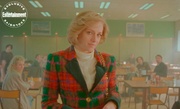

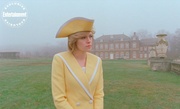
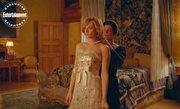
Click on images for full view.
You might not know costume designer Jacqueline Durran by name, but if you've seen a movie in the last 20 years, you probably know her work. The iconic green Atonement dress? That was her. The WWI trench coats in 1917 and man-who-came-in-from-the-cold greys of Tinker Tailor Soldier Spy? Also her; Pride and Prejudice, too.
But the two-time Oscar winner — for 2012's Anna Karenina and 2019's Little Women — faced an entirely new challenge with Pablo Larrain's feverish arthouse biopic Spencer (in theaters Nov. 3): how to represent a real-life icon without losing the movie's surreal sense of mystery — or the essence of the American actress portraying her. EW spoke to Durran about sourcing vintage Chanel, granting Stewart's wildest pirate-sailor dreams, and other to-Di-for looks from the film.
Diana's style is so distinctive, and so documented. What kind of directives did Pablo give you from the beginning?
Well, there was the overall idea of the movie, where we're investigating the idea of a princess who appears to have the perfect life but in fact doesn't. And then there was the way in which he wanted to create that story within a very designed space — he wanted our costume choices to all be very intentional, and then he also wanted to use strong colors. So there's an endless amount of research.
It's a fact that everyone mentions, but [Diana] absolutely was the most photographed person I've ever come across. I mean, if you go onto any search engine, there are thousands and thousands of pictures. And so it was a matter, really, of picking out the direction from within this huge range of options. And we also narrowed it down by having a time frame, which ran somewhere between 1988 and 1992.
There were certain outfits that I recognized, and then other ones where I wasn't sure if they were replications of looks that had existed or if they were more like interpretations.
There's one costume which is as much a replication as we could make, which is the red polo-neck and the dogtooth skirt that she wears the second costume into the movie. There's also the bomber, the blouson jacket that she wears at the end. I couldn't believe that I'd actually found one identical to the one she wore, [by a brand called] Mondi. I mean, it's the same! So that was sort of amazing.
The idea was that we were never slavishly replicating all of Diana's looks, but we were definitely riffing on the idea of them. So we were quite consciously not trying to do the closest version we could in every instance. But in some places we used things that were exactly her style and then other places we drifted off. We bought a retro pair of jeans, and the sweaters weren't made by us, obviously. But a lot of the pieces were made.
Is there a Diana scarcity now when you go shopping for vintage, because of shows like The Crown and their influence, and the general revival of interest in those styles?
It's a bit harder because it's more fashionable and more people are interested in buying it. But then again, if people are interested in buying it, then dealers have more of it and you just have to pay more for it. [Laughs]
But most of Diana's wardrobe was made for her, so we should touch on the question of Chanel. Her main Chanel period was later in her life, but there was her visit to Paris, which I think was in 1988, a [famous] red coat, which we then had replicated for Kristen by Chanel.
There are so many looks in this movie; more than you would think for a film that takes place essentially over just three days. What was the process of that like?
Pretty early on was we had an enormous fitting. It was with Kristen, Pablo, and myself, and we just went through the whole movie and kind of allocated ideas and looked at each costume.I knew that for instance, there is the montage of clothes that she needs for Christmas that's laid out, not all of which she ends up wearing.
And then there's the montage scenes where they cut away to her at different moments, which also isn't part of the kind of linear costume story. So those were clothes that I continued to look for right through shooting.
The interesting thing to me was just the mix of late '80s into early '90s with the sort of strictures of the royal family — which is so timeless on the one hand, but also a little stuck in maybe like, the '50s, '60s, and a lot less organic to her.
That's exactly what we hoped would happen because in theory, all of those clothes that you see her when she's got her kind of official linear story is all stuff that's been prepared for her, that's just part of the formality of the situation. So that's great that you got that from watching.
And how did you guys make Kristen look so tall? Because Diana had a good five or six inches on her.
It was a lot to do with how she was shot, I think. But we were just conscious in the fitting — if tweaking something, raising a waistline, moving a bust, changing the proportion of the clothes slightly, if that elongated her, then we would do that. We didn't make huge changes to anything particularly in order to achieve it. But we avoided things that kind of highlighted the fact that she was shorter than Diana.
Were there looks that Kristen particularly loved or hated?
She absolutely loved the Mondi jacket, the bomber. But you know, I can't speak highly enough of her. She is the most fantastic actress to work with because she is completely dedicated to throwing herself into the creation of the image that you're searching for. And she's totally willing to try anything, but at the same time, she gives great notes on what she thinks works and what doesn't work. And she's got such great style. Unbelievable! It's so different to Princess Diana's, but that kind of shows how great her talent is.
Did you ever feel, as sort of the resident Brit — you have a Chilean director and an American actress who didn't really grow up with Diana — like you were speaking for the record, or for England, when it came to accuracy?
At the beginning, I was quite obsessed. There was a thing in the '80s in Britain, I don't know if you've heard of it, called Sloane Rangers. [Diana] was the archetypal Sloane Ranger, so I was talking to them a lot about that, but in the end that wasn't really the movie we were making. We were making Pablo and Kristen's movie. So I didn't feel the weight of the resident Brit too hard.
Let's talk about the wedding gown. It's not actually so much like the famous real-life dress, really, that giant poof.
The wedding gown! It didn't feature in the main movie, it's [only] in the montage. And we just didn't have the money to make a Diana wedding gown for something that wasn't even part of the main story. So we just adapted a wedding dress to be an approximation of it.
I'm under no illusion that there were differences between Diana's dress and the dress that we made. But it was a kind of the spirit of the dress, rather than an exact replica. If you are not making The Crown, and if you are making artistic decisions on what you can and can't achieve, I think you just have to do those things sometimes.
What about the yellow sailor look? That has to be a favorite.
That was based roughly on something Diana wore. She went to review the Navy, I think, in Portsmouth. Pablo and Kristen loved the idea of her wearing a pirate hat, so we made the pirate hat and we made it in yellow and it was a sort of floating costume because we weren't really sure where it was going to fit, but it had to go in somewhere. And then I think it found its place. [Laughs]
There's a gown she wears to a formal family dinner early on with a pearl choker that Charles has given her as gift, and the whole look seems in a way like golden handcuffs — it's technically gorgeous, but she hates it.
It was classic, I think, and quite simple. It was just an instinctive choice. That one was one we made. And the pearls, yeah, exactly that! They were beautiful and oppressive at the same time.
Just like her life.
Yes. [Laughs]
Source: EW
Thursday, November 19, 2020
Costume designer Kathleen Felix-Hager talks 'Happiest Season' and mentions Kristen

Hulu's new original holiday movie Happiest Season stars Kristen Stewart, Mackenzie Davis, and Schitt's Creek's one and only Dan Levy. The Clea DuVall-directed film's storyline is so real that it's obvious we've been missing it from our ranks of historic seasonal favorites — Christmas With the Kranks, Home Alone, The Holiday, Love Actually, and the list goes on. Kristen plays Abby, who goes home to meet her girlfriend Harper's family, only to discover that they don't know she's gay — or that Abby is more than just her roommate. Abby promptly panics and calls her best friend, John — played by Dan — and the narrative unfolds from there. It's relatable like the characters' outfits are relatable, all brought to life by costume designer Kathleen Felix-Hager, who confirmed that just because fashion is not the movie's focus doesn't mean it isn't hugely important.
"[Clea DuVall] had a very specific vision for all of the characters and we worked closely together to create the looks," Kathleen told me. "Each character had a color palette and a silhouette that we adhered to. It was very important to keep the characters feeling like real, authentic people and to keep the costumes as classic as possible, since Christmas films live on forever." It's true that this is one holiday film that will definitely remain relevant, and Kathleen's right in that there will never be a time when the winter coats and holiday outfits here do not feel timely. In fact, the outerwear — from plaid coats and dinner jackets to bombers and beanies — is arguably the best part of the movie.
"Outerwear was super important — one because it's Christmas and it's freezing and also because it helps to define the characters," Kathleen said. Every coat does, in a subtle way, help to distinguish personality traits in the film. We see that most with Harper, who has a strong sense of self when she's alone with Abby before they get to her parents' house. But when we see her swap her sophisticated camel coat for a flannel throw-over that she probably pulled out of a childhood bedroom drawer, she is withdrawing from her relationship to be the person her parents have assumed her to be.
Kathleen enjoyed working with the entire cast, which also includes Aubrey Plaza, Alison Brie, and Step Brothers's Mary Steenburgen, but really loved collaborating with Kristen Stewart, whose Christmas dinner party outfit is reminiscent of tailored pantsuits from the star's iconic red carpet looks past. "She is really smart and has great instincts regarding her character. . . . Kristen and I went shopping together one weekend and had a blast!" Kathleen said.
Ahead, Kathleen was kind enough to break down the coat closet and fill us in on all the winter outerwear you won't just appreciate during the movie, but admire enough to shop and wear forever. Because like we said, this holiday rom-com deserves a spot in your top five, now and always.
Happiest Season will be available to stream on Hulu starting Nov. 25.
Monday, September 21, 2020
Costume designer Michael Wilkinson talks about 'Seberg' and mentions Kristen

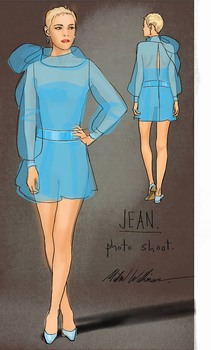
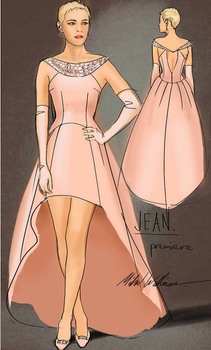
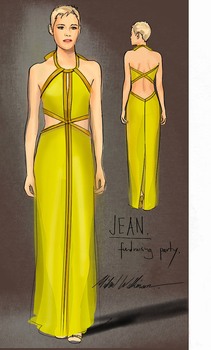
Click on image for full view.
Googled translated.
Mr. Wilkinson, how did you go about helping Kristen Stewart transform into Nouvelle Vague star and It Girl Jean Seberg?
Kristen and I were deeply moved by Jean Seberg's story. You can study human strengths and weaknesses on her, for us she was the intense discovery of a psychologically highly complex person. For me, designing costumes for people who are full of contradictions and small flaws is especially grateful. Kristen works harder than almost any other actress I've met and she is very intuitive at work. We had long discussions about what which costume should express, it was a great collaboration. It quickly became clear that Kristen had no ego problems when it came to the costumes. For both of us, it was primarily about finding clothes that fit the scene and are not just “fashion-conscious”.
Then where did you get the inspiration for the final designs?
Jean and Kristen were my inspiration for the costume design. I was fascinated by the parallels between these two women. Both are icons, both are uncompromising and completely modern. You have great self-confidence. I wanted to incorporate that into the film and express that strength with the costumes.
How would you describe the style of the two?
Kristen and Jean have a very modern style that doesn't seem effortless or ornate. You feel comfortable in very expensive designer clothes as well as in the simplest casual look. You never get the impression that a dress overwhelms or covers the person. The individual personality always shines through. I think that has a lot to do with the energy created by the contrasts: the short hair goes with feminine couture as well as a surprising personal touch, such as wearing casual clothes whose cut is based on men's fashion. Both women have a personal strength that makes the clothes they wear seductive.
Have you studied a lot of historical material beforehand?
I saw all of Jean Seberg's films so that I could “get to know” them. I wanted to understand their on-screen magic. Then I did extensive research on the period from 1968 to 1970 in which our film was set. I studied all the clothes Jean actually wore at the time, looked at her personal photos, film photos from the studios, paparazzi and fashion photos as well as magazine articles. Some of the costumes in the film are directly inspired by these images. To get the right clothes for those private moments about which there were no photo documents, I had to put myself in Jean's head and imagine what she would have chosen for them. When it comes to jeans style, most people think of the pictures of you as a world-famous it girl, i.e. the time when when she was "discovered" by Otto Preminger and played "Saint Joan" in 1957 and then appeared in Godard's "Breathless" in 1960. Back then, she sported this light, modern and idiosyncratic wardrobe: a few staples that got a personal touch with her rasped pixie haircut, which she paired with a flawless white shirt, capri pants, ballet shoes and the famous striped Breton T-shirt combined.
A look that doesn't even appear in the film ...
In the film, Jean's celebrity is almost over and her film career is starting to stagnate, she is no longer the carefree ingenious trendsetter, she has gotten older and also more insecure. I've talked about their classic casual style in a few scenes, but we mostly see them differently. We see her in her house, vulnerable and relaxed in sheer, delicate underwear and silk dressing gowns. We see her at her public appearances when she wears designer labels like armor in which she can face the world. The style of this time is very plastic and strong - Jean Seberg wore dresses from all the big houses from Yves Saint Laurent, Courrèges, Chloé to Givenchy.
Do you have a favorite outfit?
I wanted Kristen to get the glow from Jean, her indestructible spirit, that light she was giving off from within - so in some scenes I put her in bold yellow, pure blue, red and white, or chartreuse green. But I also wanted to get the paranoia across. So in some scenes she wears colors that make her pale. Director Benedict Andrews said he would like to show her as pale as a fragile orchid. After her miscarriage, she had the darkest moment of her life from which she never fully recovered, so I let her wear black. But one of my favorite costumes is the red leather jacket that I chose to reflect her passion for life and her impetuous esprit.
How did you actually start with costume design?
As a teenager, I made some money dressing up at operas, ballet, and theaters. This world “behind the scenes” captured me and I discovered my “tribe” there, people who tick just like me. That's when I knew I wanted to work through the costumes in this rich world of storytelling. I studied costume design and learned everything from pattern making to art and film history, costume making and illustration. After graduating, I started designing for small theater companies. Then came bigger orders and at some point finally the first small independent films. I moved to America and worked there for 15 years before returning to London five years ago.
And what was the most difficult project you have worked on so far?
"Aladdin" (editor's note: Disney's live film 2019) was incredibly ambitious. The task consisted of dazzling the senses with a wealth of colors and creating a world of its own that still seemed so grounded and authentic that the audience could emotionally follow. Another big challenge was “American Hustle” because it was such an organic way of filming. Director David O. Russell kept us busy with new developments in the story. It was very exciting to work so raw and energetic.
Many of your designs appear very flamboyant and impress with their remarkable feel, which is also transferred to the canvas.
I love it when a film inspires me, so I try to inspire audiences with my work too. For "Jean Seberg" I went over with director Andrews what each costume was supposed to express, discussed it all again with Kristen, and then I withdrew and designed every single detail. Because the colors, cuts and textures were so specific, I had most of the costumes made directly by a great team of tailors in Los Angeles. I looked for the fabrics and trimmings at vintage fabric collectors and in special fabric shops in Los Angeles. I sourced a few of the costumes and all of the accessories from my favorite costumes distributors on the West and East Coasts and from vintage dealers around the world.
Sometimes this is reminiscent of the costumes of classic old Hollywood. Do you have a favorite era that keeps inspiring you?
I have a very eclectic style, I love Elizabethan textiles, 3D printing, mid-century furniture, Japanese cinema of the fifties and the music of the 18th century. There is good - and bad - design in every era. But my main inspirations are colors. I draw joy and strength from those who surround me every day.
Source
Sunday, December 2, 2018
'Equals' costume designer Carlos Rosario talks about working with Kristen
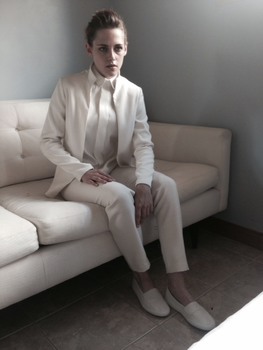
Click on pic for full view.
Q: I saw a picture of work you did with Kristen Stewart – who I regard to be the best actor around at the moment – on your website. Can you talk about working with Kristen and share any memories from your time around her?
I was initially one of the first designers on Equals. I started all the concepts and made the first samples for the lead characters.
I loved working with Kristen. She was very respectful of the design process, very professional and fun to work with. It was a small project, so I had to transform my house into an office space. I actually ended up doing her fittings in my own personal bedroom. It was such a surreal moment. I remember wondering what my neighbours’ reaction would be if they saw her coming out of my house.
Source
Friday, September 14, 2018
'Lizzie' costume designer, Natalie O'Brien, talks about the movie and mentions Kristen with Fashionista

Producer and actress Chloë Sevigny spent nearly a decade bringing the latest dramatization of Lizzie Borden's alleged 1892 ax murders of her father and stepmother to the big screen. Her vision for "Lizzie," written by friend Bryce Kass, explores the lead-up to the still-unsolved grisly murders, and the famous trial of the accused murderer, played by Sevigny, from a feminist and "smash-the-patriarchy" point of view.
As a decision-maker in front of and behind the camera, she was fully invested; she even spent a night in the Fall River, Mass. murder house (now a museum and a bed and breakfast, which can't not be haunted, honestly). That meant everything in the film, including the costumes, required meticulous dedication to authenticity. Because of the salaciousness and brutality of the hatchet murders — and the fact that the Bordens were prominent members of the community — the case was like the O.J. Simpson trial of the day. So, the costume department had copious old photos, sketches and documentation surrounding the proceedings to analyze.
Costume designer Natalie O'Brien, who also outfitted Elizabeth Olsen as a spot-on influencer in "Ingrid Goes West," carefully studied "Parallel Lives: A Social History of Lizzie A. Borden and Her Fall River," by Michael Martins and Dennis A. Binette — a comprehensive "bible" about Borden.
"It has the kind of details like, 'and Lizzie Borden wore a blue cord skirt when the murders happened,'" O'Brien explains over the phone from Los Angeles.
For roughly the first half of the movie, Lizzie also wears a pansy pin on her collar (pictured above), which O'Brien notes is visible on a number of images of the accused killer. Behind the scenes, the costume designer and Sevigny brainstormed a possible backstory and decided that the pin must have been a gift from Lizzie's father and the most expensive piece of jewelry she owned.
As a producer, veteran actress and style icon, Sevigny gave regular input regarding her costumes and O'Brien welcomed the collaboration. "It's beautiful to speak with your actors, and be like, 'How do you see it? How do you envision it?'" says the costume designer. "[Sevigny] was a huge part of telling the story."
The lead also had one significant, and daunting, ask: to wear all original vintage. "Like 1890s authentic vintage," specifies O'Brien, "and that's very difficult to maintain — and even to obtain — so we were definitely like little warriors hunting for every kind of piece." Lizzie had many costume changes, including a late 19th-century blue ruffle-front, mutton-sleeve and pleat-detailed dress for when she first meets new maid, dramatized love interest and possible future accomplice Bridget (Kristen Stewart).
"That was falling apart," says O'Brien. "Everyday we would have to French seam it back together because it's hot days in Savannah [where they filmed] and there's wear and tear on everything." In the beginning of the movie, Lizzie attends the theater in an elaborate and pristine vintage olive green evening dress (below), which garners compliments from her stepmother and catty theater-goer.
The look was also intentionally covered-up to communicate Lizzie's reported aloof and guarded nature in an era when women liked to reveal a teensy flash of collar bone or décolletage (ooh, racy). "That was something [people] would say about Lizzie Borden: 'ugh, what's her deal? Why is she so closed up?' We don't know," adds O'Brien, who sourced from "everywhere," including costume rental houses, Ebay, Etsy and private collectors.
One particular private collector proved eager to lend: Sevigny, herself, who had amassed an archive of pieces from the 19th century. O'Brien initially was skeptical, as the decade when the murders occurred was a very specific time in fashion history, when unwieldy and not-so-functional "big bell mutton sleeves" were the thing. "That was a very strange era and it only lasted so long because it was so strangely extravagant," O'Brien says. But she was pleasantly surprised after looking through Sevigny's collection, which included a black polka-dot dress with the most beautiful pleats and lace piping, which Lizzie puts on post-murders to greet the police.
"She had some really beautiful items that actually really fit in the era," O'Brien continues. "I was like, 'Wow, she's really been doing her homework for awhile.'" However, Lizzie's blue corded skirt and printed blouse murder outfit had to be custom-built, due to the need for multiples — because blood.
O'Brien's team also custom-built Bridget's maid uniforms and working-class wardrobe of dark sweaters and practical jackets paired with muted full skirts, which provided a socio-economic contrast via color palette and condition. "When she first comes in, you can see her ankles, and that was a big no-no," she explains. "That shows that Bridget didn't have anything tailored and it was more of a hand-me-down." Eagle-eyed viewers may also notice a rip on her jacket shoulder.
O'Brien even went a bit method with making sure all of Bridget's costumes literally fit into the suitcase she brings to the Borden house. Although she wasn't able to squeeze in one extra maid's costume. "I said, 'OK, maybe she made it or bought it [after she arrived], so I'll let that one one slide,'" O'Brien laughs.
One may also notice — especially in a few key disrobing scenes — the lack of buttons and fuss when it comes to Bridget's clothing as compared to Lizzie's complicated tiny buttons up the back. Back then, women of a certain class needed help from servants to get dressed, thus also allowing for an intimate moment between the two. "Bridget wouldn't have that help," O'Brien explains. "So anything she wore, it had to be something that she did herself."
In the late 1800s, women were still expected to wear corsets, which meant the actual actresses all needed help from the costume department to get dressed. "I would personally deliver Fiona Shaw's corset in the morning because she is a bundle of joy," O'Brien says, about the actress playing Lizzie's stepmother (and the deliciously enigmatic Carolyn Martens on "Killing Eve" — seriously, all your favorite TV people are in this movie, too.) For the sake of authenticity, putting on the period costumes was a whole process: "It goes bloomers, shoes and then the corset because they can't lean over and put their shoes on," O'Brien explains.
Unsurprisingly, Sevigny also fully committed to the presumably tortuous corset situation to help immerse herself into character. "In the morning, she would come up and be like, 'Can I have my corset?'" O'Brien says. "I'm like, 'You don't have a scene for another four hours.'" Also unsurprisingly, Stewart, who's a fan of slouchy denim, casual caps and distressed t-shirts in her off-hours, wasn't as excited to don the restricting foundation garment. O'Brien would sympathetically loosen the actress's corsets when they weren't shooting.
"Sometimes, she would wear her jeans under her dresses," says O'Brien, about Stewart sneaking in her preferred uniform during close-up shots. "I'd pass her and be like, 'What are you doing?! Noooo, this doesn't look authentic.' She's like, 'I know, I'm sorry.'"
O'Brien gave her a pass. "There's even funny on-set pictures that paparazzi caught of her wearing her corset and her hat and then she's got her jeans and her Converse or Vans on the bottom." It was a different type of authenticity than the one O'Brien was focused on, but authenticity nonetheless.
Source
Friday, March 17, 2017
'Personal Shopper' costume designer, Juergen Doering talks about the film and Kristen (Telegraph, Hello, Gay Star News)

Telegraph
Costume designer Juergen Doering was responsible for the wardrobe, and worked with director Olivier Assayas and the cast to piece together his own impression of how it should look. “First I read the script and I asked Olivier to tell me in three adjectives what he thinks about each character,” explains Doering. “Then I looked at the cast - so I led with the character first and the person second. Then I went to the actors and, without telling them what the director had said, I asked ‘How did you get this part and how do you see it?’ Because Olivier likes for people to feel the character and feel the clothes.”
There’s a noticeable difference between Maureen’s day-to-day clothing and the more elevated style of her boss. “We were thinking that Maureen’s American, she’s in Paris, she’s wearing jeans, she’s a little bit rugged - sneakers, vintage, sweaters,” says Doering. “I looked at some vintage Fruit of the Loom sweaters at a shop in Paris, and was looking for things that you could believe a girl like this had picked at the flea market. The flying jacket in brown leather, very manly, for when she’s always on the bike - a young person will try things.”
As the film progresses - spoiler alert - Maureen sneakily borrows and wears some of her client’s designer pieces, including a Vionnet organza gown with a harness, something that was specifically requested by Assayas. “I was looking in all the couture collections for a harness dress,” says Doering. “The director said ‘Maybe it’s a harness over a dress, or maybe it’s part of the dress.’ In the end I saw it at Vionnet and Olivier liked it immediately. We chose black because there is something ambiguous about her personality: she says she hates the job she is doing and the girl she is picking the things for, but when she comes to desire men, she wants to be that woman she hates.”
Maureen also borrows a silver sequinned Chanel dress. As Stewart has fronted several Chanel campaigns, it was no surprise to see the fashion house popping up in her movie - though Doering says there was no contractual obligation involved. “We know the team at Chanel well, but if we didn’t find what we wanted, we had no pressure,” he says. “I asked the girls there, ‘Do you have something with sequins?’ and they said ‘Oh we have this old dress that no one has worn before.’ And I saw it and I thought ‘Oh, this is it.’” It may be the only time you’ll see Stewart in a Chanel dress that doesn’t fit like a glove: “Of course we didn’t fit it onto Kristen, because it is not supposed to be her own dress. She feels uncomfortable in the dress, it’s not hers - but she likes it because it’s not correct for her to wear it.”
Though the contrast between Maureen’s casual wardrobe and this highly polished eveningwear is visually dramatic, it somehow feels like a natural fit for Stewart. The actress is known for her grungy personal style of T-shirts and Converse, but she’s also a muse for Karl Lagerfeld and a fixture on the front row. Working with her was easy, explains Doering: “Kristen knows her stuff. She loved Chanel before she was famous. For her it was easy to jump from the jeans to the dress, no trouble.”
He clearly felt that they had a meeting of minds. “Often actresses they have no taste!” he laughs. “So it’s good to actually have a conversation with someone who knows.”
Hello Magazine
What were the main things you had to consider wardrobe-wise with the film?
"The story has many levels. You have a mourning part, because Kristen's character recently lost her twin brother and she's looking to connect to his soul after the death – that's one part of the film when there are no clothes. And then there is the part where she works as a stylist for a female celebrity, who is a bit like a Kardashian, but she’s not very nice, and she hates her. At this point she wears a casual, vintage-y wardrobe, but not standout clothes. It's very personal, a little boyish; like Kristen can be - a jean, leather bomber jackets, and nice wool sweaters – it's a French style in a way. And the other element is that she is cruising a guy, and when she has to meet him she wears a crazy, shiny, embroidered Chanel dress."
How did you get into costume design?
"At the start of my career I was in fashion design andI worked for Karl Lagerfeld, but it was not the famous icon Karl of today, it was the beginning of his time at Chanel. Then I worked in Yves Saint Laurent, which was where I really refined the culture of fashion. I was not making a dress for the sake of it; I was interested in the culture of making a dress. When Mr St Laurent died fashion changed a lot, with modernisation and over-marketing luxury; I didn’t like it. A guy with the pencil from marketing school was telling designers what to produce. So I thought, no, I need something more free and creative, so I moved to cinema. A girlfriend of mine was doing costume design and she said to me, 'Why don’t you come and assist me on a film and see if you like it?' loved it!"
Kristen is an ambassador for Chanel…
"Yes she is, and we worked with Chanel for Clouds of Sils Maria, the film before Personal Shopper. Chanel always invited Kristen to their fashion shows and dressed her for them, and everybody said, 'Oh that girl is interesting', which she was. And then she made the advertisement for their glasses and makeup. The real Chanel headquarters in Paris appears in the film."
Is Kristen as comfortable in a polo top as she is in a Chanel gown?
"Yes, because the real chic is to be yourself, and not to try to be the dress. The dress has to come to you, not the contrary; and Kristen understands that exactly. When she put the Chanel clothes on for the movie, she didn't change anything about herself or the way she moved - if she is wearing a sweater or very cheap T-shirts she acts the same. She's pretty and young and moves well so everything follows her. She's fabulous."
Is it difficult to make things look authentic in a film?
"My job is to make clothes look credible, true, but I must not forget that it needs to be cinematographic, because cinema is not real life - it has to be with a special line - if it's realistic, it has to be a little bit above reality. For example, for the main dress I could have chosen a shiny or silver dress, but the Chanel dress has something really chic – although it's not something you would enjoy to wear to a party because you can’t sit in it, it's heavy and you can't move because it's really 'plumpy' but nobody watching the film knows so it gives to the image something more powerful.”
Are there any celebrities you think are really stylish now?
"That's a difficult question for me because I like people to get dressed the way they really are, and not the way someone [a stylist] dresses them - and today a lot of these stars have no personal look. A really chic person for me is, what's her name…oh…. the British girl with the very blonde hair, like this [he clips his temple with his hand]. She's a blonde, very skinny and from Scotland…I will have to call my sister. [He calls his sister and speaks to her in French]. It's Tilda Swinton! I love her because she has something personal, she follows nothing and is strong and free – raffinée."
Gay Star News
The man responsible for the amazing looks in the film is gay costume designer Jurgen Doering.
‘I’ve worked with Kristen two times,’ says Jurgen, referring to Personal Shopper director Olivier Assayas’s last movie; the amazing Clouds of Sils Maria (a drama with a strong LGBTI subtext, also starring Juliet Binoche). ‘Kristen is very inspiring and easygoing with the clothes, and easy to work with,’ he tells us.
Here, he talks about gay people in the movie industry, Kristen’s dual sense of style, and the one item of clothing that belongs in every wardrobe…
In the film, Maureen dresses casually, but is also fascinated by high fashion – that’s so like Kristen!
You’re right. In real life Kristen is comfortable with all clothes. She’s natural in a couture piece, and also jeans.
How involved was Kristen in choosing the clothes?
She gave me direction on the phone before coming to Paris. She tried things on with a friend of hers and said ‘That’s cool’ and ‘that’s not cool.’
Did she get to keep any of the clothes?
Yes, some pieces. Not all of them. She’s not that kind of actress! During the film she said [puts on sweet voice] ‘Oh, don’t forget to give me that sweater…’
What is she like to work with? Is she nice?
Oh yes. Friendly, nice, normal. I’ve worked with some that weren’t like that. I wont give names. Actors and actresses – it’s a strange job. It [makes] you crazy a little bit! You have to be very strong in your head.
Have you seen the film yourself?
Many times. What’s my understanding of it? Well, it’s normal to feel confused. She’s confused. She loves her twin brother and she’s very insecure during the film, that’s why she’s looking for the ghost, the spirit.
What is your top style secret?
Follow what you feel. Do what you want to do, be free.
What one piece of clothing should everyone have in their closet?
A white t-shirt, in proportion to your body, is very important.
Is your industry very LGBTI-friendly?
Cinema isn’t very gay. It’s very macho.
Oh really?
Yes. That was my first surprise when I moved from fashion to cinema. Fashion, we are in ‘our’ world. When one is hetero you think ‘Oh, what’s happening with them?’ But in cinema, the hairdresser and make up people are gay, but all the other ones are not telling. There’s never cruising on set – nobody comes to you and says ‘Hey, what are you doing tonight?’
Are you proud then to see Kristen talking about her sexuality in interviews?
Yes. She does it in a very natural way, in a way I understand. Take it or leave it, no apologies it’s the way I am. It’s very close to a lot of my nieces and young people [I know]. They say ‘I’m with a boy for the moment, and next week I might be with a girl.’ They don’t think about gay or not gay, it’s what they feel.
That’s reflected in fashion too, and in Kristen’s style perhaps – the gender-fluidity…
Yes, of course. I love that. One day she can be very feminine and play the girl and the day after she’s in that boyish way again. It’s all her.
Did you have any crazy nights out with her in Paris?
No, she’s not so ‘crazy’, she’s not the kind of person who wrecks a room at The Ritz! She just enjoys herself, has drinks with all the crew, listens to loud music in the car when we had to move… She’s just…cute! I would love to work with her again.
Have you seen Kristen’s new haircut by the way?
No. What’s that? How’s she looking?
She’s shaved it all off!
No – completely?
Yes, and she’s bleached the little bit of hair she’s got!
No! Does it look strange?
No, she looks lovely!
I’m going to look at this later. I’m curious!
Tuesday, March 14, 2017
Costume designer Jürgen Doering talks to Vogue magazine about 'Personal Shopper' and Kristen

Ask anyone who the biggest star at last year's Cannes Film Festival was, and the resounding answer would no doubt be Kristen Stewart. From her opening-night appearance in Woody Allen’s Café Society to her multitude of winning red carpet looks (including a controversial Vans moment), she was everywhere. The biggest news for Stewart, though, was her starring role in Personal Shopper, the psychological thriller written and directed by Olivier Assayas that premiered at Cannes and is now showing in U.S. theaters. As you may have inferred from the title, Stewart plays Maureen, an American in Paris hired to tend to the fashion needs of a famous model (they’re the same size, so she can easily shop for her). But that’s not really why Maureen is there; she’s also a medium and is trying to communicate with her deceased twin brother. Contrasted against her day job of Chanel fittings and trips to Christian Louboutin is a series of supernatural phenomena, confusing “signs” from the ghost of her brother, and a stalker who harasses Maureen via text.
Personal Shopper is Stewart’s second film with Assayas; she was the first American actress to win a Cesar Award for her role in his 2014 film, Clouds of Sils Maria. To say the stakes were high for Personal Shopper is an understatement. Many critics praised the movie and said it was Stewart’s best performance to date; at a Cannes press conference, she also admitted it was one of her toughest roles yet. That was likely the case for Jürgen Doering, the film’s costume designer, who also worked with Stewart on Clouds of Sils Maria. In both films, Stewart assists a high-wattage celebrity, so the wardrobes alternate between casual, everyday clothes and glamorous red carpet fare. In Personal Shopper, Stewart wears an old Fair Isle sweater in one scene and a metallic Chanel gown in another; we spoke to Doering about the challenges of pulling both, and what it’s like to work with one of the industry’s most-sought-after actresses.
“Kristen is amazing,” Doering says right off the bat. “She’s very cool in the clothes. For me, it’s really easy to work with her, now that I know her [from Clouds of Sils Maria], and she trusts me. She’s so chic—you can take her anywhere, and she really wants to understand [the clothes.]” Doering also acknowledged that Stewart has been a face of Chanel for more than two years, so one might expect her to want some control over the clothing choices—but the opposite was true. “She always asks what I think, what I might propose, and then we have a real talk about it,” he says. “She’s not high maintenance at all—she’s very sexy. She has this big contract [with Chanel] and dresses for her job on the red carpet, but in the film, she looks like a student in sweaters and jeans.”
Stewart wears Chanel in the film, too—but it’s not her Chanel. After picking up a silvery sequin-encrusted dress for her boss, she briefly slips into it, as if to temporarily forget her haunted journey and assume a glamorous, unencumbered life. “It’s that game of dreaming of being who you work for,” Doering says. Much of his research focused on those clothes Maureen shopped for, as those scenes were pivotal moments in the film. “Olivier would say, ‘Why Chanel?’ or ‘Why Vionnet?’ because we didn’t want it to feel too obvious.”
When she isn’t playing dress-up, Maureen wears a modest wardrobe of jeans, polos, and leather jackets, which plays a subliminal role in the film’s dark mood. “She doesn’t like her job,” Doering says. (“I spend my days doing bullshit that doesn’t interest me,” Maureen says at one point. “It’s driving me fucking crazy.”) “I took that into account,” he adds. “She’s feeling bad, and she’s missing her brother, so [those clothes] create a big contrast between the designer dresses she tries on.”
Designing costumes that look like someone’s normal, everyday wardrobe may seem easier than working on, say, a period piece or far-flung drama. But it speaks to the impact that clothing has on a film, particularly how “real” a film feels—and that’s likely why Assayas hired Doering. The director is notoriously detail oriented, so every sneaker, coat, and bag probably had to go through a scrupulous approval process. “Everything had to feel credible,” Doering says. Stewart is familiar with offhand, believable style, too; don’t forget, she slashed a Chanel T-shirt for her first appearance at Cannes at Cannes.
Source
Tuesday, July 12, 2016
Costume designer Alana Morshead talks about 'Equals' and mentions Kristen

“Equals,” out Friday, is a science-fiction drama from “Like Crazy” director Drake Doremus, starring Kristen Stewart and Nicholas Hoult in a dystopian society stripped of emotions. Needless to say, dressing the cast was a tall order for costume designer Alan Morshead. She decided to convey such a mood by crafting minimalist, androgynous looks for Stewart, Hoult and the rest of the cast.
The London-born, L.A.-based designer graduated from L.A. Film School in 2007 and landed in costume design as a hybrid of her passions for film and fashion. After “Equals,” her work will be seen in next year’s “The Hero,” starring Krysten Ritter, Laura Prepon, Sam Elliott and Nick Offerman. Here, she chats with WWD about dressing a world devoid of emotions.
WWD: How did you get involved in “Equals?”
Alana Morshead: I first heard about “Equals” in 2012 — I think in the first draft I read, the women wore long dresses. It was very vague. [But] it’s androgynous, there are no feelings, it’s completely “equal.” Then there was coming up with something that both a man and a woman looked good in and felt good in and was functional. So we went for a very minimal look, kind of like how they live their lives as equals. Their homes are minimal, it’s all about necessity and functionality. [The costumes] were also inspired by the production design because the architecture in Japan, where we shot the film, was so beautiful even though the buildings look concrete and cold far away; when you get up close you see all these tiny details. With the costumes, from afar it looks like a sea of white, and then you get up close and you see this beautiful stitching.
WWD: Were there many variations of what this androgynous look would be?
A.M.: The great thing about sci-fi and working within a completely different world is that you can go anywhere with it. You can create anything you want. But I was always sold on the all-white idea. I just wanted to strip everything away and make it basic; I didn’t want any buttons or zippers, nothing. Everything’s covered; you just have the cleanest, flattest look you can get. It took persuading but Drake [Doremus, the film’s director] was on the same team as me and so we convinced everyone it was the right look. And once everyone saw it on the screen, they were like, “OK, that looks right.”
WWD: Do you have much experience with this genre?
A.M.: No! I have never done anything sci-fi. I have only done a couple of films, but this is how I like to dress, too — I’m into the more simple, minimal. So I took all the futuristic-ness out of it. With the world that they created, there’s not people on their phone or having all these gadgets, everything’s so simple. So I just took all of the technology out of the clothing and made it functional. All of these pieces, either together or separate could be worn today — it doesn’t date.
WWD: A lot of people tend to go into metallics and heavy embellishments when they think of futurism, like what we saw at the Met Ball this year.
A.M.: Yeah, it can go very robotic when you think of sci-fi, like jumpsuits and gadgets and leather and spandex. And I was like, “What if we actually had a world with no emotions today?” I just took it back and went the other way instead of what you think of when you think sci-fi and futuristic fashion.
WWD: What was it like to work with Kristen Stewart?
A.M.: She’s a dream. She really trusts you, once you explain a look — she’s just like, “Got it, cool.” No question. She pulled off the looks so well. Like Nick [Hoult] wears the exact same look as her and she can really pull off the androgynous look just as well. Once she put it on I was like, “‘Ugh! You could wear this out, like put some heels on and go to the premiere like this.”
WWD: What is your background? How did you get into costume design?
A.M.: I went to film school at the L.A. Film School — I knew I wanted to work in film, but I didn’t really grow up thinking I wanted to be a fashion designer. I didn’t really know anything about costume design, I just knew I loved clothes and always loved fashion, but I didn’t want to be specifically a designer — I wanted to be in film. And finally when I was in school I was like I think I can do both!
WWD: In addition to the buildings and architecture in Japan, were there other sources of inspiration?
A.M.: “Gattaca” was definitely something Drake and I discussed because that is another sci-fi film that isn’t necessarily…it is sci-fi but it doesn’t have that futuristic sense. And then designers I looked to were Chloé, Alexander Wang and some others. Minimalism is such a thing in fashion now, too, so it felt very current. And very easy. And just like street style in Japan, too. You can wear anything in Japan.
Source
Subscribe to:
Posts (Atom)