


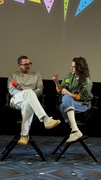





Click on photos for full view.


Pablo Larraín‘s masterful Spencer is one of the most assured, idiosyncratic and wholly satisfying biopics in memory. Kristen Stewart mesmerizes as Diana, Princess of Wales in a snapshot tone poem set at the British royal family‘s Sandringham estate over Christmas 1991, as tabloid rumors of infidelity and unrest swirled around them—a year before Diana and Prince Charles announced their separation to the world.
With an opening title card that reads “a Fable from a True Tragedy,” the drama from a script by Steven Knight (who wrote magnificent screenplays for Eastern Promises and the Oscar-nominated Dirty Pretty Things) thrusts us into the intimate life of one of the most famous women of the 2oth century as she navigates personal crises under seemingly omniscient scrutiny. Heartfelt, dryly funny and unafraid to be really sad, Spencer is a surprising, haunting success worthy of its subject. Awards-season buzz for the film and Stewart’s career-high performance has remained at a steady roar since the picture premiered on the festival circuit in September.
Spencer opens in theaters Friday, Nov. 5, about a year after Stewart received critical praise and widespread audience enthusiasm for a hilarious, touching turn opposite Mackenzie Davis and Dan Levy in Clea DuVall‘s Happiest Season, a queer rom-com whose irresistible blend of high jinks and pathos proved to be exactly what we needed in a pandemic-era Christmas film.
Parade.com spoke exclusively with Stewart about the daunting task of playing the iconic royal, her enjoyment of Netflix‘s crown jewel The Crown, and—just in time for the holidays—the warm legacy of Happiest Season.
Did you have any nerves or reservations around making a film that depicts such a famous life with some imagination and artistry?
It’s actually the only thing that made this whole experience worthwhile for me—was not reiterating facts that actually muddy the waters of truth more than they actually depict a real life. I think getting obsessed with black-and-white, he-said-she-said stuff completely waters down the opportunity that a movie would have to encapsulate a feeling. We’re not a documentary; we’re not trying to provide any new information at all. All the things we have of her, we already have of her.
I went through everything sort of in a morally responsible way to make sure I was on the right side of the street, and realized there’s nothing wrong in the script. There’s nothing that we said that she did, or that we profess to know that is actually historically inaccurate.
She also was somebody who, at the end of her life, really laid herself out—and, in a really articulate and engaged way started speaking to the public herself, unencumbered and unmuzzled. We’re very aware of her struggles with food, body image and mental health. It would be so much more satisfying to make a movie about her leaning into fantasy indulging in the hypothetical, because she never got a chance to.
What was the most daunting part of playing Princess Diana?
Two parts: I wanted to make sure the relationship with her and her boys felt true and not painted on. She’s the most realized, unshakable version of herself when she’s with her boys, and I feel from her this protective, don’t—f***-with-me nature that I don’t feel from any other aspect of her life. She’s constantly searching and reaching behind a veil in order to kind of say, “This is what I’m saying but this is what I mean!” It’s like the whole tilt-your-head-down-but-put-your-eyes-up… It was like she was always trying to say something that she’s not allowed to articulate. So with the boys, the most daunting part was making sure that felt so lived in and so true—genuinely filled with love. The most beautiful part of her is her as a mother.
Also, she is so cool [laughs] and so infectious and disarming and casual. For lack of a better word, cool. And I don’t mean cool in a detached or cold way—like the most accessible, charming, everyone loves her. The idea of her as an entity has this transcendence
Did you watch The Crown or did you avoid it in preparation for this part?
I totally watched all of it, and I was at the stage of research that was kind of obsessive. I think I binged every season that was available in like three days; I just watched it from start to finish. To a certain extent, they go together; we didn’t ever feel like we had to do what they were doing. This is a different thing.
In a really unacademic way, if I ever felt like I didn’t feel like weighing conflicting opinions or perspectives, or reading a new book, I just felt like I’d throw The Crown on, sort of live with Emma [Corrin] for a second (laughs). I really love that show, and we did genuinely use it to our advantage. I’m glad it existed.
You fully embody this character in a way that’s haunting and transcendent for the audience. Has Diana left an imprint on you?
Yeah. I hope to find a nice way to put this that’s concise and really nails it; maybe that will come at some point in this process—stepping into her skin, and just projecting this warmth that we all feel from her—although I never got to spend any time around her. She sticks out of every photo, she reaches through every lens and touches you.
I have green eyes and I’m 5’5”; she’s 5’11” with big beautiful blue eyes. She has this thing where I feel like I want her to be my mom and my best friend, I want to be a shoulder for her to cry on, and I want to see who can run faster.
She felt to me like, when I imagined who she was and how she affected people—I caught “it.” I brought that to set. It was just a projection, an idea, but by osmosis somehow being close to this idea—which is her, however spiritual you want to make it—if our experiences are totally quantified by our imaginations, I imagined a completely new confidence, a new ease, a belief in other people and faith in other people that was very reciprocal. If I came to set feeling that way then suddenly everyone was leading towards me. It was fun to play her, even though she was very sad over these projected three days. The whole crew, all of us danced every night; we cried together. I’ve never felt so connected to other people, and I think that is very clearly her.
It’s been about a year, and it feels safe to call Happiest Season a Christmas classic. What can you tell us about the experience in making that film, and all the positive feedback since its release?
Clea definitely wanted to make a Christmas classic, so that’s wonderful to hear. I love Clea, and when I read the script I was like, “Oh wow, I can’t believe it’s taken this long to do something this straight down the line but also queer. I’ve been making fun of all of the period lesbian dramas that have been made recently—which I think there should be more of! Some are better than others, and it’s kind of easy to make fun of that trope. Straight cis white people have been allowed to make Christmas movies ad nauseam.
I can’t believe that this one little cute attempt at making something sweet had such impact. It’s just a Christmas movie about two girls who go home and try to make it work with their families. We need more of them: small ones, good ones, ambitious ones and simple ones, all of them, everything in between. I’m so proud to be in that movie.

Excerpt
Plaza has been in a relationship with writer-director (and frequent collaborator) Jeff Baena since 2011 but she has, nevertheless, amassed a sizeable LGBTQ following. Not least because she has played the lesbian Krav Maga instructor pursuing Natasha Lyonne in Addicted to Fresno, Marisa Tomei’s butch partner in She Said, She Said, and an ex-girlfriend who threatens to come between Kristen Stewart and Mackenzie Davis in Happiest Season. Plaza had hoped that her character would prise Stewart away but – to the dismay of many of the film’s fans – it was not to be.
“Kristen’s got really good taste in movies and that was something we bonded over on Happiest Season,” says Plaza. “She showed me Morvern Callar, which I hadn’t seen before, and now it’s one of my favourite movies ever. She just makes the coolest choices. She is someone I admire because she got famous at a very young age but she’s done really cool stuff with that fame. She finds amazing directors and scripts. I hope I can be Kristen when I grow up.”
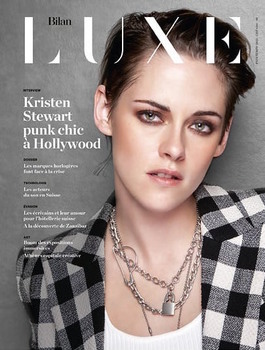
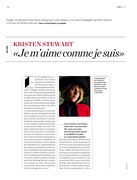

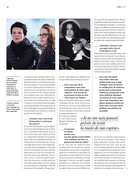
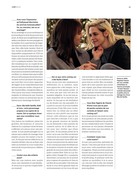


Click on images for full view.
The Swiss magazine is out on April 14.
We will update the post with a translated interview when available.
Source Digital Scans Gossipgyal
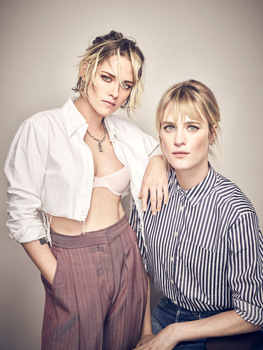
Click on portrait for full view.
Google translated.
SHANGAY ⇒ How important do you think it is that it is a same-sex couple that stars in the film?
KRISTEN STEWART ⇒ I think after a while, we'll look back and wonder how something like this hasn't been done before in commercial cinema. When I read the script, so cute and fun, and I knew it was a project with a large budget, supported by a large studio, I felt very lucky to be part of this project.
MACKENZIE DAVIS ⇒ Certain groups in our society only see their stories told on film through tragic drama. It is very sad that certain voices are not taken into account when making certain experiences visible to the general public. In a way, until not so long ago, it could seem that if you were queer , in the movies they were telling you that your life was going to be a drama. It was about time to have a Christmas movie starring a couple of two women.
SHANGAY ⇒ Was your approach different when preparing the characters knowing that they were LGBTQ?
MACKENZIE DAVIS ⇒ I asked Clea if the fact that I am not part of the community could be a problem, or if there were some keys that she should be aware of when working and doing her best. Clea told me "you play a woman in love, that's all that matters." So my approach was not at all different from that of any other woman in love character I've been able to play.
KRISTEN STEWART ⇒ I understand what Mackenzie is saying because it can be a tricky question; He did not want it to be possible to suggest that he was appropriating a character that perhaps, due to lack of personal experience, should not belong to him. But that's what acting is about. The important thing is to be with your senses open and strive to be the best character possible, forgetting about labels. Was work going to be any different because of playing lesbians? I've always lived being queer in an organic way. And although we have both had different experiences when we fell in love, we found a lot in common to contribute to the joint work. Because, as the movie says, "love is love!" [laughs].
SHANGAY ⇒ Kristen, it's not so common to see you doing comedy… Have you gotten the hang of it?
KRISTEN STEWART ⇒ It has been a special experience. At first, I was intimidated by the level of the actresses I was going to work with, although at the same time I was encouraged by the challenge of measuring myself against them. My character is a bit of a "straight man" as ironic as it sounds, given that I play a lesbian woman. It is a kind of observer, through which the viewer discovers how absurd his girlfriend's family is, and how strange they have to relate to each other. I hadn't worked for a while, and as soon as we started I saw that the more relaxed we were and the more we committed ourselves to the job, the better we had fun. The pressure was gone immediately.
SHANGAY ⇒ Have you had any experience remotely similar to the one in the film?
KRISTEN STEWART ⇒ Not exactly. I have ever felt that perhaps someone around you could feel uncomfortable knowing that the person who accompanied you was your partner. And I have tried not to make this situation a threat to others; but it has never happened to my family. Around 22 I began to really understand myself, and I felt that pressure of having to put a label on what I felt, even though I didn't quite represent myself. But the context of the film is very different.
SHANGAY ⇒ Did the chemistry you give off come about in an easy way?
MACKENZIE DAVIS ⇒ The secret is in the casting, when looking for two actresses, in this case, who must be compatible. The job started out being similar to what dating is like. In this case, I admired Kristen, and from the moment I met her I wanted to be her friend. We started spending a lot of time together to get to know each other and get comfortable before we got to set. To lose respect for touching us, for example [Kristen laughs]. In other shootings it has been difficult for me, because I have had couples who were not especially nice, and even so you have to make it credible, that is why you dedicate yourself to acting. In this case it was not so.
KRISTEN STEWART⇒ Good job, bitch! [laughs]. From the first moment I saw that Mackenzie was going to be amazing in the movie, and for that alone I loved her. She is a great actress, and I tend to love people who are good at what they do. I'm not good at creating chemistry at full speed with someone I don't know at all; in that case, I get to the set, shoot as soon as possible and fake whatever it takes. Mackenzie and I were delighted to spend time together, and because of that, filming just got better, easier and smoother. We were going in the same direction, and it showed.
SHANGAY ⇒ Do you especially value the fact that a comedy like this can be very important for LGBTQ visibility at mainstream levels ?
KRISTEN STEWART ⇒ It's something we've talked about a lot among ourselves. Because there are many young people who do not consume auteur cinema or proposals with a clear protest component, but they do use Christmas movies like this one in which they can be reflected. It is important that art is not marginalized, and that a light and pleasant tone can also be used when making visible according to what issues. In fact, if I hadn't made this film, I would have been envious of those who made it, because it clearly has a message that is important to reach the public.
SHANGAY ⇒ Was it another point in favor of having a director, and that she is also out of the closet?
KRISTEN STEWART ⇒ Since I read the script, I saw clearly that there was an intention and a commitment in it, that it was not the typical opportunistic formula that is created to show that we live in a world with greater acceptance. This story has a lot of truth, and the fact that it is Clea who tells it gives it a plus of authenticity.
SHANGAY ⇒ Kristen, since your character is the one who fights for her girlfriend to come out of the closet and show herself as she is, without lying, do you think it can be positive for viewers who are going through a similar situation?
KRISTEN STEWART ⇒ Hopefully, because I always appreciate any comments from people who thank you for making yourself visible and tell you about their experiences, which also make me feel happy and proud. That exchange of experiences is fucking wonderful.

Excerpt from the interview below. It can be fully read at the source.
In Happiest Season, Hulu’s lesbian Christmas rom-com, Levy delivers the film’s high point in a monologue; filmmaker Clea DuVall tells me, “I cried during every take.”
“Everybody’s story is different,” Levy’s John says to Kristen Stewart’s Abby, who is planning to propose to a woman whose family doesn’t know she’s queer. “But the one thing that all of those stories have in common is that moment right before you say those words, when your heart is racing and you don’t know what’s coming next,” John goes on. “That moment’s really terrifying. And then once you say those words, you can’t unsay them. A chapter has ended and a new one’s begun, and you have to be ready for that.”
He worries that he wouldn’t be able to handle uber-fame with the aplomb his co-star Kristen Stewart does. When they went out to a dive bar while filming in Pittsburgh, he says, “I was just so kind of in awe of her confidence and comfort in herself. She's so at ease — [I say that] as someone who I think will always be on their journey to have that for myself.”
“Dan’s assessment is actually incorrect,” Stewart says later. “But what I have done is try to keep that experience [of fame] fairly insular, not make other people I’m with take on the weight of my own self-consciousness — or, God forbid, have someone think I’m up my own ass and loving the attention. It’s easier for me to pretend [people noticing me] is not happening, even though on the inside I still feel like the world is a big school yard of giggling onlookers. Are they laughing at me? Yes, no… Who cares.”
If Levy ever does find himself in the position of being Stewart-famous, she thinks he’ll be fine. “What I did notice was how absolutely wonderful Dan is with everyone,” she says. “He is so loving and gracious towards people that recognize him. The positive force he puts out into the world is clearly reflected in how people come back at him.”

