










Click on photos for full view.


Excerpt from the interview below. It can be fully read at the source.
In Happiest Season, Hulu’s lesbian Christmas rom-com, Levy delivers the film’s high point in a monologue; filmmaker Clea DuVall tells me, “I cried during every take.”
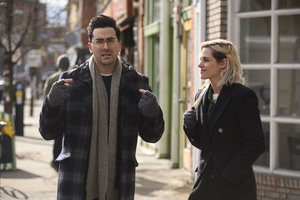
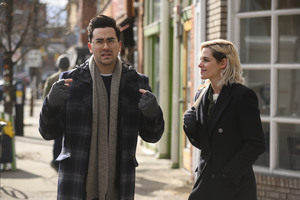
“Everybody’s story is different,” Levy’s John says to Kristen Stewart’s Abby, who is planning to propose to a woman whose family doesn’t know she’s queer. “But the one thing that all of those stories have in common is that moment right before you say those words, when your heart is racing and you don’t know what’s coming next,” John goes on. “That moment’s really terrifying. And then once you say those words, you can’t unsay them. A chapter has ended and a new one’s begun, and you have to be ready for that.”
He worries that he wouldn’t be able to handle uber-fame with the aplomb his co-star Kristen Stewart does. When they went out to a dive bar while filming in Pittsburgh, he says, “I was just so kind of in awe of her confidence and comfort in herself. She's so at ease — [I say that] as someone who I think will always be on their journey to have that for myself.”
“Dan’s assessment is actually incorrect,” Stewart says later. “But what I have done is try to keep that experience [of fame] fairly insular, not make other people I’m with take on the weight of my own self-consciousness — or, God forbid, have someone think I’m up my own ass and loving the attention. It’s easier for me to pretend [people noticing me] is not happening, even though on the inside I still feel like the world is a big school yard of giggling onlookers. Are they laughing at me? Yes, no… Who cares.”
If Levy ever does find himself in the position of being Stewart-famous, she thinks he’ll be fine. “What I did notice was how absolutely wonderful Dan is with everyone,” she says. “He is so loving and gracious towards people that recognize him. The positive force he puts out into the world is clearly reflected in how people come back at him.”

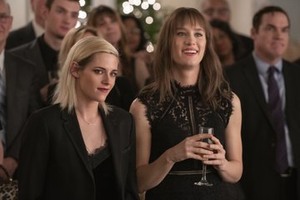
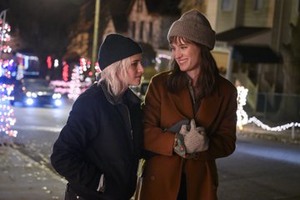
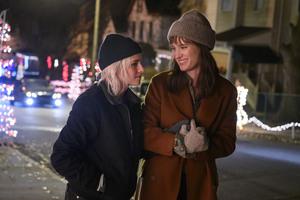
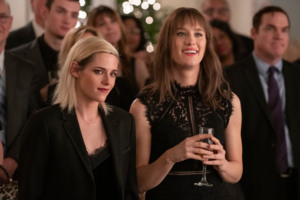
In Clea DuVall’s “Happiest Season,” Kristen Stewart plays Abby, an art history Ph.D. student whose girlfriend, Harper (Mackenzie Davis), has invited her home for Christmas. Though she’s at first reluctant to go, Abby then decides she’ll actually propose to Harper, assuming that meeting the family goes well — but Harper tells Abby she hasn’t yet come out to her parents, and they both have to pretend to be straight. It’s a romcom with a queer twist, and a conventional Christmas comedy made radical merely by centering the story on a lesbian couple.
Since her “Twilight” years, Stewart has made eclectic career decisions that have veered from indies such as “Clouds of Sils Maria” and “Seberg” to more mainstream fare like the 2019 “Charlie’s Angels” reboot — but she’s never been especially associated with romantic comedies. Yet writer-director DuVall wanted an actor who could do both comedy and drama, and so when she was putting “Happiest Season” together, she flew to the “Charlie’s Angels” set in Germany to meet with Stewart. “I already wanted her before,” DuVall told Variety about those initial conversations with Stewart. “But after meeting with her, I couldn’t imagine making the movie with anybody else.”
“Happiest Season” was backed by Sony’s Tri-Star Pictures from the start, and was poised to be first LGBTQ movie from a major Hollywood studio to be produced as a broad commercial vehicle. But with the theatrical business in its current nearly non-existent state, Sony had to bow to the realities of the coronavirus pandemic and sell “Happiest Season” to Hulu — where it will premiere on the streaming service on Nov. 25. In a recent interview, Stewart talked about building the Abby-Harper relationship with Davis and DuVall, how working with Daniel Levy made her raise her game and the thorny question of whether only gay actors should play gay characters.
I found “Happiest Season” to be a delight. How did it come to you?
Clea sent it over to see if I wanted to partner up with her to find the rest of the cast, and start early in terms of defining the character and making it something between the two of us. I thought that was a really generous offer because when I read the script, it felt so completely personal — like a story that she’d been waiting to tell for a long time.
We had a meeting early on, and I knew immediately that we were going in this together, and that it was going to be something that reflected both of us. And I’ve always loved her — I was kind of shocked that she’s so good at comedy, at writing something funny. I’ve taken her very seriously my whole life, you know what I mean? The script made me really curious about her.
Did you build the character of Abby together?
Abby is so completely Clea. Obviously, she understands both of these characters very well. But Abby is absolutely her, like all of her idiosyncrasies. Every time I needed to find Abby again, and stop just playing myself — which was easy to do in this case — there is a pragmatism and a straightforward earnestness to Clea that is not like me, that I really loved pulling into this person’s repertoire. Whatever a queer female couple is to the masses, who aren’t necessarily accustomed to that living in their homes for Christmas, I really wanted these people to feel completely lived in and self-realized. Even though the story is about someone coming to terms with their identity, I still think that these girls in a vacuum know themselves implicitly. And they’re not confused — it’s other people that are having a harder time accepting them.
I wanted to have these people fully fledged before we started because the movie starts so quickly. That would be a sort of amalgamation between myself and Clea, and both of our experiences involving coming out and having relationships and being romantic idealists. And then also people that are kind of awkward weirdos, and not very good in a new family scenario — to highlight the comedy in that.
And so basically, to make a very simple answer very complicated, she is very much that character, and I was allowed to bring aspects of myself. I definitely took a lot of inspiration from her tonal quality — she expresses herself very directly. She’ll be like, “Hello, how are you? I’ve been thinking about you.” I’m a more sideways sort of communicator.
I wanted to be proud of the couple. I wanted to be like, I like these people. You know?
I do! Have you ever played someone bumbling and charming before? I couldn’t think of another time.
No, I don’t think so. I mean, maybe in my real life — like, bumbling for sure. Charming, always trying. But no. Not in a movie.
What kinds of conversations did you, Clea and Mackenzie Davis have about what the relationship should be like?
We found Mackenzie to be such an ace up our sleeve. I couldn’t really imagine somebody that I wouldn’t halfway through the movie be like, “All right, I’m fucking out of here!” She has this open, extremely kind, aware, delightful nature. I can’t get mad at that person! Like, I really, really like her.
She’s introduced in the beginning of the film as somebody who feels like my encourager. And then suddenly she becomes this person who really lacks that assurance and is really not being honest, and it does not even remotely reflect who Abby thought she was in the beginning. It’s such a jarring reveal. Sure, the audience should be afraid that they might not get together, but it’s a romcom — they’re going to get back together!
My thing is, I never wanted to lose affection for her. I never wanted people to be, like, “Honestly, she needs to get her shit together sooner — like, fuck her!” I was constantly telling Clea, “Don’t you think I would go over and be like, ‘Hey, babe, are you OK?’” And she was like, “No! You’re angry at her!” We did go through really carefully and with a lot of consideration of the relationship being so solid that it could actually withstand something this traumatic. Because if you boil down the story to what it’s actually about, it’s a full-grown woman, like a 31-year-old woman, coming out to her family. I mean, generationally speaking, that is remarkable. And it is so unremarkable in terms of how accelerated that growth has occurred — we didn’t have a movie like this just a couple years ago. And now, if you were to tell somebody who’s 10 years younger than me that we’re making a movie about a girl coming out to her parents when she was 30, they’d be like, “What? That’s insane.”
That these people always felt like they were in a real relationship, and that they earned getting back together — it just felt more important because of the queerness of it.
You and Dan Levy together — pure gold. How did you guys establish that dynamic?
Hats off to Clea for seeing the potential of that dynamic, and then also to Dan’s energy being something that’s easy to be uplifted by. I have a tendency to be slow, emotionally speaking. I don’t know if it’s because I’m nervous — or who the fuck knows — but I sometimes will bog things down a little bit. In a comedy, that is just no good. And I couldn’t do that with him! I just felt like I wanted to keep up.
The moment he looks at me and describes his coming out story and encourages me to see how hard it can be from a different perspective — it feels historical. I’m like, we’re in a movie, but also fuck the movie! We’re in 2020, and watching him say that in that scene just feels like so different and cool. I feel so lucky to have been around him. In that moment, it’s like a rare opportunity to feel like — shit, we definitely put a little flag in there.
Totally. It’s such a smart movie, because it is so conventional, in terms of being a romantic comedy and a holiday comedy. But just the mere fact of it being a lesbian holiday movie, it becomes political and important. Was there a sense of that as you were filming it?
Absolutely. I really do admire Clea for not being defiant, and not being reactive to the world — and doing something that is welcoming. I was so pleased to have been invited onto something that was, for lack of a better term, hiding the vegetables. Because I don’t think we’re hiding shit; it’s pretty clear what we’re saying.
At the same time, it’s just presented in a way that is very conversely different to something that feels afraid or angry. It feels forward and open. I mean, it doesn’t have to be like this overwrought thing in order to be politicized!
It feels very true, and very in the moment. I love a little bit of defiance and anger, and real passionate raw exposure. But in this case — the fact that you got on the phone and say that it was a “delight,” I’m so glad to hear that. Because that was the goal.
There are a lot of people who feel it’s important that gay actors play gay characters, after so many years of that not being the case. What’s your stance on that?
I think about this all the time. Being somebody who has had so much access to work, I’ve just lived with such a creative abundance. You know, a young white girl who was straight and only really was gay later and is, like, skinny — do you know what I’m saying? I so acknowledge that I’ve just gotten to work.
I would never want to tell a story that really should be told by somebody who’s lived that experience. Having said that, it’s a slippery slope conversation because that means I could never play another straight character if I’m going to hold everyone to the letter of this particular law. I think it’s such a gray area. There are ways for men to tell women’s stories, or ways for women to tell men’s stories. But we need to have our finger on the pulse and actually have to care. You kind of know where you’re allowed. I mean, if you’re telling a story about a community and they’re not welcoming to you, then fuck off. But if they are, and you’re becoming an ally and a part of it and there’s something that drove you there in the first place that makes you uniquely endowed with a perspective that might be worthwhile, there’s nothing wrong with learning about each other. And therefore helping each other tell stories. So I don’t have a sure-shot answer for that.
I will say, Mackenzie is not somebody who identifies as a lesbian. She was the only person in my mind that could have played this with me. Sometimes, artfully speaking, you’re just drawn to a certain group of people. I could defend that, but I’m sure that somebody with a different perspective could make me feel bad about that — and then make me renege on everything I’ve just said. I acknowledge the world that we live in. And I absolutely would never want to traipse on someone else’s opportunity to do that — I would feel terrible about that.
So my answer is fucking think about what you’re doing! And don’t be an asshole.

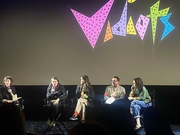
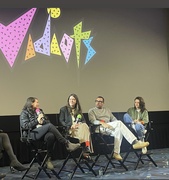
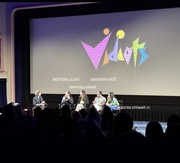
Back in February, GLAAD’s Raina Deerwater had the opportunity to visit the set of the LGBTQ-inclusive holiday romantic comedy Happiest Season (coming to Hulu on November 23) as it was filming in Pittsburgh, PA and talk with the cast and creatives involved in making the film.
Happiest Season follows Abby (Kristen Stewart) who is going to meet her girlfriend Harper’s (Mackenzie Davis) family for the first time over the holidays. However, right before they arrive, Harper reveals that she is not out to her family yet, and that her and Abby will have to hide their relationship through Christmas. The film was co-written by out filmmaker and actor Clea DuVall and comedian Mary Holland, and directed by DuVall. GLAAD also spoke with producer Isaac Klausner and stars Davis, Stewart, Holland, Alison Brie, Victor Garber, Burl Mosely and Mary Steenburgen.
GLAAD also spoke with the cast and crew on set and talk to them about how the film came to life, the experience of working on a queer romantic comedy, and the joy in this particular movie genre!
“I love Christmas movies and I love how they become a part of our lives,” DuVall told GLAAD while taking a break from shooting, “But I had never really seen myself represented in one before. I had this idea for a really long time and I wrote this outline that sat on my computer for years. And I wanted to start working on it, but with comedy it's always so much more fun to work with another person. I met Mary [Holland] on Veep and we really got along and I asked her, ‘do you want to try to work on this thing with me?’ And she said yes. It really came together even more and we fleshed it out and it turned into this.”
Holland, who plays Harper’s sister, Jane, in the film in addition to co-writing the screenplay, provided most of the comic relief in a tense scene that a group of journalists watched film over the course of the day.
“Clea had this idea in her head for many, many years,” Holland told us, “This has been something that she's been mulling over for a long time. We met working on Veep together. We hit it off right away, had a real chemistry together. So we went out to coffee and she described this idea and sent me a rough summary of what the idea was, what the movie would be about. And then we started meeting and talking about it and then just got into writing it. Clea knew from the beginning that she wanted to direct this. She came into it guiding this whole process. She has such an amazing understanding of story structure and character development. The foundation of this script was really in her head. The image I had in my head was, ‘I'm chucking spaghetti at the wall and Clea's deciding what stays on the wall and what doesn't.’”
“My way into this project has everything to do with Clea,” Isaac Klauser, a producer on the film told us, “I got to see her film, The Intervention, which I loved, and it inspired me to reach out and try to get to know her. She was kind enough to sit down [with me] and she mentioned to me that there was this script that she and Mary Holland were working on based on both her love of the holidays and particularly holiday films and her own experiences in the holidays that had never quite been reflected on film. I was lucky enough that she shared an early draft of the script with me and we started talking about it really connecting. I had a very similar love of the genre and for me, as a Jewish man, it's also not often my experience. And yet it's such a way that we think about the spirit of family, sense of community and place and kind of love. And there were so many things that our script was doing that I immediately so deeply related to this experience on so many levels, that I just fell in love with it.”
“I really think Christmas movies are so significant to people,” Holland continued, “They're really formative in a lot of ways for many of us growing up. Those are the movies that became these pillars for us. There was that atmosphere and energy of family and love and what Christmas is all about, what the holidays are all about, which is being with those you love and, and being grateful for who's in your life. And everyone deserves a holiday movie, everyone deserves a Christmas movie and something that celebrates and represents their experience. As a straight cisgender woman myself, I'm really cognizant of the fact that this is a story that needs to be told and has long been overdue in being told. I really feel so honored that Clea asked me to be a part of this process with her, because it's so important to me that all of these people are represented. I'm just very humbled and very grateful to be a part of it and be able to support this story that she's telling.”
“[It’s] really exciting, especially with queer content,” DuVall added, “because at least for me, it's not just watching movies where gay people are tortured by being gay and then they get killed or beaten up or whatever. You can just be like normal people. I'm just a normal person in my life. And I have romantic experiences and sad and happy and all kinds of the spectrum. I think LGBTQ stories are not, are not given the privilege of the spectrum of what the experience really is. And so I really wanted to do that with this movie and I'm happy that other filmmakers and other writers are [too], and other studios are supporting.”
The actors of the film were in agreement about the impact of a queer Christmas romantic comedy.
“It's so exciting,” Alison Brie, who plays Harper’s sister Sloane told us. “This movie to me feels like an amazing leap in the right direction of having mainstream film reflect what actual society is like in current culture, in our nation. So, I think to showcase a same-sex relationship in a mainstream holiday movie, and just kind of de-stigmatize it, if it even is still stigmatized for certain people. I certainly am guilty of being in the liberal bubble. So on first read, I'm just like, ‘Oh, it's so great. What a beautiful love story, so funny.’ And then I take a step back and realize the cultural implications and how important a film like this is. And I feel extreme pride.”
“When I went through and I read the script,” Burl Mosely, who plays the role of Sloane’s husband Eric in the film said, “It actually reminded me of Crazy Rich Asians and everything that that did for the Asian community, taking the rom-com and doing that. And we're sort of doing a similar thing. And as I was reading it, I was like, this is so groundbreaking, but it really shouldn't be, this should be the norm. I was surprised that we've gone this long without this. You know what I mean? It just felt so right and so normal and so awesome. So, I feel really honored to be a part of it.”
“Well, I did Philadelphia,” Mary Steenburgen, who plays Harper’s mom, Tipper, and has a decades-long career in film and television, “and I was the bad guy which was, at the time, very weird for me because my roommate and dear, dear friend died a couple of days before I went there. So, that whole experience was huge. And it was very moving to see what a difference it made to certain people - not so much the choir preaching to the choir - but people who called themselves conservative, who saw that film and felt like they understood their son better because Tom Hanks had this family that loved him and surrounded him. And I got that feedback from people and it was very moving. This is so different. This is a comedy, but often comedies are the things that make change and that put a mirror up there for us to see that families have love. And this is just, this is a family that really truly at the end of the day loves each other.”
“It’s nice that we've come to this place,” Victor Garber, the out actor who plays Harper’s father Ted, and also has an illustrious film career. “It’s nice to be not there anymore. I just did the reboot of Tales of the City, but also I'm doing a new series in Canada. It's a Canadian series with a transgender woman who plays my secretary and that's discussed right away in the very first scenes. It feels so natural. And yes, we've come a long way. We're nowhere near where we have to be, but we're certainly, we've made steps or taking steps.”
The leads only had a few moments to chat with us, but both of them sang the praises of the environment on set.
“When we first started this movie,” Mackenzie Davis told GLAAD, “We were like, I would be so jealous if somebody else was doing this with Kristen and Clea. It's not just because of the social or political import of it, it's really great, and the people making it are really great. Every day is so wonderful and full of laughter and joy. I've never had this much fun making a movie before, so, on a very personal level, it's really wonderful to be a part of positive, non-tragic depictions of queer love, but don't always have to be an incredible struggle to get through and end in tragedy. The struggle is part of the genre [but] it has nothing to do with the queerness, which I think is a relief.”
“It’s so nice to catch that sense of freedom and fun,” Kristen Stewart added. “It's super contagious. I think that the way to spread love is definitely just through giving it. We were saying something before about [how] it feels great to [work on] something sweet and something nice. And it's nice to come to work and feel like I can say anything. I'm not implying that I've had inhibited experiences because of the lack of queerness and other movies that I've done. But in this, we all feel so visible to each other and so understood and therefore allowed. It's so permissive and it feels great.”
“As a filmmaker,” DuVall continued, “It's very important to me to tell universal stories. I want to tell stories that connect with as many people as possible. As a storyteller, my goal is connecting with as many people as I possibly can and having a lot of different kinds of representation. It's really just wanting to feel like I was seeing me in a movie like this, which I had never seen before. And my experience is not unique. I'm not the only one going through it. There have to be a lot of other people who are also feeling underrepresented. The truth is I just wanted to write a movie that I always wanted to watch. So, that's what I did.”
Happiest Season will be available to stream on Hulu on Wednesday, November 25.
These interviews have been edited and condensed for clarity.

"I am so in love with Dan. It's insane. It was so important for whoever to play Abby's best friend to be a really grounded reflection of who she is obviously because we don't have a whole lot of time to develop the characters before we're thrust into this precarious situation. He's written in a way that is so nuanced and neurotic but also broadly funny. And I think that he is so perfect because when he really brings it home and he wants to connect and he comes from a place of true understanding, true understanding of what the story is and how heavy and hard it is. It can then be funny but only first it needs to be completely understood from the inside. And he's so unbelievably funny. He's so destabilized by my leaning into convention."

It’s a good thing Kristen Stewart was cast as a lead in Clea DuVall’s Happiest Season, because the out actress would have been “so jealous and very excited” to see the movie come together without her.
Stewart stars alongside Mackenzie Davis (Black Mirror’s beloved “San Junipero” episode) in the forthcoming film, a holiday-themed lesbian rom-com co-written by DuVall and Mary Holland. (It’s also the directorial debut from DuVall, who is a lesbian herself.) The movie was filmed on location in Pittsburgh, Pennsylvania, and shooting wrapped right before the COVID-19 pandemic hit.
Speaking to NewNowNext on the set of Happiest Season in late February, Stewart said she loved the script instantly. “It felt like a huge relief,” she admitted. “It didn’t feel obliged to be overwrought, but it’s so tender, and I think with a Christmas movie, knowing that everything’s going to be okay allows for you to… I don’t want to be too specific.”
She noted that a Christmas movie about a lesbian couple like Happiest Season “doesn’t exist yet,” and she’s not wrong. In the film, Stewart plays Abby, a proud queer woman who is planning to propose to her girlfriend, Harper (Davis’ character). Chaos ensues when Abby goes home with Harper for the holidays, only to realize that her GF isn’t out to her WASP-y, traditional family.
Davis added that there is “no villain” in Happiest Season. “[Harper’s parents] live in a very WASP-y, rich environment, and anything that’s out of that sort of paradigm feels scary and too foreign to them to accept immediately. But once they’re confronted with it, I think they handle it well,” she explained. She likened her character’s family to politicians who “need to have a gay child” to feel compelled to support LGBTQ equality: “You’re like, ’I’m happy you came around to it, [but] it’s so weird that you needed to be related to someone to have just the basic shred of empathy that most people are able to muster up.’ They need to be exposed to it, and they haven’t been exposed yet.”
What drew Davis and Stewart to Happiest Season? Davis also fell in love with DuVall and Holland’s writing. “It feels purposeful and important and urgent,” she explained. “I felt like the script had such a distinct voice. Clea and Mary, who wrote the script, they just have such distinct comedic sensibilities. It’s so funny.”
And Stewart knew she had to be involved with such a groundbreaking project: “[The movie] doesn’t shy away from what it is, which is a really beautiful love story and a coming-out story about two women. … I fucking belong here.”
-----
Dan Levy plays a smaller role in Happiest Season, but the Schitt’s Creek star and co-creator made a lasting impression on the entire cast, including his queer co-star Kristen Stewart.
Speaking to NewNowNext in February from the set of Clea DuVall’s holiday-themed queer rom-com, Stewart openly gushed about how much she enjoyed working alongside Levy. “I am so in love with Dan,” she said. “It’s insane.”
Stewart stars in Happiest Season as Abby, a queer woman whose plan to propose to her girlfriend, Harper (Mackenzie Davis), goes awry when she realizes her GF isn’t out to her family. Levy plays John, Abby’s longtime BFF. To Stewart, it was important for whoever played Abby’s best friend to be “a really grounded reflection of who she is.” Viewers don’t get to spend a lot of time with Abby in her natural element, so her interactions with John ensure she reads as fully fleshed-out.
“I think that [Dan] is so perfect because when he really brings it home and he wants to connect, he comes from a place of true understanding of what the story is and how heavy and hard it is,” she added. “It can then be funny, but first it needs to be completely understood from the inside.”
It helps that Levy is “so unbelievably funny” as John, too. “Dan’s fucking amazing,” Stewart said. “The entire cast is so great. We’ve said a million times to each other every single day.”
Fellow Happiest Season cast members Mary Steenburgen and Victor Garber (Harper’s mother and father, respectively) are in agreement. Meeting Levy was especially exciting for Steenburgen, who loves Schitt’s Creek.
“With Dan, it’s like, if he had been anything less than wonderful, I would have been devastated because I’m such a fan of that show,” she told NewNowNext. “I asked him, ’So the sweaters [in Schitt’s Creek], like, where did those sweaters come from?’ And he goes, ’They’re women’s sweaters from consignment stores.’ They’re women’s. And he finds them and dresses everybody in the show. And it was like—oh, I literally, I couldn’t take it. I was so enchanted.”
Garber, who is also gay, is an old friend of Eugene Levy, Dan’s father and Schitt’s Creek co-star. He and Eugene appeared together in a Toronto production of the musical Godspell in the 1970s. “I adore [Dan]. And I have to be really nice to him,” he joked, “because he’ll hopefully hire me.”
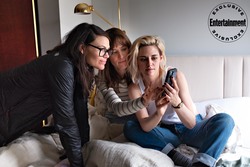
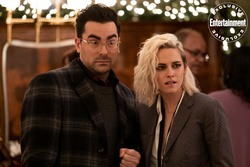
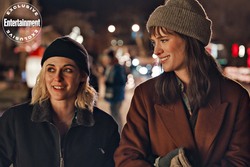
Click on the images for a full view.
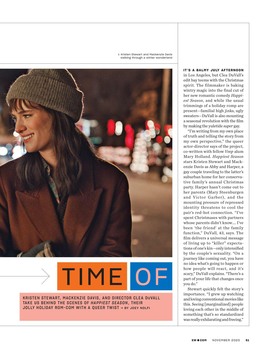
It's a balmy July afternoon in Los Angeles, but Clea DuVall's edit bay teems with the Christmas spirit. The filmmaker is baking wintry magic into the final cut of her new romantic comedy Happiest Season, and while the usual trimmings of a holiday romp are present — familial high jinks, ugly sweaters — DuVall is also mounting a seasonal revolution with the film by making the Yuletide super-gay.
"I'm writing from my own place of truth and telling the story from my own perspective," the queer actor-director says of the project, co-written with fellow Veep alum Mary Holland. Happiest Season (in theaters Nov. 25) stars Kristen Stewart and Mackenzie Davis as Abby and Harper, a gay couple traveling to the latter's suburban home for her conservative family's annual Christmas party. Harper hasn't come out to her parents (Mary Steenburgen and Victor Garber), and the mounting pressure of repressed identity threatens to cool the pair's red-hot connection.
"I've spent Christmases with partners whose parents didn't know.… I've been 'the friend' at the family function," DuVall, 43, says. The film delivers a universal message of living up to "killer" expectations of one's kin — only intensified by the couple's sexuality. "On a journey like coming out, you have no idea what's going to happen or how people will react, and it's scary," DuVall explains. "There's a part of your life that changes once you do."
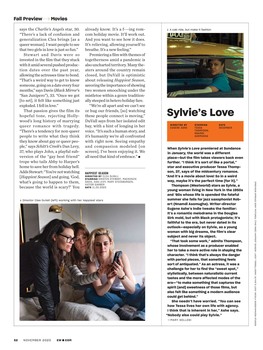
Stewart quickly felt the story's importance. "I grew up watching and loving conventional movies like this. Seeing [marginalized] people loving each other in the middle of something that's so standardized was really exhilarating and freeing," says the Charlie's Angels star, 30. "There's a lack of confusion and generalization Clea brings [as a queer woman]. I want people to see that two girls in love is just so fun."
Stewart and Davis were so invested in the film that they stuck with it amid several pushed production dates over the past year, allowing the actresses time to bond. "That's a weird way to get to know someone, going on a date every four months," says Davis (Black Mirror's "San Junipero"), 33. "Once we got [to set], it felt like something just exploded. I fell in love."
That passion gives the film its hopeful tone, rejecting Hollywood's long history of marrying queer romance with tragedy. "There's a tendency for non-queer people to write what they think they know about gay or queer people," says Schitt's Creek's Dan Levy, 37, who plays John, a playful subversion of the "gay best friend" trope who tails Abby to Harper's home to save her from holiday hell. Adds Stewart: "You're not watching [Happiest Season] and going, 'God, what's going to happen to them, because the world is scary?' You already know. It's a f---ing rom-com holiday movie. It'll work out. And you want to see how it does. It's relieving, allowing yourself to breathe. It's a new feeling."
Premiering a film with themes of togetherness amid a pandemic is also uncharted territory. Many theaters around the country remain closed, but DuVall is optimistic about releasing Happiest Season, savoring the importance of showing two women smooching under the mistletoe within a genre traditionally steeped in hetero holiday fare.
"We're all apart and we can't see or hug our friends, [so] watching these people connect is moving," DuVall says from her isolated edit bay, with a hint of longing in her voice. "It's such a human story, and it's humanity we're all confronted with right now. Seeing empathy and compassion modeled [on screen], I've been enjoying it. We all need that kind of embrace."
Digital Scans
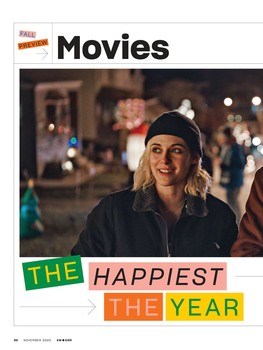
Click on scans for a readable view.