Showing posts with label Seberg. Show all posts

Tuesday, June 22, 2021

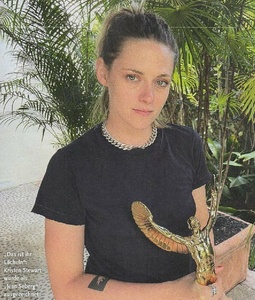
Video: Kristen wins a German Jupiter Award for Best International Actress for 'Seberg'

Kristen's acceptance speech starts at 0.44 seconds and continues at 1.17 mins.

E6A8mNxWYAUqjBq.jpg

Click on scan for full view.

Source Cinema Magazine Scan: Bon_bon001

Monday, September 21, 2020

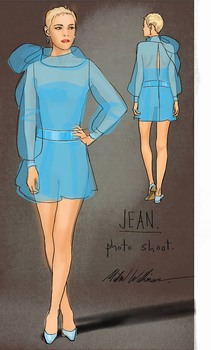
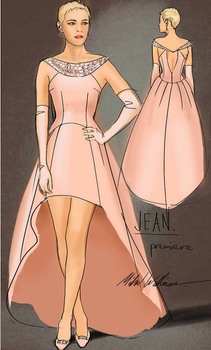
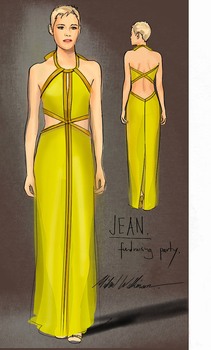
Costume designer Michael Wilkinson talks about 'Seberg' and mentions Kristen


imagebam.com imagebam.com imagebam.com

Click on image for full view.

Googled translated.

Mr. Wilkinson, how did you go about helping Kristen Stewart transform into Nouvelle Vague star and It Girl Jean Seberg?

Kristen and I were deeply moved by Jean Seberg's story. You can study human strengths and weaknesses on her, for us she was the intense discovery of a psychologically highly complex person. For me, designing costumes for people who are full of contradictions and small flaws is especially grateful. Kristen works harder than almost any other actress I've met and she is very intuitive at work. We had long discussions about what which costume should express, it was a great collaboration. It quickly became clear that Kristen had no ego problems when it came to the costumes. For both of us, it was primarily about finding clothes that fit the scene and are not just “fashion-conscious”.

Then where did you get the inspiration for the final designs?

Jean and Kristen were my inspiration for the costume design. I was fascinated by the parallels between these two women. Both are icons, both are uncompromising and completely modern. You have great self-confidence. I wanted to incorporate that into the film and express that strength with the costumes.

How would you describe the style of the two?

Kristen and Jean have a very modern style that doesn't seem effortless or ornate. You feel comfortable in very expensive designer clothes as well as in the simplest casual look. You never get the impression that a dress overwhelms or covers the person. The individual personality always shines through. I think that has a lot to do with the energy created by the contrasts: the short hair goes with feminine couture as well as a surprising personal touch, such as wearing casual clothes whose cut is based on men's fashion. Both women have a personal strength that makes the clothes they wear seductive.

Have you studied a lot of historical material beforehand?

I saw all of Jean Seberg's films so that I could “get to know” them. I wanted to understand their on-screen magic. Then I did extensive research on the period from 1968 to 1970 in which our film was set. I studied all the clothes Jean actually wore at the time, looked at her personal photos, film photos from the studios, paparazzi and fashion photos as well as magazine articles. Some of the costumes in the film are directly inspired by these images. To get the right clothes for those private moments about which there were no photo documents, I had to put myself in Jean's head and imagine what she would have chosen for them. When it comes to jeans style, most people think of the pictures of you as a world-famous it girl, i.e. the time when when she was "discovered" by Otto Preminger and played "Saint Joan" in 1957 and then appeared in Godard's "Breathless" in 1960. Back then, she sported this light, modern and idiosyncratic wardrobe: a few staples that got a personal touch with her rasped pixie haircut, which she paired with a flawless white shirt, capri pants, ballet shoes and the famous striped Breton T-shirt combined.

A look that doesn't even appear in the film ...

In the film, Jean's celebrity is almost over and her film career is starting to stagnate, she is no longer the carefree ingenious trendsetter, she has gotten older and also more insecure. I've talked about their classic casual style in a few scenes, but we mostly see them differently. We see her in her house, vulnerable and relaxed in sheer, delicate underwear and silk dressing gowns. We see her at her public appearances when she wears designer labels like armor in which she can face the world. The style of this time is very plastic and strong - Jean Seberg wore dresses from all the big houses from Yves Saint Laurent, Courrèges, Chloé to Givenchy.

Do you have a favorite outfit?

I wanted Kristen to get the glow from Jean, her indestructible spirit, that light she was giving off from within - so in some scenes I put her in bold yellow, pure blue, red and white, or chartreuse green. But I also wanted to get the paranoia across. So in some scenes she wears colors that make her pale. Director Benedict Andrews said he would like to show her as pale as a fragile orchid. After her miscarriage, she had the darkest moment of her life from which she never fully recovered, so I let her wear black. But one of my favorite costumes is the red leather jacket that I chose to reflect her passion for life and her impetuous esprit.

How did you actually start with costume design?

As a teenager, I made some money dressing up at operas, ballet, and theaters. This world “behind the scenes” captured me and I discovered my “tribe” there, people who tick just like me. That's when I knew I wanted to work through the costumes in this rich world of storytelling. I studied costume design and learned everything from pattern making to art and film history, costume making and illustration. After graduating, I started designing for small theater companies. Then came bigger orders and at some point finally the first small independent films. I moved to America and worked there for 15 years before returning to London five years ago.

And what was the most difficult project you have worked on so far?

"Aladdin" (editor's note: Disney's live film 2019) was incredibly ambitious. The task consisted of dazzling the senses with a wealth of colors and creating a world of its own that still seemed so grounded and authentic that the audience could emotionally follow. Another big challenge was “American Hustle” because it was such an organic way of filming. Director David O. Russell kept us busy with new developments in the story. It was very exciting to work so raw and energetic.

Many of your designs appear very flamboyant and impress with their remarkable feel, which is also transferred to the canvas.

I love it when a film inspires me, so I try to inspire audiences with my work too. For "Jean Seberg" I went over with director Andrews what each costume was supposed to express, discussed it all again with Kristen, and then I withdrew and designed every single detail. Because the colors, cuts and textures were so specific, I had most of the costumes made directly by a great team of tailors in Los Angeles. I looked for the fabrics and trimmings at vintage fabric collectors and in special fabric shops in Los Angeles. I sourced a few of the costumes and all of the accessories from my favorite costumes distributors on the West and East Coasts and from vintage dealers around the world.

Sometimes this is reminiscent of the costumes of classic old Hollywood. Do you have a favorite era that keeps inspiring you?

I have a very eclectic style, I love Elizabethan textiles, 3D printing, mid-century furniture, Japanese cinema of the fifties and the music of the 18th century. There is good - and bad - design in every era. But my main inspirations are colors. I draw joy and strength from those who surround me every day.

Source


Friday, September 18, 2020

Video: Kristen's interview with Nau (Switzerland)


Source

Kristen's interview for 'Seberg' with Abendzeitung (Germany)


Google translated.

Ms. Stewart, did you know the tragic fate of Jean Seberg?

I actually only knew her as the "Herald Tribune" newspaper girl in Jean-Luc Godard's "Breathless" and as the icon of the Nouvelle Vague. In preparation I watched other films and interviews with her. She radiates an incredible energy on the screen, a fascinating innocence and is incredibly present - different every time. A progressive and strong woman who fell into the clutches of the FBI in 1968 for supporting the Black Panther civil rights movement and for having a liaison with black activist Hakim Jamal. These people ruined her career, invaded her privacy, sniffed around the apartment, tapped phones and installed bugs, harassed her like an animal. The background shocked me.

What do you like about this character?

Jean cannot be pigeonholed, always surprises. She is an icon, smart and modest, not an intellectual, but an emotional person who, however, fights for his convictions, is committed to humanity. She always wanted everything, right now. At the time, she was also a pioneer in terms of equality, which scared some back then. Women with their desire for freedom and independence seemed dangerous, as they shook the male power structures. I also liked her honesty, that she didn't prudish hiding behind false shame, but lived out a very modern morality with her affairs and followed her instinct. But, and we shouldn't forget, she paid a heavy price, was lonely and self-destructive.

Should artists even take a political stance?

There is no compulsion to do this. Everyone has to decide for themselves. But in my opinion, as an artist, you should position yourself politically and say what's going on instead of just spreading mild statements. For me personally, it's not enough to just shine in the studio. I need a relationship with the audience and that includes showing my colors. At the airport, Jean took the opportunity to show her solidarity and raised her fist in a group of black activists: the trigger for the extermination campaign against them. I found it impressive how she rushes into the matter, lets her instincts decide and shows no fear. She was hungry for change, didn't want to wait any longer. However, if you are committed, you have to be aware that you can ruin your career. In any case, I won't let anyone keep my mouth shut.

Stars serve as role models. Are you feeling under pressure to always do the right thing?

One rattles loudly, the other softly. But everyone should be aware of their influence. We are in the limelight and we have some responsibility.

Instead of the sensational press like back then, social media are now setting the pace. Does this make the situation worse?

I am not active in any forums, do not use social media. But you can't avoid them, but you shouldn't react hectically to any false information, because you would be busy around the clock. I avoid getting upset about gossip and putting every stupid remark on the gold scales. I'm not going to let this kind of criticism scare me. We shouldn't overestimate social media or just pay attention to what others think of us.

The surveillance methods right into the private sphere, the targeted defamation. Was that just typical for the time?

The stink and stink of the 50s still lingered over the country, despite all the demonstrations against racial segregation or the Vietnam War. Of course, everything these FBI guys did was illegal: sheer violence, totally insane and inhuman torture that nobody deserved. Jean was deliberately psychologically destabilized until her charisma died out. As an optimist, I hope that this will not happen again. But who knows whether every wrong word we use will not be registered somewhere and whether a secret service has been targeting us for a long time. The necessary ability to compromise, a hinge for the functioning of society, falls by the wayside. We live in a very polarized world.

Where it says "Make America great again". A false promise, right?

The idea of ​​the "American dream" still haunts many minds: the rise from dishwasher to millionaire. Total nonsense. But it keeps people happy, clouds reason. The gap between rich and poor is widening. This equal opportunity message is a ridiculous lie. Unfortunately, she still raises false hopes and sedates.

The "Twilight" madness was your big career opportunity. How do you think about that in retrospect?

The madness is not over yet. Even today fans are running after me, wanting photos and autographs. I am more relaxed about the hype. I used to operate the PR machinery and answer questions when I didn't have an answer just to meet expectations. It all seems far away to me, totally crazy. Still, I think back to it with one laughing and one crying eye. It feels like opening a book from the old days.

Source

Kristen's interview for 'Seberg' with Salzburger Nachrichten (Austria)


Google translated.

Playing a historical figure, of whom there are many recordings, is always a challenge. Did you find parallels to her?

Kristen Stewart: She had this resilience, this vivacity - if I were to try to step outside of myself and look at the differences between the two of us, I wouldn't have that vivacity as naturally as she did. From the tone of voice, energetically - I think about it in similar categories to music. It has all of these flashing high notes and just because it has that very solid bass line makes them beautiful. Back then, as an actress, you had to meet certain expectations, even more than perhaps today, something feminine, a slight touch, a constant cheerfulness, that "America's Sweetheart" thing. It was very natural and familiar to her, she's always been the most popular girl in school, if you know what I mean.

Even so, she did not hesitate to take a risk for a political cause.

Yes, you can feel it in every one of her interviews - she always sided with the underdog. The people and also the film projects to which she was drawn, even if they are commercial Hollywood productions, she is always in the middle with integrity. To show that was our goal. I didn't want to present a precise image of her, there isn't much material in which she doesn't act or do public relations. How it was behind closed doors I had to figure out myself.

What was particularly difficult? 

It was really hard being her. To go through the gradual dissolution of this person is very sad. We had to make the film very quickly, it is an independent film with a small budget, there were no long pauses in which I could question everything, but it was very important to me that the film should sound as painful and bad as it is it reads in her biography. There are a couple of clips of her that show her withdrawing, beginning to fade, and that's such a big contrast to the radiance she was in her youth - that's the saddest thing ever. I got to know and love her through her work, as close as I could get to her.

Jean Seberg was not always taken seriously as an actress, also because she made "less relevant films", as the film says. You have experienced something like this again and again since the "Twilight" films. How do you deal with that? 

I don't draw a strict line between the things that are more for me and the commercial films. I'm lucky enough to be offered films like this one because I want to stay relevant, as Jean says in the film, but also films like "Charlie's Angels" that are supposed to be fun for the world. Of course, not everything goes down well. But when I allow strangers to influence my opinion about myself, it's always tricky. It's uncomfortable when you feel totally misunderstood. But without wanting to appear arrogant: If people don't like me, then they're not my friends, and luckily I have others. I can't worry about everyone's liking me.

Source

Kristen talks 'Seberg' and more - with Berliner-Zeitung (Germany)


Google translated.

Ms. Stewart, how well did you know the cult figure Jean Seberg?

I only knew her picture and the film "Breathless". But when you know what this woman went through, one wonders why her story isn't much better known. That I never heard of it seems completely crazy to me today. As a child she campaigned for the oppressed. She fought for her ideals, even if it was dangerous for her.

Seberg campaigned for the Black Panther movement. That displeased the FBI, which from then on shadowed her and ruined her with a smear campaign.

Jean Seberg has always cared more about others than herself and campaigned for the underdogs. It is all the more tragic that her life was practically destroyed by others. I got to know and love her through this film. And it broke my heart to see what happened to her: As a young woman, she had this dazzling radiance, this limitless energy. Life has robbed her of this radiance, and you could see the sadness in her.

Did you find some kind of soul mate in Seberg?

I would say that. She had an honesty and humanity that I admire.

Seberg felt like he was being monitored all the time. Has that become a normal thought for us in the digital age?

There is no comparison: the information about them was illegally collected and falsified. She was bullied, portrayed as insane, so tortured that she miscarried. The FBI even released photos of the dead baby. Seberg never started a rebellion or overthrew a government - she only campaigned for more humanity.

Do you think that actors should be politically active in principle?

I am convinced that it is not possible as an artist to remain apolitical. Art will always reflect one's own attitude. It ends at the point where you censor yourself so as not to offend. From that moment on you only have entertainment. Nothing against good entertainment - sometimes you don't need anything else. But true artists always express their political views. Your work is a statement.

You are not active on social media. Have you given up controlling your image?

I don't use social media myself, but I can't protect myself from it. Should I hide from every smartphone? It would be hopeless if I tried to control what people think of me. The many social media posts tear you into many small pieces. But the big picture is missing. We're all stuck in the circus, unfortunately. The solution for me is to stop worrying about how I will affect others, but only to act authentically, entirely from within myself.

How do you look back on the media madness of the "Twilight" era?

The madness is not over. There are still mad people who follow me for photos. But I've changed and I can deal with the madness more calmly. I used to think I had to find an answer to every question, and I often said strange things. Now I don't comment on every bullshit anymore. I realized that I can shut up sometimes.

But are you politically active?

Sure, I also communicate my opinion publicly. With every breath I take, I position myself politically. If I suddenly supported Republicans, everyone would be shocked.

How do you feel about Trump and the political climate in the USA?

We Americans all have this collective illusion that we call the American dream: We believe we can do anything we set out to do. Of course that's bullshit. This system only leads to the rich getting richer and the poor getting poorer. It's so sick that the government is reinforcing this lousy lie. I don't understand why the public still doesn't wake up and see what's being done to them.

Weren't you the perfect example of the American Dream? The 18-year-old who became world famous overnight - and who also fell in love with her film prince ...

Exactly, I was only 18, had no reference points and was completely taken by surprise by the success. Suddenly I was in the center of a hurricane - and everyone around me went insane. Nothing could have prepared me for it.

You seem more confident today. Do you feel like you are in control of your life?

Yes. I can trust my instincts and only work with people who allow me this freedom. The roles are also getting better and better as the voices of women in the industry are increasingly heard.

How do you deal with criticism now?

I no longer allow my self-esteem to be determined by people who have nothing constructive to contribute themselves. I can't please everyone anyway. And at the risk of it sounding insanely arrogant: I don't care about criticism. If someone doesn't like me, they're not my friend. I have great friends so I prefer to put my energy into them.

A friend has been missing since 2019: Karl Lagerfeld. What did you particularly like about him?

Karl was a fantastic storyteller. He saw people for who they really are. His fashion was never a superficial appearance, but rather helped women become a better version of themselves. I have often wondered why he was considered arrogant. Perhaps he has kept an external distance so that one cannot look inside him.

Do you know what he loved about you?

We were united by our conscientiousness. For me it is still an honor to represent Chanel because the house doesn't hire anyone who doesn't suit them. Those who represent Chanel are loved by Chanel. Working with them is always authentic, never a superficial show.

Source

Kristen talks 'Seberg' and more with Tages-Anzeiger (Switzerland)


Google translated.

A collective pause in front of the door: Kristen Stewart appears, slips into the salon, sits down at a small table, a crack in the door remains open. Beauty specialists are starting to work on their hair and lips. Then I am asked to come back in. I start the tape recorder and Stewart asks if she can pour me a glass of water. "Thank you!" - "You're welcome!" She bobs her crossed leg, a kind of metronome that won't rest for the next 15 minutes.

You have already been to Switzerland to film - in 2014 for "The Clouds of Sils Maria" . What do you remember?

Well, we were shooting in the mountains, I felt very isolated. My impressions were therefore primarily nature and Juliette Binoche, so very strong impressions. (laughs) We were “in the middle of nowhere”, but it was fantastic.

It is said that you wanted to go shopping at the time, but you were told that it was not possible.

Uh, I don't know what you mean ... wait a minute! That's because all your shops in Switzerland are closed on Sundays, right? Well, that leads to certain frustrations among Americans.

You are the only American actress to date to win a French César for “The Clouds” . What does that mean to you?

I am honored by the award, but I couldn't say that my knowledge of European cinema is particularly great. I am fascinated by the philosophy behind these films, the cultural aspects, and I am attracted by this certain complacency in Europe, where one can and wants to assert oneself detached from the entertainment and film industry constraints.

In contrast to more commercial films like “Twilight”?

Yeah, although I think if you use commercial films for your own benefit, it's some of the coolest shit you can do. However, my personal favorites are American independent films.

Speaking of which: Before you became a star with “Twilight”, you played alongside Eddie Redmayne, who was also unknown at the time, in the road movie “The Yellow Handkerchief”, produced by Swiss Arthur Cohn. How important was the film to your career?

Oh, I haven't thought about that in a long time. There was a time when I was making one film after the other, small pebble-like works that also featured Robert De Niro or Sean Penn and which, with a little luck, ran at the Sundance Festival. When I think of “The Yellow Handkerchief”, it's a time when I haven't had to answer any questions about the trajectory of my career. I just made films and saw what happened. I'm still trying to do that today.

But today you are a star. And, like Jean Seberg back then, you rarely mince your words. How do you protect yourself from being hunted?

Jean Seberg was attacked in a very special way, which was unusual at the time. For comparison: The way we watch each other nowadays I sometimes find glaring, but I've never seen a car chase like the one Seberg endured by the FBI - it was abusive and illegal. I myself am not afraid of being as lost as Seberg at the end of her life. On the other hand, I'm afraid that you can run to ruin much faster today than back in the sixties.

Is that why you are not present on social media?

Let's put it this way: I'm happy that I can share my life with others by making films. It is a big playground to express myself and I reveal the most intimate details of my existence there. I don't need Twitter or Facebook, but I understand that this is important for other people to communicate with.

Would you rather live in your sixties if you could?

No. It is a privilege to live in a modern age and to communicate with modern means. For example, it is possible to look through all kinds of lies and name them as such. Jean Seberg did not have these options, because everything happened in hiding back then. There was a deceptive calm, which ultimately led to her freaking out, leaving her country and never coming back.

Would you never leave your country?

No, I don't want to be an ex-patriot. I still believe we have a chance in the US.

Jean Seberg also believed in a chance. What do you have in common with her?

She was so tangible in everything she did. That made it easy to empathize with her. It was more difficult that I hardly had any sources available, there are almost no private video recordings. So I didn't know how she would enter a room when she was completely casual. In that sense, the film is an imaginary idea of ​​what it might have felt like to be Jean Seberg. There is no way of really knowing them.

Can you describe how you got Seberg's liveliness in the film?

Well, it's always a mix of fear and adrenaline that drives me in roles like this. If I'm supposed to impersonate someone like Seberg, I first think it's definitely not me. And in contrast to her, I have a rather deep voice.

Then director Benedict Andrews advised me to speak an octave higher. That helped me. In addition, I admire Seberg for her generous, uncompromising manner.

What does this have to do with your role?

I prefer to think twice before I say anything. Jean Seberg was the exact opposite. She was so incredibly open. But when I finally get on set, I have to push all those thoughts away to get into the role. If it works, if I can combine things that are both familiar and completely alien to me, then at first it is scary. But then it feels great.

Source

Thursday, September 17, 2020

Benedict Andrews talks about 'Seberg' and mentions Kristen with Film Rezensionen (Germany)


Google translated.

What interested or inspired you in the story of Jean Seberg?

I became interested in this period in her life when her success as an actress, her political engagement and her love life intersected. Jean was a very idealistic person who tried to voice a good cause, which ultimately got her into the crosshairs of a big FBI wiretap. This action ultimately broke her up, her private life was severely disrupted, everything was approved by the state. In a way, that was a fascinating discovery for me and a very complex subject.

Many celebrities these days use their popularity to express their political opinions or support movements. Would someone like Jean Seberg be treated differently today than they were in the 60s?

To be honest, I don't know because my film is about a very specific example within a very specific context. Of course, today social media and the internet allow many celebrities to express their opinion on political issues, but in Seberg's case we also have a very special socio-political framework. Because African American political movements within the mainstream media as well as a racist FBI were perceived as a threat, it became a target. That had less to do with the nature of her political engagement, which, in contrast to that of Jane Fonda, for example, was by no means so public. Jean's engagement was mostly of a private nature and was reflected in her donations for the Malcom X Foundation or the Black Panthers.

What I find so terrifying about their story is how surveillance is directed against a person and changes them, brings them to the brink, and all for purely political reasons. Added to this is how this institution used the private life of the intercepted person as a weapon against them, discredited them and spread “fake news” about them. In our world we live with the reality of a war of information, whether it is true or false. Jean Seberg is, if you will, one of the first victims of this war.

Regarding Una and Ray, you once said that you are interested in characters whose experiences make them strangers to themselves. How could this apply to the characters in Against All Enemies ?
If you look at a character like Jean Seberg in my film, you could say that his experience is similar to that of Jack O'Connell's character. Both have to go through fire and in Jean's case it results in the destruction of what she sees as truth and reality. This is the consequence of surveillance and the lies that are being spread about them. She is caught in a spiral that is associated with high personal losses.

This experience gives her a changed perception of the world, which one can sense in the last moments of the film. Then she is no longer that somewhat naive, very impulsive woman that we met at the beginning of the film. Characters like Blanche DuBois from Tennessee Williams' Endstation Sehnsucht  or King Lear, but also characters like Una and Ray have to go through this painful experience in order to then arrive at a different understanding of their world. This process is very complex and not exactly easy to define.

In parallel with Jean's story, Jack O'Donnell's character goes through a similar development. He changes from a man who believes in democratic values ​​and the moral integrity of the FBI to someone who, by seeing what happens to Jean, sees how corrupt this system is. Because his truth, his world, has also changed, he ultimately becomes a whistleblower, a person who has completely emancipated himself from his character at the beginning of the film.

The scene in which Kristen Stewart and Anthony Mackie's characters rehearse a dialogue from a script is very beautiful, well played and staged. Can you tell us something about the creation of this scene or others that you are particularly proud of?
In this scene we wanted to show Jean's life as an actress on the one hand, but also to shed light on her affair with Hakim. Hakim gets a glimpse of their world, but within this game of conversation they are rehearsing, he also gets an idea of ​​who she is and can be. I like the way Anthony Mackie plays in that scene and the location, which was incredibly beautiful. The scene they both play, i.e. the one in the fictional screenplay in the film, comes very close to a scene in Seberg's film Westwärts the wind draws very close, but we changed and adjusted the dialogue for the film a bit.

In general, there is a lot that I'm proud of in this film. This includes the subtlety of Jack O'Connell's play and the very courageous portrayal of Jean Seberg by Kristen Stewart. A very exciting and dramatic scene that I really like is the children's birthday party. On the one hand it is a happy, almost idyllic occasion with the many children, the beautiful weather and the barbecue, but then you know that Zazie Beetz, who plays Hakim's wife in the film, knows about the affair and is now confronting Jean with it . She insults her as a tourist who is only superficially interested in black people's concerns for reasons of prestige. In addition to the performance in the scene, I like how the complexity of the relationships between the characters is shown here.

Another example of a scene that I like is the picture of Jean in the swimming pool, when the process of her mental decline from reporting and surveillance is well underway. On a visual level, I find this sequence beautiful and very complex.

I also find the scene with Jack O'Donnell and Vince Vaughn's characters interesting, when they both have dinner with their families and Vaughn's character suddenly has a very loud argument with his daughter.
This scene roughly shows the Republican-Conservative nightmare (laughs). Vince's character is someone who is fighting something like war with his son and daughter when he talks about his son joining a commune. At the same time, this war is also the one he is fighting in his work: to make the USA a white, conservative, very masculine dominated country. This is a character who tries to maintain control, but who keeps losing control.

In addition, the scene is interesting because here the FBI is no longer perceived as just a machine or an institution, but as a viewer you get an insight into the private life of the investigators.

It was important to me that every scene refers to the relationship between Jean and Jack. So when Vince's character annoys at the end of the scene and asks who she looks like while looking at his daughter and her short hairstyle, the film comes back to this relationship between Jack and Jean.

Can you tell us a bit about your collaboration with cinematographer Rachel Morrison?
One of the most important decisions we made about the look of the film was that we wanted to use real film cameras, not digital ones. Even if we had to make do with a limited budget, we wanted to make a film that was formally similar to the films of the 60s, but also to those conspiracy thrillers of the early 70s, especially the works of Alan J. Pakula ( Klute , Witness a Conspiracy , The Untouchables ) . In general, we had to find a visual language for surveillance, but also for Jeans collapse.

In addition, we sat down with our production designer Jahmin Assa very early on to find suitable locations that should be provocative and expressive. Since we didn't have the money to show a detailed picture of the time, we instead focused on the inner drama of the characters and how the locations and the camera could express it.

Rachel helped a lot with this, because she can shoot extremely beautiful and powerful hand-held camera shots, which you can see in this film but also in her earlier work such as Ryan Coogler's Next Stop: Fruitvale Station . Especially in the later course of the film, the change from initially still static recordings to these restless but very sensitive handheld camera recordings illustrates the process and decay that Jean is going through. The viewer is, I think, able to better understand what Jean is going through.

Thank you for the nice conversation.

Source

Video: Kristen's interview for 'Seberg' with Fred Carpet (Germany)


Friday, August 7, 2020

Audio: Kristen's full conversation and Q&A at the Zurich Film Festival - 3 October 2019


imagebam.com

Click on image above for full view.

Listen to the podcast below or at the source here.


Click on the link here for more on the conversation and Q&A with Kristen at the Zurich Film Festival on 3 October 2019.

Source Zurich Film Festival

Saturday, July 4, 2020

Cinematographer Rachel Morrison talks 'Seberg' and mentions Kristen


Part of the attraction of Seberg was getting the opportunity to work with Kristen Stewart. “I thought Kristen was an interesting choice to play Jean because she has lived so much of her life in the public eye as well. At such a young age she was engaged in many public ‘scandals’ which to me raises the question ‘What right do we have to cross from her screen presence to her private life?’ Her performance is really quite stunning.”

“Our supporting cast which included Margaret Qualley, Zazie Beetz, Anthony Mackie, Jack O’Connell, and Vince Vaughn were each incredible to work with,” remarks Morrison. “The chemistry between Anthony and Kristen was amazing; they brought so much life to the screen.” When asked about her favorite shot in the film, the Academy Award-nominee replies, “I’m partial to the underwater shot because its unexpected. You’re with Jean for so long above water, but its this fluid moment and then suddenly you descend below the surface with her.” Any other surprise takeaways from the film? “Benedict was obsessed with mirrors. There is a theme about reality versus perceived reality versus someone’s fractured reality. While I think that there are twice as many mirror shots than we needed they’re admittedly quite beautiful.”

Read the full interview here.

Source Thanks Korita05

Wednesday, March 4, 2020

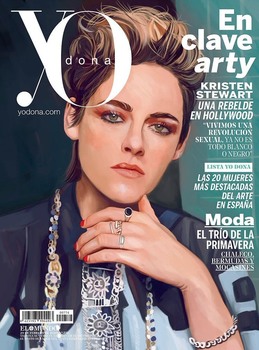
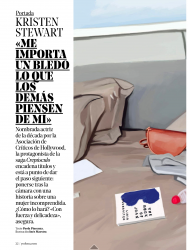
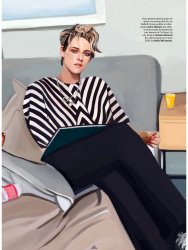
Kristen on the cover of Yo Dona (Spain)


imagebam.com 

imagebam.com

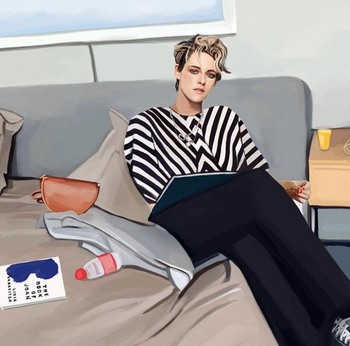
Illustration by artist Inés Maestre.

Digital Scans

imagebam.com imagebam.com imagebam.com imagebam.com imagebam.com

Click on images for full view.

Translation thanks to Uchiland
Transcribed:

Yo Dona: Do you feel identified with the tragic examples of people who fail to overcome the pressure of labels?

I have never felt labelled. They threw me to the front line when I was very young, my relationship with that world was more naive than now. But I have never been one of those who say: "It is people's fault, nobody understands me." Actually the opinion others have about me does not have to be wrong. After all, these opinions are the result of information that, consciously or unconsciously, I have transmitted to them. Jean Seberg understood really fast that much of what happened in her life was beyond her control, there were established structures she had to adapt to. I feel the same way. As for labels, for me they are an interesting topic, especially when I think about the sexual revolution we are currently living. Today it is much easier to talk about this than a few years ago, now things are not just white or black.

You do it. Is it thanks to female empowerment, to #Metoo?

I am proud to be part of it. Frankly, I don't understand how it hasn't happened before.

Does your decision to direct The Chronology of Water have something to do with greater freedom when it comes to talk about sexuality and gender?

One hundred percent. The film talks about a woman whose voice is locked up in a body that has been victim of abuse. Until she decides to relive the pain to look inside. And she finds a powerful voice, first on paper and then in the world, with no hint of shame. There are very few self-help novels about women who are not willing to accept the mechanism established and proposed again and again by society and tradition. Lidia Yuknavitch's story is dirty and primitive. When I read it, I had the same impression I felt when I read Ham on Rye by Charles Bukowski.

Bukowski with a feminine point of view? It is almost scary.

Yes, doubly ashamed. For the violence suffered and for being ashamed of it. The feeling that they do not understand us and do not accept us as we are.

An exciting project, how do you plan to address it?

With strength and delicacy.

How do you start this new phase of your life and career? In Underwater you sport a shaved head, like a submarine version of Alien, and in the Charlie's Angels remake you fight with your hands and make a foray into comedy.

In the new Charlie's Angels we go beyond the cliche of three women with exceptional abilities who work for a mysterious philanthropist. That alone is already a beautiful story, but in this movie there is something else, something typical of our time. The world is full of women with exceptional abilities, now we are aware of it. Not to mention super heroines. What I like most is that it is not an action movie in which they do the same thing that men would do. It is not "we can do it too" but "look at what results the feminine force obtains."

Are there moments in your life outside the movies when you feel you are using your strength?

When I vote. We are all born and grow up in a family, a social class, a group of friends, and we usually consider them to be coordinates that will last forever, But it's not like that. In these issues we can also exercise our right to decide, we can surround ourselves with small or large worlds that define us, which amplify our strength. Seek strength in others and understand that theirs multiplies yours: this has been a great discovery for me. When you feel [she jumps on the chair with enthusiasm "We did it, we are aligned, and someone answers: Yes!"

However it seems that at this stage of history new currents of atrocious machismo are appearing.

Yes, there is a male typology that will not naturally extinguish. The truth is that some people are very dear to me are old white dudes. We can't generalize.

Can I have any of those dude's names?

Are you kidding, right?

Many public figures want and at the same time fear being the center of attention. Have you managed to avoid this paranoia?

According to a very popular story in North America, certain individuals, just because they are the center of attention, stop being people and become comics, two dimensional creatures. And there is a lot of money that revolves around that, many people get a chunk of the cake. To understand that you are part of a machine and that you are a gear allows you to concentrate solely on the opinions of the people you value and do without the rest. Before this topic drove me crazy, but now I see the force behind.

In Seberg, a character says: "the revolution needs movie stars". I think you think the same.

In certain situations, we can help things change, I am convinced. It's difficult to make a revolution standing on a fruit box shouting through a megaphone. Is somewhat more subtle and requires more time. To influence or not to in politics depends a lot on who your travel companions are. If I can help someone not be ashamed of who they are or their decisions, I am glad to do so. And if the price I have to pay is my photograph taken while I'm doing the groceries. I accept it. Letting them look gives a great sense of power.  It is important not to try to control what the world thinks of you. Frankly, I don't give a damn.

Source 1 2 Digital Scans Korita05

Friday, February 21, 2020

Kristen's interview with the SF Chronicle Datebook on 'Seberg' and more


Who better to play Jean Seberg, the American actress who went from Hollywood star to icon of the French New Wave, than Kristen Stewart, a Hollywood star who became the first American actress to win a Cesar Award for acting in a French film?

The similarities don’t end there. Seberg’s career was “very hopscotch. Very similar to mine,” Stewart said.

And both took more than their fair share of lumps in the media, Seberg during a rough beginning to her Hollywood career and then, most famously, while facing intense scrutiny after becoming involved with the Black Panthers in the late 1960s. That period is the subject of the new film “Seberg.”

Stewart, meanwhile, experienced a meteoric rise as star of the megahit “Twilight” series and gained an intense fan base that follows her every move. And, fairly or not, every movie she has made since the conclusion of that series in 2012 has been scrutinized over its box office success — or lack thereof — as well as what she brought to the film artistically.

“That I can totally relate to — that platform turning against her so violently is something I have superficially tasted, so the feeling of being out of control of that made me feel all the more understanding of her particular plight,” Stewart said during a visit to San Francisco in October, the afternoon before she received an award at the Mill Valley Film Festival. “Just in terms of growing up and achieving a certain level of acknowledgment that requires you to interact with the press and the public at large, there are times when things just don’t seem true, no matter how hard you try and convey yourself.

“Just having lies written about you, and people hounding you … but obviously, I was never attacked in the way that she was.”

“Seberg,” which opens in the Bay Area on Friday, Feb. 28, is the third film starring Stewart to open since November — after “Charlie’s Angels” and “Underwater.” It takes place mostly in California and Paris during the late 1960s, almost a decade after “Breathless,” when Seberg was under FBI surveillance for being involved with the Black Panthers, operating in Oakland and Los Angeles. Directed by Benedict Andrews, it co-stars Anthony Mackie, Zazie Beetz, Vince Vaughn and Margaret Qualley.

It’s also an example of the underrated part of Stewart’s career: her penchant for making interesting independent films, from starring as Joan Jett in “The Runaways” to making two films in France with noted director Olivier Assayas: “The Clouds of Sils Maria” and “Personal Shopper.” Also recommended: the 2018 indie “Lizzie.”

“I love independent films more than anything,” Stewart said. “I love them! But it’s not a ‘One for me, one for them’ thing. I’ve honestly been drawn to the larger movies I have been involved in, and then I’m like, ‘Oh, OK, I gotta switch it up.’ … Even in between all the ‘Twilight’ movies — we did five of them — I did one or two other indie movies. I’ve always been lucky enough to find things that stimulate me and people I want to align myself with in a lot of different realms.”

If anyone seems well equipped to navigate the ups and downs of Hollywood, it’s Stewart. Born into a show business family (her mother, Jules, is a script supervisor and directed the indie film “K-11”: her father, John, is a stage manager), she became a child actress, most notably as Jodie Foster’s daughter in David Fincher’s “Panic Room.” Even though she is just 29 — she turns 30 in April — Stewart has been in the business two decades.

So naturally, she wants to direct.

“Oh, hell yeah!” she said with a laugh. “I’ve been wanting to direct since I was a little kid. … Being so young and working with Fincher was interesting because I didn’t know how anyone else worked. So his sort of radical, kind of fierce immersive way of working was instilled in me at a young age. I thought it was fun because everyone was kind of at their wit’s end. It gives the set kind of this awesome feeling, like the only thing worth doing is something that really pushes you. And I loved that. I loved doing 60 f—ing takes and being like 10 years old and being like, ‘Yeah, we gotta keep going!’ ”

Stewart, who directed a short film called “Come Swim” to, uh, test the waters (it’s on YouTube), is preparing her feature debut, “The Chronology of Water,” an adaptation of a memoir by Oregon writer Lidia Yuknavitch. She hopes to begin filming this year.

“Honestly, it’s not arrogance, because it takes such a large group of people to put a movie together,” Stewart said, smiling. “But a commitment to a singular vision is pretty crazy behavior. It’s a gnarly claim to be like, ‘I’m going to direct a f—ing movie. I’m going to make it myself.’ Literally, like, all of the decisions are up to me.”

She said she learns from each director she works with from Fincher to Assayas (“Someone like Olivier is much more meditative, quiet, but still has that feeling like you’re doing the most important thing in the world”) to Sean Penn (“Into the Wild”), Walter Salles (“On the Road”), Woody Allen (“Café Society”) and Ang Lee (“Billy Lynn’s Long Halftime Walk”).

But lately she has been watching work directed by women for inspiration as well. Her current favorite director is Scottish filmmaker Lynne Ramsay, whom Stewart called “honestly one of my heroes.

“I watch her movies, and I really feel like in certain ways my perspective or transient, impressionistic ways of making a film are so substantiated by her work and how impactful it is and completely concise, while also being quite sprawling. So she’s my f—ing favorite. I love her so much. I’m very fixated on her right now.”

Directing is also one way for Stewart to further shape a career she admits has been random. “When I was younger, I never felt like any of my choices were super tactical,” she said. Now, as she turns 30, the self-proclaimed workaholic said she doesn’t feel a window is closing but that new ones are opening up.

“If I could stay on the track that I’ve been on thus far, I’d be very happy,” Stewart said. “I’ve never been bored in my life. I’ve somehow continuously found things that I’ve found not just redeeming, but wonderfully maddening. I’m never not obsessively working. If I could maintain that, I’d be very happy, and I’d probably live a long time.”

Source

Benedict Andrews talks 'Seberg' and Kristen with Screenrant


Jean Seberg is a legendary actor who American audiences and younger generations might not be as familiar with as they should be. Do you feel a certain responsibility to point out to viewers why she was so important, why she was persecuted, why she deserves to be remembered and championed?

I don't think it's even generational. I think it's part of her story that people know her as an icon from Breathless, but then her career never catapulted. She was very famous when she was cast as Saint Joan and had this immediate moment of fame, but there's a shadow over her legacy, and it may well be to do with the events that the movie portrays. I feel an enormous responsibility to shine a light on this part of her life, the injustice that happened to her. But more than that, I feel it's the responsibility of a filmmaker, whether the character is living or fictional, to find and enter into the emotional truth of that character. The film looks through a very specific window into her life, but in that, we're trying to kind of leave a trail of clues. The Jack O'Connell character, he has the same questions as some of the audience: "Who is Jean Seberg?" By him drilling into her life, we're able to start pulling threads and leave trails for people to follow about her past. We don't try to tell the whole story. That would be a whole other thing.

That would be a miniseries.

Every character in the movie, and Jean herself, there would be multiple miniseries, because their lives are so complex and fraught and loaded. But we deliberately narrowed to these couple of years at the end of the 60s. But at the end, we leave trails for people to follow, like the burning in Saint Joan, when she was burned on that set, and all these little clues. But each aspect of her life is so extraordinary. We barely touch on her marriage to Romain Gary, which is a fascinating story in itself. I feel it's an invitation for people to get closer to her. We wanted to get closer to her in the period the movie covers, and to show the FBI's campaign against her, both from her side, as someone going under and being driven mad by that experience, but also from the other side, with Jack watching her. But yes, there's an enormous responsibility to her legacy, and to not allow her story to disappear. Politically and culturally, it's a hugely important story that seems to chime with the current moment that we're living in.

For sure. Just watching the movie, it's so telling how the FBI's campaign against her and the Black Panthers was all about reducing her to a hysterical woman, and them to a bunch of angry black guys who want to overthrow the entire government. Kind of how equality becomes conflated with supremacy, and how it's weirdly inverted now, with white nationalists who feel disenfranchised because they believe white supremacy is being threatened. It's wild. Those false equivalencies. And they were successful with Jean, because she's so comparatively obscure today.

And also successful because of the destruction of those relationships. The destruction of her political relationships, as well as personal ones. I mean, what happened to Jean was just the tip of the iceberg. As the Anthony Mackie character says, she's caught in the crossfire of white America's war on black America. There's not really an equivalence in terms of the war on those activists. We hint at it; for instance, when you see the school destroyed, it's devastating, and a direct consequence of this kind of warfare that Vince Vaughn's character represents. A secret, dirty war. In Jean's case, she's giving financial support and she's holding fundraisers. She's not even necessarily giving a huge public voice. There were other activists, like Jane Fonda and Marlon Brando, who were a lot more in the public eye for their actions, but even for that, and for crossing those boundaries, the machinery of the state surveillance is turned against her. There's a real loss of those productive relationships between Hollywood and the black activists. People who genuinely believe in changing their country and a woman who was horrified by injustice in her country and trying to find a way to change that. And to see her sense of truth destroyed, and her private life destroyed. But, of course, those legacies still continue in a really positive way, too.

Yes. I think you see it a bit in the "shut up and sing" mentality that pops up on Twitter all the time. Like when Joaquin Phoenix won his Oscar and gave an important speech about what he believed in and got mocked online. I mean, that's obviously nowhere near on the scale of what was done to Jean, but maybe it's a vestige of that relationship... But one thing that's really uplifting is the all-star cast that you assembled for what I imagine is not a hugely-budget movie.

It is not. (Laughs) Which, also, you know, is one of the achievements of the whole team. It's an extremely elegant movie. She was an elegant woman, but the movie also crosses these different worlds and we needed to create and do justice, on a period level, to all of those worlds. I wanted each of those worlds to have their own photographic beauty and so on. On our budget, that was a real challenge, but an accomplishment I'm really proud of. But you asked about the cast?

Ah, we can circle back to them, we've got time. I've talked to people who've done period films before and they've all sighed and gone, "It's not easy." Any anachronism sticks out like a sore thumb. It takes a lot of work to make sure every car is period-appropriate, every prop, every costume... And her costumes are amazing.

Yeah, Michael Wilkinson (Justice League) did an incredible job.

That scene where she tells Anthony Mackie that she's pregnant, and she's wearing that yellow and black outfit, it's just gorgeous.

He's a genius, Michael. And he works beautifully with actors. I've been particularly impressed with those clothes in American Hustle. What he gets away with with all of them, but you can just see the trust of the actors, in particular the actresses in that movie. With both elegance and sophistication, but also the way the clothes talk. We couldn't afford to go outside that much. Another movie set in the late 1960s was being shot at the same time, with something like, 11 or 12 times the budget. Margaret Qualley is in both, though! (Laughs) I remember, I was coming home at 3:00 AM or something, after a late shoot, and I got stopped at the traffic lights on the corner of Hollywood Boulevard. We'd been recycling our couple of period cars, and we got stopped for, like, eight minutes while Tarantino's period cars went by.

Oh my gosh, a convoy!

There's his budget versus our budget! But still, I'm incredibly proud that we got such a true and non-cliche sense of period across all of those different worlds. The movie, in a way, is also about that intersectionality of worlds. Jean is a boundary-crosser. From the first minutes of the movie, she goes from the Left Bank of Paris, where she lives with Romain Gary as the darling of La Nouvelle Vague, and then she crosses to 1968 LAX, meets the Panthers, goes to her exquisite glass house in the Hollywood Hills. Going crazy by herself, chucking ice cubes into the pool, she decides to drive down to Compton. And that's all within the first ten minutes of the movie, we cross those worlds. And Jack's first day at work, and suburban L.A., in the belly of the beast in the FBI building. Jean's a boundary-crosses, moving across all of those different worlds. So the story becomes about a woman who is testing these boundaries and crossing these borders, and the movie had to do that, had to move between all of these different worlds and kind of contrast them and get them right, but it also becomes about these borders being crossed, and the way the FBI are interested in someone who is violating that. And they are on this border, too. There's a beautiful scene, early on, when Jack's in the van, and in an homage to The Conversation, the camera drifts out through the car and onto two women doing their makeup. It's a metaphor for cinema, since he's sitting there, looking at these two people through a screen with his camera there. That delicious kick of voyeurism is similar to what the audience is getting. That's one of the things that appealed to me on a cinematic level. This woman, who lives her life in public as an actress... And I've spent my life working with incredible actors in the theater, and their job is to kind of go into their private – all the stuff we usually keep hidden, that we're not meant to show other people – the actor's job is to dig into that and use their memories, their emotions, expose their raw nerves in front of the audience or the camera. That's their craft, their product, and their soul. It's their truth.

It's so complex, because with the FBI enforcing the understood segregation. And Jean tries to cross those lines and then Zazie's character, Dorothy, calls her a "tourist."

It's at a moment where everything's starting to change. That change is up in the air, and as Zazie's character says, the revolution needs movie stars. That tension is there, and it could flip either way. And in fairness, the FBI have leaked evidence of Jean and Hakim's private life, so Dorothy's just found out that her husband's having an affair. But she hasn't found out because she's seen him coming home late or anything; she's found out because the FBI leaked the tape. Then it flips to the other side, where Jean has become a tourist. All the contradictions become exposed and get weaponized. What really interested me, and this touches on all of it... As an actress, having private space, the FBI turns the same cinema equipment against her. Cinema should be the pursuit of truth, an exposure of the living fabric of life and the world and human relations and political relations, and the cinema is our tool par excellence to kinda look into our living substance and reflect on that, and the actor's job is to put that truth in front of an audience. The FBI used those same tools, cameras and microphones and study of he minutia of a life, to destroy her, to destroy her political relationships, and to destroy the very notion of truth. And to take the things they find and weaponize them against her. She was on the boundary between cinema and surveillance. It's a really fascinating study now that we live in a surveillance culture, a reminder of how terrifying that machine of state surveillance is. We see it in its infancy in the movie. Now it's grown up into the mass cultural surveillance we live in.

Yup, not that they even need surveillance anymore; they can just make stuff up and call the truth "Fake News." I mean, not to get political or anything.

The movie touches on that, it's another way it's prophetic.

Right, it's not Hakim's baby.

When Vince's character... He's like a kind of sick author, or writer/director of that side of the film within the film. He's taking that evidence he's collected, and you see that moment where he's listening to them and distorting it, knowing the damage it will do, and being very cavalier about it. The same with his boss, like he's signing off for the studio.

Bringing it back to this cast you've assembled. Again, not a huge budget movie. But is that the power of Jean's story? I imagine a lot of these actors worked for less than their standard rates...

Yeah, and I think it was also a testament to the script. I think there's many ways to tell her story. And I think, once people got to know her, I know this was certainly the case with Kristen, she felt such an incredible empathy and understanding, and really wanted to do Jean's life justice. But I think when people read the script, they were pulled in by the sheer ride of the writing, the way these two worlds, and the surveillance thriller of it, intersect with this study of that portrait of Jean. And also, I think people just had an understanding that this was a story that needed to be told, and that it's a powder keg in terms of how 1968 speaks to 2019 or 2020. I think there was a sense of that, that people could feel.

Kristen Stewart is so talented. I know it, you know it, everyone knows it, and her performance in Seberg is incredible.

She's phenomenal. She puts herself on the line. It's tricky for an actress to play another actress. She didn't want to do an impersonation. It can very easily end up like that. There's such a burden in playing someone else, copying someone else. We very deliberately copied Jean, 100%, in the scene of her Otto Preminger audition, and the moment of the final scene from Breathless. Then, in a way, we could find of put that aside and go, okay, now we can find it from the inside out and find the living, raw, vulnerable character and go into that. That's what Kristen and I were concentrated on doing. What is this situation this person is in? What does she believe in? What is she fighting for? How is she trying to keep her head above water? She gives a very elegant, very brave, very intelligent, very raw performance that echoes with Jean. I think they both have a raw impulsive quality, and they both have a tremendous life force. That's one of the reasons I was so interested in Kristen for the role. And a very tricky thing for it, too, is she's not just playing an actress, but a style icon. I hoped to have someone who was a style icon in her own right, so they're not faking the funk on that. They get that and can do it their own way. I think that also helped. I love watching the movie, and you can oscillate between, "Yes, that's Jean Seberg, and yes, that's Kristen Stewart."

Source