Showing posts with label article. Show all posts

Wednesday, January 6, 2016

'Personal Shopper' filming details in Les InRocks magazine


imagebam.com imagebam.com 

Still

imagebam.com

Click on images for full view.

Translation:

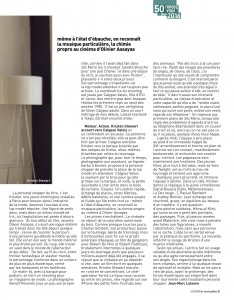
Ghosts and fantasies After Sils Maria, Olivier Assayas reunites with Kristen Stewart for Personal Shopper, expected to come out in the spring. Report on how filming went. The weather is amazing this morning at the Bois de Boulogne. And yet, fall is upon us, but the sun shines and casts some sort of golden, crimson and rust-colored halos on the hundred-year-old trees that surround the lake in the woods. Ten joggers or so are running around at a different pace ; only a few of them slow down, intrigued by something unusual. Artifical lights swarm a small boat moored to the lakeside, about thirty women and men trot around, walkie-talkies in hand. Sat almost on the ground with a video monitor on his knees is Olivier Assayas, concentrating on the last take of his new film Personal Shopper. Short hair held back with a hairband, a leather jacket with fake fur around the collar, black tight pants, a Lacoste sweater on top of a black shirt, white sneakers, a tomboy at the last stage of deglamorization – Kristen Stewart can hardly be seen as someone who is isn’t from the crew, with whom she seems to share a close relationship. She knows them well. The team is almost identical to the one that worked on Sils Maria, Olivier’s last film, for which Kristen earned a César in February 2015. Even her bodyguard is the same, a giant german named Hannibal, who is following from the corner of his eyes, the swarm of paparazzi who are hiding behind the bushes and have been tracking the star non-stop.

The “Personal Shopper” from the title is Kristen Stewart, a young American who is living in Paris to work in the fashion industry. She has become the slave of a renowned model. A proletarian, therefore, but in a world surrounded by money, where everyone is in glamor attire. “At the beginning of the film, Olivier Assays says, there was an idea that kept running around in my head. It had been there for a while: I wanted to tell the story of a person that hated her job. She is surrounded by the most brutal material world around. So that’s why she finds solace in the abstrac and idealistic world.”

Therefore, along the film, from a fantasy thriller to a slasher movie, the characters gets deeper and deppers in a universe more and more esoteric, with ghosts and fantasies. That morning, with the small boat for a podium, a photoshoot is happening for a fashion magazine. The photographer, Benoît Peverelli plays himself, you could say, as he had already done in Sils Maria (where he was photographing Juliette Binoche for a Chanel ad) “and as a side-note, I was also sleeping with Kristen’s character” he says, joking between two takes. His character is losing his patience because the awaited model has still not arrived.

The film coordinator is played by Calypso Valois, daughter of Elli and Jacno, an electro-pop band for whom Assayas did their music videos in the 1980s. “It’s a bit weird to have Calypso as an adult in one of my films. Her mother was pregnant with her when I filmed my short in Tokyo years ago. It was never finished.” Camera. Ready. Action. Kristen Stewart runs towards Calypso Valois, apologizing profusely. Her boss didn’t wake up, maybe she’ll arrive soon. Calypson takes Kristen to the small boat lightened by fake lights, themselves under other lights for the film. The photographer, who, to kill time, is taking pictures of his assistant – a hipster with a beard and a beanie, suggests that the personal shopper should take the model’s place in the meantime. Calypso Vallois helps her onto the boat by holding her arm and there you go, the tiny, anxious, assistant ends up in the light bubble. Cut.

People running around, others switching places, stressed out bodies while a camera flows around filming everything: Even in its early stages, you can already recognize Olivier Assayas’ magic. There are takes after takes. The director is happy with the colors of the fall in the woods. And as usual, Charles Gillibert, his producer who has been present almost everyday, arrives on set. After months of dodgy dealings with no end in sight on Assayas’ project, a gangster movie with Robert Deniro & Pattinson, brutally stopped shortly before filming started, and after millions of dollars had already been invested, Gillibert is thrilled that the director bounced back so quickly, with he film he wrote in only a few weeks. Kristen Stewart walks around in circles as she concentrates.

The director of photography, Yorick Le saux tells us that in between takes, she watches short films from Youtube on her iPhone about animals. “Not stupid stuff that make you laugh. Rather, documentary images with monkeys, cats, dogs. I feel like she’s trying to understand how they move around. It’s funny because I think that there’s something inside her that is very wild, a very sharp attention to everything that’s going on around her, a feral instinct.” He also describes her particular intensity, her speed of delivery and this ability that she has “of adding human interest, and making it almost poignant, the shot of a woman opening a door, taking off her coat or looking at her phone.” 

We think back to the first shots of Sils Maria, when she’s on the phone, fixing problems for Maria’s agenda, walking around in the corridor of a train. And while we have no idea what’s going on, there’s something that seizes us.

In the afternoon, the team is in front of a posh building in Paris’ XVIe arrondissement and is filming a scene where the actress runs out of the building, obviously shaken up, as she jumps on her vespa before leaving. There are almost thirty paparazzi around. Young girls, not what you would call teenagers, are ex-twilight fans, found the place where filming is taking place and are triving to come closer. A few days later, we meet with the team at Sèvres. In a coffee shop, Kristen is acting opposite the young Sigrid Bouaziz (Eden, Metamorphosis), Pascal Rambert & Audrey Bonnet. Their conversation is hushed, deep, mysterious. There’s a question about a swedish painter, Hilma Af Klint, who painted portaits and landscapes her whole life. And a few years before Malevitch, she started painting abstract things. She invented the abstract, but without anyone knowing it. She apparently got the idea by studying spiritualism.

The news influences the expression on Kristen’s face in a nuanced, contemplative way. Depending on the take, the actress has a match that she either nibbles on or that she nervously touches in her hands. She stares fixedly at things around that can’t be seen on camera.

There’s something spiritual and invisible about it. But we won’t know anything else until spring, esoteric forces that carry out in their turmoil, this troubling personal shopper.

Source Thanks to @Gossipgyal for the scans and @somelostbliss for the translation. (Via)

Tuesday, December 29, 2015

Nancy Kirkpatrick (ex-head of marketing at Summit Entertainment) talks about Kristen


Nancy Kirkpatrick with Catherine Hardwicke at the 'Twilight' premiere in LA.

And Stewart, who as a child costarred with Jodie Foster in "Panic Room," has proved herself post-"Twilight" not only with the big-budget follow "Snow White and the Huntsman" (one of 2012's top 20 films at the box office), but also with smartly chosen roles in indie movies like "Still Alice" and "Clouds of Sils Maria," which is generating Oscar buzz for the actress.

"Kristen was a really gifted actress before she ever read 'Twilight,'" said Nancy Kirkpatrick, who worked with the actress when she served as the head of marketing at Summit Entertainment, which made the "Twilight" films. "When she's 50, we're still gonna see her work."

"Now I watch her in interviews and feel like I'm actually seeing the real Kristen, but that's taken a long time," Kirkpatrick said of the 25-year-old. "She has an amazing team and publicist. She's practiced. But she also just grew up."

Source/Via

Monday, January 13, 2014

Q&A with "Camp X-Ray" Director Peter Sattler


Q: In your own words can you describe what this film is about? 

At its most basic level, CAMP X-RAY is a story about two people trapped in a very strange place that manage to find a connection with each other. But of course, it’s about a lot of other things too. It’s about a young woman who leaves her home for the first time. A woman who joins the army to find purpose, only to end up in a place where that purpose couldn’t be less pure. It’s about a man desperate to reach out beyond his world as well. To experience something outside the routine of his tiny cell.

Q: What was the inspiration for CAMP X-RAY?

It all started with the book cart. I saw some documentary footage of a guard and a detainee arguing about the different books on the library cart. Their exchange was so mundane, so idiosyncratic, so utterly ridiculous given the context of where they were. And in that exact moment, I could see an entire film. One hallway, two people, and the utterly absurd relationship that they are forced to have. And that’s what I was drawn to. I just wanted to put those two characters in a room and see what they said to each other, which is very much the way I started writing. Having no direction at all. Just dropping them in a test tube and seeing what words came out of their mouths. And the more banal their conversation, the more interested I was in it, because it was the absurdity of these moments that most perfectly captured my feelings on Guantanamo Bay. I very much wanted to paint our portrayal of this place in stark absurdist colors.

Q: Why did you decide to set the film at Guantanamo?

Guantanamo is a fascinating place to me, and it’s a place I knew very little about before I started researching it. So part of my attraction was to explore untrodden territory. To make a movie about something you haven’t seen before. But at its core, this movie isn’t really about Guantanamo as much as it is about the PEOPLE who are down there. It’s not a political film; it’s a deeply human one.

The setting of Gitmo really serves as the pressure cooker that amplifies and complicates a very personal relationship between two strangers who are forced to find a way to live together.

Q: Can you talk about the casting process and how you ended up working with Kristen, Payman and the rest of the cast?

We started with a Hail Mary to Kristen. It was certainly a long shot, but she was absolutely perfect for the role, so we had to try. Her character requires a lot of acting without words, a lot of living in the moment, and that is something Kristen absolutely excels at. Her character also needed a mixture of toughness and vulnerability which, to me, are traits that she embodies perfectly. So we got the script to Ken Kaplan, her agent, who, much to his credit, sent it on to her, and a few weeks later we sat down to talk about the film. And in that first meeting, I was blown away by her approach to the material, her dedication to the details, and her passion for independent cinema. I think we could both tell that we were pointing in the same direction, so off we went. It all happened pretty quickly by Hollywood standards.

Payman’s a funny story. I adored his performance in the Academy Award winning Iranian film, A Separation, but he was so stern in that role, I didn’t see him as our loud-mouthed detainee. We scheduled a video chat with him in Iran anyway, and the moment he popped up on my screen, everything was different. He was the most buoyant, vibrant man you’ll ever meet, he talked a mile a minute. I loved him, and the fact that he was so different in A Separation just testified to his incredible range as an actor. I remember that night very vividly because I couldn’t get Payman out of my head. I knew that he had to be the one.

But first I needed to see what they were like together. The entire movie hinges on their relationship. So we arranged another video chat, and the second they started speaking, it was like they were already their characters. Payman was talking and talking and talking, and Kristen was kind of quietly listening to him, wryly observing, chiming in, Payman would coax a laugh out of her. It was like I was literally watching a scene from the script play out before my eyes. I gave Payman the job right then and there during the phone call. We all knew there was a magical chemistry between the two of them.

I remember the first time I met Lane Garrison, I couldn’t help but notice that he literally had a red neck. We joked about it, but in truth, it’s not insignificant. It helps that he knows the world of a West Texas soldier inside and out, it’s very much the world he came from. But what really makes him special is the kind of sad sweetness and intelligence he could bring out underneath that veneer. THAT was the undertone that I really responded to in Lane, and something he nailed in the movie. I really gravitate to actors who can play two tones at once. It creates such depth.

John Carroll Lynch’s name was brought up by my casting director, Richard Hicks. Now there’s an actor who’s got range. Comedy, drama, lovable, intimidating; he’s a damn chameleon. I really loved watching him bring his colonel character to life. He brought such a wonderful reality to a role that, in the wrong hands, could have been just another military brass cliché. His performance really played into the larger approach we had, which was to make a film with no ‘bad guys.’ Characters can do bad things, everyone can make bad decisions, but we need to understand, and to some degree sympathize with, why they’re doing what they’re doing. Everyone has an opinion, and if you took the time to talk to them about it, you’d probably find a reason or two to agree with them. And John really understood that, and really worked hard to show the other side of the military’s thinking.

Q: What was your favorite scene to write, and what was your favorite scene to shoot?

I most enjoyed writing the scene that inspired the entire film: the first exchange over the book cart. It is the scene where Kristen and Payman’s characters first meet. We open the movie as a young woman enters the detention camp, which is, understandably, a very intense and frightening place. But when she first meets Payman’s character, we are given a very surprising moment of levity. It underscores the surreal duality of this place and these characters, where one moment you can be literally fighting for your life, but the next, you find yourself arguing with a detainee over Harry Potter.

I also just loved the idea of doing a movie about Gitmo, but not focusing on torture or politics and instead writing scenes about the stupid little things. These two sides are set up to be antagonistic to each other. It’s unavoidably engineered into their relationship. But they can’t fight a real war, so instead they fight it through these little idiosyncratic battles. Arguing about what’s on the lunch menu today or about when they’re getting new books. Stupid arguments, but to these characters, they’re supremely important. This is their Bunker Hill. This is their jihad. And I loved writing those scenes because they were an amusing way to illustrate the idiocy of their conflict in the first place.

My favorite scenes to shoot were always the ones with Kristen and Payman. They were, on the whole, the more daunting ones to film because they were big scenes. But every moment, every take that those two interacted had a real magic to it. They would find their own rhythms and create little interchanges. It was always so effortless and natural. You usually have to fight to get a scene on its feet before you can start working it, but with those two, it was always just there, which meant the three of us could focus on shaping and molding that reality instead of trying to bring it to life.

Q: What was the most difficult scene to shoot?

The end of the movie was the most difficult to shoot. Reel six is essentially one giant 21-minute scene divided into three or four sections. It was terribly difficult to stage and direct such a massive piece of drama. And to add to the pressure, it is the emotional climax of the film, one that required both actors to reach into the absolute depths.

Q: Why did the story of these two intersecting characters appeal to you? 

One of the primary dramatic interchanges we have in our day-to-day life is meeting and dealing with strangers. Anytime you meet someone, there’s posturing, subtle bragging, feeling one another out. Whether it’s a first date, your first day at school, or the first time you meet a guy you’re supposed to be guarding. It really all comes down to that primal fight or flight instinct. Can I trust this guy? Is he nice? Is he being too nice because he’s trying to play me? I see it happen every single day all around me, in small and large ways. A million scared little monkeys trying to figure one another out. Ali and Cole, to me, are just playing out that intrinsic eternal dance of raising and lowering your defenses when you meet a stranger.

Q: The story of a woman in the service is one not often told – what attracted you to that angle? 

My initial reason for writing a woman in this film was one of contrast. How do I make these two characters start as far apart as possible at the beginning. And from the research I had done and given the very complicated relationship Muslim extremists have with women, it was clearly the most interesting way to go.

But in a way, it was about more than that. As I was writing this film, my wife was pregnant with our first child, a daughter, and it made me see much more clearly how few films are told from a female point of view. It was kind of an eye-opening realization for me, and it only made me more determined to create a strong woman who wanted something more than to just be rescued.

Q: When and where was the film shot, and how long was the shoot? 

We shot in the summer of 2013, mostly in an abandoned juvenile prison in Whittier, CA, which is just outside of Los Angeles. We shot for 21 days.

Q: How did you prepare the actors for their roles before production? Was there a rehearsal process? 

Kristen and Payman are interesting in that they both work in very different ways.

Kristen really loves intellectualizing her character because she absolutely wants to live in the moment. And to do that, it requires truly knowing your character from the inside out. So we spent a lot of time talking about girls we knew that were like Cole. Really just talking around the character, building out her backstory. Going back and forth about little awkward moments from her fictional life that we felt was the type of girl we were building.

Payman, to some degree, had a similar approach. He would share stories with me about people who knew who had been imprisoned in Iran, and he would invent little rules which he felt defined who Ali was. But what’s interesting about Payman is that he’s an accomplished writer and filmmaker as well as an actor. So he would most often gravitate towards little turns of a phrase, or try and establish very visual reactions or ticks his character could employ on-screen.

I had some time to develop both of these methods with Kristen and Payman separately, but due to Payman’s schedule, we were only able to get him in the states to rehearse a few weeks before shooting. In that time, the three of us spent as much time as possible together. We concentrated mostly on the big scenes. There’s about four or five of them, really long scenes that are the crux of the film. In the first pass, we mostly just dialed in intentions and wants and particular approaches to certain lines. We also auditioned new lines and improvised around the scenes a little to find truth. The script was never sacrosanct; it was always just about getting to the truth of their interaction.

But the most helpful thing we did was actually to go rehearse in the actual prison where we shot. It was here that we worked out the dance of how to play the back and forth of lines as Kristen’s character was patrolling the hallway. What line she said where and how that was going to all work out. As I’ve said before, those scenes are incredibly complicated to stage properly, so it was something we definitely had to work out before hand.

And then, finally, during our last rehearsal at the location, I left Payman in his cell, and had Kristen walk in circles around that hallway for about twenty minutes. We left them there alone to try and get some sense of what it would actually be like to be spend all day stuck there. There’s a very palpable reality to being behind those thick doors, walking those long hallways.

Q: How much historical research did you do while writing the film? Were some scenes influenced by real life events? 

CAMP X-RAY required an immense amount of research, most of which was done during the writing process. The idea I had was to focus on the mundane minutiae of life at Gitmo, but to really pull that off required the kind of details that reporters don’t normally cover. So I watched lots of documentaries, read lots of books and news articles. One unlikely asset in all this was through Wikileaks. They had leaked the Standard Operating Procedure for Gitmo’s Camp Delta. It was a treasure trove of microscopic military procedural details. Exactly the kind of material I needed to write the type of movie I was attempting.

And while the film wasn’t inspired by any real events, I did, as much as possible, try to weave true elements into the film. So for example, if I read about a certain nickname that soldiers would use for detainees, I’d try and work that into the movie. Or if there was some small detail about the mess hall, or about life on the base, or a story about something weird that happened down there, I’d very much try to find a way to digest and regurgitate that into the script.

The broad movements we approached like a work of art. The small details we treated like a documentary.

Q: How did you find the location, and what went into recreating Guantanamo?

Camp Delta, where our film is set, looks almost exactly like any high security prison you’d find in the states. And the reason for that is simple. That’s who the military hired to build it. So early in preproduction, I started looking for prisons to shoot in. Lo and behold, I found one right in my own backyard, not thirty minutes from downtown LA. An abandoned juvenile prison. The bones were exactly like the detention blocks at Gitmo. It would take a lot of work to transform the rest of it, but we knew that the location had given us a huge head start.

There were two phases of research that went into our film. The first was done by myself during the writing process. But the second was done almost entirely by my production designer, Richard Wright. I always knew that we were facing a challenge in trying to recreate life at Guantanamo, but Richard pushed the design of the film further than I had ever imagined. He painstakingly analyzed Department of Defense videos to try and measure the size of the food slots in the detention doors. He worked with our Muslim consultant Suhad Obeidi to track down appropriate Arabic books. He studied everything from Middle East geometric art to military police procedure to get all the props and dressing correct.

Richard would come in almost every day with a new photo he had found and wanted to recreate. So we eventually ended up making him our second unit director. We’d send him off with our second unit D.P., Adam Stone, and they’d just go stage all these amazing little slices of life that he’d found in his research. Guards wrapping Korans. Detainees hanging their laundry out to dry on a chain link fence.

And this was very much the side of Gitmo that we wanted to focus on. From the beginning, Richard and I wanted to limit the scope of our world to the things that our characters would actually experience. If you actually worked down there, you wouldn’t experience some sweeping helicopter shot over a thousand miles of fence line. You’d actually spend far more time looking at dorky military issue motivational posters and coffee makers. So that’s where we put our focus. We wanted to recreate Gitmo on a very human scale.

Q: What are you working on next?

I can’t really work on two things at once. I kind of just need to go all in on something. So it’s only now that the movie is completely finished that I can start to purge the old film and make room from a new one. Ironically, the film I plan on writing next is, in many ways, a two-hander like CAMP X-RAY. I’m not sure if that’s by design. I think it’s just hard for me to think of a character without thinking of the other character they’ll be in opposition to. No character can exist in a void.

Ser'Darius Blain Discusses "Camp X-Ray," Mentions Kristen

How would you describe the story of “Camp X-Ray”?

It tells the story of a soldier who comes to a really rough prison and is taught how to stand up for what she believes is right at any cost. Along the way, she gains some friends and also makes a few enemies, but the story itself sheds light on everyone’s humanity and the notion that we as humans all need the same thing.

What was it like working with Kristen Stewart in the film?

Getting the chance to work with Kristen one on one was an amazing experience. She’s one of those people who really knows everything about her character. She’s always prepared, very down to Earth and the consummate professional. She’s so easy to work with.

Tuesday, February 5, 2013

Gerald Nicosia talks about Kristen & 'On the Road'


Exercepts:


We all know where the best-laid intentions lead, and I must admit that once I met with all those stars in Montreal, I got as seduced by all that movieland glamor as any Catholic, workingclass Midwesterner normally would. I told myself that these were just ordinary people, like I was, but finding myself a few feet from Kristen Stewart's cleavage in an unbuttoned shirt, or from incredibly handsome Garrett Hedlund lounging James Dean-like in T-shirt and motorcycle boots, I would begin to stumble over my words, falter, blush, and stare like a five-year-old. Hollywood has done this to us--given us these beings larger than life, who never fail to intimidate us and make us feel small. I would have to keep reminding myself that I was the teacher and they were the students. Which is to say, it was a little hard to push the spiritual qualities of On the Road in that situation.

And yet eventually I did become friends with all the major actors, and we hung out together in our hotel bar in Montreal. I came to like Garrett, Kristen, and Sam Riley immensely, and to feel as if they had as good a chance as anyone to portray the intense and driven threesome of Cassady, Lu Anne, and Kerouac. To know them was to learn that they all had great gifts as well as great insecurities to match up with the people they were playing. Sam had been a small-time rock-'n'-roll musician who got drafted into being a movie star--he actually had some trepidation about what it was going to be like to be famous like Kristen, for whom we always had to enter the hotel through the secret underground entrance to keep from being mobbed by her fans. In that, he was not unlike Kerouac himself, who wanted to create beautiful prose but not to be mobbed as the King of the Beats. Garrett, though physically bigger than the real-life Neal, had likewise followed a similar trajectory to that of his character; he had grown up on a hard-scrabble Minnesota farm, where he calloused his hands in the summers and froze his ass off in the winters--and was drawn as if by a magnet to the dream of year-round pleasure in sunny California, much like Cassady leaving behind the snows and skid-row streets of Denver for the jazz, women, and illicit substances of North Beach. And Kristen--though again, physically quite different from her character, who in real life was large and blonde--had a lot of Lu Anne/"Marylou" inside her. She kept her high intelligence well-concealed beneath her sexuality and good manners; she cared enormously about people, both the ones she knew personally and those whose urgent need seemed to demand that she reach out to them; and, perhaps most like Lu Anne/"Marylou," she had learned to be utterly self-reliant even in her teens, prizing independence above men, money, power, or any of the other lures that Hollywood actresses are known to covet.

The amount of research they had all put in--from director Salles to the lowest members of the crew--was phenomenal. Salles arranged for other instructors to come to the boot camp; and although Lu Anne Henderson herself had died recently, I connected him with Anne Marie Santos, Lu Anne's daughter, who came to Montreal and shared memories, photos, and a great deal else with all of them, but especially of course with Kristen, who has many times acknowledged how much she benefitted not only from Annie's help as consultant, but from her spiritual guidance and encouragement as well. In fact, everything seemed on track for a great movie to be made.

But I remember one incident during Beat Boot Camp that left me more than a little queasy. Among the tapes I had brought for them to hear was a very rare tape of pure, drunken, off-the-cuff Kerouac. It had been recorded in 1964 in the studio of Kerouac's artist friend Stanley Twardowicz in Northport, New York. Originally, the interview, conducted by Miklos Zsedely, whom Kerouac called "Mr. Funny Hungary, was intended for deposit at the Northport Public Library. But Kerouac had said so many shocking and even libelous things on the tape that the library had refused to touch it, and gave it back to Stanley Twardowicz for safekeeping. Twardowicz, a close friend, later gave me a copy of the tape shortly before his death. For those (including myself) who get Kerouac's wacky and confrontational sense of humor, it's hilarious. Think, Don Rickles on steroids, and with ten times the IQ. I started playing the tape in a small room at boot camp, where there was just myself, Sam Riley, Kristen, and Walter. Kristen seemed ill at ease with its crude sexual and racial humor; Sam Riley, ever intent on learning his part, listened intently, silently; but Garrett got all the jokes, laughed raucously, sometimes even wickedly, at everything Kerouac said. Garrett, who by far had led the wildest and most unconventional life of those three actors, was having the time of his life listening to it, and told me he wanted to hear the whole thing, as much as there was of it. None of that bothered me. What worried me was Walter getting up and walking out of the room. I think he left at the point where Kerouac was telling how--to get back at Robert Frank for making a movie called The Sin of Jesus--Kerouac had presented him with a Star of David made of pork sausages. Walter didn't want to hear the tape. When I asked him about it later, he said he wanted me to tell the actors about the world that On the Road and its characters came out of, and how the book changed that world. "I don't want to hear what he became," Salles said. "I know what he became. I don't want to hear the racism and anti-Semitism." When I tried to explain that Kerouac was like that all his life, to greater or lesser degrees, Walter turned away. This wasn't what he wanted to hear either.


Read the full & detailed article written by Gerald Nicosia at HuffingtonPost

Via @LutzElle via itsoktobeyou.org thank you.

Thursday, January 3, 2013

Scans: Kristen in Elle UK (February 2013)


imagebam.com imagebam.com imagebam.com imagebam.com imagebam.com


FOR THE LOVE OF STYLE
Cutting-edge style moments at nursery? KRISTEN STEWART, we salute you.

I HAVE ALWAYS BEEN A TOMBOY.
I wanted to look like my older brother when I was younger. I lived in hand-me-downs and was always borrowing his clothes. My earliest fashion memory is cutting up an old pair of Levi's and going to careers day at nursery dressed as a rock star.

MY FILM COSTUMES MEAN A LOT TO ME.
I usually take one or two things from each film as a souvenir. It's fun to put that stuff on; it reminds you of good times. I have my armour from Snow White and the Huntsman and still wear the T-shirts from The Runaways; I gave the leather jacket I wore to Joan Jett, the Blackhearts frontwoman [who I played in the film], with a note scrawled on the black in white pen.

IT'S CLEAR WHEN I DON'T LIKE MY OUTFIT.
I've always worked with the same stylist, Tara Sweenen, who I love, but I've definitely had fashion regrets, which I can't reveal - I'd hate to offend anyone. But I'm way more comfortable now. The other day I realised I do actually have more than one pair of jeans and a T-shirt. I have some cool stuff that I need to start wearing.

I LOVE STELLA McCARTNEY.
She's so talented and I am drawn to simplicity - I'm not really into adornments and decoration. If you were to mix Patti Smith and Brigitte Bardot to make one person, she would be my style icon.

MY MOST TREASURED ITEM
is the leather jacket Balenciaga gave me. I would be devastated if I lost it. I live in it! It started off fairly sturdy but now it feels like a blanket.

FASHION INSPIRES SELF-DISCOVERY.
I first met Nicolas Ghesquière [ex-Balenciaga creative director] on a shoot six years ago. Our interests go hand in hand. What I love about my job as an actress is that you can discover aspects of yourself that are really surprising and fashion inspires you in exactly the same way.

MY FIRST FASHION SHOW
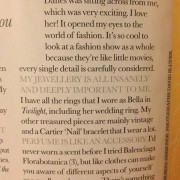
was Burberry A/W 2010. Claire Danes was sitting across from me, which was very exciting. I love her! It opened my eyes to the world of fashion. It's so cool to look at a fashion show as a whole because they're like little movies, every single detail is carefully considered.

MY JEWELLERY IS ALL INSANELY AND DEEPLY IMPORTANT TO ME.
I have all the rings that I wore as Bella in Twilight, including her wedding ring. My other treasured pieces are mainly vintage and a Cartier 'Nail' bracelet that I wear a lot.

PERFUME IS LIKE AN ACCESSORY.
I'd never worn a scent before I tried Balenciaga Florabotanica, but like clothes can make you aware of different aspects of yourself so a smell can elevate you. There's something hot about it - a little heated and slightly more dangerous than the name suggests.

Scans thanks to @allmannerofsins via robstendreams via fiercebitchstew
and transcription via itsoktobeyou.org thank you.


Friday, November 16, 2012

Kristen & Rob's Interview with Flicks and Bits


How was it for you getting your head around the psychological aspect of Bella becoming a vampire, and her powers?

Kristen Stewart: I was really, really excited about developing Bella’s vamp thing. And not just the look, I know people are obsessed with the look and all of that, but really, for me, she’s definitely my favourite vampire – I like her powers the best. Bella doesn’t even realize she has these really enormous talents, she discredits everything she’s got. Even though she makes fun of it, her super self-control is actually probably the coolest power in the series. Also she can project her shield, like a membrane. Bella can protect anyone who steps within that, and any other vampy power has no effect on her whatsoever, which is why Edward cannot read her mind. It all starts to click why it’s been so difficult, why they’ve been drawn together, and why she’s been such a mystery to him….all of that makes sense now. It was really interesting.

It’s a pretty happy beginning for Edward in ‘The Twilight Saga: Breaking Dawn – Part 2,’ and fatherhood has its own psychological affect on Edward, in a good way….

Robert Pattinson: Yeah. The beginning of ‘The Twilight Saga: Breaking Dawn – Part 2 starts off with a pretty happy moment again (laughs). All of the tribulations from before have ended up with everything being ok. Bella’s made the change into a vampire without a hitch really. The only worry is that Bella worries about how she’s going to behave as a vampire, is she going to go crazy? Especially because she’s stronger than all the Cullen’s put together at the beginning. You find out very rapidly that she’s very much in control of herself and finds it even easier than anybody else when they’ve been turned into a vampire. It’s a very happy beginning. With Edward, when he has a child, I think it’s such an irreplaceable union that he doesn’t just think about himself any more, he thinks of himself being him, Bella and Renesmee. So it becomes a different thing, I guess he grows up quite a bit. He stops being so self-obsessed.

Renesmee becomes a big part of this story and the development of Bella….

Kristen Stewart: Yeah. Renesmee is a really, really special little kid. She has her own way of communicating, she somehow passes a tonne of information, sensory information – that’s how Bella and really talk to each other. It’s awesome to see because she develops so young and so quickly, you see a mother communicate with her infant child more so than we would be able to in real life. I’m sure every mother feels that they’re speaking to their children, but Bella and Renesmee really are speaking to each other in this mythical way. I was so excited to see how that looks visually.

How was it for you acting opposite Mackenzie Foy in that role?

Robert Pattinson: Mackenzie’s great. She’s very self-possessed for a really young girl. She’s really smart, she’s really talented. She’s had to do very difficult things. She’s playing the face on the body of maybe 15 other young girls of varying sizes, which is very, very difficult to do for any actor, let alone a young girl who’s doing her first movie. She’s very funny. She’s taught us a lot of things about life and how to be polite to people. She’s very professional and likes to have her swear bucks. She made a lot of money off me and Kristen (laughs).

Kristen Stewart: We are so lucky to have Mackenzie. When you work with good actors, everything just becomes more real and natural for you and you create a more complete environment – it just lives within it. Mackenzie is so smart and she loves doing this. She’s never out of it, she probably knows more about what’s going on and what the next shot is than most other actors on set. She’s amazingly cool and I’m very proud to have her be playing my daughter (laughs).

While Edward has a better understanding of what is happening between Jacob and Renesmee, Bella is sort of blindsided by that dynamic?

Robert Pattinson: Obviously it causes a lot of problems in the Cullen household considering Jacob’s imprinted before Bella has even seen her own kid. I think because Edward can read Jacob’s mind and he knows a little bit about imprinting, and he’s kind of certain that Jacob wouldn’t necessarily be attracted to a newborn baby if he wasn’t kind of forced by his genes into doing it (laughs). So he kind of has a quicker understanding of it than Bella does. Bella has to go purely on trust.

While the other Vampire and Werewolf characters have had a feral and animalistic side to them throughout the ‘Twilight’ movies, this is Bella’s first time with that aspect to her – and it’s very much channeled in the new protective, maternal side to her.

Kristen Stewart: It was fun to throw Taylor around because Taylor’s not only the best at getting thrown around, so I wasn’t scared of hurting him, but it definitely makes you feel very empowered when you flick him and he flies across a forest (laughs). The cool thing about that moment was that it came from a very instinctive, protective, maternal….something that I’ve never experienced but I can feel it, having to play with it for a bit – I obviously don’t have a child to protect (laughs), but I can sort of feel it. Everyone’s toyed around with being very feral and crazy and aggressive, it’s fun to do, for blood lust and anger and all of that. But more so for protecting the child, that’s fun. That just takes it to a whole new level. It’s a lot of fun to play because I feel like there’s nothing you’ll fight for harder than your kid.

There’s been a large ensemble cast for each of the ‘Twilight’ movies, yet ‘The Twilight Saga: Breaking Dawn – Part 2 takes it to a next level. How was that for you?

Robert Pattinson: We’ve had the same cast for years, so it’s such a huge change having like 70 people on this one – it’s kind of amazing. There are some really great actors, really great people and it’s interesting because it gives it a very epic feel, which is nice for the final one of the series. Also, really nice people seem to be attracted to be in the cast of Twilight movies. And this one, it suddenly turned into an action movie at the end. I did a few stunts, like the one where I did a jump on a wire, which was pretty fun.

Bella starts the ‘Twilight’ series as pretty awkward, shy, and clumsy. Yet in this film she’s evolved into a fiercely protective mother and powerful vampire. How has that arc been to play?

Kristen Stewart: I am so very human in the ‘Twilight’ series, I’m full of idiosyncrasies. Being a clumsy person is not always the easiest thing to do, and also, the way that I usually learn my lines, I learn the idea, then I find the words and they come out – which is why I stutter a lot in ‘Twilight.’ That’s something that I liked. But now it’s just a really different way of approaching movement and talking in a scene. I have to approach it completely differently because Bella’s mind now works so fast. Bella has had clear insecurities that show – which is really, really good for the series because at this point, to be really still, to be so controlled and to know that your mind works faster now, in that before you speak you already know what you are saying, before you move you are already there mentally. It’s like its already happened, that was interesting to portray.

In the book, the hunt was my favourite. I loved how alive she became. The idea was really clearly stated in the book that, as a vampire, Bella is different and she is special – you could feel it instantly. Everything’s easy for her. Now she’s excelling. It’s been really awesome to conceptually play that I am the strongest person in the room (laughs). That had an effect on how I stand next to these big huge guys, who are clearly stronger than me. I got to do wire work and kick people. It feels good to get physical, because I’ve always literally stood behind people.

‘The Twilight Saga: Breaking Dawn – Part 2 explores the vampire world beyond the romance of Bella and Edward….

Rober Pattinson: Yeah. This one, it’s a lot bigger. The story spans the globe and encompasses many different characters, showing the variety of powers and abilities vampires can have. It shows a huge amount of the vampire world. Many, many different character. It shows how many different powers and abilities vampire’s can have. And is also it’s about the fulfillment of Bella’s character, first seeing her as a vampire is going to be a powerful moment. It’s very interesting.

Thursday, November 15, 2012

Ben Affleck Mentions Kristen


Kristen Stewart may be "desperate" to get some new work now that Twilight is coming to an end, but she's going to be just fine, thank you very much.

In fact, it does sound like Ben Affleck is itching to work with her in Focus, a romantic comedy from Crazy Stupid Love directing duo John Requa and Glenn Ficarra.

It was reported by Variety earlier this month that K. Stew was in talks to costar as a young woman Affleck's character, a veteran grifter, meets in his travels.

We asked Affleck for an update when we caught up with him the other night at the GQ Men of the Year party at Chateau Marmont.

"I'm hesitant to get into casting stuff because I don't know what's finished or isn't because people come in and out of things all the time," he said. "But she's terrific and hopefully it will work out."

Julien Macdonald Talks About Kristen Wearing His Creation


Julien Macdonald has spoken exclusively to Grazia Daily about his reaction to seeing Kristen Stewart wearing his demure creation in Madrid today. So what’s his verdict? ‘I think the styling was perfect, she kept it quite simple with tousled hair and a classic pair of black heels,’ he told us.

‘Kristen is an actress who never gets it wrong on the red carpet and she lets the clothes speak for themselves whilst keeping them looking modern and cool.’ And are you a Twilight fan, Mr Macdonald? ‘I’m a big fan of Twilight – I have liked it since the beginning and am so sad to see it come to an end!’ Hear, hear.

‘Kristen Stewart is one of my favourite actresses of the moment and it’s an honour to dress her for the red carpet.’ Of course, it’s an incredible feeling for the London-based designer to see any of the world’s style-setters donning his dresses. ‘It inspires me to create more collections and push myself more and more,’ Macdonald says. ‘I’m lucky to have dressed a wide range of celebrities and VIPs who are great role models to others and who are often watched for their style choices.’


Walter Salles Mentions Kristen

loading

And Salles gets Kristen Stewart.

As he told me, "She's attracted by roles that trespass borders and she gives life to these characters with passion and intelligence.

"Yes, I do feel she's fearless."

Wednesday, November 14, 2012

Kristen's Interview with LA Times


loading

Kristen Stewart wishes she was better in "New Moon" and acknowledged that if she's being really honest, she "didn't love" "Eclipse." As the star of "The Twilight Saga" since its inception in 2008, Stewart has been at the forefront of the lucrative vampire franchise throughout its five movies.

Along the way, she's worked with four different directors, battled the ever-present media scrutiny and learned how to handle a fervent fan base that has very specific ideas on how Stephenie Meyer's beloved books should be translated onto the big screen.

When Stewart looks back on the movies, she has varying thoughts about each of them.


On "Twilight": "What I remember the most about the first one is sitting with Rob [Pattinson] in a room tearing our hair out over the script. We were getting notes from the studio incessantly. Every day. I now love everybody but then I was like ‘Don’t you dare say anything to me.’ It was such a fight. And it’s so much fun to fight. That’s my thing. It’s great."

On "New Moon": "It's always been my favorite. I think the depths that are described in that and going from the forest to the bedroom to Italy. Oh my God, that’s why you live. If I were to do that movie now.... I really, really, really, really wish I could go back and do that movie again. I would just be better. But I love it and I had a great experience with [director] Chris [Weitz]."

On "Eclipse": "I just didn't love it. At the time we were kind of pumping them out. The movies were really close together. It felt a little mechanical. That is the most painful, when you know it. When you are on a set and you know that you are dropping things. We were letting things just fall through our fingertips."

On "Breaking Dawn Part 1": "'Breaking Dawn' was the most exciting for me. You just rip through it. Plus, there was so much detachment on the last one that on this one I was raring to go. [I was] simply not going to let that happen again. There was no way."

Kristen, Rob and Bill's Interview with Washington Post


LOS ANGELES — Kristen Stewart and Robert Pattinson sit side by side on a sofa at the Four Seasons hotel, discussing the end of the five-film project that made them famous and brought them together.

“Twilight” rocketed both to superstardom, and their real-life romance only propelled them further. With Friday’s release of the final film in the franchise, “The Twilight Saga: Breaking Dawn — Part 2,” the young actors bid farewell to the worldwide fantasy sensation, but not to the tabloid attention they garner wherever they go.


Dedicated Twi-Hards were devastated when Stewart admitted in July to cheating on Pattinson in a “momentary indiscretion” with her married “Snow White and the Huntsman” director. Bella and Edward, er, Stewart and Pattinson briefly split, which not only threatened to jeopardize marketing for the final “Twilight” film, but unraveled the real-life element of the vampire love story.

Now reunited, the pair finish each other’s sentences during a recent interview as they talk about how much their lives have changed since the first “Twilight” movie was released in 2008.

“After the first one, I mean, it’s a different world you’re living in,” says Pattinson, 26.

“Also, we’re at that stage of life when things are shifting anyway,” adds Stewart, 22, who was just 17 when she first played Bella Swan.

Global fame makes growing up challenging, they say, acknowledging they’ve become more insular.

“It’s a really weird thing because you kind of have to hide,” Pattinson says, “and hiding really destroys the thing which, for one thing...”

Stewart interjects: “That fuels you as an actor.”

“Yeah. It destroys your fuel,” he continues, “and also it destroys — you get to the point where you start to lose interest in things because you spend so much time...”

“Guarding,” Stewart says.

“Yeah, and that’s your world,” Pattinson says. “Your world gets smaller. There’s a massive contraction. And the weirdest thing is the more you contract it, the more the (public) interest goes up. It’s so crazy. There’s no way around it. You’re either on a 24-7 reality-TV show, or people think you should be.”

“No, it’s hilarious,” Stewart says, not looking like she finds it very funny. “Either way, people are like, ‘Ugh. Famewhores.’”

But she has wanted every “Twilight” film to be successful and knows it’s not popular to complain about the personal costs of fame.

“This is a really scary question to answer because people instantly just hate you for even saying that anything is close to unsavory or whatever or however you want to put it,” she says.

Director Bill Condon, who began working with Stewart, Pattinson and Taylor Lautner in 2010, says the young megastars understand the pressures of the spotlight.

“They appreciated the good stuff about it, they were able to kind of glide through the stuff that wasn’t so good, and, really, they’re three very grounded human beings who really just, I have to say, matured into better versions of themselves,” Condon said. “They didn’t get altered by it, which is kind of extraordinary.”

Stewart said it’s been an indulgence to play the same character for so long, but there is some relief in having reached the end of her story.

“There are so many beloved moments in this series that we would think about for five years,” she said. “They weigh on you, whereas in a normal movie, you’ve got five weeks, five months... We, for five years, have been waiting for the story to be told. And now that it is, I don’t want to say that I’m so excited that it’s done, because that sounds like I just don’t want to do it anymore, but I’m just excited that we don’t have that on us anymore.”

Wrapping up the second “Breaking Dawn” film was a relief for Condon, too.

“It’s something you obsess on for so long,” he said. “It’s good to say goodbye to it.”

Pattinson and Stewart are also glad to finish the last round of “Twilight” promotions and press interviews.

“Doing press for a different movie, you’re literally just talking about the movie,” Pattinson says. “This, 90 percent of the time we’re talking about our lives rather than the movie.”

“But this is it,” Stewart says. “It definitely makes today easier.”


Kristen's Interview with The Coventry Telegraph

loading

Kristen Stewart has revealed that she has no regrets about signing up to the Twilight franchise - and says they didn't even think the first film would do well enough to get a sequel.

The 22-year-old - who reprises her role as Bella in the final instalment, Breaking Dawn Part 2 - has been the focus of tabloid attention, due to her on-off relationship with co-star Robert Pattinson and is constantly chased by paparazzi and the films' fans (aka Twi-hards).

"There have been some heavy moments obviously but I would trade nothing," she said.


"It's such a strange job; you need to be a little crazy, you need to be a little obsessive.

"Also being so young it's really rare. How often do people find what really genuinely challenges them in life at this age? I get so much more time to do what I love than most people do."

The actress, who will attend the film's UK premiere tonight with co-stars Robert and Taylor Lautner, added: "I started [acting] when I was 10 years old so I definitely wouldn't trade anything."

Kristen, who was 17 when she was cast in the first Twilight film in 2007, admitted they never knew that the series would become such a huge phenomenon.

"We didn't even know a sequel was possible. It genuinely wasn't the goal," she recalled.

"It definitely had a following but I think we all imagined it was fairly cult-ish. And then when it suddenly took like wildfire, it actually made sense.

"It's not like it was expected but it was like if anything was going to do it then it made sense it was this."

Thank you! :)

Saturday, June 23, 2012

Kristen & Rupert's Interview with The West Australian

Photobucket

 If you are going to inject a classic fairy tale with contemporary relevance, it helps to have as your leading lady an actress who speaks to her generation.

Director Rupert Sanders admits that he has seen only the first Twilight film - but he knew when it came to finding a girl who embodied all the qualities of the gutsy heroine at the centre of his first feature film, Snow White and the Huntsman, there could be no one better suited to the role than Kristen Stewart.

"She's very contemporary and very spirited," Sanders says of the 22-year-old star who has become a household name playing Bella Swan in the hit vampire film franchise.

"She carries a lot of weight on her shoulders and does it with far more years than she has under her belt. There was just something about that spirit that was undefined and raw that drew us to her. It's very unbridled and kind of un-manicured."

It's the morning after the Australian premiere of Snow White and the Huntsman (or SWATH as the film is known on Twitter), Sanders' ambitious, big-budget adaptation of the Brothers Grimm fairytale, featuring a stellar cast including Australian Chris Hemsworth and Oscar-winning actress Charlize Theron.

In the plush confines of Sydney's Park Hyatt Hotel, Sanders is sitting alongside his leading lady whose casual leggings, old grey t-shirt and flannel shirt, belie the fact she has, just that morning, been named by Forbes as the highest-paid actress in Hollywood.

"Well, she's worth every penny," he adds, giving the uncomfortable- looking actress a reassuring smile.
Sanders, a respected commercial director whose resume includes advertisements for Sears, Toyota and the video game Halo 3: ODST, had been considered for several prominent films, including The Hunger Games, before he was hired by Universal to direct the $170 million Snow White reboot.

After reading Evan Daugherty's script - which is more along the lines of the original fairytale first published in 1812 than Disney's 1937 animation - the 41-year-old Brit realised that he had an opportunity to "create a world people hadn't seen before".

The "new" Snow White tells the story of the daughter of King Magnus (Noah Huntley). After his wife's death, the king falls in love with the captivating Ravenna (Theron). The two marry but on their wedding night Ravenna murders her new husband, seizes control of the kingdom and locks her stepdaughter, Snow White, in the castle.

Years later the queen learns Snow White holds the key to eternal youth, but before she is able to consume her heart which will make her immortal, Snow White escapes into the dark forest.

Ravenna sends out the Huntsman (Hemsworth) who, on learning he has been tricked by the queen, ends up helping Snow White in her effort to defeat Ravenna and end her reign.

There are elements of the story which older generations will identify with - a mirror, a red apple, an evil queen and, of course, a merry band of dwarves - but thrown into the mix are massive battles, a rebellion, stunning special effects and an underlying message "teaching us to understand mortality and not bury ourselves in jealousy or rage" and it becomes an altogether visually sumptuous and mature affair.

"It's certainly darker than Disney but I don't think it's darker than the Grimms' version," Sanders says. "It's like an original fairytale - they scare you to inform you. And people like to be scared a bit.

"We're not scaring people in a gratuitous way. It's peripheral fear, not horror. It makes you tingle and it makes the ride more intense."

Stewart, whose films outside the Twilight franchise include Into the Wild and The Runaways, admitted at the Australian premiere of SWATH on Tuesday that she never really liked the original fairytale.
 
"It's not that I wasn't a fan," she says. "I just couldn't connect with Snow White growing up. So when I first heard about the project I thought, 'Snow White? Why?'"

Like Sanders, she changed her mind upon reading the script and identifying with a character who was not prepared to be relegated to being saved by someone else. Sanders describes her as a "female Luke Skywalker".

"There has been a void of women being strong in movies and finally it's been done well," Stewart says. "You recognise Snow White but it's like all her perfect qualities have been put at the bottom of a pit of mud to see if she can find them and take them and polish them."

Indeed, Sanders pushed all of his stars to their mental and physical limits during the 80-day shoot in sheeting rain and miserable mud in some of the remotest areas of Britain during winter.

For Stewart, who at one point during filming had to jump into a freezing lake, the most uncomfortable part of her role was having to ride a horse.

"That was by far the highest hurdle for me to get over," she says. "It terrified me. I think that's good though - genuine fear and discomfort is cool on screen."

For Sanders, the discomfort came early on in the piece when he contemplated the enormity of adapting such a beloved fairytale for the big screen.

"You are a bit nervous whenever you do anything in life where you are opening yourself up," he says.

"I don't think my job was any more nerve-racking than Kristen's or Chris' who are the face of it. I could have probably slid away into anonymity and never worked again if it had been a disaster. I guess there's pressure for all of us."

With strong reviews and box office results and talk of a sequel, Sanders doesn't have to worry too much about his future. As for Stewart, she will take a month's break before starting work on her next film - a thriller named Cali by The Notebook director Nick Cassavetes.

"It's hard to talk about because I haven't got into the zone. Literally as soon as I get home, we need to cast it ... sit down with the script," Stewart says.
 "But it's pretty extreme in every way.
 "It reminds me of movies from the 90s - weird cult movies."

She will next appear on the big screen as the uninhibited Marylou in the screen adaptation of Jack Kerouac's classic novel, On the Road, which opens in Australia in September.

Then of course there's that little film opening in November - the final instalment in the Twilight Saga - Breaking Dawn: Part 2.

While keen to press on with new and challenging roles, Stewart admits it was hard saying goodbye to a character she has lived with for the past four years.

"It's always the same feeling at the end of something you have invested in," she says.
"In this case it was just longer.
"I will probably have to talk about (the role) for the rest of my life but I am lucky because it's a fond memory."

Snow White and the Huntsman is out now.

Source Via @RobStenation  - Thank you! :)

Thursday, June 21, 2012

Kristen & Rupert Sanders' Interview with Sydney Morning Herald


”She’s been imprisoned by Twilight and this is her breakout,” says Rupert Sanders, the British director making his first feature with Snow White and the Huntsman. ”Kristen’s very talented and she’s got a huge career ahead of her where she will constantly surprise people.”


As one of the few successful child actors to transition without a hitch into adult roles, Stewart feels like a familiar screen fixture despite being merely 22 years old. She was just 17 when she was cast as Bella Swan, the chaste teenage girl who falls in love with Robert Pattinson’s brooding vampire in 2008′s Twilight. That overwrought franchise finally ends this November, and it appears that while she’s grateful for the exposure, Stewart is ready for the next phase of her career.


‘I’m not trying to distance myself from Twilight, but there are several films coming out this year that are going to compound the sense of change,” Stewart says. ”I’ve done things that are far and away from anything I could imagine, and right now I’m bursting with emotions and questions.’
 

‘Our take on the whole idea of a fairytale is very elemental,” says Sanders, a graduate of television commercials, who delivered the film on a painfully tight schedule to meet the studio’s pre-ordained release date. ”But the fact that we’ve got two strong women playing masculine roles is very modern, and that’s part of what excited me.’

‘I think that the reason the story has never been irrelevant is that it’s so fundamental: you have to have heart,” Stewart says. ”I’ve met so many people who’ve become so ugly, people that I thought were really beautiful, because they don’t come from anywhere apart from the purely superficial. What they do doesn’t work and it doesn’t move you. Women can see that, and they can sense it.’

‘Sometimes you have qualities that you don’t know about until you meet someone, or read something, or hear about a story and you realise, ‘Wow, that’s scary and it speaks to me, I should do that,”’ Stewart says. ”Rupert presented a world I wanted to live in and so I believed in the cause.’


‘I love close-ups,” she says. ”I’ve never done theatre and although I started at a young age, I was never the kid in the middle of the room. I was never a performer. When there’s a camera in my face there’s just no going back, there’s no excuse. It’s better for me because as soon as you pull the camera back there are one hundred walls I can get behind. With a close-up, you can’t hide.’


Read the full article here Via @kstewartnews
Thank you!

Kristen's Interview with Sydney Morning Herald


Kristen Stewart is set to make her mark, writes Craig Mathieson.

IN HER new film, the fantasy epic Snow White and the Huntsman, Kristen Stewart plays a young princess who escapes deprivation and confinement, survives testing trials and acquits herself as a leader ready to claim what is rightfully hers. The story is derived from a Brothers Grimm fairytale, but it has no shortage of contemporary relevance, especially for the American actress.


'
'She's been imprisoned by Twilight and this is her breakout,'' says Rupert Sanders, the British director making his first feature with Snow White and the Huntsman. ''Kristen's very talented and she's got a huge career ahead of her where she will constantly surprise people.''

As one of the few successful child actors to transition without a hitch into adult roles, Stewart feels like a familiar screen fixture despite being merely 22 years old. She was just 17 when she was cast as Bella Swan, the chaste teenage girl who falls in love with Robert Pattinson's brooding vampire in 2008's Twilight. That overwrought franchise finally ends this November, and it appears that while she's grateful for the exposure, Stewart is ready for the next phase of her career.


''I'm not trying to distance myself from Twilight, but there are several films coming out this year that are going to compound the sense of change,'' Stewart says. ''I've done things that are far and away from anything I could imagine, and right now I'm bursting with emotions and questions.''


The media image of Stewart established through the various Twilight cycles is that of an uncommunicative young woman alternating between disdain and boredom in her promotional appearances. However, on a quick visit to Australia with Snow White co-star and former Phillip Island lad, Thor lead Chris Hemsworth, she spoke in swift, excitable sentences and referred to roles in films she believed in as ''causes''. Stewart repeatedly used ''tactful'' in a pejorative sense, as if it was plainly preferable to shake things up.

Stewart was widely praised at the recent Cannes film festival for her turn as the libidinous, forthright Marylou in Walter Salles' adaptation of Jack Kerouac's seminal Beat-era text On the Road, but right now it is Snow White and the Huntsman that is fortifying her commercial leverage. Sanders' film has quickly earned more than $250 million overseas in a season where several expensive blockbusters, such as Battleship, have failed commercially.


The revised storyline, rich with bloody ill-doing and tactile physical textures, has Charlize Theron as the evil queen, Ravenna, who literally kills young women for their youth, and needs to recapture the stepdaughter she locked away when she killed the girl's father. In a landscape alternately bleak and idyllic, Ravenna's unwilling agent is Hemsworth's widowed Huntsman. In this swords-and-spells edition there are seven dwarves, but they definitely do not sing.


''Our take on the whole idea of a fairytale is very elemental,'' says Sanders, a graduate of television commercials, who delivered the film on a painfully tight schedule to meet the studio's pre-ordained release date. ''But the fact that we've got two strong women playing masculine roles is very modern, and that's part of what excited me.''


The movie's take on femininity feels connected to a 21st-century world view, suggesting that in a world where men expect to rule, women will turn on each other in a bid to prosper. Ravenna's hunger to destroy Snow White could apply to the corporate world or to Hollywood, where female stars have narrower windows of opportunity than their male counterparts.


''I think that the reason the story has never been irrelevant is that it's so fundamental: you have to have heart,''
Stewart says. ''I've met so many people who've become so ugly, people that I thought were really beautiful, because they don't come from anywhere apart from the purely superficial. What they do doesn't work and it doesn't move you. Women can see that, and they can sense it.''

Sanders saw the possibilities in the respective roles for Theron and Stewart early on. The former, he says, had a beauty and a strength she was willing to turn into something destructive, while the latter has a rebellious streak struggling to get out from under the weight of the world on her young shoulders.


'
'Sometimes you have qualities that you don't know about until you meet someone, or read something, or hear about a story and you realise, 'Wow, that's scary and it speaks to me, I should do that,''' Stewart says. ''Rupert presented a world I wanted to live in and so I believed in the cause.''

Unlike some of her contemporaries, who are adept at promoting themselves but are workmanlike on the screen, Stewart struggles to banter with David Letterman but excels at playing someone else. In close-up, the most technically demanding camera set-up for an actor, she can convey complex emotions without saying a word. That's a blessing and a curse, but she's now completely comfortable with that.


''I love close-ups,'' she says. ''I've never done theatre and although I started at a young age, I was never the kid in the middle of the room. I was never a performer. When there's a camera in my face there's just no going back, there's no excuse. It's better for me because as soon as you pull the camera back there are one hundred walls I can get behind. With a close-up, you can't hide.
''

Thank you all!

Wednesday, June 20, 2012

Kristen’s Interview with News.com.au

Photobucket


KRISTEN Stewart talks about her starring role in new movie Snow White and the Huntsman, dealing with isolation, learning to ride and painful stuntwork with News.com.au

- I assume you have read James Franco’s glowing review of your performance in Snow White and the Huntsman, in which he dubs you the warrior queen.

K: I have. Wow. I mean, really! It came out of nowhere.

– In it, he says you have braved more scrutiny of your private life than most presidents.

K: I guess I wouldn’t know how to compare it. But people would definitely like to know about things that I don’t want to tell them, which is fine. It’s not something I am uncomfortable with any more.


– Any more?
K: Once you find your boundaries, you stop playing this weird game of jumping too far over and then too far back, if you know what I mean. I know where I am comfortable, now.

In his essay, Franco draws parallels between Snow White’s premature ascension to the throne and your own rise to stardom.

K: I could really relate to her isolation – she goes through something tough and isn’t broken by it. When you have fans and people following you or looking up to you, you have to do things from a very, very true place. Snow White, instead of just being this ball-busting fighter, I think the reason she is strong is because she really stays, it sounds maybe cliched, but she stays true.


– I hope it didn’t feel as though you were locked in a tower for seven years.

K: No! (Snorts.) Only in so far as that she is isolated from people that look up to her. On that level, I absolutely felt for (Snow White). You look up to people that you identify with, so there is probably a commonality. I understand. I’ve been around certain musicians and not been able to speak. It’s a natural reaction. But at the same time, you want to go: “we’re no different”.

– Given the number of column-inches devoted to Kristen Stewart, we actually know very little about you. What sort of music you like, for instance.

K: It changes quite a bit. Today, I am obsessively involved with Bon Iver. It might be all I listen to right now, actually. The Shins are my favourite band. I love Interpol and Jenny Lewis.

– What did you read on the plane?

K: I read the newspaper on the plane.

– Since you travel a lot, can we assume you have made the switch to an e-book?

K: Technology literally disagrees with me. This is going to sound so ridiculous, but warranties, passwords, accounts, numbers with emails coinciding with different websites … I have gone through quite a few Kindles. I need to get a new one because I love them.

– What’s your idea of a perfect Saturday night?

K: I have a pretty close-knit group of friends. I am from LA. I love Los Angeles. Because I usually work elsewhere, I am really happy to just be home with my friends. We do very normal things people our age do – play a bit of music and stuff.

– You don’t strike me as a gym junkie. What do you do for exercise?


K: I am really active just generally. I hike with my dogs. I swim. I have never really worked out, other than for this, really, because I knew I was going to need incredible stamina that I did not have at that point. I didn’t want to be charging up the stairs in armour to Ravenna’s chamber and have to stop at the top and go (mimics leaning against a wall, sucking in gulps of air.)

– You also learnt to ride horses for the film. And did some stunt work.

K: A little bit. The cool thing about the action in this movie, it has a lot of integrity. Everything I do in the movie, a girl my size could do. So that made it more challenging because we weren’t faking it. (Director) Rupert (Sanders) really was belting the crap out of me. Any time we look uncomfortable or scared or possibly in pain, we are most likely experiencing that.

– Three Snow White stories are coming out in quick succession (Mirror Mirror, this one and the TV series Once Upon A Time). Theories?

K: Considering the source material, there is a lot of room for interpretation. If you take a story that has always spoken to people, moved them on some level, and make it a bit more palatable for now … In this case, she is living in a more dangerous world but she stays recognisably Snow White … that essentially female and delicate but strong girl.

– Traits shared by Twilight’s Bella Swan and The Hunger Games’ Katniss Everdeen?

K: The reason it feels so satisfying is because that’s how we are. It’s natural. It doesn’t feel forced.