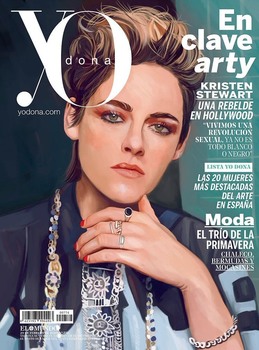
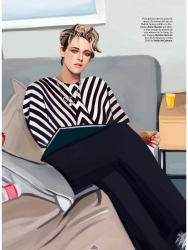
Who better to play Jean Seberg, the American actress who went from Hollywood star to icon of the French New Wave, than Kristen Stewart, a Hollywood star who became the first American actress to win a Cesar Award for acting in a French film?
The similarities don’t end there. Seberg’s career was “very hopscotch. Very similar to mine,” Stewart said.
And both took more than their fair share of lumps in the media, Seberg during a rough beginning to her Hollywood career and then, most famously, while facing intense scrutiny after becoming involved with the Black Panthers in the late 1960s. That period is the subject of the new film “Seberg.”
Stewart, meanwhile, experienced a meteoric rise as star of the megahit “Twilight” series and gained an intense fan base that follows her every move. And, fairly or not, every movie she has made since the conclusion of that series in 2012 has been scrutinized over its box office success — or lack thereof — as well as what she brought to the film artistically.
“That I can totally relate to — that platform turning against her so violently is something I have superficially tasted, so the feeling of being out of control of that made me feel all the more understanding of her particular plight,” Stewart said during a visit to San Francisco in October, the afternoon before she received an award at the Mill Valley Film Festival. “Just in terms of growing up and achieving a certain level of acknowledgment that requires you to interact with the press and the public at large, there are times when things just don’t seem true, no matter how hard you try and convey yourself.
“Just having lies written about you, and people hounding you … but obviously, I was never attacked in the way that she was.”
“Seberg,” which opens in the Bay Area on Friday, Feb. 28, is the third film starring Stewart to open since November — after “Charlie’s Angels” and “Underwater.” It takes place mostly in California and Paris during the late 1960s, almost a decade after “Breathless,” when Seberg was under FBI surveillance for being involved with the Black Panthers, operating in Oakland and Los Angeles. Directed by Benedict Andrews, it co-stars Anthony Mackie, Zazie Beetz, Vince Vaughn and Margaret Qualley.
It’s also an example of the underrated part of Stewart’s career: her penchant for making interesting independent films, from starring as Joan Jett in “The Runaways” to making two films in France with noted director Olivier Assayas: “The Clouds of Sils Maria” and “Personal Shopper.” Also recommended: the 2018 indie “Lizzie.”
“I love independent films more than anything,” Stewart said. “I love them! But it’s not a ‘One for me, one for them’ thing. I’ve honestly been drawn to the larger movies I have been involved in, and then I’m like, ‘Oh, OK, I gotta switch it up.’ … Even in between all the ‘Twilight’ movies — we did five of them — I did one or two other indie movies. I’ve always been lucky enough to find things that stimulate me and people I want to align myself with in a lot of different realms.”
If anyone seems well equipped to navigate the ups and downs of Hollywood, it’s Stewart. Born into a show business family (her mother, Jules, is a script supervisor and directed the indie film “K-11”: her father, John, is a stage manager), she became a child actress, most notably as Jodie Foster’s daughter in David Fincher’s “Panic Room.” Even though she is just 29 — she turns 30 in April — Stewart has been in the business two decades.
So naturally, she wants to direct.
“Oh, hell yeah!” she said with a laugh. “I’ve been wanting to direct since I was a little kid. … Being so young and working with Fincher was interesting because I didn’t know how anyone else worked. So his sort of radical, kind of fierce immersive way of working was instilled in me at a young age. I thought it was fun because everyone was kind of at their wit’s end. It gives the set kind of this awesome feeling, like the only thing worth doing is something that really pushes you. And I loved that. I loved doing 60 f—ing takes and being like 10 years old and being like, ‘Yeah, we gotta keep going!’ ”
Stewart, who directed a short film called “Come Swim” to, uh, test the waters (it’s on YouTube), is preparing her feature debut, “The Chronology of Water,” an adaptation of a memoir by Oregon writer Lidia Yuknavitch. She hopes to begin filming this year.
“Honestly, it’s not arrogance, because it takes such a large group of people to put a movie together,” Stewart said, smiling. “But a commitment to a singular vision is pretty crazy behavior. It’s a gnarly claim to be like, ‘I’m going to direct a f—ing movie. I’m going to make it myself.’ Literally, like, all of the decisions are up to me.”
She said she learns from each director she works with from Fincher to Assayas (“Someone like Olivier is much more meditative, quiet, but still has that feeling like you’re doing the most important thing in the world”) to Sean Penn (“Into the Wild”), Walter Salles (“On the Road”), Woody Allen (“Café Society”) and Ang Lee (“Billy Lynn’s Long Halftime Walk”).
But lately she has been watching work directed by women for inspiration as well. Her current favorite director is Scottish filmmaker Lynne Ramsay, whom Stewart called “honestly one of my heroes.
“I watch her movies, and I really feel like in certain ways my perspective or transient, impressionistic ways of making a film are so substantiated by her work and how impactful it is and completely concise, while also being quite sprawling. So she’s my f—ing favorite. I love her so much. I’m very fixated on her right now.”
Directing is also one way for Stewart to further shape a career she admits has been random. “When I was younger, I never felt like any of my choices were super tactical,” she said. Now, as she turns 30, the self-proclaimed workaholic said she doesn’t feel a window is closing but that new ones are opening up.
“If I could stay on the track that I’ve been on thus far, I’d be very happy,” Stewart said. “I’ve never been bored in my life. I’ve somehow continuously found things that I’ve found not just redeeming, but wonderfully maddening. I’m never not obsessively working. If I could maintain that, I’d be very happy, and I’d probably live a long time.”
Source