
Showing posts with label Love Lies Bleeding. Show all posts
Showing posts with label Love Lies Bleeding. Show all posts
Saturday, July 12, 2025


Tuesday, November 5, 2024
'Love Lies Bleeding' is nominated in 12 categories for the British Independent Film Awards

Rose Glass was a BIFA winner in 2020 for Saint Maud. Her sophomore feature, the blistering noir Love Lies Bleeding, is a potent blend of romance, murder and drug enhanced bodybuilding free, which scores 12 nominations. Alongside Best British Independent Film are nominations for Best Director sponsored by Sky Cinema for Glass, Best Screenplay sponsored by Apple Original Films for Glass and Weronika Toilska, Best Joint Lead Performance for stars Katy O’Brian and Kristen Stewart, and eight craft nominations. These are Best Casting sponsored by Casting Society & Spotlight, Best Cinematography sponsored by Kodak & Molinare for Ben Fordesman, who won this award in 2020, Best Costume Design, Best Effects, Best Make-Up & Hair Design, Best Original Music sponsored by Universal Music Publishing Group for three-time nominated Clint Mansell, Best Production Design sponsored by ATC & Broadsword and Best Sound.
- Best British Independent Film
- Best Director
- Best Screenplay
- Best Joint Lead Performance - Katy O’Brian & Kristen Stewart
- Best Casting
- Best Cinematography
- Best Costume Design
- Best Effects
- Best Make-Up & Hair Design
- Best Original Music
- Best Production Design
- Best Sound
The winners are announced at a ceremony on 8 December in London.
Friday, July 19, 2024
Kristen's interview with Vogue Germany for 'Love Lies Bleeding'
Google translated.
Kristen Stewart in an interview about “Love Lies Bleeding” and her role as Lou.
What a love story: Lou, the daughter of the local gang boss, runs a gym in the dullest backwater of New Mexico. When the aspiring bodybuilder Jackie ends up there - confident, ambitious and damn sexy - the two fall in love and dream of escaping together. But they haven't reckoned with Lou's father, played brilliantly nasty by film veteran Ed Harris. He'll stop at nothing, even his own daughter's dead bodies if necessary. The young British director Rose Glass ("Saint Maud") sends Kristen Stewart and martial artist Katy O'Brian on a crackling trip full of pitch-black humor, unbridled violence and a pulsating Eighties soundtrack: "Love Lies Bleeding" is the most uncompromising film of the summer and a whole new chapter in Kristen Stewart's impressive career. We met her in Berlin for a chat.
Kristen Stewart in an interview about “Love Lies Bleeding”
VOGUE: Lifting, pumping, eating protein – is weight training your thing in real life?
Kristen Stewart: I've always had an aversion to weight training if you do it purely for aesthetic reasons. Going to the gym to be as attractive as possible? I've never been interested. Nevertheless, it's a good feeling to know your own strength, to really be in control of every inch of your body. I can understand that it's like an adrenaline rush and you can be obsessed with it. But that doesn't really affect my character Lou. At the beginning of the film, she tries to take up as little space as possible, almost as if she were going to die out. But then she meets Katy, who comes over the city like a primal force, who is brazen and impudent and, above all, doesn't deny herself. And that sets something in motion in Lou that is beautiful, but also disgusting and terrible. Everything has two sides.
Going to the gym to be as attractive as possible? I was never interested.
In addition to the violence, the focus is also on the amour fou between the two dissimilar women. The topic of queerness is dealt with rather casually.
Lou is allowed to simply exist as a character in this film. She simply lives her life. I was happy to play a queer character who doesn’t lecture others on how to deal with queerness. Our film is of course not the first in which this is the case. But I think that very often the audience's perspectives are to be broadened with a raised index finger. People are encouraged to articulate themselves and create space for alternative points of view. That's good. But at the same time, we work in an industry that is about making money. It's difficult to realize projects that have not yet proven their suitability for success. Being one of the first is always difficult. Many films tick off a kind of checklist in terms of their share of marginal phenomena. According to the motto: Here we have a film in which a woman is the focus. But then she has to at least overcome a nasty argument or have a coming out in the course of the plot. When you pitch a film project, the first question from the financiers is: "What should people take away from the cinema?" I hope that people can just watch our film and absorb it, that they can feel the desire, the curiosity, the love and be inspired by it.
Many films tick off a kind of checklist in terms of their share of marginal phenomena. According to the motto: Here we have a film in which a woman is the focus. But then she has to overcome at least one nasty argument or come out in the course of the plot.
In "Love Lies Bleeding" there is intense love, lies and a lot of blood...
...which is why there is a lot of cleaning. Lou has to clean all the time: clogged toilets, brain matter, pools of blood. Humans are violent by nature, that's how they have opened up the world. You want to love Lou as the main character of the film and be on her side. But people also do bad things to protect and preserve their pleasure, their comfort or even their family. We humans are prepared to do almost anything for that - and we glorify this idea! So it only depends on the context whether an action is bad or good. Instead of going to therapy, Lou tried to go underground and ignore her problems and traumas. At some point everything comes up, her overloaded self-deception system collapses and then the crap really starts. And as for the lies, Lou telling herself that her criminal father is to blame for everything and that she is one of the good guys helps her clean up the mess. But what really scares her is how similar she and her father really are. The flashbacks show Lou as a young woman with her father, at a time when she was very much involved in all the evil, violent dealings. In these scenes I literally look like Bella Swan (Stewart's famous role in the "Twilight" films, editor's note). I have long hair and wear a buttoned-up western shirt. Lou only developed her hairstyle, taste in music and clothing style after she separated from her family. Nobody in this small town looks like her or listens to her music. That was very difficult in the 1980s, a time before the Internet. Back then there were no cool vintage shops where you could find the perfect muscle shirt to match your style. The cigarette thing was very hard for me, by the way, because Lou smokes non-stop. But for every scene in which she smokes in the finished film, there were at least six shots and ten takes in which I had to smoke. If you have to eat cheeseburgers for a scene, at least there's a bucket next to it in which you can spit the food out after each take. But cigarettes?! I almost died, I couldn't breathe.
How did it go for your film father Ed Harris?
Ed is the most emotional and poetic Marlboro Man in the world! A cool guy, a real guy, hot and sweet and attentive to everyone on set. But admittedly he didn't like the script.
And he still went along with it?
He said to Rose and me: "Okay, ladies. I don't really understand what this is supposed to be. But I'll help you do whatever you want to do anyway." Ed Harris is so nice! He sees his job, as he always emphasizes, as a service to the filmmakers. Luckily, he liked the finished film afterwards and said to me: "I'm really blown away. This thing works really well!" What more could you want?
Monday, May 6, 2024
Kristen on the cover of Porter Magazine - May 2024

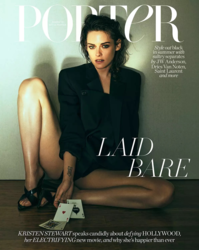


Click on images for full view.
She first shot to fame as a child actor, before solidifying her status on the global stage at the age of 18, in one of the highest-grossing movie franchises of all time – the Twilight Saga. Now 34, actor KRISTEN STEWART talks to BILLIE JD PORTER about her electrifying new movie, Love Lies Bleeding, defying Hollywood, and why she’s feeling happier than ever.
On a sun-drenched afternoon in Los Angeles, Kristen Stewart is winding down her latest press tour. We’re in her home office, nestled on a hillside in the Los Feliz neighborhood, overlooking far-reaching views of the city. After a whirlwind first quarter of 2024, this time marks the end of one chapter for Stewart, before her next is written.
Since premiering at the Sundance Film Festival at the beginning of the year, Love Lies Bleeding, the sophomore feature from writer-director Rose Glass, has gripped audiences and critics alike, due in large part to Stewart’s spellbinding portrayal of Lou – a seemingly nihilistic gym manager, whose world is turned upside down when she falls hard and fast for a female bodybuilder.
“I think we were shocked that we could even get this made,” she tells me, as we make our way to her back porch. “Because it's so weird. It’s violent and kind of irredeemable at times, but it makes you look; it’s scary. It’s confronting.”
To box the film into any one of the categories it’s been labeled thus far – action, thriller, romance, mystery, neo-noir – feels reductive. Glass has cited both Showgirls and Saturday Night Fever as influences, while one Letterboxd review calls it, “True Romance for the gays.” Somehow, Love Lies Bleeding invokes the spirit of all these legendary titles, yet is at once in a league of its own: a bold, genre-bending fever dream that oozes sex, vulnerability and surrealism simultaneously.
In amongst this chaos, Stewart’s performance strikes a delicate subtlety, that leaves you moved to tears in one moment, and laughter the next. “I kind of feel like, in the most dramatic moments of your life, it does get hilarious… It’s an odd mix of tones,” she says. “That’s why Rose is so fucking good. You’d think that would be clunky.”
There’s an almost childlike effervescence to the way Stewart speaks about working with Glass, becoming so animated at times that she lifts up from her seat, excitedly remarking at the filmmaker’s fearlessness, her character design, and her flat-out rejection of the “prescriptive bullshit” that many industry executives have come to expect from female-perspective art. “I’m so in awe of her… and it’s been really inspiring. But, at the same time I’m, like, Whew, I am so not there yet.”
Only time will tell. When we meet, Stewart is relishing the last two weeks of calm, before embarking on what is set to be a career-defining project of her own; directing her first feature. The film is based on The Chronology of Water – a piercing 2011 memoir by American writer Lidia Yuknavitch that explores her experiences of addiction, childhood sexual abuse, and ultimately finding both writing and competitive swimming as a means of catharsis.
“I’m in what they call, ‘soft prep’, which sounds kind of weird,” Stewart says. “It’s the dreamy place that you get to live in before you actually have your crew at your disposal.” To some degree, this soft prep has been in motion for over seven years. After gaining rights to the material, she first announced the project at the 2018 Cannes Film Festival, before going on to attach British actor Imogen Poots to play the lead. But the journey to bring the project into fruition hasn’t been easy; Stewart has been vocal about her plight in financing the picture as recently as this year, having stated in January that she would quit acting until she could get the film over the line.
“It’s kind of a self-conscious thing to talk about, because it’s hard to get anything made. You know, [a film] that’s not regurgitating something that’s pretty standardized,” she muses. “My movie is about incest and periods and a woman violently repossessing her voice and body, and it is, at times, hard to watch… but it’s gonna be a fucking thrill ride. And I think that’s commercial, but I don’t think that I have any gauge on what that means,” she laughs. “I think people would want to see that, but then… I think maybe people wanna watch movies about, like, Jesus and dogs.”
To bring her vision to life, Stewart is taking production for the film to Latvia – rather than in the movie-making bubble of her native Los Angeles, where she lives with her fiancée, the screenwriter Dylan Meyer. It’s a decision which she tells me is empowering her to have the freedom she needs for a truly explorative process. The small, northern-European country will be playing backdrop to scenes in New York, San Diego, Florida and the Pacific Northwest, spanning three decades of the story. “It’s a fledgling film culture there. Look, I’m all about the way we make movies here [in the US], but I needed a sort of radical detachment. I am not a director yet. I need to make a student film. I can’t do that here.”
There is a raw, self-effacing candor that emanates from Stewart – a multi-award-winning, Academy Award-nominated actor who has been in the entertainment industry since childhood, and who played the lead in one of the highest-grossing movie franchises in history. Despite her position in Hollywood – across acting, producing, and now directing – she speaks about the machine, that she is unarguably a part of, with a sense of distance and impossibly charming cynicism. As we dig into her decision to hold out as long as she has, to create the art she wants to, her passion for the material itself is clear, but there’s something deeper at play too. Her choices feel like a retaliation against an industry where artists, specifically women, are so often forced to compromise on their instincts to succeed.
“[There’s a] thinking that we can check these little boxes, and then do away with the patriarchy, and how we’re all made of it,” she considers. “It’s easy for them to be like, ‘Look what we’re doing. We’re making Maggie Gyllenhaal’s movie! We’re making Margot Robbie’s movie!’ And you’re like, OK, cool. You’ve chosen four… And I’m in awe of those women, I love those women [but] it feels phony. If we’re congratulating each other for broadening perspective, when we haven’t really done enough, then we stop broadening.”
Two days before we meet, Stewart rang in her 34th birthday, an occasion which she tells me she would not have ordinarily celebrated, if it wasn’t for the encouragement of her loved ones. (Meyer, her partner of five years, shared birthday wishes on Instagram, captioning a Polaroid of Stewart cross-legged on a bed and holding their cat, “I like really really love you and am wishing you a meteor shower of good stuff in the year to come.”) But there is a deep gratitude Stewart feels for this specific time in her life.
“I am very, very happy to be my exact age,” she states, contemplating the ways her creative priorities have shifted over time. “As an actor, I’m called upon to serve other people’s visions. You get greedy; it feels good to be called upon… even if you don’t love the thing. I think it’s nice that, as I’ve gotten older, I would much prefer to tailor my experiences to result-oriented goals, versus, just, ‘This is gonna feel good for me right now.’”
Her contentment also seems anchored in the knowledge that, while her experience as a woman in the public eye has been far from easy, it was a precursor to an era that is even more merciless. “Even if we’re still emotionally violent towards women right now, it’s so much more passive aggressive… [Before] it was just so fucking straight up.”
Stewart is shrewd to the fame game and has found ways to navigate the scrutiny. She’s conflicted about social media, on the one hand labeling it fake and performative. “But then I’m like, that is presumptuous and totally reductive because everything you’re seeing, you can see something true about it.” She only has a secret Instagram account that she keeps private and purely for “selfies with friends”.
But there are public-facing parts of the job she has come to enjoy. Her style in particular has evolved into a distinctively playful mix of casual-meets-luxury, bringing an effortless edge to red-carpet looks. “If [fashion] wasn’t part of the job, I would wear the same thing every day… and I wouldn’t know that part of myself, which is actually kind of fun.”
For the PORTER cover shoot, a few days before our meeting (incidentally, for Twilight fans, on the day of the solar eclipse), Stewart loved collaborating with the team and photographer Zoey Grossman to create a story that she wanted to break the mould. “I’m lucky to have done a lot of photo shoots… but it’s always in some chic, mid-century house, and you’re like, lounging fancily around some domestic environment. The whole idea [with these images] was that we wanted to make them all feel stretched. I just read this story about a housewife who realizes she’s a ghost, and I was like, ‘What if [we pretend] I’ve been in this photo shoot for a hundred years?’ I love working with Zoey. You can really try things and do wild shit.”
As we get ready to say goodbye, I’m struck by the unguardedness with which Stewart has spoken; with no publicist and a palpable aversion to the sycophancy that so many in the industry find themselves slaves to. “I’m embarrassed by anything inauthentic,” she laughs, “But then I’m like, what is ‘authentic’?” From where I’m sitting, it doesn’t seem like she needs to look much further.
Saturday, May 4, 2024
Tuesday, April 2, 2024
Audio: Kristen's podcast interview with Smartless
Saturday, March 30, 2024
Wednesday, March 27, 2024
Audio and Video: Kristen on the 'Not Skinny But Not Fat' Podcast
Apple Podcasts (below) Spotify (below)


Click on the images to listen to the podcast on your preferred platform.
OR
Wednesday, March 20, 2024
Kristen and Katy O"Brian on the cover of Them for 'Love Lies Bleeding'

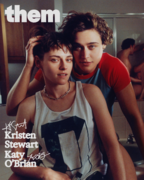


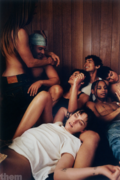
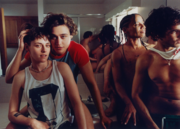
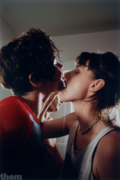

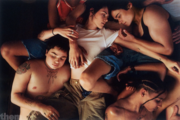
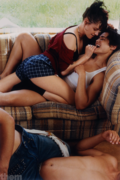
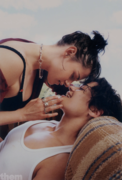
Untagged
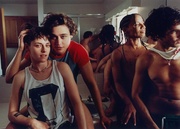
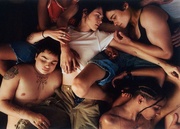
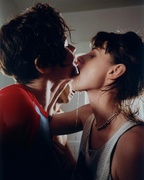
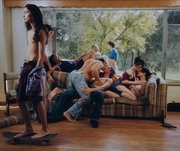
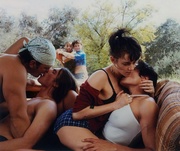

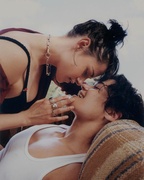
Click on photos for full view.
Inside Kristen Stewart and Katy O’Brian’s Sapphic Fever Dream on Steroids
The stars of Love Lies Bleeding are proving that lesbian film can be shocking, sexy, and strange.
BY WREN SANDERS
PHOTOGRAPHY BY LUKE GILFORD
One winter morning in Altadena, I follow the smell of sweat and the sounds of Kelela into the bedroom of a rented home, where a heap of queers tussle atop a satin-sheeted mattress. Amid the pile are four nonbinary models (names: Rae, Jay, Ray, and Raw), a couple who will spend the afternoon passionately making out, and, at its center, Kristen Stewart and Katy O’Brian — co-stars of A24’s thriller Love Lies Bleeding — gripping each other with sapphic warmth.
Shoots like these can be fun, but they’re almost never this fun — a sentiment that’s palpable on set, as giggles echo, limbs intertwine, and cover stars prance around in their boxers. Between the playful atmosphere and laid-back styling, Stewart is in her element, a welcome change for the longtime couture muse. “I’ve been wanting to do this photo shoot for the last 15 years,” she beams after wrapping the day.
We’re sitting on a ratty couch in the makeshift music studio of the Altadena home. A thick knob of palo santo burns on a nearby table strewn with discarded joints and empty bottles of Coors Light. Stewart wears a black Dickies bomber and cream-colored Carharts. Sunlight slants through the smoke as she reflects further on the shoot: “It feels a little bit like, duh, but in a way that’s nice and in no way scathing. In a way that [shows how] I have grown into a chiller, more mature place, where I’m not so pissed that this didn’t happen 15 years ago anymore.”
That the 33-year-old former child star would be eager to partake in such a gay tableau at this moment in her career makes sense; after decades of leading Hollywood juggernauts from Twilight to Charlie’s Angels, her recent projects have been defined by creative agency and unruly queer narratives. Today, audiences around the country can catch her as Lou, the elegantly mulleted manager of a seedy gym in Love Lies Bleeding, which opened in theaters nationwide on Friday. Also in the pipeline: the starring role in a genre-spanning portrait of critic Susan Sontag and an adaptation of Lidia Yuknavitch’s 2011 memoir The Chronology of Water, which will mark her feature directorial debut.
For fans who have been paying attention, Stewart’s upcoming slate is not some sudden swerve. From her work on 2014’s Still Alice to her Oscar-nominated take on Princess Diana in Pablo Larrain’s Spencer, she has long focused on independent cinema. That said, we’ve never seen anything from Stewart quite like Love Lies Bleeding. Sure, there were subtle ripples of queer desire pulsing through her part in Olivier Assayas’ Clouds of Sils Maria. And yes, she even played an out(ish) lesbian in Clea DuVall’s 2020 holiday rom-com, Happiest Season. But there’s a difference between being the “hidden vegetables” of a family-friendly movie designed to promote tolerance, as Stewart now sees the Hulu original, and being the controlling softbutch at the heart of a film that brazenly portrays some of the fucked-up shit real dykes go through.
“The identity was beaten out of my goals there,” she says of Happiest Season. “I was getting so many studio executive notes about my hair and my clothes. I was like, ‘You did read the script. You did hire me. What are we doing here?’ It was fucking annoying.”
She continues, “And it’s fine, because I guess there are ways that you need to shroud things for everyone to easily digest. And I’m down with that. And honestly, fucking hats off to Clea, because I don’t have the patience [to do] that.”
With her latest, there was no shrouding necessary. “It’s pretty fucking sick,” she says with a laugh.
If Love Lies Bleeding represents a kind of breakthrough performance for Stewart, the project represents a more traditional breakout for her co-star, Katy O’Brian, who auditioned for the role of Jackie — her first lead in a feature — after a fan DMed her the casting call on Twitter. “A gay bodybuilder from the Midwest,” read O’Brian, herself a gay former bodybuilder from the Midwest. I’ll die if I don’t get this part, she thought.
In person, the 35-year-old martial artist and Mandalorian actor appears every bit as powerful as Jackie, her biceps ready-made for TikTok thirst. Though unlike her character, whose pyrotechnic rage drives the film, O’Brian is goofy and unguarded — “a little dork,” to use her words.
While eating lunch at a small park in Beverly Hills, she relates her initial impression of the script: “Holy shit.” I can see her eyes widen through the chestnut glass of her aviators as she remembers that mixture of enthusiasm and terror. “I’m shaking as I’m reading,” O’Brian recalls. This is definitely going to be the most challenging role that I’ve ever played.
It would also be the most exciting. “Because [Jackie] was a full character with real stakes and real emotions,” she tells me. “And there were some [sex] scenes, too.”
There sure as hell were. In fact, those deftly realized sequences are part of why Love Lies Bleeding reflects a turning point not only in the careers of its lead actors, but also the landscape of modern sapphic cinema. Arriving at the end of an era almost comically saturated with a certain sort of lesbian narrative — that is, largely tepid, often white, and invariably antiquated — Rose Glass’ propulsive second feature embodies everything that films like these were not. It’s horny, it’s brash, and it’s invested in portraying contemporary queer relationships with all the telltale markings of tenderness and toxicity that make them legibly ours. Only rarely since the Wachowskis’ Bound have onscreen dykes made such a delicious mess. This was the plan all along, the director notes with a wry smile. “There are a lot of very tasteful lesbian period dramas out there,” she tells me over Zoom. “I knew I didn’t want to make that kind of film.”
What she did make is a sapphic fever dream on steroids, a lurid, gloriously gay romp starring a brawny soon-to-be heartthrob and the most recognizable queer actress of her generation.
What would you do for love? Would you run away from home? Would you fight? Would you kill? These questions have inspired scores of romantic thrillers. Lucky for us, Love Lies Bleeding adds some new prompts to the canon, namely: What would you do for sex so good it makes you feel reborn? So validating it replaces the loose ends of a rudderless life with sudden, undeniable purpose? How far would you go for a pious top who worships at your altar? For a switchy princess who makes you feel like a god?
Enter Kristen Stewart’s Lou and Katy O’Brian’s Jackie. Set in a nowhere southwestern town during Reagan’s America, Love Lies Bleeding is at once a revenge story and a refreshingly empathetic depiction of infatuation, one that treats the subject with curiosity rather than as a cautionary tale. Where other films might focus on the tragic consequences of romantic obsession, this one seeks to understand how two characters who barely know each other can take their love to murderous extremes.
“What I love about this movie is that the queerness isn’t the conflict,” says O’Brian. “It’s the type of film that I, as a queer person, would want to watch — to not have drama around my sexuality, and to just admire these two absolutely wacky individuals.”
Our protagonists collide early, when Jackie stops by Lou’s gym on her way to a competition in Vegas. The meeting reads easily as cosmic; time seems to slow as they flirt between the bench presses. For O’Brian, the moment evokes memories of her own first brush with queer attraction. “I had the same experience the first time I saw someone with that kind of androgynous look — someone who wasn’t worried about putting on all the stupid fucking makeup and stuff,” she tells me. “That was my awakening.”
Back in the gym, Jackie gamely pulls down her shorts, offering a cheek to fill with Romanian steroids. “Feel it already?” Lou grins after administering the injection. “Like Popeye and his spinach.” Soon the pair have made it to Lou’s apartment, where they stumble passionately toward a honey-lit bed. What follows is the first in a series of striking love scenes — energetic yet unhurried, earnestly erotic without tipping into sapphic pandering. “Compared to something like The Handmaiden, where you’re watching them go at it and screaming, this is a lot more intimate,” O’Brian observes.
Stewart agrees, noting that what makes the scenes hot is more than a granular attention to physical maneuvering. “It’s not about [showing] simulated sex on film,” she tells me. “I’m so embarrassed by that. I’m so sick of watching it. I’m so sick of doing it.”
The actor is far more interested in the sexual subtext and tacit dialog that fuel onscreen intimacy — “the ways that you let the person you’re with either take over or be consumed,” she explains. “Those were choices, and they were very articulate, yet nonverbal decisions that we made together. And without that dynamic, nobody would have cum. Literally, you could almost take the body out of it. You could tell me the right thing, and that’s what’s going to get me there. Tell me I am something to you. Tell me I can be taller than you, even though I’m 5’5”, and you’re fucking 5’10”, and I’m there.”
Jackie and Lou’s instant attraction is even more remarkable knowing the decidedly unsexy circumstances of their real-life counterparts’ first meeting. This was back in 2022, on a warm spring morning in Los Angeles. Stewart had already been cast and O’Brian was coming by for a chemistry read.
“I never thought I’d meet Kristen Stewart. Then I walked in, and she was just there. I was like, Huh, it’s Kristen Stewart. That’s cool,” O’Brian remembers. Not long after, while another potential Jackie was screaming in the other room, the newcomer decided to introduce herself. “I should just go talk to her and see what the vibe is… [see] if we can do this,” O’Brian tells me. “So I went up to her and said, ‘Hey, I’m Katy. I’m reading for Jackie. And Kristen is just like, No shit.”
So far, it doesn’t sound like the kind of interaction that translates naturally into licking each other’s armpits in front of a director, which at this point is less than an hour away. “I told her, ‘I had a super short drive here, but it felt long because my cat peed in my car, and I can’t get it out,’” O’Brian says. “And that’s how I met Kristen.”
When I ask Stewart about the encounter, she says the actors’ mismatched energies actually positioned them ideally for the roles they played. “The weird interpretations we had of our characters, and what might be happening in a given moment, they were never the same,” she explains. “It was perfect, because they’re obsessed with each other even while they’re [rarely] having the same conversation.”
Some two years and one six-month shoot later, the actors share space easily, at one point draping themselves around each other on a sun-drenched couch. During a break in photography, I pull up a seat. We’re chatting about astrology when O’Brian excavates a frayed notebook from between the cushions. I gulp, noticing the familiar coffee-stained pages. That’s my journal, I tell her, sheepishly.
“Can I take a look?” she grins, aware of how audacious the request is, and yet charmingly unbothered.
“Sure.”
Stewart watches quietly from the other side of the sofa as O’Brian flips, stops, then slowly reads aloud, “Good girl.”
I glance around nervously, flustered by the sudden intimacy. “A line from your movie,” I croak.
Stewart brightens, quickly recognizing the moment — one in which Lou oozes approval as Jackie touches herself. “There’s nothing better than that feeling,” she exclaims, projecting herself into O’Brian’s character. “Tell me I’m doing a good job; God, I’ll do anything.”
Later, Stewart elaborates on the potency that sexual narratives carry: “We’re all in our heads, it’s all fantasy. That doesn’t mean it’s a lie, but we need to believe the stories we hear about ourselves in order to then reckon with a body, put it out in the world, and allow it to be touched in the way you’ve decided feels good.”
The thing is, sometimes the stories we tell to turn ourselves on leave us with pieces missing when morning comes. Jackie and Lou learn this the hard way. About halfway through the film, after a night of bitter fighting and transcendent sex, our lovers wake up to a brutal twist, sending them down a bloody path of retribution.
Contrasting countless timid movies about unrequited yearning, Love Lies Bleeding actually lets its dykes fuck around and find out, subverting what it even means to be a “lesbian” film. “To imply that ‘our’ experience can be in a genre of its own is dangerous. I don’t want to perpetuate that,” says Stewart. “We have so much unearthing to do — so much unabashed self-exploration and self-touch. We need to touch base, dude. It’s the only way to tell stories: from the inside.”
Amid the beauty and chaos of rippling muscles and exploding cars, Glass finds subtle ways to continue the sapphic coding. Notably, as O’Brian points out, Lou pulls up to a crime scene in a curiously specific get-up. “She puts on her murder outfit,” the actor giggles. “She’s got this red jumpsuit with short sleeves. It’s stylish, but a murder cleanup outfit? It’s hilarious.” (I guess if we can have farmers market chic, we can have the perfect little fit to dispose of a dead body.)
In truth, Jackie’s just getting started. Yet even as the film descends deeper into violence, it still traces the textures of codependence woven through relationships we can actually recognize. Yes, the stakes have been played up for dramatic effect. But who among us hasn’t chased the promise of love into the jaws of infatuation?
Back in Altadena, Kristen and I are talking about blood. Specifically, she’s describing the sensory inspiration for her upcoming adaptation of The Chronology of Water, Lidia Yuknavitch’s stunning exploration of grief, kink, and adolescent ambition.
“I love the book. I love how it’s written — I can smell it. I can feel it pulsing, I can feel it leaking, and that needs to be seen,” she tells me. “The first shot in the movie is just blood seeping out of the body.”
Real blood, the director adds, then wonders aloud: “Do I get her to fill a DivaCup, or do I get a vial of blood from a vein? It needs to be chunky.”
She’s talking about Imogen Poots, who’s set to star in the film. “I’m going to get her blood and my own probably,” Stewart muses.
Using her own body isn’t the only way she seeks to bring herself to the adaptation. In addition to Poots, Stewart sees the rest of the cast being filled out with fellow former child stars — “people that we missed, women that just stopped getting hired because they weren’t ‘the girl’ anymore.”
“Not to say they’re not still around,” she clarifies. “But I want to give really fucking great parts to the people I looked up to when I was little. I want to put [them] in movies.”
For Stewart, stepping behind the camera is a natural transition; after feeling constricted on past sets, she craves creative flow. “Working with a bad director feels like breathing through a straw, like any truth or room to be seen is stifled,” she says. “I feel like I have nowhere else to go. I have to make a movie.”
As the final rays of the afternoon sun fill the room with amber light, our conversation turns to chemistry — the kind that brings people together, that turns us on, that inspires us to grow. I’m thinking specifically of a passage from The Chronology of Water. Opening again the journal O’Brian pulled from the couch cushions, I begin to read: “You will see that you have an underlying tone and plot to your life underneath-”
“-the story that you’ve been told,” Stewart continues, from memory. “Who would have thought of it but you — your ability to metamorphose like organic material in contact with changing elements.”
Many actors wish to be seen as the Platonic ideal of themselves, wax sculptures in the public eye; Stewart is seeking something different: the space to be mutable, to resist the confines of calcified industry expectation. “In a word I’m fucking liquid, man,” she says. It follows that this freedom would lead her to Yuknavitch, whose memoir finds beauty in “repossessing pain, repossessing bad experience, and repossessing narrative.”
“Retelling story is so necessary for survival for anyone who’s had to change the path where they were put,” she continues. “You know what I mean?”
I nod, then ask, “You’re talking about yourself a little bit, right?”
“Absolutely,” she confirms after a pause. “I don’t know who else I’d be talking about.”
Monday, March 18, 2024



Saturday, March 16, 2024
Friday, March 15, 2024
Rose Glass and Katy O'Brian talk to British Vogue for 'Love Lies Bleeding' and mentions Kristen

Where did this audacious story come from?
Rose Glass: After Saint Maud – and maybe in response to its “women looking elegant in plush-curtained houses”, theatrical kind of feel – I wanted to challenge myself and do something more visceral. I’ve always enjoyed body horror and quite violent films. It wasn’t, like, a full story I’d had in my head for a long time. A lot of the writing process felt spontaneous and slightly experimental. The initial spark was wanting to tell something about a female bodybuilder because it seemed like both visually and psychologically interesting territory. I’m very obviously not a bodybuilder and probably incredibly physically frail and pathetic and weedy. So I find it impressive and fascinating, the psychology it must take to be a bodybuilder.
Why a bodybuilder instead of another kind of athlete?
Glass: I’d seen photos from the ’40s or ’50s, before bodybuilding was a competitive sport, at least for women. At that point, strong women were more of a sideshow attraction. These women had amazing ’50s pin-curl hair-dos and incredible muscular physiques, and the visual juxtaposition was intriguing to me. The more I found out about it, the more it seemed like this slightly anarchic but beautiful, strange sport, which is as much a performance art as a sport. It’s an aesthetic sport. So I wondered about the psychology it takes to do something like that, how that can either clash with or spill over into other elements of their life. And falling in love seemed like an appropriately derailing kind of chaos to throw somebody into when they’re otherwise very driven and focused.
Katy, you’ve competed in bodybuilding. Was Rose’s vision of that world accurate to you?
Katy O’Brian: At least with the people I know, there’s certainly less murder. [Laughs.] It takes focus and discipline and can be obsessive. You have a weird relationship with food, where you’re counting and weighing calories. And it can be isolating because you can’t go out and enjoy a meal with your friends – you have to stick to your routine. I’m a live-by-moderation type of person, but I know a lot of people who had liver or kidney failure.
Did you connect with Jackie on a personal level?
O’Brian: We’re both from the Midwest, and it’s still weird being a bodybuilder there. CrossFit has helped because it’s such a sensation and everybody’s getting bigger. But even recently someone there came up to me on the street and just touched my muscles. Female bodybuilding started out as a circus attraction, and I guess it still feels unnatural to some people, especially in a place that’s more conservative.
Bodybuilding is something Jackie loves, and it makes her feel safe, but a lot of people reject that – it’s more like she’s doing this freaky thing to her body. In acting, I’ve been told I’m too big for roles that are literally asking for bodybuilders or I get a butch characterisation because they don’t feel like muscles are feminine.
What were some of the film’s references?
Glass: I suggested people should watch David Cronenberg’s Crash, Showgirls, and Saturday Night Fever, and the tiny Venn-diagram crossover was the cinematic universe the film might take place in – dark, melodramatic, sexy films. I tried to avoid watching the more Americana cornerstones of Thelma & Louise and Wild at Heart until after we’d made it so I didn’t get too referential.
Why set the film in the 1980s? Could it have taken place today?
Glass: One of the main reasons for putting it in the past was wanting it to be pre-internet or pre-social media. What I liked about doing it before everyone became so connected is that it heightens the fact that both Lou and Jackie are misfits and alone. They’re both from different small towns, very isolated, and haven’t found their people because they’re not physically around them. So when the two cross paths, there’s recognition there.
The year 1989 was right before anabolic steroids became illegal, so in the film there’s a naivete to how they’re being handled. And this excess of the ’80s and more, bigger just before the ’90s, when everyone becomes more nihilistic – I thought Jackie’s the ’80s and Lou’s the ’90s, a love story between a romantic and a cynic.
Katy, you’re an accomplished martial artist, and one of the leads of True Detective: Night Country, Kali Reis, is a former pro boxer. Is there something about this moment that’s particularly primed for depictions of complex women whose physical strength is also foregrounded?
O’Brian: Hollywood has made a big push to be more supportive of female writers and directors. These aren’t things that are weird to us – a lot of women box, go to the gym, work out.
Glass: The way that both Katy and Kristen appear in this film shouldn’t be radical. There are many women who look like both these characters. How people are responding to seeing them as main characters versus how unextraordinary it is in real life – the fact that’s such a stark contrast just highlights the homogeneity that, as everyone’s well aware, has been present in films for a long time.
The film also has a real playfulness and sexiness in its depiction of desire, even amid all the menace and violence.
Glass: There’s a lot of queer films in particular, and a certain type of tasteful period lesbian film, where all the looking is done very secretly and with longing in a sense of forbiddenness. So I enjoyed that here they’re both more horny and blatant. When Lou sees Jackie across the gym, if I’m referencing anything there, it’s the bit in The Mask where Jim Carrey sees Cameron Diaz across the bank. It was fun to lean into the silliness.
Rose Glass talks to People about 'Love Lies Bleeding' and mentions Kristen

Kristen Stewart has a "dorky" side that shined through on the set of Love Lies Bleeding.
Director Rose Glass tells PEOPLE that the Twilight alum, 33, has a "good sense of humor" and is "kind of dorky in a really lovely way."
"Considering how super famous she is and considering the sort of surreal, strange life she must have had, she's about as grounded and cool a person as you could be, given all that," says Glass, who co-wrote the film with Weronika Tofilska.
"She's very focused and unpretentious and just good fun," the Saint Maud filmmaker adds.
In Love Lies Bleeding, Oscar nominee Stewart plays Lou, a gym manager in the 1980s who keeps mostly to herself until she falls for a bodybuilder (Jackie, played by Katy O'Brian) who's new to town.
The pair get tangled up in crimes connected to Lou's estranged father, Lou Sr. (Ed Harris), that tests their love and commitment for each other. The cast also includes Dave Franco and Jena Malone.
O'Brian says she found costar Stewart to be "laid back" and "freaking stoked" about the project, which filmed in New Mexico.
"I feel like unless you've lived under a rock, you know who Kristen Stewart is, so I knew who she was," says the Ant-Man and the Wasp: Quantumania actress. "In general, you never know how someone who's been in the limelight for so long is going to behave — will there be diva moments or whatever? She just kind of kept to herself and was just really laid back."
"What excited me the most, and surprised me the most, was how excited she was for this project," says O'Brian. "When someone's been doing this for 20-plus years and is still really excited and passionate about something, that gives me hope for the next 10-plus years that I hopefully get to be in the business."
She added, "That was refreshing and fun and cool."
'Love Lies Bleeding' interview with Cosmopolitan

Rose, you always had Kristen in mind for the role of Lou. What did it take to convince her to do the movie?
RG: Luckily she saw Saint Maud and really liked it. Now that we're doing press for this film, she's said I could have offered her anything and she would have done it, which is nice. I met her when she came to London to promote Spencer and we had what I thought was a really bad meeting, I thought I came across very badly and got unexpectedly really starstruck and tongue tied. But anyway, she was up for it.
Katy, I read you heard about the part of Jackie because a friend tagged you in something on Instagram. When you actually got your hands on the script, what were your first reactions?
KO: I got my hands on the script after my first audition. So I didn't know anything really in that first audition except that it's this queer Midwestern girl going for a bodybuilding competition, and I was like, well, that's me, so I'm just gonna do me. Then when I when I finally read the script, I was terrified. Jackie goes through a lot. She does a lot of shitty things in this movie. I've not done scenes this violent before. I haven't done scenes as intimate before, but also I haven't had scenes that are so fucking embarrassing. I was like, Okay, I have to do this project. This is the thing that's either going to help me as an actor or tell me I don't want to do this anymore.
How did you both know the pairing of Katy and Kristen would work?
RG: They met for the first time when we did the chemistry reads. We saw a couple of other people read with Kristen, but the thing that clinched it was seeing the two of them together and just being like, Oh, you can really see something there. The chemistry thing is so unquantifiable. There has to be this extra spark of something.
KO: We're both such awkward people that we could work as our characters and people are like, Oh my god, this is amazing. You must be like, so tight. And then offset we're like, so, um, how are you today? We're just like really awkward people. It was fun to see her process and the way that she builds up her energy and nervousness. She has to really physically manifest that, running around jumping up and down and getting into that moment, she gets really anxious and she stays in that elevated state.
RG: They both really embody the yin and yang of the characters. Katy's incredibly strong and powerful and Kristen's the weak, frail one. But Katy brings this really important softness and vulnerability and sweetness to Jackie. Kristen brings a real hard, moody antihero kind of vibe. It's a very complimentary couple.
Katy, what was your favorite moment working together?
KO: There's a scene where Kristen and I push a car off a cliff, but our stunt doubles did that. They were like, it's not safe, and we were like, we want to push that car off a cliff. But Kristen got throw real Molotov cocktails off of the ridge. So the car is already on fire from below. And then Kristen throws a Molotov cocktail over, so it explodes. And we feel the explosion from the top of this ridge. Those reactions are genuine. We were not expecting that much fire to come back up.
And luckily for this role, you're already someone who is absolutely shredded. But what further prep did you have to do?
KO: I was given two weeks notice that I booked the project, so they hooked me up with my trainer two weeks beforehand. I was grateful I already had the muscle because then we were in the cutting phase. I tend to do bodybuilding workouts year round anyway, but not as intense. So in reality, if you're going to be competitive, you have to think of it as like a year-round thing. You're eating to grow muscle in the offseason. And then you're very slowly cutting fat. My trainer is really good at training people for film. So he knows okay, this is the muscle that a camera is gonna see better, so he really knows how to train you for the camera lens. And it's different than training for stage. So he was able to do some cool things with my muscles to make them pop on camera.
A lot of people are praising this movie for how horny it is, but I want to dig into that a little deeper. Rose, how much does that factor into your process when writing the script? Did you want to write a "horny" movie?
RG: I knew I wanted to make something sweaty and violent. So the sweat came first and the visceral bodyness. But then very quickly in writing it me and Weronika Tofilska, my writing partner, decided it should be a love story. If you've got sweaty, muscle-y, greasy people taking a bunch of drugs and falling in love, probably they're gonna have some interesting, fun sex as well.
What was it like for both of you to work with an intimacy coordinator, both in front of and behind the camera?
RG: I was a little apprehensive that it would feel like somebody else was taking over, but it's kind of like working with a stunt coordinator. You try to be as specific as you can in writing the scenes, like, hand goes here, head goes there. I talk with the intimacy coordinator about each scene and clarify with them exactly how I'm thinking of shooting it. And then she basically has separate meetings with both the actors and they have a chance to voice any concerns. So by the time you get on set, everybody knows exactly what is and what isn't going to be happening. Then they kind of take a backseat and it almost feels like you have a motherly school teacher sort of vibe, in a nice way, checking in.
KO: I loved it. They're like, don't hesitate to pull me aside and be like, I'm not comfortable with this. But we were doing some intimate scenes in 100 degree weather. So when we were pulling each other's pants off, we had some kind of cover, like fake underwear, and they taped that down. And then they put another layer on and they taped that down, and then they put a cut out yoga mat on top of me and they taped that down. But everyone was very collaborative and making sure that everyone was comfortable. I wanted to make sure Kristen knew I wasn't trying to take advantage of her. She wanted to make sure that I didn't feel taken advantage of.
Where do you both think Jackie and Lou end up after the credits roll?
KO: The realistic side of me is like, well, they get arrested eventually, they get extradited back to New Mexico and they go to jail for murder and all the things. But the movie side is like okay, so they go out to California and try to start anew, and I think they would eventually get over each other. I kind of hope they don't stay together because they're not good for each other. Maybe they'll go to California and murder more people and that can be Love Lies Bleeding Part Two. But whatever the end is, I hope the cat is fine.
RG: Short term, I think it's going to be great and continue to be a lot of fun. Maybe they'll get to the next bodybuilding competition. I'm not sure how highly I rate their long term prospects, but you never know. It's what they both needed at that point. So long as Jackie continues bodybuilding, and Lou doesn't really have a huge amount of purpose beyond getting out of this town, she'll continue to latch herself on to Jackie too much. At one point were like, maybe maybe Lou should go and become a slightly manipulative manager, but I don't want to write a sequel just yet.
Subscribe to:
Posts (Atom)