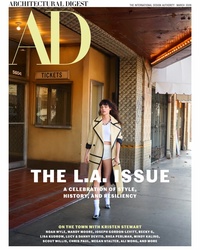
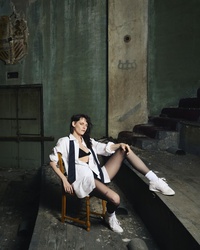
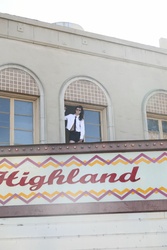
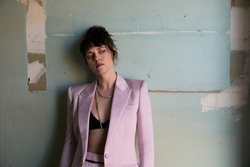
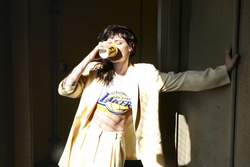
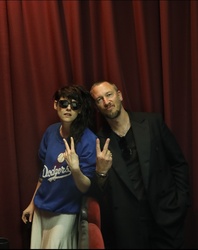
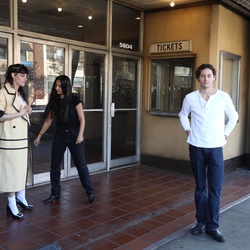
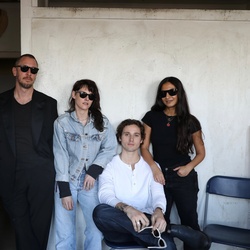
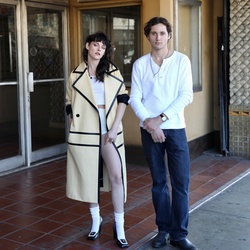
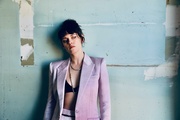
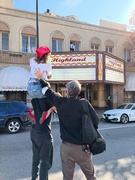
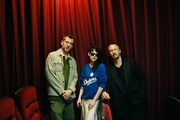
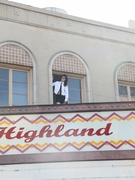
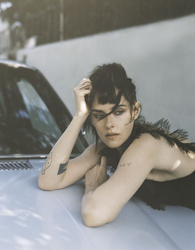
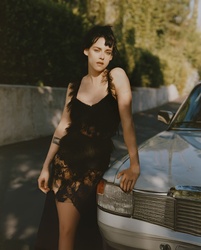
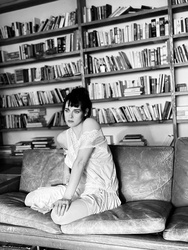
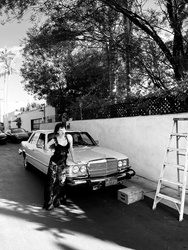
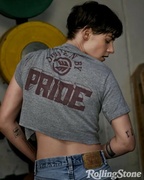
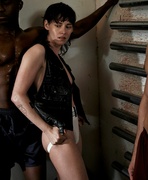
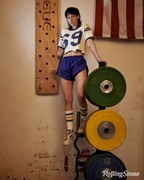
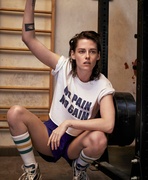
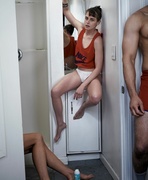
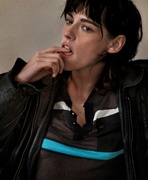
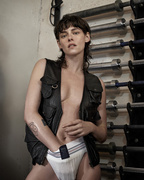
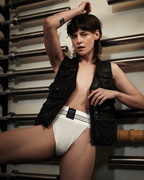
“Making films is a political act,” says actor-director Kristen Stewart. “You have to decide how you want to wield your presence and your voice.” These days she is making hers heard at Highland Theatre—the 1925 Highland Park movie palace and onetime vaudeville performance space, designed by noted architect Lewis Arthur Smith, whose resume also includes the Vista theater in Los Feliz, the El Portal in North Hollywood, and the Rialto in Pasadena, all from the mid-1920s. Stewart recently purchased the noble yet dilapidated building, which closed its doors and dimmed its marquee in 2024.
“I didn’t realize I was looking for a theater until this place came to my attention. Then it was like a gunshot went off and the race was on. I ran toward it with everything I had,” she recalls. “I’m fascinated by broken-down old theaters. I always want to see what mysteries they hold.”
Stewart’s vision for the Highland goes beyond a straightforward restoration. “It’s an opportunity to make a space to gather and scheme and dream together. This project is about creating a new school and restructuring our processes, finding a better way forward. We want to make it a family affair, something for the community. It's not just for pretentious Hollywood cinephiles,” she explains. “I see it as an antidote to all the corporate bullshit, a place that takes movie culture away from just buying and selling. I think there’s a huge desire and craving for what this kind of space can offer.”
The original bones of the theater, including an extraordinary mezzanine and stage, remain partially intact, but the resurrection of the space will require a herculean effort. Nevertheless, Stewart is determined to recapture the glamour of Hollywood’s Golden Age while positing a new kind of social cinema experience: “There are so many beautiful details that need to be restored. I think there’s a way to bring the building back to life in a way that embraces its history but also brings something new to the neighborhood and something new to the whole LA film community. That’s the point—new ideas.”
A native Angeleno, Stewart grew up in the San Fernando Valley and moved to LA’s Eastside when she was 20. “I absolutely f**king love this city,” she insists. “There’s a kind of unified dissonance because it’s not really a city as much as a cluster of neighborhoods, but there’s unity in that. I like the spaciousness. You can decide how you want to fill it.” Asked if she’d ever consider abandoning Tinseltown for the mean streets of New York City, the actor demurs. “LA gets a bad rap for being unserious, but there’s so much art and culture here. I find something a little heavy about the East Coast. When I come back to LA, I can breathe.”
Still, Stewart has no illusions about the problems facing Los Angeles and indeed most major cities in our country. She is indefatigable in her championing of the Downtown Women’s Center, an organization founded in 1978 that was the first in the U.S. to provide permanent supportive housing to homeless women—a mission it continues to pursue to this day, in addition to a health clinic that exclusively serves women in LA’s Skid Row community and a drop-in day center, where women can receive three daily meals and access to showers, restrooms, mail, laundry, and telephones. “LA is drowning in inadequacy in our response to homelessness. The city is at odds with itself,” Stewart laments. “There has to be a way to unearth a tender, empathetic approach to getting people off the streets. I wanted to align myself with an organization and people who’ve been doing this work for decades at a grass roots level. Amy [Turk, Chief Executive Officer of DWC] spends every waking hour helping these women. I’ll do anything for her.”
Reflecting on the future of the Highland Theatre, the film industry, and the city at large, Stewart remains optimistic yet emphatic: “The narrow path that’s been forged has to be broadened, not by tokenized diversity but by doing things really differently. We can’t keep making the same movie over and over again. And we can’t turn our backs on the people who are most in need.”
Olivier Assayas didn’t read the screenplay for Kristen Stewart’s directorial debut, but he would have greenlit the project immediately.
“This is the movie of someone who needs badly to make a movie,” he tells Stewart over Zoom one morning in November. Assayas, who directed the 35-year-old actor-turned-filmmaker in 2014’s Clouds of Sils Maria and 2016’s Personal Shopper, knows a thing or two about a film made on one’s own terms at all costs. For Disorder, his own 1986 feature debut, he was offered the crew of the monumental French director Alain Resnais. Assayas turned the opportunity down, opting to continue working with his far less seasoned peers. “The foundational decision I made in filmmaking,” he continues, “was not to go the safe route.”
With The Chronology of Water, an adaptation of championship swimmer Lidia Yuknavitch’s memoir of the same name, Stewart demonstrates the safe route is of no interest to her either. The Imogen Poots-led deep dive into the long shelf life of trauma refuses linear narrative or easy viewing. The reviews it received out of Cannes, where it premiered in May, testify to Stewart’s ability to successfully helm an unconventional project. American audiences will see for themselves when the film arrives in theaters Dec. 5, but Stewart has already proved her mettle to the audience member she cares about most—herself. The Chronology of Water spent almost a decade in development limbo, a period during which the actor became well acquainted with rejection. “Every producer in town was like, ‘So what’s it about? A swimmer who gets raped by her father?’” she tells Assayas. “That’s just a hard no.”
It’s telling that it was a little-known indie distributor, the Forge, that picked up the American rights for the film, reaffirming for Stewart that Hollywood is no petri dish for independent cinema these days. “You have to leave this country to do that,” she insists.
But Stewart isn’t done with the industry just yet. Next year, she’ll star in her wife Dylan Meyer’s directorial debut, The Wrong Girls, opposite Alia Shawkat. The film will be her first comedy, proof that even someone who has been a fixture onscreen since the age of 9 can still surprise us. She’ll follow that performance with her first TV series, The Challenger, where she plays a member of NASA’s first diversified class of astronauts in 1978. Also in the queue is Full Phil, where Stewart acts as Woody Harrelson’s estranged daughter on a Paris trip gone awry.
For this Artists on Artists issue cover story with Assayas, she sifts through the victories, obstacles, and lessons of a life spent on the screen.
Olivier Assayas: I can see the notes for your film on the wall behind you. Do you function like that?
Kristen Stewart: Well, I’ve only functioned once in my life, this being my first [directorial] project. It was necessary to see the movie as a body, because some of the fractured memories in the story needed to find a different circuitry.
Assayas: You are disturbing the logic of how a film has to be made because you have an intuitive knowledge of what it is, of what it should be. This film is adapted from a book you love, which is an excellent starting point. At the same time, it’s a self-portrait. I think it’s very close to the bone.
Stewart: I just wanted to be the person who got the ball rolling. I’m a really good follower. I’m such a faithful soldier, but it’s really fun to lead the charge. I thought this book really lent itself to adaptation because it lacks any kind of structure that makes it easy to digest or palatable. I was like, This feels so much more like a whole life, a DMT trip, or a dreamy recollection. This is a film about one person—but that doesn’t mean it was easy to make. We draw ourselves every single day. Sometimes that self-portrait’s hideous, disgusting, self-hating, lacerating. Other times, it’s cool. To attempt to say something true about yourself or a character is such a slippy, squirrely thing. Making movies is inherently embarrassing because it’s egotistical.
Assayas: I see it as a privilege. It’s about understanding the world in ways that are not open to everybody. You have to be constantly aware of that, and you must be up to the task.
Stewart: Which is why women don’t normally do it—we are not trained to accept that. It’s not our first instinct to fill that role. It’s audacious. That’s what the book’s about, too—her finding her voice. If it feels like a self-portrait it’s because, look, I’m 35 years old. I’ve wanted to make movies since I was 9. Why the fuck did it take me so long?
Assayas: Ultimately, it was an epic. It was a fight. It was a war. And you won the war.
Stewart: It’s just a way of relating to reality. It’s not fundable entertainment industry fare. The script was very hard to read. I guess now that I’ve done it—not to sound too dramatic or self-aggrandizing, but against all odds—there is the feeling that execution is inevitable. I’m not gonna sit around and wait for someone to pay for my movies ever again. I’ll just do them for fucking nothing. I will steal them. I will not wait another eight years to make a movie. I will just operate in Europe in complete liberated isolation, and then hope that some American distributor will buy it after we make it. Independent cinema in America is a farce. People are going to fucking quote that all over the Internet, but it’s true. I apparently make independent movies, and it’s like, barely.
Assayas: I wrote to you after watching the film. I was just so happy for you because I felt that you had the fight of your life and you won. It reminded me of how I started making movies. My first screenplay was not as abstract as the movie you made, but it was daring for the times. I remember a producer who told me, “You know what? I’m producing a film by Alain Resnais, the famous French filmmaker, and I’ll give you the crew. You will have an experienced crew that will guide you.” I wanted to make that movie with the guys I’d been working with when I made my short films, who were my age, who shared my taste. The foundational decision I made as a filmmaker was not to go with the seasoned professionals, but to trust the kids I’d started with. Sometimes, a film crew can be like a punk band.
Stewart: I’ve seen you talk about that first movie, and it genuinely encouraged me to avoid “studio musician” engineers that have been suggested to me. The times when the movie found itself about to fall apart were when people who were overly experienced were sinking the ship, and they needed to be removed. Our producers were not confident, thrilled, or happy with me at all.
Assayas: When you want to break the mold, when you want to make movies that open doors for yourself and for other people, it’s going to be tough. No one understands where you’re heading—not because you are so far ahead, but because you are somewhere else. What do you think art can do?
Stewart: It can make the world a much bigger or smaller place. We make art to get closer to each other, but at the same time, when you make really good art, the vacuous spaces that you find yourself inhabiting as an actual human become immense. What can art do? I don’t know. Keep a lot of people from offing themselves?
Assayas: I think art is a disease. You’re born with it, you know? I need to have my back to the wall to be able to make anything, because it comes from insecurities. When you’re acting, writing, or directing—there is pain. You deal with the pain, and art is the result. You also have to protect it—from the industry, from the boredom of modern droning. Movies are living proof that at least there’s one kind of art that can reach the mainstream. I started as a painter, a clumsy painter, but a painter. I dropped the idea of being a painter because I knew I would never connect with my times, whereas the power of movies is the fact that you can communicate with more people. Art is about proving that it can be done.
You can purchase a copy of the Artists on Artists issue, featuring this conversation and many more, here.
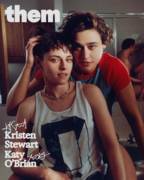
Inside Kristen Stewart and Katy O’Brian’s Sapphic Fever Dream on Steroids
The stars of Love Lies Bleeding are proving that lesbian film can be shocking, sexy, and strange.
BY WREN SANDERS
PHOTOGRAPHY BY LUKE GILFORD
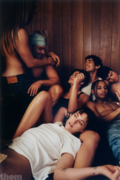
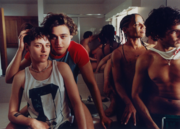
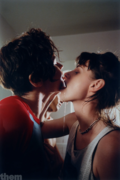
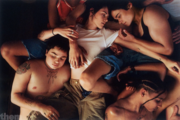
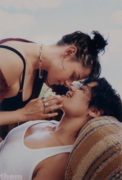
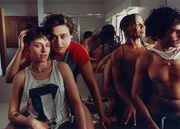
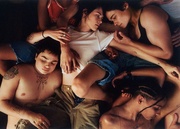
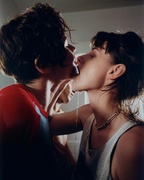
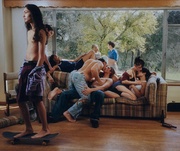
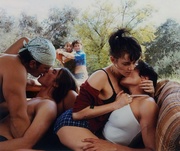
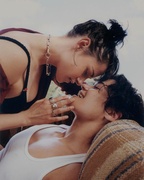
One winter morning in Altadena, I follow the smell of sweat and the sounds of Kelela into the bedroom of a rented home, where a heap of queers tussle atop a satin-sheeted mattress. Amid the pile are four nonbinary models (names: Rae, Jay, Ray, and Raw), a couple who will spend the afternoon passionately making out, and, at its center, Kristen Stewart and Katy O’Brian — co-stars of A24’s thriller Love Lies Bleeding — gripping each other with sapphic warmth.
Shoots like these can be fun, but they’re almost never this fun — a sentiment that’s palpable on set, as giggles echo, limbs intertwine, and cover stars prance around in their boxers. Between the playful atmosphere and laid-back styling, Stewart is in her element, a welcome change for the longtime couture muse. “I’ve been wanting to do this photo shoot for the last 15 years,” she beams after wrapping the day.
We’re sitting on a ratty couch in the makeshift music studio of the Altadena home. A thick knob of palo santo burns on a nearby table strewn with discarded joints and empty bottles of Coors Light. Stewart wears a black Dickies bomber and cream-colored Carharts. Sunlight slants through the smoke as she reflects further on the shoot: “It feels a little bit like, duh, but in a way that’s nice and in no way scathing. In a way that [shows how] I have grown into a chiller, more mature place, where I’m not so pissed that this didn’t happen 15 years ago anymore.”
That the 33-year-old former child star would be eager to partake in such a gay tableau at this moment in her career makes sense; after decades of leading Hollywood juggernauts from Twilight to Charlie’s Angels, her recent projects have been defined by creative agency and unruly queer narratives. Today, audiences around the country can catch her as Lou, the elegantly mulleted manager of a seedy gym in Love Lies Bleeding, which opened in theaters nationwide on Friday. Also in the pipeline: the starring role in a genre-spanning portrait of critic Susan Sontag and an adaptation of Lidia Yuknavitch’s 2011 memoir The Chronology of Water, which will mark her feature directorial debut.
For fans who have been paying attention, Stewart’s upcoming slate is not some sudden swerve. From her work on 2014’s Still Alice to her Oscar-nominated take on Princess Diana in Pablo Larrain’s Spencer, she has long focused on independent cinema. That said, we’ve never seen anything from Stewart quite like Love Lies Bleeding. Sure, there were subtle ripples of queer desire pulsing through her part in Olivier Assayas’ Clouds of Sils Maria. And yes, she even played an out(ish) lesbian in Clea DuVall’s 2020 holiday rom-com, Happiest Season. But there’s a difference between being the “hidden vegetables” of a family-friendly movie designed to promote tolerance, as Stewart now sees the Hulu original, and being the controlling softbutch at the heart of a film that brazenly portrays some of the fucked-up shit real dykes go through.
“The identity was beaten out of my goals there,” she says of Happiest Season. “I was getting so many studio executive notes about my hair and my clothes. I was like, ‘You did read the script. You did hire me. What are we doing here?’ It was fucking annoying.”
She continues, “And it’s fine, because I guess there are ways that you need to shroud things for everyone to easily digest. And I’m down with that. And honestly, fucking hats off to Clea, because I don’t have the patience [to do] that.”
With her latest, there was no shrouding necessary. “It’s pretty fucking sick,” she says with a laugh.
If Love Lies Bleeding represents a kind of breakthrough performance for Stewart, the project represents a more traditional breakout for her co-star, Katy O’Brian, who auditioned for the role of Jackie — her first lead in a feature — after a fan DMed her the casting call on Twitter. “A gay bodybuilder from the Midwest,” read O’Brian, herself a gay former bodybuilder from the Midwest. I’ll die if I don’t get this part, she thought.
In person, the 35-year-old martial artist and Mandalorian actor appears every bit as powerful as Jackie, her biceps ready-made for TikTok thirst. Though unlike her character, whose pyrotechnic rage drives the film, O’Brian is goofy and unguarded — “a little dork,” to use her words.
While eating lunch at a small park in Beverly Hills, she relates her initial impression of the script: “Holy shit.” I can see her eyes widen through the chestnut glass of her aviators as she remembers that mixture of enthusiasm and terror. “I’m shaking as I’m reading,” O’Brian recalls. This is definitely going to be the most challenging role that I’ve ever played.
It would also be the most exciting. “Because [Jackie] was a full character with real stakes and real emotions,” she tells me. “And there were some [sex] scenes, too.”
There sure as hell were. In fact, those deftly realized sequences are part of why Love Lies Bleeding reflects a turning point not only in the careers of its lead actors, but also the landscape of modern sapphic cinema. Arriving at the end of an era almost comically saturated with a certain sort of lesbian narrative — that is, largely tepid, often white, and invariably antiquated — Rose Glass’ propulsive second feature embodies everything that films like these were not. It’s horny, it’s brash, and it’s invested in portraying contemporary queer relationships with all the telltale markings of tenderness and toxicity that make them legibly ours. Only rarely since the Wachowskis’ Bound have onscreen dykes made such a delicious mess. This was the plan all along, the director notes with a wry smile. “There are a lot of very tasteful lesbian period dramas out there,” she tells me over Zoom. “I knew I didn’t want to make that kind of film.”
What she did make is a sapphic fever dream on steroids, a lurid, gloriously gay romp starring a brawny soon-to-be heartthrob and the most recognizable queer actress of her generation.
What would you do for love? Would you run away from home? Would you fight? Would you kill? These questions have inspired scores of romantic thrillers. Lucky for us, Love Lies Bleeding adds some new prompts to the canon, namely: What would you do for sex so good it makes you feel reborn? So validating it replaces the loose ends of a rudderless life with sudden, undeniable purpose? How far would you go for a pious top who worships at your altar? For a switchy princess who makes you feel like a god?
Enter Kristen Stewart’s Lou and Katy O’Brian’s Jackie. Set in a nowhere southwestern town during Reagan’s America, Love Lies Bleeding is at once a revenge story and a refreshingly empathetic depiction of infatuation, one that treats the subject with curiosity rather than as a cautionary tale. Where other films might focus on the tragic consequences of romantic obsession, this one seeks to understand how two characters who barely know each other can take their love to murderous extremes.
“What I love about this movie is that the queerness isn’t the conflict,” says O’Brian. “It’s the type of film that I, as a queer person, would want to watch — to not have drama around my sexuality, and to just admire these two absolutely wacky individuals.”
Our protagonists collide early, when Jackie stops by Lou’s gym on her way to a competition in Vegas. The meeting reads easily as cosmic; time seems to slow as they flirt between the bench presses. For O’Brian, the moment evokes memories of her own first brush with queer attraction. “I had the same experience the first time I saw someone with that kind of androgynous look — someone who wasn’t worried about putting on all the stupid fucking makeup and stuff,” she tells me. “That was my awakening.”
Back in the gym, Jackie gamely pulls down her shorts, offering a cheek to fill with Romanian steroids. “Feel it already?” Lou grins after administering the injection. “Like Popeye and his spinach.” Soon the pair have made it to Lou’s apartment, where they stumble passionately toward a honey-lit bed. What follows is the first in a series of striking love scenes — energetic yet unhurried, earnestly erotic without tipping into sapphic pandering. “Compared to something like The Handmaiden, where you’re watching them go at it and screaming, this is a lot more intimate,” O’Brian observes.
Stewart agrees, noting that what makes the scenes hot is more than a granular attention to physical maneuvering. “It’s not about [showing] simulated sex on film,” she tells me. “I’m so embarrassed by that. I’m so sick of watching it. I’m so sick of doing it.”
The actor is far more interested in the sexual subtext and tacit dialog that fuel onscreen intimacy — “the ways that you let the person you’re with either take over or be consumed,” she explains. “Those were choices, and they were very articulate, yet nonverbal decisions that we made together. And without that dynamic, nobody would have cum. Literally, you could almost take the body out of it. You could tell me the right thing, and that’s what’s going to get me there. Tell me I am something to you. Tell me I can be taller than you, even though I’m 5’5”, and you’re fucking 5’10”, and I’m there.”
Jackie and Lou’s instant attraction is even more remarkable knowing the decidedly unsexy circumstances of their real-life counterparts’ first meeting. This was back in 2022, on a warm spring morning in Los Angeles. Stewart had already been cast and O’Brian was coming by for a chemistry read.
“I never thought I’d meet Kristen Stewart. Then I walked in, and she was just there. I was like, Huh, it’s Kristen Stewart. That’s cool,” O’Brian remembers. Not long after, while another potential Jackie was screaming in the other room, the newcomer decided to introduce herself. “I should just go talk to her and see what the vibe is… [see] if we can do this,” O’Brian tells me. “So I went up to her and said, ‘Hey, I’m Katy. I’m reading for Jackie. And Kristen is just like, No shit.”
So far, it doesn’t sound like the kind of interaction that translates naturally into licking each other’s armpits in front of a director, which at this point is less than an hour away. “I told her, ‘I had a super short drive here, but it felt long because my cat peed in my car, and I can’t get it out,’” O’Brian says. “And that’s how I met Kristen.”
When I ask Stewart about the encounter, she says the actors’ mismatched energies actually positioned them ideally for the roles they played. “The weird interpretations we had of our characters, and what might be happening in a given moment, they were never the same,” she explains. “It was perfect, because they’re obsessed with each other even while they’re [rarely] having the same conversation.”
Some two years and one six-month shoot later, the actors share space easily, at one point draping themselves around each other on a sun-drenched couch. During a break in photography, I pull up a seat. We’re chatting about astrology when O’Brian excavates a frayed notebook from between the cushions. I gulp, noticing the familiar coffee-stained pages. That’s my journal, I tell her, sheepishly.
“Can I take a look?” she grins, aware of how audacious the request is, and yet charmingly unbothered.
“Sure.”
Stewart watches quietly from the other side of the sofa as O’Brian flips, stops, then slowly reads aloud, “Good girl.”
I glance around nervously, flustered by the sudden intimacy. “A line from your movie,” I croak.
Stewart brightens, quickly recognizing the moment — one in which Lou oozes approval as Jackie touches herself. “There’s nothing better than that feeling,” she exclaims, projecting herself into O’Brian’s character. “Tell me I’m doing a good job; God, I’ll do anything.”
Later, Stewart elaborates on the potency that sexual narratives carry: “We’re all in our heads, it’s all fantasy. That doesn’t mean it’s a lie, but we need to believe the stories we hear about ourselves in order to then reckon with a body, put it out in the world, and allow it to be touched in the way you’ve decided feels good.”
The thing is, sometimes the stories we tell to turn ourselves on leave us with pieces missing when morning comes. Jackie and Lou learn this the hard way. About halfway through the film, after a night of bitter fighting and transcendent sex, our lovers wake up to a brutal twist, sending them down a bloody path of retribution.
Contrasting countless timid movies about unrequited yearning, Love Lies Bleeding actually lets its dykes fuck around and find out, subverting what it even means to be a “lesbian” film. “To imply that ‘our’ experience can be in a genre of its own is dangerous. I don’t want to perpetuate that,” says Stewart. “We have so much unearthing to do — so much unabashed self-exploration and self-touch. We need to touch base, dude. It’s the only way to tell stories: from the inside.”
Amid the beauty and chaos of rippling muscles and exploding cars, Glass finds subtle ways to continue the sapphic coding. Notably, as O’Brian points out, Lou pulls up to a crime scene in a curiously specific get-up. “She puts on her murder outfit,” the actor giggles. “She’s got this red jumpsuit with short sleeves. It’s stylish, but a murder cleanup outfit? It’s hilarious.” (I guess if we can have farmers market chic, we can have the perfect little fit to dispose of a dead body.)
In truth, Jackie’s just getting started. Yet even as the film descends deeper into violence, it still traces the textures of codependence woven through relationships we can actually recognize. Yes, the stakes have been played up for dramatic effect. But who among us hasn’t chased the promise of love into the jaws of infatuation?
Back in Altadena, Kristen and I are talking about blood. Specifically, she’s describing the sensory inspiration for her upcoming adaptation of The Chronology of Water, Lidia Yuknavitch’s stunning exploration of grief, kink, and adolescent ambition.
“I love the book. I love how it’s written — I can smell it. I can feel it pulsing, I can feel it leaking, and that needs to be seen,” she tells me. “The first shot in the movie is just blood seeping out of the body.”
Real blood, the director adds, then wonders aloud: “Do I get her to fill a DivaCup, or do I get a vial of blood from a vein? It needs to be chunky.”
She’s talking about Imogen Poots, who’s set to star in the film. “I’m going to get her blood and my own probably,” Stewart muses.
Using her own body isn’t the only way she seeks to bring herself to the adaptation. In addition to Poots, Stewart sees the rest of the cast being filled out with fellow former child stars — “people that we missed, women that just stopped getting hired because they weren’t ‘the girl’ anymore.”
“Not to say they’re not still around,” she clarifies. “But I want to give really fucking great parts to the people I looked up to when I was little. I want to put [them] in movies.”
For Stewart, stepping behind the camera is a natural transition; after feeling constricted on past sets, she craves creative flow. “Working with a bad director feels like breathing through a straw, like any truth or room to be seen is stifled,” she says. “I feel like I have nowhere else to go. I have to make a movie.”
As the final rays of the afternoon sun fill the room with amber light, our conversation turns to chemistry — the kind that brings people together, that turns us on, that inspires us to grow. I’m thinking specifically of a passage from The Chronology of Water. Opening again the journal O’Brian pulled from the couch cushions, I begin to read: “You will see that you have an underlying tone and plot to your life underneath-”
“-the story that you’ve been told,” Stewart continues, from memory. “Who would have thought of it but you — your ability to metamorphose like organic material in contact with changing elements.”
Many actors wish to be seen as the Platonic ideal of themselves, wax sculptures in the public eye; Stewart is seeking something different: the space to be mutable, to resist the confines of calcified industry expectation. “In a word I’m fucking liquid, man,” she says. It follows that this freedom would lead her to Yuknavitch, whose memoir finds beauty in “repossessing pain, repossessing bad experience, and repossessing narrative.”
“Retelling story is so necessary for survival for anyone who’s had to change the path where they were put,” she continues. “You know what I mean?”
I nod, then ask, “You’re talking about yourself a little bit, right?”
“Absolutely,” she confirms after a pause. “I don’t know who else I’d be talking about.”
KRISTEN STEWART IS STRONG as fuck, and I do not mean this metaphorically. I am not, for instance, talking about any experience from her past that she has quote-unquote risen above, like that time she was in those vampire-werewolf movies and dubbed the World’s Most Hated Actress because she did not appear sufficiently stoked to sit in a room full of journalists and discuss making out with her co-stars. Or the time she was photographed kissing her much older (and married) Snow White and the Huntsman director, and, due to the horror this engendered, was banished from the sequel. I am not talking about the bravery it took to play Joan Jett in front of Joan Jett. Or the bravery it took to play Princess Diana in front of the entire moviegoing world. Or the bravery it took to come out on SNL in the form of a snappy retort to the mean tweets of a demented reality-show host turned president. In other words, I am not talking about “strength” as the gold-star descriptor given to famous women who don’t crumble beneath the other labels society lobs at them. No. I am talking, quite literally, about Kristen Stewart’s biceps.
OK, let me back up. It’s an early afternoon in January. We’re on a large deck perched neatly on a hillside of Los Feliz, with a commanding view of tropical foliage. The weather has reverted to that bland meteorological perfection endemic to Los Angeles, despite a morning that was topsy-turvy, bringing down a small tree in Stewart’s yard. “Wtf kinda crazy witch energy you bring to L.A.?!!” read an email waiting in my inbox when I awoke. “It’s crazy out there!” It was the latest message in a chain we’d started to try to figure out what to do on our second day together, though the back-and-forth had quickly devolved (evolved?) into a series of book and article recommendations and Stewart’s confession that, when it comes to these types of interviews, “the disco anxiety is real.”
Eventually, she invites me along to what she’d planned to do anyway that afternoon: kickbox with her trainer Rashad. We are ostensibly meeting so she can promote Love Lies Bleeding, a roided-up romantic thriller directed by Rose Glass, in which Stewart plays a gym manager lusting after a bodybuilder (played by Katy O’Brian) who, as Stewart describes it, “comes in and shakes up the Coke can, but it fucking explodes and everyone gets messy” (“messy” being the quaintest way possible to describe the bloody, sweaty, id-driven hellscape that follows). In this context, kickboxing is the sort of cliché, movie-promotion-adjacent thing Stewart would usually refuse to do, and therefore, we figured, the most subversive thing she could do. “Less talk, more rock,” she advised.
By now, it’s pretty well-established that “subversive” is Stewart’s thing. Imagine her, age 17, refusing to play Bella Swan in the perky, bright-eyed manner the adults all had in mind, and choosing instead to mope around like she was actually in love with an undead person. (“The studio was trying to make a movie for kids. They didn’t want what actually was the book. When the fuck are [Bella and Edward] smiling, ever?”) Then, having spent five years on a franchise that earned more than $3.5 billion worldwide, spawned such things as Twilight-branded blow dryers, and momentarily made Stewart the highest-paid actress in the world, there was the transition once and (mostly) for all to art-house indies — which she’d been making in between all those Twilight installments, sometimes shooting three or four movies a year. There was Clouds of Sils Maria, for which she turned down the part of the starlet in favor of the slightly grubby assistant, and proceeded to win a César (the French equivalent of the Oscar), the only American woman to have done so. There was Spencer, which earned her an Oscar nomination for Best Actress for so artfully crawling out of her own skin. After we hung out, she was headed to Park City, Utah, where she was being honored with a Visionary Award while premiering her 11th and 12th Sundance films — Love Lies Bleeding as well as Love Me, a post-apocalyptic romance in which she plays a buoy to Steven Yeun’s satellite (“Basically, the internet — the knowable universe — is contained in this machinery, and they start trying to figure out how to date,” she explains). “We were starting to film, and it can be a very tense scene,” Yeun tells me of working with Stewart on such an unconventional project. “She just put her hand on my shoulder and was like, ‘Hey, I like you.’ And that just melted away all the brain fog. She’s very deep and cool that way.”
That depth and cool have long made Stewart a go-to choice for countercultural roles, women who stand out because they are at a remove from whatever world envelops them. But they are also the qualities behind Stewart’s ability to make characters seem countercultural by virtue of the fact that she is playing them, bringing a reserve and restraint that might seem like underkill in a franchise in which she has to speak, out loud, lines like “Hello, biceps!” but that scintillates in more nuanced fare. “She understands how people cover, and she is able to play that, which makes her work so interesting and different,” says Jodie Foster, who began shooting Panic Room with Stewart when she was 10. “I remember just being in awe of this kid.”
By the time I arrive at her house, Stewart, now 33, has been up for many hours. There was a spell when she had “a very fucked-up relationship with sleep,” but now she goes to bed early and rises early, waking up to work with fiancee Dylan Meyer on one of the many projects being spearheaded by Nevermind, the production company the two founded with producer Maggie McLean in 2023. (Stewart tells me that it wasn’t named after the Nirvana album per se, but that they do share the band’s urge to “somehow slip in and fuck shit up for the better.”) “Me and Dylan are writing something, so the first three hours, we treasure them. Our brains are just working well at that time,” Stewart says. “When she moved into this house, I had no curtains, three forks, and I never drank coffee, and I was like, ‘I don’t sleep.’ She’s like, ‘In the morning, you drink coffee and you work, and you’re alive, and you’re awake, and then at night you close the curtains.’ In retrospect, it was so obvious.”
When Stewart leads me outside, Meyer is already on the deck, limbering up in a white New Order T-shirt while Rashad arranges yoga mats and free weights. Soon Stewart has a playlist going, and Rashad is having us “separate our shoulder blades and engage our core” to the croons of Vivien Goldman as Stewart’s black rescue mutt, Cole, meanders between the mats. We stretch. We shadowbox. Then comes the moment Stewart had warned me about: the chin-up competition on a free-standing contraption set up on the deck. I do approximately zero. Meyer manages several. Stewart does chin-up after chin-up after chin-up, then switches to a different grip and does some more, as we all look on admiringly.
“You should know that Kristen is good at everything. It’s both inspiring but also annoying,” Meyer says to me quietly without a hint of actual annoyance.
She flashes that famous sideways grin, and then glances toward the body pads: “Let’s get in the ring.”
It was really fun to be allowed to have the little, dykey sister be the main protagonist.
IT HAD BEEN A SUBVERSION of the idea of a “strong woman” that led Stewart to Love Lies Bleeding, she’d told me a few weeks earlier, sitting in her living room on a black leather sofa under large metal letters that spell out “ASS.” This afternoon, it is witchy raining, and the view out the glass doors barely goes past the deck, where in addition to the pull-up stand, there is a claw-foot bathtub Stewart had moved from one of the bathrooms and hooked up outside (“It breaks a lot, but it’s really fucking nice to take a bath out there”). Unimposing from the outside, the house slopes down the hillside elegantly, but is haphazardly furnished and a little unkempt. Across from the sunken living room — where a white plastic mannequin perches on a bench laid out with stacks of Nevermind scripts and papers — there is a wall of books to one side (Mary Shelley, Jack Kerouac, Kim Gordon, Kathy Acker) and a sort of game room to the other, complete with an orange-topped pool table, a Playboy pinball machine, a row of metal lockers, and a refrigerator with a large orange biohazard sticker on the door. A room off the kitchen boasts a crumbling sofa, a drum kit, and a collection of acoustic and electric guitars. Near the stairs, water stains mark the ceiling, and the words “life is beautiful” are graffitied in bright-red paint.
“Just so you know, that ‘life is beautiful’ thing — do you know Mr. Brainwash?” Stewart motions wryly to the graffitied wall. “He came over with a friend of mine and did this, and I was like, ‘So I know that I do sort of live in a frat house, but that is psychotic.’ Do you know what I mean? To think that you could just do that to someone’s fucking house.” During the pandemic, Stewart graffitied the word “MAINLY” underneath in all caps. “Anyway,” she continues, shrugging, “just to contextualize that: Fuck that guy.”
Stewart bought the house about 12 years ago, as a place to “go hide in” during a breakup with Robert Pattinson, back when they were both having to ride around in the trunks of cars to try to thwart the prying paparazzi. In a theoretical way, she understands the interest people still have in that relationship — she really does — but as she’ll later tell me: “Rob and I can’t just keep talking about that shit, because it’s fucking weird. It’s like if someone kept asking you — I mean for literally decades — ‘But senior year in high school?’ You’re like, ‘Fucking A, man! I don’t know!’”
Whatever her reserve on film, today Stewart has an excitable, spring-loaded quality. Soon after we begin talking, she wanders off, without preamble, to change from black leather workman’s shoes into sneakers (“I’m a soft-shoe guy. I went somewhere today and got dressed or whatever, but now I’m like, ‘Why the fuck am I in these big shoes?’”). A few minutes later, she wanders off again (“She just keeps walking away from me,” she narrates from my perspective), and returns from the biohazard fridge with two Coors Lights. “You can have a beer if you want,” she announces. “I’m going to have one.”
We crack open the cans. She returns to the couch. She wears a worn, black T-shirt with holes in both armpits, baggy black jeans, and chipped black nail polish. Her mullet is pulled into a short ponytail at the back of her head, dark strands escaping errantly.
“Do you already know what you’re—” she stops herself. “I know actors are defensive. I don’t mean this, like, ‘Do you already know what you’re going to write?’ But are you already — I don’t know — a little outlined or something?”
No, I tell her. We only just met. How could I know what the contours of the story would be?
“OK, cool.” She leans toward me, legs wide and elbows on her knees. “We’ll figure something out.”
There’s a lot to say about Love Lies Bleeding, so we might as well start there. And here’s how that went: Stewart was in London for the premiere of Spencer. The morning after, having slept not a wink (“We were really Englanding out”), she came down to the lobby of her swanky “press junket” hotel for a meeting with director Rose Glass, whose debut film, Saint Maud — a psychological fever dream about religious obsession — Stewart had loved. They sat at a table off to one side. They sipped tea. Glass explained that her takeaway of what people wanted from her next was a film about a strong woman, a strong lead character.
“What does that mean?” Stewart asks now, narrowing her eyes. “It’s bullshit. It means that we’re not actually letting women define themselves. It’s the assumption that we need to be empowered by the people deciding who gets to have perspective, that we have to provide something aspirational. It’s the lowest-hanging fruit there is.” Glass told her that she had figured out a way to subvert that expectation: She had taken the note literally. “She was like, ‘Strong girl? Bodybuilding. Got it.’ Simple as that.”
I loved to be sad and shit. Oh, my God. I made a complete art project out of it: my whole life.
By the time she left the meeting, Stewart knew she would take the part that Glass had written with her in mind — the role of Lou, the gym manager, who is butch and tough and closed like a fist, until the bodybuilder, Jackie, explodes her whole world — but she didn’t officially sign on until she’d returned to L.A. and read the script. “I had some friends over for dinner when I got the message,” says Glass of receiving the news. “I think I was a bit drunk already. I just remember there being lots of very jubilant shouting and excited jumping up and down.”
Afterward, Stewart finished the campaign expected of Oscar-nominated actors (“It becomes like you’re teaching a curriculum on your movie”) and then flew to Albuquerque, New Mexico, where Love Lies Bleeding would film, showing up at Glass’ house with a stylist to lay waste to Diana’s blond hair, even grabbing the scissors at the end to make it look like Lou had cut her mullet herself. “Once I cut my hair, I was like, ‘See you, forever,’” Stewart says of leaving Spencer behind.
Lou was a very different story — a character whose seedy, pumped-up world could not have been more different from Princess Diana’s gilded cage, whose sex scenes were about female pleasure and female bodies alone, who wasn’t aspirational or going on some journey of self-discovery, and who was not at all the type of person about whom movies are generally made. “It was really fucking fun to be allowed to have the little, dykey sister be the main protagonist in a movie,” Stewart says. “That’s never the main character in a movie. That’s never the one that you want to fuck. I mean, that’s the one some people do, but not the one that you are prescribed to want to fuck.”
As an openly gay movie star — “and there aren’t that many openly gay movie stars” — it felt personal in a way Stewart hadn’t quite expected: a queer film that didn’t revolve around the “coming out” narrative, and in which the queerness was less a plot point than a vibe. She has long talked about roles as not a form of escapism, but rather a means of exploring different facets of her identity — imagining who she might be if her “nature” had been exposed to an entirely different “nurture.” But playing Lou felt like a return to her “first setting,” she tells me. “It is a really weird, kind of moving return to form in some way. Kind of like who you are when you’re 11 — physically, the clothes you choose to wear — before you’ve just been pummeled by male expectation.”
She takes a swig of beer and leans back into the sofa. “I never have felt like I have performed a femininity in order to reap its benefits in a way that felt like a lie,” she continues. “I’m very fluid, and I’ve never felt like, ‘Oh, wow, I was doing this lie for a long time in order to get jobs.’ That would be wrong. I have had a good time playing with all of the tonal qualities. But there’s so much room for success when you choose the girlie one. There’s no room for this other one.”
OK, LET ME BACK UP AGAIN. Because nurture does matter, here are some broad strokes.
Stewart grew up in the Los Angeles suburb of Woodland Hills. Her dad was a stage manager who worked on shows like the Oscars and Fear Factor, and when Stewart went to work with him, she hated it — all the rushing around and commotion (“I would hide in the engineers’ room and play bass with them”). Her mom was a script supervisor who worked on movies like Mortal Kombat and Little Giants, and when Stewart went to work with her, she loved it — the quiet and stillness, the feeling of everyone working together to suspend some fragile bubble of make-believe. When she was eight, and because she had noticed acting was the only job kids could have that allowed them to miss school, she asked her mom to take her to an audition seminar, one of those one-stop shops where you get headshots and the promise of being connected to some agents if you don’t suck too much. Stewart — whose drama experience up to that point consisted of reenacting scenes from Titanic on the jungle gym at school — found that she didn’t.
She booked a Porsche commercial. Then she booked The Safety of Objects. Then David Fincher saw the Porsche commercial and had his people track her down, and she booked Panic Room. “I mean, everybody said at the time, ‘Look, if this kid wants to continue to do this, she’s absolutely got the acumen; she’s got the sensitivity,’” Fincher tells me. “But when you’re standing next to Jodie Foster, and the question for a 10- or 11-year-old is ‘What do you want to do with the rest of your life?’ — you know, Jodie’s extremely protective of people who are not capable of making those decisions: ‘She doesn’t need to think about that. She needs to think about what we’re doing before lunch.’”
Anyway, there was only so much Foster could do: When shit hit the fan for Stewart, career prospects had nothing to do with it. Puberty did. “It’s as soon as I started to want to have sex,” Stewart specifies of the moment in sixth grade when she went from being like “everything’s fucking gravy” to suddenly feeling like “I can’t find the words and I want my face to be on the back of my head instead of the front.” She takes another gulp of Coors: “Puberty is a real fucker.”
There are a few core memories here: the time she went to school with her legs unshaved and someone was like, “Eeeewwww”; the time she accidentally hit a friend in the nuts, and he howled “Oh, you fucking man!”; the way guys treated her girlie friend Britni vis-à-vis the way they treated her. “I was immediately aware that these guys who I was friends with saw me as not fuckable,” she says. “My sexuality is totally fluid. I’m all over the fucking map — and I think I was then. But I also really wanted to be normal and hot, so I was like, ‘Cool. I’m going to do everything I can to try and fucking figure out how to look like a girl and get these guys to like me.’ That’s it. It’s totally a normal story.” Except that it didn’t play out normally because by then she was well on her way to filming movies like Into the Wild and Adventureland and — as part of her actual Twilight audition, believe it or not — rolling around with Pattinson on director Catherine Hardwicke’s own bed.
Which means that while Stewart was still figuring out who she was and what being “fuckable” meant to her, the world was busy schooling her on both fronts. She couldn’t leave the house without the male gaze following her in the form of TMZ photographers, couldn’t arrange her face without becoming the cultural signifier of every single woman who’s ever been told, “You’re so much prettier when you smile.” Plus, it was the aughts (“The Nineties and the early 2000s were really horrific for young women. Don’t you feel that way?”). Her anxiety got so bad that she’d lie on bathroom floors, unable to unclench her fists — so bad, at one point she had to be hospitalized (“They were like, ‘She’s dehydrated.’ I was like, ‘I’m not dehydrated. I’m fucking flipping out.’ They gave me an IV and a mild sedative, and I started calming down and my hands started opening up, because you fucking atrophy”).
There was a span of years when she couldn’t enter a room without scoping out the exits, when she needed to know where a bathroom was at all times (“I was always like, ‘Who knows? I could spontaneously combust in a puddle of puke right now’”). There was that period when she couldn’t sleep, and then got addicted to not sleeping, thought she might die from not sleeping, but then, somehow, didn’t. “I loved to be sad and shit,” she tells me. “Oh, my God. I made a complete art project out of it: my whole life.”
Of course, all of that was a long time ago. Stewart wanders over to the fridge and gets us another round. Here’s the thing: She’s grown up. That’s not who she is now. But also: In a way, it kind of is. As a queer woman in the public eye, she’s had occasion to think about identity, and what it all means. She’s considered the arc of things. “And it goes: Jodie [Foster], me, boygenius,” she says, plainly, of the spots she imagines they all hold on the queer-celebrity continuum. “I’m in the middle. Do you know what I mean? Jodie had such a hard time [as a gay actor], and I’m not speaking for her — I am objectively analyzing the time and place in which she was being her, and that is not easy — I would say fucking near-impossible if you wanted to continue doing what you love.
“For me, it wasn’t a problem,” she continues. “But that’s probably because of the sort of space that I inhabit and the parts that I’m attracted to and the filmmakers that are attracted to me and the audience that exists for those movies. Had I really wanted to carve out more commercial space and maintain that, I don’t know if that would’ve worked.”
Still, she points out that, for her, coming out was not a painstaking process. She was “very physically out with my body” long before she publicly came out on SNL. And even that was a “very shoot-from-the-hip moment,” she says. “It did not feel like this bloodletting.” Nor was it something she’d planned in advance. She was merely sitting with the SNL writers, going, “This is the most boring monologue ever. What are we going to do? What the fuck?” when someone brought up Trump’s tweets about her. “He’s mad at me for cheating on my boyfriend?” she’d retorted. “Little does he know.…” As soon as the words were out of her mouth, she knew she’d use them. (As for her thoughts on Trump? “Of course he had to weigh in on my tarring and feathering. It’s like, ‘What is this 20-year-old who has no idea about life doing to this man?’” And: “He’s such a little baby.” And also: “Fuck you, bitch!”).
She says that Foster has been a mentor to her — a number she will keep in her phone always, even if they aren’t consistently in touch — and she’s aware that her own openness about her queerness has likely been a model for others. But she also knows how much the needle has kept moving, at least in the “specialized little nook” of the world where she resides. She directed boygenius’ “The Film” — a 14-minute music video that culminates in the three musicians making out with one another — and she can see the evolution from herself to them, how she has an awareness of gender-conformity that feels very “millennial” compared with what’s on offer now. “I look at these kiddos that are so chilling on all of those fronts, and can have [gender] be like an accessory, can actually play with the novelty of that — have [femininity] one day, not have it the next.” It’s a psychological fluidity Stewart covets: “I’m so aware of these things.”
And so she did what she could: She leaned into that awareness. She began reading mainly female writers (“I was really obsessed with male writers. I’ve only recently been like, ‘What the fuck are they doing?’”). She began boning up on gender theory, giving herself the college education that, in another life, she might have had. She began thinking of female bodies not just physically and sexually, but also metaphorically (“The coolest fucking part of us is that we have this ever-present and unclosable opening, and we’re walking around with it all the time, and we sort of pretend like it’s not there, but it’s our greatest strength”). She began to interrogate the “violence of the dynamic” when it comes to gender, whether someone has had a #MeToo moment or not (she says that she hasn’t). “The violence and the shame that women internalize and then use as triggers for pleasure? We can’t get away from it,” she says. “To think that we know what we want in a way that’s remotely divorced from the patriarchy is impossible. We will never. And I’m so much more interested in leaning into that versus away.” In other words, she began, as she puts it, “Vagina Monologue-ing all over the place.”
Now, I want to do the gayest fucking thing you’ve ever seen in your life.
Some years back, Stewart read a memoir that seemed to magically spew onto the page all that was cohering in her mind. Before she’d even finished The Chronology of Water, she emailed its author, Lidia Yuknavitch, asking if she could adapt her story, a cult favorite about female shame and female rage and female art and female-on-female BDSM and a bunch of other things “so taboo it’s almost horny.” It took Stewart years to complete the screenplay, which she refers to as a “living document.” For several weeks while she was working on it, she camped in a van outside Yuknavitch’s Pacific Northwest home. Then she read the script to Yuknavitch, out loud, in the writer’s living room. Then she cast Imogen Poots to play Yuknavitch. Then she went looking for money to make the actual movie, which proved to be damn near impossible because, as it turns out, female shame and female rage and female art and female-on-female BDSM are topics that are not seen to lend themselves to box-office gold. Which only underscored how every single fucking thing in the book was true.
We’d been having a fairly chill time up until this point, but suddenly Stewart is standing up, pacing back and forth in front of the bookshelf. She knows her screenplay is “radical in a million ways.” She knows she’s never directed The Tree of Life. But she also knows the misogyny embedded in the system and that she could make something subversive and beautiful and true if only she were given the chance. “And it makes me fucking angry. And not in a way that’s like, ‘I’ve been doing this for so long, and so therefore I deserve it.’ It’s really more like, ‘If I were a man, you would fucking believe me!’”
Stewart’s voice has risen to the point that she is screaming now, over there by the books. Eventually she strides to the pool table and begins racking the balls.
“Do you want to play a game of pool?” she asks. “It’s the party trick of any fledgling lesbian.” It may be worth mentioning that we are not entirely sober at this point. Outside the window, it’s too dark to tell if it’s still raining.
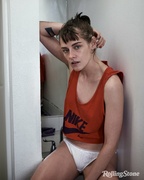
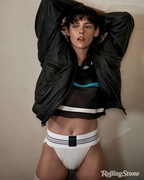
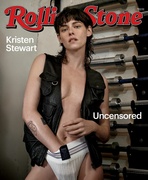
Stewart chalks a cue and then leans over the table and breaks. It’s soon clear that she’s the better player: When she sinks a ball, it’s swift and decisive. Still, she’s distracted by the conversation. Have I read any Jeanette Winterson? Or Kate Zambreno? What about Genesis P-Orridge’s memoir? That’s an extreme experience! Do I realize that we are setting ourselves up for failure here, with this whole cover-story thing? That it’s impossible to pin down any moment in time, any fixed identity? Still, she wants the cover image to send a clear message: hyper-sexualized, left of andro, and flipping the gender script. “If I got through the entire Twilight series without ever doing a Rolling Stone cover, it’s because the boys were the sex symbols,” she points out. “Now, I want to do the gayest fucking thing you’ve ever seen in your life. If I could grow a little mustache, if I could grow a fucking happy trail and unbutton my pants, I would. Guys — I’m sorry — but their fucking pubes are shoved in my face constantly, and I’m like, ‘Ummmm, bring it in.’”
Apropos to that, she won’t give up on Chronology, she wants me to know. She’s been talking about it with journalists for years — to the point that it’s getting embarrassing — but it’s now her only plan for the future. She’ll keep writing things with Meyer, keep looking for other stories they could tell that she feels aren’t being told, but she’s not taking other parts; the next movie she films she wants to be her own.
I make a bank shot, and she looks at me with mock horror: “Now get the fuck out of my house.”
BY THE TIME WE PLUNK ourselves back down in her living room a few weeks later, Stewart seems more relaxed, and not just from the endorphins released by her millions of chin-ups. About a week before our first meeting, she’d traveled to Latvia to lo-cation-scout for Chronology, and had been astounded by the beauty and diversity of the landscape — beaches that looked like Florida just a few miles from forests that looked like the Pacific Northwest. She’d now calculated that the movie could be shot there for a fraction of the cost, and though it was weird for her to consider making a movie outside of the Hollywood system, she was coming around to the idea. With these set pieces, she felt she could keep the project small and intimate, could suspend that fragile bubble of make-believe. “I don’t want 80 people on set,” she says. “If I see a truck, I’ll lose my fucking mind.”
Over the years, Stewart’s most intimate relationships have tended to be with people she views as creative partners, which, she admits, has “not been great for having relationships.” When it comes to Meyer, she says, “we don’t have that separation. I found the right person because I can be so obsessive about what I do. And luckily my girlfriend, my partner, we are into the same shit. We have taken the things that we’re spending our time on and interlocked them, and we’re so much fucking smarter and stronger together. And you’re just like, ‘Fuck, that is the best.’”
The two met on the set of American Ultra, connected immediately (“in a way where you aren’t sure if you want to fuck or be like, ‘Dude, let’s think of a handshake’”), and then unconnected immediately because of other romantic entanglements (“We were both so wrapped up in fucking other things, literally”). Six years later, they ran into each other again. Stewart asked why they hadn’t stayed in touch. Meyer said she’d emailed. Stewart scoffed and then — oops — pulled up all the messages she’d ghosted. “It was my fault, for sure,” she says. “But then I very much made this [relationship] happen. I was intense, because I was just positive.”
Which, she found, was an interesting place to be. For so much of her adulthood, Stewart had felt unsettled. Years had been spent “really white-knuckling life and getting off on the highs and lows of things” and running headlong into “fucking horrific relationships” and leaning into experiences that were “emotionally psychotropic” because you can then “put so much into your art.” And art had come out of it, art she’d sometimes even been proud of, art where she’s been able to “deposit desire in people” and make her feelings their feelings — and, honestly, what’s fucking better than that? “There was never a moment where I was like, ‘Man, what am I doing with the time that I have on this Earth?’” she says. “I don’t know what the fuck else I’d be doing. I love it.”
And, look, it has been great to experience all these facets of herself, great to try them on and then figure out how she wanted to cast herself in her real life, which — let’s be honest — is what we all do, all the time: “We make choices every fucking day about who we’re going to be. Not in a controlling way, but just in a way that acknowledges, ‘This is who I am. It’s the easiest one. It’s the one that’s the most comfortable. It’s the one I’ve chosen.’”
But also — and bear with her here; she knows she’s about to contradict herself — she’s aware that there can be something fundamental to who we are that can be lost and hard to retrieve. “I feel like I’m just getting back to that 11-year-old,” she says. “It does take kind of a long period of growing up in order to get back to who you were when you were a little guy.” She knows these things “might seem like a contradiction, like I’m presenting something that doesn’t play well together.” She balks at the concept of “authenticity” (“Are you fucking kidding me? We are all so malleable”). But she still feels like maybe there’s something essential that you feel the loss of when it’s denied, something that can help you grow into who you once were and stick that out, because “it’s boring to not. It is unevolved to not. Now, I’m actually creating a home where I’m an adult and a person.”
A few years back, Stewart and Meyer moved into a house down the road, keeping this one to use as the offices of Nevermind and as a landing pad for friends going through breakups or other hard times, as Stewart was when she bought it (she refers to it as the “Heartbreak Hotel,” adding that it’s otherwise “crazy to have a secondary mansion down the street from your house”). Since Meyer proposed in 2021, they’ve thrown around ideas of how they want to get married, once joking (or half-joking? Or not joking?) that they wanted Guy Fieri to officiate. Since then, they’ve realized that their main focus needs to be their two passion projects — Stewart’s Chronology and Meyer’s The Wrong Girls, in which Stewart will star and which she describes as “a stoner buddy comedy about two slacker girls coming of age.” It’s the one movie that Stewart says that she would do if it got greenlit before Chronology. With all that percolating, Stewart explains, “we don’t have it in us to have a big wedding. We’re probably just going to do it soon. We just are busy trying to make movies because they’re our babies.”
Then again, they’ve been talking about the possibility of actual babies. “I don’t know what my family’s going to look like, but there’s no fucking way that I don’t start acquiring kids,” Stewart told me during our first meeting. “And also, ideally at some point soon I go, ‘I want to have a kid.’ I really want that to happen.” Having watched that desire solidify in so many of their friends, she and Meyer have started making preparations for how they might go about getting pregnant, and have discussed the possibility of carrying each other’s embryos. “I’m not scared of being pregnant. I’m not scared of having a kid,” Stewart tells me. “But I’m so fucking scared of childbirth, it’s crazy. Have you ever been too on drugs where you’ve suddenly needed to be on your hands and knees?” she asks of that sensation of your body operating outside your control. “I hate that. I mean, I smoke a lot of weed — I obviously self-medicate — but I don’t like hard drugs. And I’ve tried — a lot. I just can’t deal.” Still, the thought of carrying a pregnancy is so “radical” that she’d like to think she could be up for facing that fear.
Right now, though, she can’t wrap her head around creating anything — or anyone — before Chronology. She hopes that by March she’s in Latvia shooting — she’d love to get there in time to capture some scenes of snow. She shows me the locations deck she put together, then asks if I want to see the sizzle, then spends several minutes fumbling with a remote control (“You know when you’re too fucked up and you’re trying to get music to play? This is like that”). Finally, she gets the video going, the plot approximated in pastiche, the tone strange and dark and exuberant. This is who she is, is what she’s trying to say; she just wants to be able to say it. Less talk, more rock.
So I turn my tape recorder off. We swill some more Coors. The Los Feliz skyline darkens. Eventually Meyer texts to see what’s up, and we head to a dive bar a few minutes down the road where we sit at a booth and eat chicken wings and where not a single person approaches the table except the woman who takes our order. Stewart sits close to Meyer, who does most of the talking (about books, about writing, about how these are the best wings in Los Angeles to such an extent that “I’m not interested in other wings anymore”). Periodically, Stewart reaches out to gently touch Meyer’s neck. At one point, they go outside to split the joint that’s been hanging out behind Stewart’s ear and return smiling and chummy. When the wings are done and the beers are finished, I call a car, and they wait outside with me until it arrives. They give good hugs, both of them.
Before we part ways for the final time, Stewart asks me again if I know what I’ll write about her, which of course I don’t. She’s right: We’ve set ourselves up for failure with this whole cover-story thing. Identity is so fucking malleable, a series of choices made over and over again in service to something elusive. It can take so much strength to drown out all the noise and get to the point where you know how to make those choices in a way that feels true. So, yeah, I guess what I have to say is this: Kristen Stewart is strong as fuck — whatever the fuck that means.