Home
- Home
- Team Kristen
- Affiliates
- Wins and Nominations for 'Spencer'
- Cannes Film Festival 2018
- American Ultra
- Anesthesia
- Billy Lynn's Long Halftime Walk
- Cafe Society
- Camp X-Ray
- Certain Women
- Chanel
- Charlie's Angels
- The Chronology of Water
- Crimes of the Future
- Clouds of Sils Maria
- Come Swim
- Equals
- Happiest Season
- JT Leroy
- Lizzie
- Love Lies Bleeding
- Love Me
- Personal Shopper
- Seberg
- Spencer
- Still Alice
- Underwater
- Scheduled Appearances in 2026
Sunday, May 18, 2025
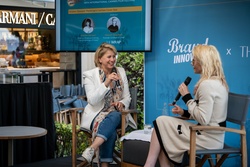
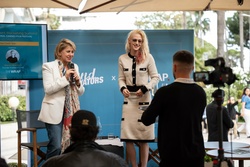
Kristen talks 'The Chronology of Water' at the Cannes Film Festival with Indiewire
Saturday, May 17, 2025
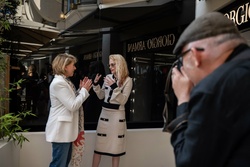
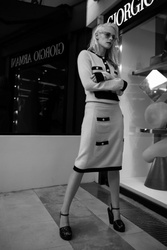
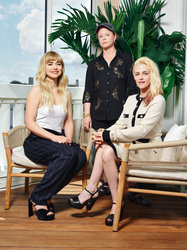
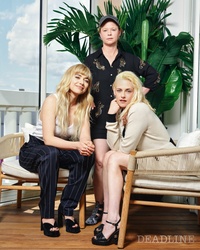
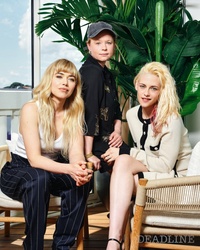
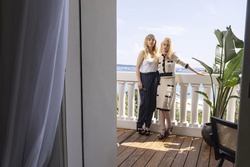
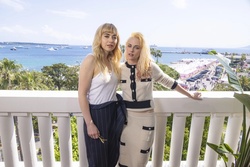
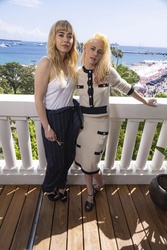
Portraits of Kristen and Imogen Poots with the cast of 'The Chronology of Water' at the Cannes Film Festival
Deadline
Kristen's interview with Numero for 'The Chronology of Water'
Google translated
Interview with Kristen Stewart
Issue: The Chronology of Water is your first feature film as a director. It feels like it's a long-standing endeavor for you.
Kristen Stewart : I've wanted to cross over—one way or another—ever since I started making movies . So, since I was nine. I'm 35 now. I really thought I'd become a director when I was younger, but I guess it just wasn't the right time. You have to wait for the triggers. Even if the desire is there, it doesn't materialize immediately. If the machine is ready to go, you still have to find the key.
Was Lidia Yuknavitch's autobiographical novel the trigger?
Not all books can be turned into films. This one swept me away. I immediately wanted to make it a collective experience.
The story is very difficult: it's about a woman abused by her father who becomes a writer. The film evokes trauma on one hand and creativity on the other.
Some things can live inside the body, joyfully, fully. Others need to be evacuated. What Lidia Yuknavitch 's text tells me made me feel like it needed to be shouted from the rooftops, so that the skeletons we all have in our closets would start to come out. Of course, what happens to this woman is quite extreme. But the abuse, the things that are stolen from us, the feeling of suffocation, the hiding of what we are going through, all of this is so palpable for almost everyone... 50% of the population is affected!
Was it your goal to represent trauma?
At the very beginning of the film, we see blood flowing. Almost clumped, it sticks. We understand that it can only come from one place: not a wound, but an orifice. This blood comes from far away inside this woman's body. So, I show it. I wanted my film to be like a crackle in the wind, a scream that becomes hysterical laughter. The way this woman organizes the events of her life is not haphazard or fractured. What she goes through is brought together with such a great emotional connection that the story becomes almost a living organism. We feel the tissues connecting together. The only possible way to make cinema out of it was to bring together very different talents. I had to listen to myself a lot. Say no, constantly. Say yes, but to the right people.
Your film is primarily made up of fragments. Did you shoot a lot, even if you didn't include everything in the final cut?
I shouldn't say this, because the producers might never want to make something like this again, but the only way to get to the end was to shoot a lot and then cut half of it. The film had a life of its own, its own memory.
A feminist and radical vision
Even though the story isn't yours, The Chronology of Water feels very personal. How did you find the right distance?
I wanted to see things on screen that would move me. Thinking about this, I hesitate to use certain words because I'm afraid it might become a sensationalist headline. And that tires me a little...
Not my type.
You never know. But I'm at the point where I let it happen. Go ahead, take what you want! In The Chronology of Water , we see a female ejaculation. The heroine's hand is completely covered. She says to herself: "I didn't know a girl's body could do that. " This dialogue made me feel very good. Usually, women are forced to hide. We are asked not to tell anyone that we are in pain, not to tell anyone that we are pregnant for several weeks, to keep things to ourselves. A woman is supposed to live with all of this. It is not healthy to keep the experience of pain inside. We must release it to better understand it and reformulate it.
Is this one of the important themes of the film?
My film is about birth, death, and rebirth, but it simply addresses the issue of living in the open. This may sound like a cliché: I think women are capable of absorbing a lot. We create life from what we put into our bodies, while many of the things we let into our bodies kill us. If we don't get rid of that deadly part and let the good live, it doesn't work. For me, The Chronology of Water was the perfect opportunity to address this subject.
You just mentioned the female ejaculation scene, a subject related to pleasure, only to immediately shift your focus to the question of pain. Why?
One of the film's themes is reclaiming pain and transforming it into pleasure. Certain things are imposed on us since childhood, even if we don't experience scenarios as terrible as the one experienced by the film's heroine. This can be a male experience, of course. But the world we live in, the images it produces, all of this prevents young women from feeling ownership of their intimate space. Life emerges and imposes itself on us.
How does this transformation take place?
As we get older, the desire for strange things takes over us. We wonder why. Then we realize it's related to what everyone wants to take from us. Pleasure is then linked to pain. There's a crack. Before we can safely release it, we go through a state of extreme vulnerability, we're open to dangerous things. The creative process is about not letting the things that hurt linger inside us. We redefine them through words and actions.
Cinema as a tool for emancipation
Do you advocate emancipation through art, like your heroine who starts writing?
Whatever our history, we can change it. It's vital to remember that. We can also look at it from a different perspective. We can use our shame. The feeling of shame is inherent to the female experience. That shame and pain can even be quite arousing. There's something sexy about it, it's our animal nature to indulge what hurts us. It's linked to the architecture of our bodies; we're open. It's not an opinion, it's a fucking fact. The Chronology of Water is a film of two faces: it hurts, it feels good; it's funny, it's sad. When you get that far into the pain, when you're completely free of it, when you're done sobbing, there's nothing left to do but laugh.
“I felt like I wasn't the right actress for the role.” Kristen Stewart.
How did you develop your vision as a filmmaker?
I wanted to depict things that would make me laugh. The film is a bit harsh, but it's also a thrill ride. It's a lot of fun to see this heroine fall and get back up again and again. I wanted to create frustration in the audience. Normally, we're used to characters who win; we want to follow winners. But what does winning mean? In the film, Lidia talks to an audience about her trauma when she wrote a short story. She seems to have won something, but right after, she relapses. That's how it is.
How did you approach this point in your film?
The film I wanted couldn't give us too many rational explanations about this woman. In the end, she arrives somewhere, but her journey has been messy. She thought she'd win, lost, and died. Now she manages to float. Besides, to continue the maritime metaphor, this film was a shipwreck. We kept hitting walls. I really thought several times that we'd messed everything up. Then I understood that each loss, each mistake, was exactly what we needed.
Why did you choose not to star in The Chronology of Water ?
I would love to star in a film I'm directing. It should happen very soon.
Good news!
That's nice of you to say. But this time, I felt like I wasn't the right actress for the role. Yet, I had a connection with this girl. I spent my days watching someone else play her, making it a rule not to tell her what I would do in her place. God knows, at times, I thought, "You do it like this. Ah, that's funny, because I..." I forced myself to stop talking! I forbade myself from peeing in Imogen's pool, basically (laughs).
Imogen Poots is flamboyant and striking. She takes a lot of risks.
Imogen is truly a brilliant actress who embraced the role. We're so different. She had the perfect body because she's powerful, like a mermaid. Plus, she reads a lot. When we started talking about the original book, I realized she's a literary type. She could be a teacher. She's one of the craziest girls I've ever met. She's intelligent, open, fearless, with lots of cracks to open, as gentle as a forest animal.
Why was she better suited for the role of Lidia?
If I had been in her shoes in the film, I would have danced in the middle of the fire non-stop, as if it were my comfort zone. When you see her, you wish she would stop touching the flames, it doesn't suit her. Imogen transports you with her charisma. When I first met her, I thought to myself: "Fuck, I'll follow you to hell." Plus, she has blue eyes. And I have green eyes. Her gaze goes better with water, a central element of the film. This answer makes no sense, have fun with it (laughs).
As an actress, you've worked with great filmmakers like Kelly Reichardt ( Certain Women ) and Olivier Assayas ( Sils Maria , Personal Shopper ). Did that help you mature your vision as a director?
Olivia Assayas was very important. When we shot Personal Shopper with Olivier, the way he extracted elements from our lives was fascinating. I had never seen anything like it. He taught me that you can say a lot with an image, without having to explain. If you need to, it's because you're not working well. He also raised the question of dreams. For him, cinema is the simplest and most direct way we've found to externalize our dreams. A film is like the collages we make of our life experiences when we go to bed. I don't know if you're a fan of lucid dreaming, but it can be close. When I was shooting The Chronology of Water , I spent a lot of time editing the film in my head at night. It was unproductive and pointless, yet the images imposed themselves on me.
What references did you draw on for The Chronology of Water ?
Only male films, I realize. Thank you, John Cassavetes , for really seeing your wife ( actress Gena Rowlands ). Thank you, Taxi Driver . Our film has a very present voice-over, but it doesn't guide the narrative. It's there, holding our hand. Thank you, Martin Scorsese , for making me understand that this was possible. It just so happens that my heroine is a woman. Our voices have an echo, we're not just telling our little story that no one listens to. Confessional women's literature is as important as the rest and I'm inspired by it.
Why do you think female directors are not always listened to?
Women have been destroyed by a modernist idea of art, which would have it that personal stories cannot be heard, as if we absolutely had to detach ourselves from our bodies to analyze the world and comment on it with the authority of professors. We have to put everything back in the body. Fuck the form. When I say that, it's not lightly. I think women have to come back in force to penetrate the form, pull off a heist, and remix everything. This is true in literature and cinema. If we don't do that, we'll stay at the castle gate forever, damn it! When I see men's films, I tell myself that I want to do that too! But I want to do it my way. Let's look inside ourselves.
Her future projects
What are your plans for the coming months?
I'm in the movie The Wrong Girls , which I also produced. Dylan Meyer ( Kristen Stewart's wife since April 25th ) directed and wrote it. It's a stoner comedy with Alia Shawkat , who is kind of a genius! The movie is positive about lack of ambition, about female friendship, with these two girls who are still growing up at 35 in a world that doesn't really welcome them with open arms.
How did filming with Alia Shawkat go?
Alia taught me so much, especially since it was my first comedy—by far, the scariest and most difficult work I've ever done. It was a hell of a trip working with Dylan and Alia in Los Angeles. For me, this is one of my most important projects. We're here at Cannes, we're talking about serious films, but this comedy is about deep things. The central idea is that you have to be chill and not become jerks or bitches. That's so important (laughs).
Kristen's interview with Vulture for 'The Chronology of Water'
Kristen Stewart threw what she describes as a “temper tantrum” to make her directorial debut, The Chronology of Water. She worked on it for eight years, refusing to let it die even as she gained and lost financing and actors and department heads, threatening not to act again until she was able to finish it. She dragged it bloodily over the finish line just in time for last night’s premiere at the Cannes Film Festival. After a standing ovation, she told the audience she’d finished the movie “five minutes before” the screening.
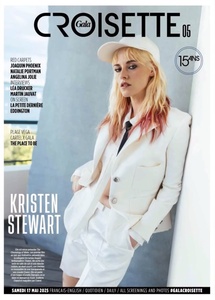
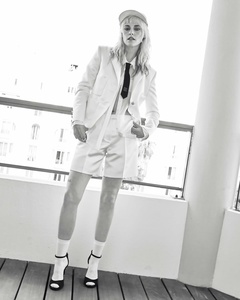
The result is a guttural yell, raw and poetic, and a real showcase for Imogen Poots as Lidia Yuknavitch, whose memoir of the same name Stewart adapted for the screen. Chronology is messy, structurally and visually and viscerally, playing with time and space and memory and oozing with bodily fluids — tears, spit, sweat, come, pee, blood, vomit. It’s a film about pain and pleasure, abuse and addiction, love and sex, and how women are forced to abandon themselves. I caught up with Stewart, clad in Chanel with a new shock of pink running through her blonde hair, on a rooftop overlooking Cannes to talk about how badly it hurt to make the film, getting the rights to Fiona Apple’s songs, creating her own cinematic language, Poots’s “big tit energy,” and the new, Chronology-inspired tattoos she got just before she arrived in France.
Tell me about the pink hair.
It’s a bloody motif. I wanted to bring a little bit of the movie into my body.
I was moved by the film and in particular the use of Fiona Apple’s “For Her” at the end. You wrote her a letter?
Oh, yeah. I wrote her a letter, and she wrote me one back.
What did you say? Why that song?
Where the fuck is my phone? I’ll paraphrase. She has a really similar place in my life to Lidia. There are just certain voices that help you find yours. That is a really concise way of putting it — your taste is formed by the people that come before you. Your impulses are encouraged or stifled by all of the things you consume. And I’ve really consumed and metabolized all of those albums. [Laughs.] That particular album, you can tell she made it in private. It sounds like a secret. She’s banging on pots and pans. There’s a sort of Richter release. And a kind of like, mama thing. You just go, “Fuck, thank you so much.” I think I said, “What’s yours is mine now.” Like, “I know that these are your songs, but they’re fucking mine. They belong to me, they really belong to this movie, and can we please show that?” I said, “I hope you understand the space you take up in the female collective unconscious.” I feel like I know her! I feel like we’re friends, even though we’ve never met. I think I wrote a pretty fucking good letter. I was desperate to get the songs. And it wasn’t even flattery. I was like, “Dude, I revere you.”
You guys do need to meet. So last night you said at the premiere that you were working on the movie five minutes up until its premiere. Was that a slight exaggeration?
Not at all. I’m not even done. This is so funny. People think we were tweaking it. No, we were making the movie! We edited the movie over nine months. I did take one break to be in a movie called The Wrong Girls with Alia Shawkat, that Dylan [Meyer], my girlfriend directed — well, she’s my wife now.
Congrats, by the way. That’s really cool.
Yeah, it’s sick. This movie is about iteration. It’s not about the things that happened to this person. Or even really about Lidia Yuknavitch. Even though she is the ultimate kickstarter — which is a word I used in Fiona’s letter, aptly. It’s just about how the things that happen to us live in our bodies and how we excavate, recreate, reframe things in order to survive. And also to define ourselves. To have a bit of fucking volition in terms of desire and the things that we want. Because the things that we want are so gouged out of us at an early age. The things that happen to girls — we’re not making those choices. Living in this world as a woman is violating. It’s about the reframe. Especially now that reality is breaking so hardcore under our current administration. I’m like, “What’s real? Oh, it’s malleable? Okay, cool. I’m gonna take a page out of that big fuck’s book and make my truth my truth.
You’re breaking reality.
Yeah. The reason we had to go make a bunch of puzzle pieces is because the movie had to have a whole life, a whole memory. I didn’t want to regurgitate the book. I needed to be able to create very precise images, but they had to be ephemeral. And so we couldn’t be as precise in the planning. Also my plan got completely commandeered. And my ship wrecked. We were floating in tatters down the Mackenzie River, trying to pick up the pieces of a really tumultuous shoot.
What happened?
Oh my god. Dude. It’s crazy. We would need so much time.
What are the bullet points? Did you lose financing?
Ten times. Cast. Department heads. Crazy, crazy act of god weather. I had written it for over eight years.
And you were writing and rewriting that whole time?
Absolutely. At some point, I’ve adapted every single page of the book. It needed to live every single bit of it in order to distill it. And then also, it needed to change. I think my fingerprints are all over the movie but I don’t strangle it. It’s Imogen’s movie. We shot the ever-living shit out of it so we could come home and intuit, based on sense memory, things that are connected. All of the flashes in the movie where you go, “Oh, this feels like that” — she makes a certain expression that reminds you of another expression. Basically I needed to give the movie a life in order for me to slice it up and make something that felt more like a DMT trip, like a repossession of the body through words. Versus: “Then her dad abused her. And then drugs abused her. Then the world abused her.” No, no, no. This is about what’s real, what happened. We all remember things differently. Taking that power into your hands is something that I’ve learned to do as I get older. It’s a movie about salvation through art, but it’s also about the inner voice. The sneaky inner voice and the secrets that we keep. Fuck that.
Especially right now. It’s scary to talk about this right now because our country is falling apart. If I’m putting a target on my pussy and you want to try and come and grab it, you give it your best fucking shot. That’s the only way. I do feel like I’m putting a target on my back doing stuff like this.
Tell me about Imogen’s “Big Tit Energy,” which you mentioned yesterday at your talk. What does that mean to you?
Imogen Poots! She doesn’t have big boobs. But I kept thinking she did. We were talking about costumes and how to age her. She plays 17 to 40 and it works. It’s crazy. She just has so much fucking integrity. We were talking about clothes and stuff and I was like, “We have to be careful with the bathing suit, she has…” And they were like, “Kristen, you have the same exact bra size.” And I was like, “What?!” [Laughs.] But she just seems…she’s such a gorgeous, open, lush, alive mammal. She’s so mammalian. A forest animal slash killer whale. So I think she must have these big tits. My brain, like, made her grow bigger boobs than she has.
Did you tell her that on set?
When we were doing costumes and stuff. I was like, “I thought you had big boobs, dude!” And she was like, [affects British accent] “No!” And that was the whole conversation. But now in retrospect I’m like, that’s so funny.
You said to the festival that this was the “biggest wound” of your career. Why?
It hurt so fucking bad. Because it was almost impossible. It was absolutely my inexperience that allowed me to pull this over the finish line. The amount of dropouts, acts of god — the movie was terrorized. It was really treated like a woman. It was really pissed upon. I really thought the movie was dying every day that I was making it. It was a really interesting ego check because I was convinced that I ruined it, that sure, we could string something together and I have to go show everyone. But that was just me trying to ingratiate myself with newness, which is really hard to do when you’ve planned something for eight years. And when I got out of the wreckage and into the safe harbor of the edit, I started opening all of these presents I didn’t know were given to me. I planted all of these seeds in these people and they bloomed like a motherfucker. I got home and I was like, “I have too much! I don’t know where to slice this!”
And then by the end, it took so long to edit the movie and then I made Dylan’s movie, and we got out of that and people were like, “Can we please submit to Cannes?” And I was like, “Can you please get away from me…” There’s no more violent question than, “How’s it going?” [Laughs.] “Did you get any work done?” I didn’t want to hang out with people I hadn’t seen in awhile. I ceased to exist. I could not handle talking about it. But it was really fun getting into the final touches. It should have been a six-to-nine week process. But we did it in two and a half weeks. I need to go home and finesse it.
Get this. My reference, what I cut to my low-res scans — they don’t exist. They were done in Poland by different interns every day. There is a genuinely irretrievable, ephemeral, low-res version of the movie. I don’t want to screen a low-res version, I want a high-res. But this kaleidoscopic rainbow that fell off the truck because these kids were experimenting with my footage— that’s what I fell in love with. It was diffused with a foggy glass. And all of a sudden, when I stepped into color, it was like I was looking at Instagram. It felt like a ‘90s movie, covered in a gritty texture. It felt like a movie I might like, but it was really masculine. And it didn’t feel like a dream, it didn’t feel pink enough. I was like, “Oh no!” I was crying. I was so sick, dude. I can’t believe I’m standing right now. I know that sounds self-aggrandizing.
You don’t.
I thought the movie was dying all the time. And then finally in the nick of time…I was so ready to come here with a movie that I thought was not what I wanted it to be. But the movie is itself. The movie speaks for itself. It’s totally out of my body and having its own relationship with the world. And I’m so proud of it. I need to give it a new outfit or two. Brush its hair. But the movie is the movie and it’s kind of cool to show it in its adolescence. I think it’s punk as fuck to come to Cannes without being done. We threw it under a closed fucking door. I can’t believe we got here.
On the festival site, you mentioned this idea of a feminine grammar of cinema that’s yet to be written. It reminded me a lot of how Celine Sciamma talks about reinventing a feminine language for film. Can you tell me about finding that language, trusting that voice?
There’s granular and then big-picture. When I go microscopic, it’s the texture of the blood that sticks to the grout before it goes down the drain. There’s no question about where that blood comes from. It’s not from a cut. It’s from a hole. It was really hard to convince people that this movie was going to be fun to watch. Because it’s frustrating. It’s not the three-act success story that, as audiences, we’ve been trained to want. It’s like, “Aren’t we supposed to be happy now? Jesus Christ, you’ve dragged me through hell.” It’s like a female orgasm. It’s like, “Almost, almost, almost. Stick with me, stick with me, stick with me!” I don’t think the movie is long. It’s two hours and eight minutes, with a killer credit sequence that you have to see til the last frame to finish the movie. But it’s a serious fucking movie. We deserve to take up space. I didn’t need to make an hour and a half digestible experience so it would be less difficult for the consumer. It’s cool that at one point you go, “Are we still doing this? Why?” I have “Why” tattooed right here [points to her upper arm].
Did you get it just now?
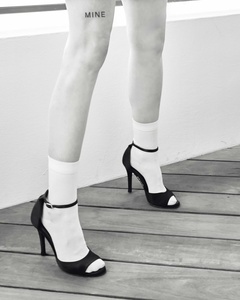
Yes, the day before I got on the plane. I was running ragged, we had just finished the movie, and I was like, “No matter what, top priority, find a woman who can give us three tattoos today!” The crew is going to get this one. [She points to a tattoo that says “MINE” on her thigh.]
What does that mean?
The coolest song in the movie is when she comes on her hand, smells it, wipes it on her fucking bicep, and goes, “I didn’t know a girl body could do that. Shoot come.” And then this song comes on and it goes, “Mine, mine, mine, mine.” And it’s just fucking mine.