
Wednesday, September 12, 2018


Tuesday, September 11, 2018
'Lizzie' Clip + interview with Chloe Sevigny and director Craig Mcneill with INTO
Historians have attempted to discern whether Lizzie Borden’s love of female friends and eschewing of male partners meant anything in particular about her sexual identity (some, opting out, instead call her a spinster), but there’s not a ton of proof either way. Still, some believe Lizzie’s friendship with performer Nance O’Neil was a romantic one, and that Lizzie also had a relationship with Bridget “Maggie” Sullivan, her family’s 25-year-old Irish maid.
In Lizzie, hitting theaters this Friday, Sevigny plays the titular character as a repressed, buttoned-up young woman imprisoned in a boring day-to-day as dictated by her overbearing and judgmental father (Jamey Sheridan). Stewart is Bridget, quiet and dutiful out of monetary necessity, even when she’s expected to perform sexual acts outside of her job description for Mr. Borden. As Lizzie and Bridget discover each other’s shared hatred of their suffocating situations, they find a bond that evolves into emotional and physical affection, leading to the ultimate climax: the bludgeoning Lizzie Borden is infamous for, whether she’s guilty or not.
“It’s them finding strength through one another, and it’s also a tragic love story,” Sevigny tells INTO. “Lizzie is projecting so much on to Bridget and expecting so much and her expectations are thinking she’s going to find happiness and freedom through this love and in the end, fighting for it actually loses it, and we thought that was a tragic twist.”
Sevigny was the driver of the project and has been for several years as it went through many iterations – first as a television series with HBO that was eventually killed because of Lifetime’s own version starring Christina Ricci. There were directors attached at times (Pieter Van Hees was to helm at one point), but Craig Macneill eventually took on the feature, written by Bryce Kass. Sevigny says she met with women directors as well, but liked Macneill’s previous film, The Boy, and enjoyed “the respect that he had for Kristen and me and the script and for the project.”
“I tried to stick true to the feelings I had when I first read the screenplay,” Macneil tells INTO. “I genuinely cared for these two women who were trapped in this oppressive home under the control of this sadistic man. These two women were merely trying to survive and they found comfort and solace in one another. That connection took the form of an intimacy. And love.”
When Lizzie premiered at Sundance this January, it was one of four high-profile films that centered queer women protagonists, and one of the first to get scooped up for distribution (Saban Films acquired North American rights).
This is a pervasive and frustrating scenario in modern cinema, and though it’s not as off-putting as it can be in other dramas of this nature, the male gaze is perhaps illustrated best by an actual scene from Lizzie: When Lizzie and Bridget finally become intimate – believing they are finally alone together, undiscoverable in the barn – they are so involved in making love they don’t realize they are being watched through the window by Lizzie’s father, Bridget’s abuser.
“I thought it was important to keep Lizzie and Bridget clothed for the love scene and not overly glamorize it in any way,” Macneil tells INTO. “We shot it handheld with wide lenses, very close to the subjects, which gives you sense that you are participating and sharing the space with them as opposed to observing from afar.”
The inescapable repression is palpable in that moment, reiterating that for women like Lizzie and Bridget, there is no way out – they are stuck under the thumb of men unless they do something drastic.
Although reviews out of Sundance were favorable, especially regarding the leads’ performances, Sevigny shared that she was somewhat disappointed with Macneill’s decisions to cut scenes she shared with both Stewart and co-star Fiona Shaw (who played her step-mother). Considering the best scenes are when Sevigny and Stewart have any chance to share a secret conversation or exchange of emotion in an otherwise stoic existence, this was frustrating for Sevigny, who had been trying to get some iteration of the project made since 2010.
“It was very hard,” Sevigny told Huffington Post. “I was like, ‘If you have another scene with Kristen Stewart and you don’t put it in your movie, you’re stupid. What’s your problem?’ But almost every movie goes through that. Almost everything that was on the page was filmed, and a lot of it didn’t make it in the movie. … There was more to the relationships that made them more complicated, and also then informed why Lizzie [commits the murders]. Now it’s a little more vague than what Bryce and I intended originally to do.”
“There were several scenes that didn’t make it into the final cut as a result of the overall running time,” Macneil tells INTO. “It’s always hard to let go of moments and scenes you love, particularly when you remember how thrilling it was to capture on set – but that’s just the nature of post-production. It’s like that on every project.”
Sevigny understands how this works – she’s been in the business for 25 years now, beginning with her first role in Larry Clark’s Kids. To say she puts her entire self into the Lizzie role is an understatement, so believing the cut scenes she referenced were necessary to this feminist re-telling of Lizzie Borden’s story isn’t difficult.
“It’s always a gamble,” she says, acknowledging that finding a director to come aboard a project that already had its script and stars in place leaves them with less ownership.
The now 43-year-old actress has been cast in explicitly sexual and often violent work. That much of this work is queer-themed is both for better and for worse, as sometimes it means heartbreaking consequences and punishment for the LGBTQ characters within – Lizzie included. Sevigny’s breakthrough role as Lana Tisdel in Kimberly Peirce’s 2000 film Boys Don’t Cry is perhaps what she’s best known for, garnering her Indie Spirit and Satellite awards, Academy Awards, Golden Globe, and SAG nominations. She was also up for Best Kiss at the MTV Movie Awards for her on-screen love scene with co-star Hilary Swank, who portrayed trans man Brandon Teena. Later, Sevigny would play a trans hit person on the self-contained controversial series Hit & Miss, as well as appearing in lesbian, bi, and queer roles in television (American Horror Story: Asylum), film (Party Monster) and the all-star HBO TV movie If These Walls Could Talk 2, which had her playing a motorcycle-riding butch greaser dyke opposite a love interest played by Michelle Williams.
Sevigny says the roles she chooses, though explicit or racy and, at times, contentious, are not without reason or merit.
“I think other films are more, I don’t know, titillating or something – like Bound,” Sevigny says. “I think my films – not that I’m any better – but I think there’s a certain respect around them that maybe that kind of [salacious] talk isn’t prevalent around them. I think what happens between Kristen and I in the movie and our friendship is we’re connected outside the boundary of class or sexuality or sexual identity, you know? It’s something bigger. And it’s not gratuitous, either, and I think that’s also a main thing that runs through all of my films. Whenever there’s sex, it really serves the story. Even in this movie – we’re never even out of our clothing together but still, it’s as sexy, or as possible if we were naked because of where you’ve gotten up to that point in the movie because you’ve seen how repressed they are, so it’s satisfying in its own way when you get to that point.”
Lizzie and Bridget’s being found out weighs heavily into the rest of the film, with homophobia leading Mr. Borden to ensure his daughter will receive nothing from him should he ever meet an untimely death. (Instead, he signs his estate over to Lizzie’s uncle, the equally evil Denis O’Hare.) Audiences will likely root for Lizzie to succeed, and for her relationship with Bridget to survive outside of the stifling staleness they’ve been forced to live in, which turns a lot of queer horror tropes on their head. Instead of seeing Lizzie’s homosexual leanings as proof that she’s sinful and, therefore, a villain who deserves to be punished, Lizzie provides a much more complex context in which to understand why a young woman who might have it in her to murder her own parents.
“Yes, I do think she’s likable,” Macneill says of Lizzie Borden. “The film intentionally walks a fine line though. It allows you to identify and sympathize with a person doing who has done something extremely brutal. I want the audience to care for her – but I also want us to be afraid of her.”
Sevigny tells INTO she loves films like Heavenly Creatures, “where women find strength within each other and fight their oppressors.”
“If Lizzie did, in fact, do it, there’s no way that Bridget couldn’t have known that it was happening and/or have been a part of it in some way,” she says, basing her theory on a tour she took of the Lizzie Borden house. “To us, the love story is greater than anything. It’s them finding strength through one another, and it’s also a tragic love story. Lizzie is projecting so much on to Bridget and expecting so much and her expectations are thinking she’s going to find happiness and freedom through this love – and in the end, fighting for it, she actually loses it. We thought that was a tragic twist.”
Kristen and Chloe Sevigny's interview for 'Lizzie' with AP + Portraits
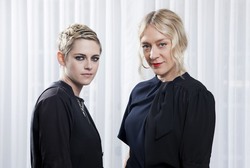
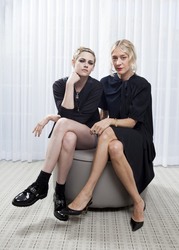
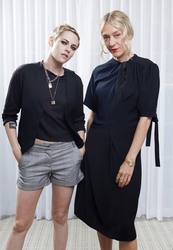
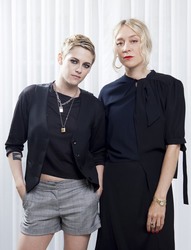

Click on photos for full view.
A fateful trip to the house in Fall River, Massachusetts, convinced her to look at Borden’s life through a different, more empathetic lens, pulling back the curtain on the suffocating circumstances surrounding the infamous 1892 ax murders of her father and stepmother and what might have driven her to do it. Borden was tried and acquitted of the killings, but continues to be a source of intrigue today.
After years of false starts, “Lizzie,” a tense and beautifully rendered psychological thriller co-starring Kristen Stewart as Bridget Sullivan, the maid and a pivotal figure in Borden’s life, is finally making it to select theaters Friday.
Sevigny, 43, and Stewart, 28, it girls of different generations, spoke to The Associated Press about the shoot, why the nudity in it is “punk” and directing short films before features.
The following remarks have been edited for clarity and brevity.
__
AP: How did you decide to go after Kristen?
Sevigny: Bryce (Kass), the writer, said Kristen and I was like ‘Oh yeah. No one else.’ So then we went about trying to seduce her.
Stewart: I’m really easy. It was not difficult.
AP: Visiting the house helped you figure out the story?
Sevigny: It bore out our decision to tell the story this way. Not only were we interested in the love story, a tragic love story at that, and them both searching for freedom and finding each other, but also just the practicality that she (Bridget) was outside the house. There was no way she couldn’t have known what was going on.
AP: Kristen what did you find compelling about Bridget?
Stewart: I felt protective over her. She’s got truly no voice. I really liked the kind of lens that she provided us of Lizzie. The way she saw her was really sweet and kind of innocent but also pure.
AP: It shows women at that time of different classes.
Sevigny: They’re all Andrew (Borden’s) prisoners. Me and Abby and Emma and Bridget. We’re all prisoners in this household together with no options.
AP: Tell me about the decision to be fully exposed in this film.
Sevigny: The movie deserved it. That’s what the movie needed. I think it was even my decision. I wanted the movie to have that. And I think it’s kind of punk as a 43-year-old to be naked. I feel like we’re bombarded with these beauty ideals and I am trying to in my small way (with my Instagram) to say look at this woman, look at Anna Magnani, she’s a great beauty, and have girls see that and see more diversity and shapes and sizes and looks and know that these people are also appreciated for whatever they bring, not only their looks, but their talent.
AP: I saw on your Instagram that you two hung out at this bar, Original Pinkie Masters, during the shoot in Georgia.
Sevigny: That was I think the first gay bar in Savannah. And there’s an art school there so a lot of the art students and professors would be there. It was a nice generation gap. They had a great jukebox with all this amazing obscure music and it was just our local.
Stewart: It’s just a great bar.
Sevigny: Cool crowd. Nobody bothered her. They bothered me more than her.
Stewart: Which means it’s a REALLY cool bar.
Sevigny: It just means they’re older.
AP: Why did you both start out directing shorts before features?
Sevigny: I was frustrated as an actress, always giving myself over to someone else’s vision. Not that I didn’t always agree with their vision or wanted to be part of it or thought they were great filmmakers, but still you’re not in the editing room, it’s somebody else’s thing. I wanted to have my own thing and express my own ideas and visions and loves.
Stewart: Yeah same, I started so young, I’ve never felt more seen or expressed or like allowed to really be as when you’ve really told a story well, one that got inside you. I don’t draw a huge distinction between acting and directing. I think as an actor I love the indulgence, but I don’t want to say lack of control because I’m very controlling, I’m always in the director’s back pocket like, “How is this being seen?” I want to be able to fit into your frame perfectly. I want to know what it looks like.
Sevigny: I don’t. I become too self-aware.
Stewart: But I wanted to do a short before a feature because I had never done it before. Straight-up. And I love what shorts do for people’s willingness to do weird things. You’re not trying to entertain people, not that that’s something that I’m not into, I’m into that too, but it’s fun to do truly a free-verse poem.
Sevigny: More of an expression.
Stewart: It doesn’t have to be an hour and-a-half, it doesn’t have to be digestible. It just has to have a taste.
Sevigny: People are like why are you doing another short, why aren’t you doing a feature? And I have such reverence for feature filmmakers, I’m not prepared yet. I still am experimenting and learning.
AP: And as actors you both are often rebelling against the big business of Hollywood, consistently choosing interesting projects and directors to work with.
Sevigny: It’s called taste.
Stewart: And she strikes again! Dude! Honestly if I said that I would sound like such a tit, but because it’s her, because you genuinely actually have the pull, you can actually lift up that statement and (expletive) hurl it.
Source
Monday, September 10, 2018
Director Justin Kelly and Savannah Knoop talk about 'Jeremiah Terminator LeRoy' and Kristen with Vanity Fair

Since Kristen Stewart left the Twilight franchise, she’s used her star power to help get a series of thoughtful, indie movies made—the latest being Jeremiah Terminator LeRoy, Justin Kelly’s fascinating film about the the wildest literary hoax of our lifetime. That the story also examines gender fluidity—a subject on which Stewart has spoken about before—and thoughtfully probes issues of identity may have been an added allure for the César-winning actress.
In the film, which premieres this week at the Toronto Film Festival, Stewart stars as Savannah Knoop, the artist who helped author Laura Albert (played in the movie by Laura Dern) dupe the public into believing the myth of JT LeRoy. Albert wrote three books under LeRoy’s name, and pretended to be the pseudonymous persona—purportedly a teenage boy who wrote semi-autobiographical fiction—over e-mail and phone. Knoop, who was Albert’s sister-in-law, donned a blond wig and sunglasses to play LeRoy in public, fooling a cult of famous fans including Courtney Love (who has a cameo in the film), Gus Van Sant, Madonna, Winona Ryder, Carrie Fisher, and Bono. Though there have been other movies made about the hoax, Jeremiah Terminator LeRoy—which is based on Knoop’s memoir Girl Boy Girl: How I Became JT LeRoy—is the first to be told from Knoop’s perspective.
After Stewart got ahold of the script, she reached out to Kelly, whose previous films I Am Michael and King Cobra explore queer issues. (Kelly joked that the LeRoy movie is the third in an “accidental trilogy.”) Stewart immediately won Kelly over with “her energy and her thoughts on the story, and the fact that, at the time, she was kind of going through a very similar trajectory as JT, dealing with issues of sexuality and being in the public eye kind of thing,” he said.
In preparing for the role—a complicated exercise in playing a character who is playing another as the primary character transforms—Stewart met with the real-life Knoop and did extensive research.
“One of the main things that felt clear as Kristen and I met was that she had studied JT’s character from all of the various public sources, and had it down,” Knoop e-mailed Vanity Fair on Monday. “She is a skillful physical mimic and, I remember, one of the first days on set, seeing her do a sort of turned updown smile that was more of a nervous grimace, and thinking, that’s JT! There was also a clap with flat, stiff palms—jilted and emotional. She really perfectly captured the discomfort of Laura’s character, as well as the headspace of me playing that character. She had also read my memoir, Girl Boy Girl, so she had all of the emotional mapping from that, and when we came together I could feel her pocketing Sav solo gestures as well. The main point that I gave her was to play Savannah as someone open, and curious; someone who could discover themselves by going deeply into JT’s character.”
The film is part coming-of-age love story, as Savannah—while in disguise as JT—falls for an actress named Ava Avalon (Diane Kruger). Boundaries are blurred on different levels as the two have a fling, and Savannah finds herself pulled between her affection for Ava—who does not know her true identity—and a boyfriend in San Francisco, who does.
Given the complexity of the story, it took Kelly and Knoop—who met through a mutual friend in 2009—nine years’ worth of script drafts until, as Knoop wrote, “the logistics faded and the emotions materialized as one clear trajectory.” Like Stewart, Dern also expertly inhabits alter egos including Speedie, a British handler who accompanied Knoop’s LeRoy while traveling.
When Jeremiah Terminator LeRoy filmed in Winnipeg last summer, Knoop got along so well with Stewart and Dern that the co-screenwriter extended what was supposed to be a several-day visit. “The vibe of us all being there was just so on point,” said Kelly, reminiscing about evenings at his Airbnb discussing the script over wine and Thai takeout.
Before filming, Kelly asked Van Sant—whom Kelly considers a mentor—for his blessing on the project. Kelly was heartened to find that both the filmmaker and Love supported the movie, in spite of the fact that they had been duped by its characters. “I think in Courtney’s mind and Gus Van Sant’s, [the hoax is] too weird and brilliant to be that upset about,” said Kelly. “Like, you feel weird at first, and then it’s like, ‘Well, I’m not going to be butthurt for the rest of my life.’”
Asked what Kelly learned about human nature from being steeped in this hoax for nine years, Kelly paraphrased something Albert once said herself: “You can create a character, get someone to believe you, and then drop your accent or take the wig off, and people will still believe who you are. Because who you said you are is so ingrained in their mind that they’re not just going to stop believing it. Savannah, as JT, would at times take the wig off. There are photos of Savannah as JT looking so much like her real self—a woman—but people still believed it.” (Today, Knoop prefers they/them pronouns.)
The film’s lesson about human nature can be applied to current events as well. “I don’t want to get political, but in our current climate, there is another character right now who’s very JT-esque—who has messy hair, a signature hat, and lies out of his teeth,” said Kelly. “But people just keep believing and believing and believing, even when every single thing he says is revealed to be a complete lie. There are a lot of correlations right now with what’s going on in politics and JT. It’s really funny to me—this ability to spin lies and get people to believe you even when those lies can be completely debunked.”
Source
Reactions and reviews on 'Jeremiah Terminator LeRoy' from the Toronto International Film Festival

We will update this post as they come.
Reviews
Indiewire
The JT Leroy saga is readymade for the movies, and two years ago it gave birth to Jeff Feuerzeig’s documentary “Author: The JT Leroy Story.” That provided a fascinating overview of extensive scheme by Bay Area author Laura Albert, who wrote under the nom de plume of the fictional Leroy and gave him a backstory, hoodwinking fans all over the world by pretending that (s)he was a former teen prostitute with prodigal talent.
Albert pulled it off for years, pretending to be Leroy on the phone while sending her androgynous sister-in-law Savannah Knoop to play the character in public. But while “Author” explores the eccentric Albert’s identity crisis in her own words, it relegated Knoop to a supporting character. Writer-director Justin Kelly’s “Jeremiah Terminator LeRoy” puts her front and center, bringing an intriguing new angle on the bizarre literary con as we see Knoop being forced into playing a character more exciting than herself.
Based on Knoop’s memoir, the movie’s ace in the hole is Kristen Stewart as its lead, inhabiting the genderqueer character with a credible shyness and curiosity that suits the actress’ strengths; she’s complemented by an energetic Laura Dern as a dead-ringer for Albert. While Kelly’s faithful dramatization doesn’t offer a lot of fresh insights, and fizzles by the end, it remains an involving snapshot of two women grappling with their private and public personas until they collide.
Kelly is a natural fit for this material. His underrated debut “I Am Michael” focused on real-life gay activist-turned-Christian pastor Michael Glatze, and “Jeremiah Terminator LeRoy” focuses on a similar case of people uncomfortable in their own skin. When Knoop first shows up in Albert’s life, she’s already deep into her writing life as JT Leroy, with her musician husband Geoff (a fine, understated Jim Sturgess) begrudgingly a part of the scam. Albert recognizes that she limits the potential for JT by keeping the character to a voice on the phone, and coaxes Knoop into joining the facade with ease.
Their initial attempts to bring JT into real world are compelling as these actors excel at inhabiting their roles on several levels at once. “I’m really good at pretending to be a feral 19-year-old street kid,” Knoop says to Alpert, who plays JT’s exuberant British manager when the pair go on a photo shoot. “That’s not weird, right?”
Of course, everything about the situation is exactly that — from Albert’s excitement over the expansion of an increasingly risky plan to the awkward blond wig that Knoop wears when she’s in character. Knoop goes from being the custodian of Albert’s creation to developing her own sense of ownership. For a while, Kelly generates a remarkable degree of intrigue as Tim Kvavnosky’s high-pitch score injects the scenario with an aura of mystery. The movie, which opens with the Oscar Wilde quote that “the truth is never pure and rarely simple,” explores that notion as both women realize they’ve created a real character stuck between two vessels. Stewart remains a compelling, enigmatic screen presence, but she’s well served by her veteran co-star. While technically a supporting character, Dern often steals the show, relishing the opportunity to shift between a trio of personalities to darkly comic effect. That’s appropriate in a movie all about the perils of seeking attention.
The drama becomes less engaging as the story grows busier, with Diane Kruger surfacing as Eva, a not-so-thinly-veiled riff on Asia Argento. The actor-director is keen on coaxing JT into giving her the rights to adapt “The Heart is Deceitful Above All Things,” which Argento did shortly before a New York magazine article outed JT as Albert and the plan came crashing down. (The timing of “Jeremiah Terminator LeRoy” has the unfortunate tarnish of arriving shortly after news broke that “Heart” star Jimmy Bennett allegedly had sex with Argento while he was underage; Argento has denied the charges.)
By hinging the stakes on this scenario while reducing the journalistic exposé to the final minutes, “Jeremiah Terminator LeRoy” downgrades the traumatic impact of the media attention for both Albert and Knoop to a coda; as a result, the story has a lopsided quality, lingering in redundant scenes of Knoop playing JT — while Albert grows envious — and lessening the dramatic downfall for everyone involved.
Nevertheless, Stewart is captivating in a challenging role that requires her to juggle several identities at once. While developing a romance with a guy she meets in her day job (“It Comes at Night” breakout Kelvin Harrison Jr.), Knoop also falls in love with Eva, inadvertently constructing a love triangle that puts her fluid sexuality to a complicated test. The meta qualities of watching Stewart tackle this as she moves further away from the straight-laced roles that defined her career before she came out sit well with a movie about a thorny coming out process. (The movie’s meta qualities extend to the stunt casting of Courtney Love, who was hoodwinked by Albert herself, in a fleeting supporting role.) Kelly’s screenplay is especially adroit at investing the fresh desires that Knoop uncovers in the midst of her role playing, and why she struggles to let it go. Arguing with her boyfriend about why she should keep up with the game, he tells her, “You sound like an addict.” At its best, “Jeremiah Terminator LeRoy” magnifies the impulse behind this obsessive tendency to embrace a personality beyond one’s self.
The movie culminates with a trip to the 2004 Cannes Film Festival, where “Heart” premiered a matter of months before Albert and Knoop were exposed. As Kelly brings the story to a tidy completion, it manages to leave open the question of whether Alpert — now a celebrity in her own right — got what she wanted all along. But by handing the spotlight to Knoop, it makes that final mystery less relevant. “Author” remains the superior chronicle of the JT Leroy story, but “Jeremiah Terminator LeRoy” contains the tantalizing suggestion that it wasn’t Albert’s story to tell in the first place.
The Guardian (4 stars out of 5 stars)
Of the actors slated to star in Jeremiah Terminator LeRoy when Justin Kelly first got the production’s wheels turning in 2016, only Kristen Stewart saw it through to shooting. She plays Savannah Knoop, a young woman who posed as the invented literary persona JT LeRoy in the early 2000s, and thank the gods of cinema she stuck around. A fascinating synergy runs both ways between Stewart and the unlikely story of Leroy’s ascent to stardom in the publishing world. The actor’s intensively documented public life adds one more layer to a film that already has a lot on its mind regarding celebrity, constructed identity, gender and authenticity.
Both Stewart and LeRoy, a 19-year-old street kid created by Knoop’s sister-in-law Laura Albert (Laura Dern) as an avatar for her writing, have appeared to be uncomfortable with their fame. Each resisted the attention heaped on them, which only made the public hungrier for details. They’ve toyed with androgyny, using short-cropped haircuts and loose, body-masking clothing. And they each, in their own way, made a career of pretending. Stewart has described herself as a bad liar in interviews, suggesting that honesty paves the way to summoning truth in a performance. Laura and Savannah are united in the belief that a lie from the heart can be more real than a reality foisted on them by fate. The main difference is that Laura and Savannah just played it a bit faster and looser with their ethics.
Dern plays Laura as a master manipulator, who can talk anyone into anything with the right melange of new-age platitudes. (“I felt JT leave my body and enter yours!” she says, convincingly enough for Savannah’s satisfaction.) When her lover/bandmate Geoff (Jim Sturgess) introduces her to his sister, Laura immediately recognises the ideal collaborator in Savannah, a lump of clay she can mould in an image incompatible with her own.
She earns the girl’s trust by sharing juicy moments from her past – work on a phone-sex line that taught her how to be someone else; the period she was 100lb heavier – and assumes her position as puppetmaster. It starts innocently enough, with Savannah donning a wig and shades for an author photo to accompany an article, but matters quickly spin out of control. Laura kept an eye on her alter ego by posing as LeRoy’s British handler Speedie, feeding the disguised Savannah responses to inquiries. But by the time an Asia Argento stand-in named Ava (Diane Kruger) has launched a multi-million-dollar film adaptation of a LeRoy-credited novel, both Laura and Savannah have got in far over their heads.
While in LeRoy mode, Savannah behaves not unlike the way Stewart did during the Twilight press tours when she was swarmed by journalists intent on worming their way into her private life. It’s only when she starts to sever her marionette strings, making remarks not preapproved by Albert and striking up a romance with Ava, that their fragile success starts to fall apart. Their arguments and the exposé that follows give way to the film’s most intellectually substantive bits – debates over the limits to which anyone can remould their sense of self. Does Laura’s troubled life story have less value depending on who’s telling it? Can incidental good, expressed via an anonymous boy who tremblingly says that their work saved his life, validate a lie told for personal gain? Was the joke really on the preening upper crust who fell over themselves to praise an image? Director Justin Kelly doesn’t come down too hard on either of his subjects, acknowledging that there are few clear-cut answers.
Savannah and Laura’s stories had happy endings. They each parlayed their notoriety into careers, the irony being that they had to forge an ersatz life story to make their own life stories interesting to the literati. All of which speaks to the matter at the heart of Kelly’s theoretical tangle: our unwillingness, inability, or simple lack of interest in viewing the artist independent of the art. JT LeRoy may have been an elaborate fib, but Kelly finds a genuine pearl of wisdom in the web of deception.
Screendaily
There’s nothing about this watchable but somewhat workmanlike dramatisation of the literary fraud behind author ‘JT LeRoy’ which is anywhere near as extreme as the story on which it is based. But Justin Kelly’s low key directing choices allow the two very fine central performances to take centre stage. Kristen Stewart (playing Savannah Knoop / JT LeRoy) is typically subtle; Laura Dern (playing Laura Albert / Speedie / JT’s words and voice) is a hurricane of enthusiasms, mannerisms and agonising naked neediness. Intriguing themes of identity, fantasy and creative ownership are explored in a film which, in some ways, takes the form of love triangle; albeit one in which one of the parties is fictional.
The curious story of teenage truck stop rent boy-turned-bestselling author JT LerRoy has already been explored in the documentary Author: The JT LeRoy Story, by Jeff Feuerzeig. And one might assume that LeRoy, the alter ego or literary avatar of Laura Albert, had already outstayed his welcome in the public arena, but for the canny casting of Kristen Stewart in a gender fluid role which is pretty much tailor made for her skillset. Stewart will be a key selling point for the picture; likewise the playful tone and flashes of humour should generate positive word of mouth.
Stewart imbues Savannah, fresh off the bus and new to the city, with a fragility and malleability. She’s barely grown, a crop-haired waif, in awe of her big brother Geoffrey (Jim Sturgess) and his girlfriend Laura. She praises everything – their apartment, Geoffrey and Laura’s wretchedly average rock band Twist And Scream. And Laura, clearly a fan of affirmation in any form, embraces Savannah like a long lost sister, love-bombing her with attention and unsolicited confidences in return for Savannah’s wide-eye appreciation.
When Savannah is visibly moved by the newly published book by JT LeRoy, secretly penned by Laura, an idea forms. The androgynous Savannah dons a blonde wig and shades and poses as J T, her supreme discomfort in the deception working in her favour. Laura, meanwhile, pulls on a bright red wig and an unconvincing British accent to play another of her alter egos, JT’s friend, handler, and spokesperson Speedie.
But where Speedie is abrasive and off-putting, ostracised in the very circles into which her writing has bought them entry, Savannah’s husky whisper of sensuality in her JT guise is like catnip to the literary and, later, the movie world. She beguiles a brash Hollywood producer, played by Courtney Love (in a meta twist, Love was one of the artists who was photographed draped over the real JT).
But it’s the actress and director Eva (Diane Kruger), based on Asia Argento, who becomes a flashpoint. Savannah as JT has a sexual encounter with Eva; Laura, who talks to the actress daily on the phone, voice disguised with a treacly Southern accent, is at pains to point out that it’s JT’s words, not Savannah’s body, that Eva desires. The relationship between Laura and Savannah becomes a tussle for ownership, of JT and of Eva.
Based as it is on Knoop’s book, Savannah is the focus of the film. But it is Laura – this desperately unhappy woman who only feels comfort in reinvention – who is the more fascinating character. Dern, always just pulling back from the brink of grotesque in her depiction, is superb.
Of the film’s creative elements, the score is particularly noteworthy. A questioning flute motif, it adds to the film’s appealing enigma; meanwhile the choice of Hole’s Celebrity Skin for the closing titles is an on-the-nose wink to the audience.
The Film Stage
Kristen Stewart’s young career is peppered with highs–most notably, Olivier Assayas’s Clouds of Sils Maria and Personal Shopper–but the actress has never been more natural, more unaffected, or as legitimately fascinating onscreen as she is in Jeremiah Terminator LeRoy. As Savannah Koop, the infamous “body” of nonexistent author JT LeRoy, Stewart is vulnerable, funny, and wounded. Yet she’s also nonchalantly charismatic, showing how and why the sight of the quiet, bewigged LeRoy was so utterly enticing to a world craving for mystery.
It’s a stunning performance, one matched by the wondrous Laura Dern as Laura Albert, the author who created LeRoy and wrote his works. Jeremiah is bouncy and pleasing, if overfamiliar and never as insightful as one would hope. That is not necessarily the fault of director Justin Kelly (I Am Michael, King Cobra), who co-wrote the film with Koop herself. It has far more to do with the existence of the 2016 documentary Author: The JT LeRoy Story. That delightfully juicy film tackled the tale first, telling the sordid tale with wit and visual ingenuity. When watching Jeremiah Terminator LeRoy, it’s nearly impossible to be surprised by the revelations therein–if, that is, one has seen Author.
Jeremiah director Kelly and his cast deserve credit, however, for creating a film that is so undeniably entertaining. The focus here smartly shifts from Albert, the real subject of Author, to Koop. As Jeremiah begins, young Savannah has arrived in San Francisco and the home her musician brother, Geoffrey (Jim Sturgess), shares with his bandmate and wife, Laura. The duo have a secret to share with Savannah: Laura is the uncredited author of Sarah, a much-buzzed story of a boy’s fractured youth with his lot-lizard mother in West Virginia. The credited author is one JT LeRoy, a puzzling figure to the literary world. Laura knows how to milk LeRoy’s invisibility, often masquerading as the author on phone calls. But the sight of Savannah presents Laura with the unique opportunity to give physical life to the reclusive writer.
In a blonde wig, sunglasses, and baggy, ill-fitting clothes, Savannah fits the role perfectly. Laura reassures Savannah that her reservations about the lying and the possibility of being discovered are slim. And this is true, for a while. Savannah’s LeRoy is showered with attention, from fellow writers to Hollywood producers (a well-cast Courtney Love plays one) and even an international icon (Diane Kruger portrays a famous European actor-director named Eva whose identity will be obvious to anyone who saw Author). And by her side, as always, is Laura Albert. She found her own role to play: a chatty British handler named Speedy. Dern is a delight as Speedy, whose exaggerated accent draws raised eyebrows among all who come into contact with her and LeRoy.
The JT LeRoy saga was always doomed to end in disappointment. As Kelly shows, Laura’s grip on the situation becomes increasingly tenuous, while her work with husband Geoffrey becomes further marginalized. Meanwhile, Savannah grows more and more accustomed to portraying JT. And her intimate relationship with Eva further complicates matters. During this stretch, the work of Stewart and Dern is particularly strong. They capture the complexity of the situation, as well as the inherent drama. The existence of JT LeRoy, writer and superstar, means Savannah and Laura must coexist, and must deal with the complex jealousies and passions involved. How could a situation this murky last forever?
Jeremiah Terminator LeRoy is less concerned in issues of authorship and authenticity than Author was, and that’s a key distinction. Instead, this film works to establish a real emotional link between Savannah, Laura, and the audience. The hugely talented Kelly nails it. Yet the aforementioned air of over-familiarity is impossible to overcome. It keeps Jeremiah from ever approaching greatness, but while the film may not count as a complete success, the performances are worthy of great praise. The casting of Stewart and Dern is inspired, and they make Jeremiah Terminator LeRoy a tasty, satisfying version of one of the most gobsmackingly wacky literary hoaxes of the last two decades. It’s certainly fun to revisit the JT LeRoy story again. Now, it’s time to let it rest.
We Live Entertainment
Based on a fascinating true story, Jeremiah Terminator LeRoy tells the story of author Laura Albert and how the creation of a literary persona led the world to believe that she was a teenage boy. The film stars Laura Dern as Laura Albert and Kristen Stewart as her sister-in-law Savannah Knoop. The film is based on Savannah Knoop’s Memoir: Girl Boy Girl: How I Became JT LeRoy.
While Jeremiah Terminator LeRoy is one of the lesser known films to premiere at the 2018 Toronto International Film Festival, it was undoubtedly one of my most anticipated. When the film was announced as the closing night film, I was incredibly excited because I adore Kristen Stewart and had a feeling that she was perfectly cast as Savannah Knoop. The film also stars Laura Dern, who let’s be honest, is pretty spectacular in almost everything.
The story behind Jeremiah Terminator LeRoy is a remarkable one because it occurred during a time where the internet was everywhere so I can’t help but wonder how Laura Albert and Savannah Knoop were able to trick the public for over five years without getting caught. Justin Kelly’s film highlights how Laura Albert convinced Savannah Knoop to take on the role of JT LeRoy as well as how JT LeRoy’s mysterious and random public appearances ultimately lead to Ava, a notable actress (Diana Kruger) wanting to make a movie about JT LeRoy’s life.
JT LeRoy’s story is very relevant to today as it reminds me of the way that many people adopt a different persona when on social media. Throughout the film, there is this theme that suggests, if we don’t like who we are, we can create a persona that will make us feel better about ourselves. This was the feeling I got whenever Laura Albert was talking to other people while pretending to be JT LeRoy. In a scene, near the end of the film, JT LeRoy is talking with Ava, the actress who she gave the movie rights to, who asks JT if he’s real. JT replies with “JT is whoever you want him to be.”
Laura Dern portrayal of Laura Albert is terrific. Since the film is being told from the perspective of Savannah, we see Laura as a manipulator who has created the persona of JT LeRoy to have her 15 minutes of fame. Throughout the film, we see Laura taking advantage of everyone she comes in contact with by telling them stories about her past to make them feel sorry for her. Dern portrayal of Laura reminded me of a great salesperson where she was able to sell pretty much anything because she genuinely believes in what she is doing and saying. She has a way of toying with people’s emotions and making them do things that they don’t necessarily want to do.
There are a few times during the film where Laura is talking to Savannah and telling her things as a way to coax her into doing something that she doesn’t want any part of. Laura tells Savannah various stories about how she used to be 100lbs overweight or how she was abused and put in a mental home. She is an extortionist that has become obsessed with playing out the role of JT LeRoy although she isn’t him. This is easily one of my favorite Laura Dern performances to date because it feels so unique and unlike anything that she has done before.
Kristen Stewart as JT LeRoy is the very definition of perfect casting. This is a role that Stewart was born to play. When you see the film and then look at photos or videos of JT LeRoy online, they look pretty much identical. Another reason why Stewart is so perfect for the role is that she often comes across as somewhat uncomfortable when in the spotlight which is just like the persona she is playing in the film. Stewart’s performance comes across as so authentic because she is someone who enjoys being a creative artist but isn’t a fan of the limelight. This element of Stewart’s personality elevates her performance to a whole another level.
Stewart’s performance in this film is very reminiscent to that of Jekyll and Hyde. When she becomes JT LeRoy, she is very quiet and is very much afraid to say a word. However, as this story progresses, whenever we Stewart as Savannah, she becomes much more vocal and isn’t afraid to speak up. The more she gets involved with playing JT LeRoy, the more we see Savannah stick up for herself and lash out whether it be with Laura or with her boyfriend.
If you aren’t familiar with the story of JT LeRoy, Justin Kelly does an incredible job of retelling this story in a very entertaining and engaging way. The film, for the most part, sticks to the facts when recreating what happened between Laura and Savannah. The names of specific people have been changed in the film such as the character Ava played by Diana Kruger. Ava might be a fictional character, but a lot of what is shown in the movie is very similar to what occurred between LeRoy and Asia Argento in real life. The film does take a few liberties here and there but nothing that strays too far from the truth.
Jeremiah Terminator LeRoy is a terrific little film about identity and celebrity. The story of JT LeRoy confirms the old saying that sometimes the truth is stranger than fiction. Kristen Stewart and Laura Dern light up the screen and deliver two of their finest performances to date. If you are a fan of Stewart and/or Dern, I highly recommend seeking this one out when it is released later this year.
Digital Journal
Freud talked a lot about how people develop their personalities, what they consist of, and how they’re presented to the outside world. Many believe we are a sum of our experiences, while others think we can choose what people see. Identity is an essential part of the human existence, though its truth can often be debated — particularly whether one person can claim to have more than one identity. In Jeremiah Terminator LeRoy, this is taken even further as two women begin to share a third identity.
Savannah (Kristen Stewart) just made the move from her childhood home to her brother’s (Jim Sturgess) old apartment in the city. He’s dating Laura (Laura Dern), an eccentric older woman, who is harbouring a secret: she’s written a New York Times bestseller under the guise of a tortured young man named J.T. LeRoy. Presented as a piece of non-fiction, Laura has projected this persona over the phone for months but declined all in-person requests. However, when this short-haired nymph enters her view, Laura sees the personification of J.T. and asks Savannah to pose for a photo to accompany an article about her nom de plume… then a photoshoot, followed by book reading and press conference in Paris. Suddenly, the snowball is gaining speed and girth, and people are getting steamrolled by their charade.
Post-Twilight, the leading couple have individually taken on challenging projects and proven they could do more than just sparkle and swoon. After Clouds of Sils Maria and Personal Shopper, people couldn’t wait to see Stewart’s next outing — and she couldn’t have chosen a more appropriate role. Savannah preserves a “no curves” figure, binding her breasts and wearing loose, layered outfits. She doesn’t prescribe to a label, dates men and women, and is a perfect skin for the androgynous and introverted J.T. Unfortunately, beneath the exterior shell is still Savannah who can’t prevent her own feelings from getting rolled into J.T.’s affairs. Soon, there’s a tug-of-war between her and Laura regarding the ownership of the persona as each claims a different part of him.
There’s a fine line between having an additional public persona and being a fraud, and most people tend to side with their feelings of being deceived before an explanation can be provided. Laura is very conflicted about their scheme: she’s excited to witness the admiration for her work in person as she poses as J.T.’s obnoxious, British publicist, Speedy, but becomes upset as she’s pushed to the sidelines and Savannah’s personification of the writer is dragged less and less forcibly into the spotlight. However, Laura never wonders if what they’re doing is right because she’s convinced it’s fine since J.T. is her alter ego and convinces Savannah of the same.
Dern and Stewart have an excellent on-screen chemistry, whether they are mapping J.T.’s responses together or fighting about which of their representations is the true J.T. Dern’s vocal portrayal of her creation is generally delivered behind closed doors and comes off as reluctantly passionate, exemplifying the mistrust and need for obscurity that oozes from the book. Hiding behind blond wigs and big sunglasses, Stewart gradually learns to lose herself in this fragile survivor who connects with people in a way Savannah can’t; particularly an admiring French actress (Diane Kruger) who clings to the young writer as if he has life’s answers. But as time goes on, Laura and Savannah are both missing the other half of this stirring being and it’s all on the brink of falling apart.
Laura speaks a lot about J.T.’s existence sans body, which ignites this stimulating exploration of identity and what constitutes a real person versus a figment of one’s imagination.
Slash Film (excerpt)
Thankfully, Kelly has two sensational actresses front and center. Laura Dern plays Albert, delivering a manic, abrasive performance. Dern manages to make us both dislike Albert while also feeling sympathy for her. When we first meet her, she can’t sit still, and bulldozes over everyone with her words. As the movie progresses, however, we learn more and more about how damaged she is due to trauma from her past. We come to understand why she’s so committed to living a lie.
Kristen Stewart steals the show, though, as the conflicted Savannah. When we first meet her, Stewart’s Savannah is shy and nervous – a trait that translates well onto JT LeRoy’s withdrawn persona. But the more Savannah plays JT, the more confident she grows. Along the way, she find herself drawn to Eva (Diane Kruger), an actress and filmmaker based on real-life actress Asia Argento. Eva wants to adapt Sarah into a film, and she flirts with Savannah, as JT, while the movie deal is being worked out. Herein lies a problem: is Eva really attracted, or is she merely using her charms to lock down the film rights? And if she is really enamored, is she enamored with Savannah herself, or with the fictional JT LeRoy? Complicating matters is the fact that every time Savannah and Eva interact, Laura then calls up Eva and pretends to be JT.
Stewart handles all this confusing duplicity magnificently, portraying Savannah in a near-constant state of uneasy and uncertainty. The more she plays JT, the less she seems to know herself.
Twitter Reactions
TheOtherScottM Jeremiah Terminator LeRoy is a unbelievable & fascinating look at identity & celebrity. Kristen Stewart delivers another spectacular performance in a role that she was born to play. Laura Dern’s portrayal of Laura Albert is on-point. A must see. #JeremiahTerminatorLeRoy #TIFF18
DCfilmgirl #JermiahTerminatorLeRoy is such an amazing story! Wow! And omg @LauraDern and Kristen Stewart are perfection in those roles. Perfect choice to play these unique, twisted and wild characters! Diane Kruger is also memorable. Is JTLeroy going to be one of my next cosplays? #TIFF18
ethanalter Jeremiah Terminator LeRoy: The script struggles w/the usual biopic tidiness and splitting time between the two leads. But Kristen Stewart’s turn as a woman exploring her sexuality by assuming another identity is excellent. Further confirmation she’s one of our best. #tiff2018
flickchickdc Laura Dern and Kristen Stewart were fantastic in #JeremiahTerminatorLeRoy! I loved their chemistry & both Dern and Stewart’s ability to portray such an insane story with realism instead of going off the hinges. And I cannot WAIT to see all of the Halloween costumes to come! #TIFF
dunerfors"Jeremiah Terminator LeRoy" - the bizarre true story about a fake author makes a very entertaining and often sad movie. Perfect casting of Kristen Stewart as Savannah/JT, Laura Dern is also fun. #TIFF18
intothecrevasse JEREMIAH TERMINATOR LEROY: not half bad as a movie about the JT Leroy story, fascinating as a movie about Kristen Stewart.
Cinesnark Jeremiah Terminator LeRoy is Laura Dern doing her best kook and Kristen Stewart doing her best shy. Surprisingly grounded for such a wild story.
joeynolfi I counted nine wig changes between Laura Dern + Kristen Stewart in #JeremiahTerminatorLeRoy. There’s also a scene where Laura Dern — operating at peak Amy Jellicoe eccentricity — gifts Courtney Love onions and baked beans in a Neiman Marcus bag. #TIFF #TIFF18
blackfilm Just watched Jeremiah Terminator Leroy aka JT Leroy, where @kelvharrJR plays the boyfriend to #kristinstewart. Interesting story, where KS is obviously is the draw, but Laura Dern has fun with the role.
Friday, September 7, 2018
Kristen's interview with Entertainment Weekly for 'Lizzie'

Craig William Macneill’s Lizzie (out Sept. 14) slices down to the bone of speculative history with his feminist reframing of the mysterious Borden family murders, which suggests the infamous suspected murderess (Chloë Sevigny) actually rebelled against her father’s abuses with her Irish maid-turned-lesbian lover, Bridget, played by Kristen Stewart, who explains to EW why patriarchal oppressors should heed the film’s bloody warning — and how the project avoids dressing its central lovers in same-sex cinema clichés.
So, sex in a pigeon coop and bloody murder: this is the feel-good romance of the year.
[Laughs.] Hell yeah!
Lizzie’s story has, in reality, become a pulpy, almost cartoony legend over the years, which kind of dehumanizes it. Do you think this film reintroduces a missing human element?
I think it’s transformed from salacious, media-frenzied, true crime into folklore. Everyone knows the headline, but it’s nice to look inside and read the piece and consider there were a lot of details that added up…. She was really mad. Something must have pissed her off. She’s not just out-of-her-mind crazy…. I’m not encouraging that we empathize with murderers. I never think being super violent is necessarily the answer for anything. But it is cool to take a story that everyone is so familiar with on a really black-and-white level and breathe life into it.
Is there a punk-rock rebelliousness to it all, given all the twisted liberties you take in this film?
Definitely…. I went to Savannah [to shoot] two days after Trump was elected. These very loud conversations that are happening now were not necessarily at the forefront of everyone’s newsfeed on their phone. It wasn’t something that was so persistently in the press right now. So yeah, I think when we made the movie we were like, God, imagine two women who have these gaping voids, and they recognize that in each other…. Their instincts are so opposing but they fill each other’s voice in this way that bolsters each other enough to kind of go, actually, I’m done being taken advantage of and utterly controlled with absolutely no options for the rest of my life. I’m basically a prisoner in my own household.
It’s entertaining and it’s a tragic love story. Everyone’s into true crime, everyone wants to know how somebody could be capable of something so heinous…. But for this movie we’re not empathizers, but we are just saying that it was a lot harder to live then as a woman, and we’re still gunning and fighting and acknowledging things for the first time, so it’s kind of trippy to imagine: What did ‘gay’ look like then? What did it look like for young women to have really warm, transcendent feelings with pheromones flying between them, and support they’ve never even imagined from another person? And yet they’re wearing corsets and [Bridget is] sweeping the floors and being taken advantage of by [her] employer. Imagine all the different stories that have been told but completely partially.
Chloë told me she wanted to bring down the patriarchy with this film. Did you channel any rage against the patriarchy into your performance?
[Bridget is] conflicted about her natural feelings and she’s not as outspoken as Lizzie because she doesn’t, in her mind, have that right. She comes from extreme poverty; she’s totally displaced in America. She’s completely and utterly alone. When she meets Lizzie…. there’s a spirit coaxed out of her because of their mutual recognition…. I never got to taste that [rage] because I was playing somebody who was entirely subdued. Theoretically speaking, yes, absolutely I wanted to be a part of this movie because you see these two girls who are entirely oppressed and unable to breathe and being strangled. Choice isn’t even a word that probably exists in the realm of their vocabulary…. Even though it doesn’t end super successfully for either of them, just being able to watch two people who are not allowed to f—ing be and just feel okay or happy for just one second, just share a few moments and kind of breathe together as one is, to me, so triumphant.
Bridget does deal with issues that are in headlines right now: She’s sexually assaulted by Andrew and is reluctant to speak up about it in fear of losing her job. I know you’re not trying to empathize with murderers, but in the twisted world of this movie, are the murders justified since Lizzie’s father is an abuser?
I don’t want to mince words and say it’s obviously why Lizzie had to kill him. I’d never justify violence, but we’re all animals. If you corner an animal after locking it in a cage and doing bizarre things to it, what do you think’s going to happen? It’s going to bite back. It’s satisfying to see that turn…. Theoretically, it’s total justification. Lizzie wasn’t an evil, crazy monster; she was an abuse victim.
The infamous murder scene takes place in the nude. How did you feel about that?
I love that detail…. The fact that we see her carry out this murder fully in the nude, she becomes feral. She becomes an animal. She’s visually, strikingly female in that moment, and also strikingly strong…. The image of Chloë’s face, checked out, turned off, carrying out this murder with blood spattered on it while you see her full tits out — you better watch out, dude!
It’s interesting to me because the sex scene is fully clothed, and it’s not until the murders that they bare their bodies.
We were never inserted into overly beautiful [scenarios]. We were never like, “Okay, then your corset bursts open!” Of course it doesn’t burst open! It takes, like, 10 minutes to take off, so if we’re going to f—k, we’re going to do it with our clothes on! That intimacy level, that sort of hushed, quiet, whispered exchange they have, [fits]. It was present and honest. Same with the murder scene: They couldn’t wear clothes because blood would get on them, so they had to take them off. [But] seeing Chloë naked with an ax…is so representative of what this movie is about. Conversely, us in our clothing while being intimate is trying to get under these binds, trying so hard to just get one inch of space closer…. we realized what’s sexy is the immediacy of not taking our clothes off.
How did you guys approach presenting the same-sex relationship intimately, but not sexually exploitative?
Naturally, from an insider’s perspective. [It’s] a queer story line in a movie that doesn’t define the movie in its entirety — it’s f—ing cool to make movies that are nuanced, layered, and true to life rather than taking something that matters to me and making it cliché and broad. That gets under my skin; I hate seeing it presented that way. [For them] the word ‘gay’ doesn’t factor. It’s an instinct that doesn’t have a name.
Chloë and Bryce said they had spiritual encounters with a few ghostly presences before and during filming this movie. Were you spared from that?
No, I was never visited. [Laughs.] I totally believe Chloë had a really trippy experience…. she had a disturbed night and couldn’t sleep, and she was positive that it was Andrew being like, ‘No!’ I, on the other hand, didn’t have any specific experiences. When you do a movie about a real person — especially if they’re no longer living — it’s like that thing where…. you wonder if they can see you pick your nose or something. You wonder how they’re overlooking you…. any little gust of wind, Chloë was so consumed like, oh, that must be Lizzie!
Well, if the spirits do visit you in the future, hopefully it’s to say you did a great job on the film.
God, I hope so!
This interview appears in the print version of the magazine with Captain Marvel on the cover.
Source
Thursday, September 6, 2018
Kristen interviewed 'Lizzie' costar Chloe Sevigny for Who What Wear


Sevigny and Stewart have been giving formal interviews all day to promote Lizzie—still an emotional challenge for the two introverts, even after so many years of fame. Sevigny refers to any job that isn’t acting or directing as “fake work”: photo shoots, press days like this one. But anything beats standing still. “I am kind of a workaholic,” she says. “With Lizzie, I was on screen almost every second of the movie. That was really draining and fulfilling and terrifying all at once.” The next half-hour will offer some reprieve: We’ve organized for Stewart to ask the questions instead of me this time (celebrity-on-celebrity interviews are currently enjoying a bit of a media renaissance, and this seems like an ideal pairing), which instantly steeps the room in a relaxed energy. Sevigny’s PR rep leaves, and we ensconce ourselves in a triangle, our postures slouched. Sevigny takes off her shoes.
So the two actresses are chatting about the benefits and hazards of being a free-thinking, weird-dressing woman in Hollywood—a nonconformist, a “cool girl”—particularly now compared to the 1990s, when Sevigny began her career. Today, both women are dressed in dark hues, like a steampunk bride and groom: Stewart is in a tuxedo blazer, shorts, and layered chains around her neck, Sevigny in a calf-length two-toned frock (half black, half navy) tied at the neck. Contrasting the floral sundresses everyone else at the Four Seasons seems to be wearing, perhaps Sevigny is indeed dressed “like a weirdo.” But for her, that’s nothing new.
One of modern Hollywood’s original outcasts, a 19-year-old Sevigny was christened in 1994 by The New Yorker as “the coolest girl in the world.” This was before the indie cinema queen had made her onscreen breakouts in Harmony Korine’s Kids and Gummo. (Sevigny has held onto the blue T-shirt and bunny ears she wore in those films. “My wardrobe is vast and exhaustive and a little embarrassing,” she says.) It was before she’d received an Oscar nomination for her turn in 2000’s Boys Don’t Cry, before she’d posed for iconic fashion houses like Miu Miu and Kenzo, and long before she’d added the diaeresis above the “e” in her first name (because an unembellished “e” simply wouldn’t do). But it was after Sevigny had shaken her suburban upbringing and moved to Brooklyn.
The product of a conservative Connecticut town, rebellious Sevigny grew up, as she once told The Times, “very bored.” But she spiced things up quickly. Less than a year after moving to New York, Sevigny had already hypnotized the city’s downtown fashion scene with her iconoclastic vintage style and refusal to take herself too seriously, even when everyone else seemed to. Before age 20, she’d already become the muse of ’90s cult label X-Girl (designed by Kim Gordon of Sonic Youth), posed for Paper magazine, and appeared in music videos for The Lemonheads’ “Big Gay Heart” and Sonic Youth’s “Sugar Kane.” New York loved Sevigny. But she didn’t want to be a fashion icon; she wanted to be an actress. And Hollywood told her a different story.
“One of the worst things I ever heard was from a female casting director, who said, ‘You have to make the men want to fuck you and the women want to be you,’” Sevigny recalls. “I was a real weirdo kid. But I wasn’t allowed to be. Everyone was like, You have to be more approachable. Hollywood thinks you’re too weird. You’re never going to get any parts. Meanwhile I was like, Johnny Depp gets to be weird! But it didn’t work for me.”
“That’s why everyone else thinks you’re so cool, though,” says Stewart.
“Well now that’s acceptable,” Sevigny explains. “Now ‘weird’ is a brand. But before, it wasn’t. Before, you were telling Hollywood you didn’t want to be a part of it.”
Sevigny did want to be a part of it, though. She wanted big, challenging roles, and sometimes she caved under the pressures of Hollywood’s patriarchal power structure in an attempt to get them. She posed for pictures with men she didn’t like; she brushed off inappropriate commentary from industry higher-ups in auditions. “I’m ashamed to say it, but it’s true. My whole career, I was always so insecure,” she says.
"Cool” was never something Sevigny aimed to be; in fact, from what I can tell, both she and Stewart (who also boasts an irreverent, IDGAF reputation) are some of the nerdiest give-a-fucks in the business. The two bond over how easily intimidated they get on set: “I’ve worked with some actors who are really capable and objective, confident, but also probably pretty narcissistic and insane. You and I aren’t like that,” Stewart says. “I have so much crazy energy and nerves. I have to remember that it’s actually more fun not to want to kill yourself after one scene you didn’t do perfectly.” Sevigny relates, referencing a Jim Jarmusch zombie flick she just finished shooting alongside a star-studded cast: “When you’re working with people like Tilda Swinton or Bill Murray or Adam Driver, you’re like, everybody’s exceptional. And I’m just here going womp womp. What am I doing here? So then I torture myself. … I can’t trust that I’m going to be good.”
But Sevigny’s self-criticism doesn’t get in the way of her desire for creative power. She and Stewart are both shifting their focus to behind-the-camera work; they want to direct. With enthusiasm, Sevigny tells us about a short film she just wrapped as director, a female empowerment piece called White Echo that explores the “feather witch” movement of Los Angeles: “You know all those girls who like, bathe their crystals in the moonlight? All these ‘witchy girls’?” Stewart and I nod. “I am very eyeroll-y toward that. But I wanted to explore what we believe in ourselves and how we convince other people of that talent, or art, or whatever it may be. For example, can I really direct? Do I have to convince other people, or myself, that I can do it? And then how can I communicate that?”
Sevigny had a love-hate relationship with the authority that came with the director’s chair. Our culture, certainly the entertainment industry, doesn’t provide enough examples of women in power for it to feel natural once they get there.
“My level of control freak–ness was really overboard,” Sevigny says. “But I was very vocal and cheerlead-y with everyone, too. I was just walking around calling all the guys handsome. Then I was like, am I #metoo-ing them all? And I had to apologize. Because I guess you can’t do that anymore.” (She says all this with irony, of course—parodying the imperious men she’s been forced to impress her whole life—and Stewart laughs appreciatively.) “Oh well. I like objectifying men.
I think it’s fun.”
But maintaining authority in Hollywood as a woman is difficult, even for one as accomplished as Sevigny. (As of 2018, there is only one female film director per every 22 men in the role.) A man directed Lizzie, and according to a recent HuffPost interview, some of Sevigny’s “punchier moments,” plus much of the romantic relationship between Stewart’s and her characters, ended up on the cutting room floor. “I was a producer, and this was my baby. I developed it from the get-go, and I had to relinquish control and power over to the other producers and the director. … It was very hard,” Sevigny told the publisher. “I was like, ‘If you have another scene with Kristen Stewart and you don’t put it in your movie, you’re stupid.’” Evidently, Sevigny is still too weird for Hollywood.
It’s no coincidence, then, that Sevigny’s next focus is to direct a full-length feature. Stewart is trying her hand at directing for the first time too, currently adapting Lidia Yuknavitch’s memoir, The Chronology of Water, for the screen. Sevigny and Stewart figure if the kinds of directors and roles they want don’t exist, they’ll just cast each other. “I can’t fucking wait to put you in something. You have no idea,” Stewart says, to which Sevigny responds, “You’re going to be one of those directors that I’m intimidated by. I’m gonna cry.” Says Stewart, “No way. I will literally fucking hold you.”
If it’s rare for an interviewer to promise her interviewee that she’ll “literally fucking hold” her, it’s even rarer to witness such an unfiltered human exchange between two women as enigmatic as Stewart and Sevigny. A few weeks ago, a reporter penned a hot take in response to this format of celebrities interviewing other celebrities. She wasn’t so charmed by it, calling the concept “an extremely bad media trend” and criticizing a number of recent pieces for offering nothing but “inside jokes and compliments.” The frustration with substanceless, overly sanitized interviews that are more about fluffy optics than providing a personal window into a celebrity’s life is understandable. But it’s worth asking: Can you really blame these women for wanting to be gentle—for wanting to “literally fucking hold” each other? Hollywood can be an unwelcoming place for “cool girls” like Sevigny. Perhaps there exists a well-earned place in the media for them to be barefoot, among friends, and weird on their own terms
Source
Wednesday, September 5, 2018
Tuesday, September 4, 2018
Kristen donated $10,000 to the Black Jaguar White Tiger Foundation for a reward to stop animal cruelty

Kristen donated $10,000 to the Black Jaguar White Tiger Foundation to assist with a reward to catch the monstrous people who caused a horrific act of animal cruelty.
Black Jaguar-WhiteTiger ... Kristen Stewart (I told you that she was Lovely when she visited us) with 10k...
If you click on the source, please note it includes distressing details and a heartbreaking photo. 💔
Subscribe to:
Posts (Atom)