
Wednesday, October 15, 2025


Kristen's interview for 'The Chronology of Water' with Telerama (France)

Google translated
She can't remember. We do. First met at the height of the Twilight phenomenon , Kristen Stewart spoke through gritted teeth, her eyes filled with panic, a tortured kitten shriveled in the corner of a sofa, while fans, massed outside her Parisian hotel, screamed her name and that of Robert Pattinson in the vain hope of attracting the royal couple to the balcony. That was fifteen years ago. Or, perhaps, in another life, judging by the actress's spectacular metamorphosis in interviews, who now probes you with her blue marbles, straight into your soul, to ensure that the current and the ideas are flowing. The 35-year-old first-time director has made, with The Chronology of Water (in theaters from October 15), a tormented and poetic film, based on the autobiographical story by Lidia Yuknavitch. Incest, violence, drugs, and rescue through writing, above all, narrated through memory, in disorder therefore, a story of water carried at arm's length by a young woman on fire. Presented at Cannes in the Un Certain Regard selection, awarded a Revelation Award at the Deauville Festival, the feature film, penniless, personal, is the fruit of his obstinacy and a desire to send the executives flying, both patriarchal and Hollywood.
Get out of the cannons
“ The Mechanics of Fluids , Lidia Yuknavitch’s autobiography (published by Denoël), had moved me with its visceral, radical nature. Its non-linearity seemed to me both more interesting than a classic unfolding but also more logical: memory proceeds in this way, in fragments, in retinal flashes, it imposes itself on you. Transposing the book to the screen required breaking with the prevailing canons and retracing her life in the form of a puzzle, a patchwork. It is not only about a traumatic experience, about a woman who survives incest or escapes an overdose, it is the story of a woman who reclaims her voice and her body. It speaks of art, of writing, and of rewriting the narratives that are imposed on us and that lock us into little boxes.”
My film, my battle
“I worked on the script for six years, and it took me two more to get this project off the ground. I was constantly advised to make it more “digestible,” or even to start with an easier subject… I wanted The Chronology of Water to give the impression of being on psychotropic drugs, and the result is very faithful to what I wrote. In the end, it was a very small film, shot in Latvia because it couldn’t be done in the United States. The only person I called during filming was Pablo Larraín, on the eve of a drastic change I was hesitant about, and he replied: “Kristen, if your imagination isn’t on fire, it’s dead!” In short, I made the change! A film must be protected with the strength of a mother capable of lifting a bus—and I can tell you, this one wiped me out.”
From one actress to another
"I'm not saying my film is brilliant, but its actress, Imogen Poots, is! She was ready to bare all. To give it her all. Imogen is honest, cultured, credible as an 18-year-old student as well as a 40-year-old writer; she reveals a rare strength. I don't like the method of telling actors what to feel or think; I hate manipulation, secrets, and demiurges. I like us to be on the same team, driven by passion. I specifically wanted to become a director to make actors evolve in my images so that they break them, transform them, and give me something else. I certainly didn't want to control everything, and I wanted to push someone to surpass themselves, because I think I have a rather contagious flame."
Kristen talks to Vanity Fair (France) for 'The Chronology of Water'

Google translated
In the cinematic landscape, she is an artist apart. A free woman, free from the gaze of others. A privileged collaborator of Olivier Assayas , the first American to win the César for Best Actress, Kristen Stewart is now making a remarkable debut behind the camera. In The Chronology of Water (currently in theaters), she adapts the memoirs of writer Lidia Yuknavitch , published by Editions 10/18, with the support of Chanel . The American author and former swimmer discusses the family abuse she suffered as a child, as well as her journey towards writing. How to find her way? This question also haunts Kristen Stewart, whose mind seems to be filled with a thousand ideas per second.
On the occasion of her appearance at the Deauville American Film Festival, where she left with the Revelation Award, we discussed the genesis of the film, her influences and the directors she admires. No doubt, a filmmaker is born.
As a self-taught filmmaker, what were your points of reference when designing the film's aesthetic?
To enter Lidia's world, I wanted to first adopt a first-person perspective, a bit like Being John Malkovich . Then, as the character reaches adulthood, I wanted to take a broader, more objective look at the world.
Once on set, do you let yourself be surprised by the unexpected? Or is everything written and you follow your plan for the day to the letter?
Generally speaking, I set out to write a very detailed script, while allowing myself to be surprised. Seeing the set, the actors' performances, the defined images changed. For example, the house we were shooting in had mold in a corner. Instead of looking at the pouring rain, as was written in the script, Lidia looks up and observes this trace of humidity. And then, it brings back a memory. These are not accidents. We were constantly looking for visual associations, flashes that transport her twenty years back, then abruptly bring her back to the present. Playing with the notion of time reminds us that memories, whether audio or physical, are constantly with us. They make us who we are, whether or not we manage to metabolize them and get something more positive out of them. I didn't want the film to be plot-driven, but rather to feel like a collection of memories.
You say that art saves lives. Do you think creativity most often comes from suffering?
Yes, I think the best art comes from suffering, or at least from a sense of necessity. But extreme joy can also push you to write a poem, immortalize an image, or express yourself. Our film is as if joy and sadness are holding hands. Without one, you don't have the other. You feel intense happiness because you know how painful life can be. You sometimes cry when you realize that everything is fleeting.
Your film is about transformation. How is the Kristen Stewart of today different from the one who presented her film at the Cannes Film Festival last May?
In the meantime, I was able to finish the edit. At Cannes, we weren't quite ready yet. The film was adolescent, much more instinctive and honest. It was nice to go home and finish it. It's like dressing your child and sending them to kindergarten. They have a nice outfit, a nice haircut, their notebooks in their backpack. And you are proud of them. Today, I feel like I've directed the film I really wanted to make. It won't appeal to everyone. It's not linear. It's openly feminist when you think about it, but at the same time, it's a story that requires the engagement of men. We don't want to just look at each other, into the void. I want to be visible to everyone.
Do you think men should be included in these feminist discussions?
Yes. Lidia loves the men in her life. Ken Kesey , her writing teacher, truly embodies a father figure. She finds a family in the film and some very beautiful male relationships that ultimately save her. For years, she rejects all signs of kindness and tenderness, before finding a stereotypical ending: a husband, a son, a house with a white picket fence. The little scribbles in her notebook, these little secret stories, she agrees to reveal them. She finally feels fulfilled.
The Chronology of Water is the kind of singular work that you rarely see in Hollywood . Have you ever seen a movie and said to yourself, "I can't believe it exists"?
Barbie , one of my favorite movies. I was really surprised that Greta pulled it off, in front of a gigantic company like Mattel. No matter what you think, there are some really good ideas in the feature film and a real joy at the end. She took the very reason for Barbie's success and completely destroyed it. All with the complicity of the company that markets her. I admire her for managing to navigate this capitalist world on a massive scale without ever sacrificing her intended story. Her jokes have societal resonance, but they're still funny and entertaining. I was in shock. I really thought, "How could she do that?"
How have your experiences as an actress, good or bad, influenced the way you direct?
On set, you have to create a bubble for yourself. That doesn't mean we all have to have the same opinions, but just live together. Also, you don't talk to all your friends the same way, do you? Same with actors. There are people you can be very objective and really analytical with; those who are more witty; or those you shouldn't talk to. I've learned to control myself and not be in everyone's way all the time. It's like you let things fall into place and let people figure it out for themselves. You have to let them follow their instincts rather than impose yours on them, especially as an actress. Sometimes I'd see someone acting and think, "I'd rather do it like that." I've learned to put my expectations aside and let the discovery guide me.
So it's a matter of patience above all...
Absolutely. Sometimes you have to put pressure on because you don't have time. It's now or never. The best solution, if the person can handle it? A good kick in the butt to move forward. There's no better feeling than seeing someone finally reach the top of the mountain.
You thank Sofia Coppola in the end credits of The Chronology of Water , why?
Several years ago, she took a look at my script. She never does that, it was a real gesture of friendship. At that time, I was having a lot of trouble finding financing. In the end, it took me seven years to get it. Instead of urging me to give up, she basically said to me: "I understand why you're having so much trouble, but you should really trust your instincts." She gave me some very good advice on voiceover, and above all reminded me that I had all the keys to succeed.
You both have one thing in common: a style that was clearly defined from the first film.
Yes, and hers has developed over the years. It suits her perfectly. I love her films. She knows how to create a particular atmosphere like no one else. I like that she returns to her obsessions, that she delights in the images, letting them give us an emotion. The Virgin Suicides is one of the first films I loved when I was little. Kirsten Dunst is the coolest girl in the world. Somewhere is also one of my favorites.
You recently said in an interview that critics hadn't been hard enough on you. Why such a reaction?
I was surprised by the good reception at Cannes. But we were at a festival, in France. It wasn't a typical international audience. When I bring this film back to the States, people will probably think it's completely out of order and too long. I may be wrong, but I was expecting a slightly more mixed reaction, simply because I'm tackling some pretty difficult subjects. You wish Lidia would learn faster, or the world around her would understand more quickly how wonderful she is. Watching her turn down good things, like seeing her say no to positive things, is frustrating. It's such a feminine experience to think, "I don't deserve this." I expected this fragmentation, this up-and-down success story, to frustrate people and make them leave the theater, but it doesn't. Ultimately, this isn't a film about Lidia Yuknavitch, the author of the book, but rather about how her story is rewritten. So we had to shoot a lot, create real memories, and assemble them. We were faithful to every impulse and instinct, without thinking about how others would see us.
The Chronology of Water , by Kristen Stewart, in [French] theaters October 15.
Monday, October 13, 2025
Thursday, October 9, 2025
Kristen talks 'The Chronology of Water' with Trois Couleurs (France)

Google translated from French
To see a career like yours and to make such a daring first feature film, it's courageous...
Cool! When I hear that, I think, "Imagine if you had done something else!" It wouldn't have made sense. If I had been hired as a director on a film and just done my job... I could never do that.
After breaking out as an actress with the Twilight saga, you took a different direction, moving towards European auteur cinema with Sils Maria (2014) and Olivier Assayas's Personal Shopper (2016).
Do you feel that this first feature film as a director marks the same kind of break in your career?
Yes, I feel like it's something that was unlocked. It's been building up for years, not just with this project. Ever since I was very young, I wanted to move to the other side of the camera, to be the one who lights the fuse. I didn't want to be in a position of power, because I don't believe a movie set can function like that. I think the only real power you have is to choose the people around you. Then, your role is to clear the way for them to shine. This film had to be very precise so it didn't feel like a complete mess. And if we had given it a simpler, more expected structure, it would have become banal. It would have just been the story of Lidia Yuknavitch who becomes a writer after going through typical struggles: a rotten father, drugs, alcohol. That's what this film tells, on paper.
In reality, it's about transforming pain into narrative, about sublimating traumatic experiences. About digging into one's wounds, one's desires, and reorganizing them. Reorganizing memory: that's what writing is all about. And there's no better medium than cinema to accurately convey that fleeting feeling of remembering an entire life. For me, this book was an opportunity to do something original.
Have you been made comments in the profession?
Many people told me that I should have chosen a simpler, more contained film for a first directorial effort, because this one was immense, fragmented. It was necessary to shoot several puzzle pieces so that the film had its own memory. The script was written quite precisely, and we stuck to it, except for one big piece that we deleted in the middle. But all the little flashes, the little lightning bolts—the images, the sounds, the flashbacks that take us back up to twenty years—were discovered on set, because I had a team and a cast ready to follow me in this way of telling the story.
The project was so difficult to put together that you temporarily put your acting career on hold to complete it. Do you want to direct more than act now?
Hmm… I think I really need to consciously jump off the train I've been on since I was 10, which is going full speed ahead. I'm landing one role after another, and I still love it. But what I love about directing is the relationship with the actors. I need to give myself more space in my life to be able to direct more. I currently have four projects in the works, bubbling over, and I'm waiting to see which one takes off first. If I keep getting attached to films because I love this director or that script… It's sad, but I have to kind of close the door and say, "No, I'm not going to read." Because if I read, I'm going to want to do it. I have to find that balance. I'm just starting out.
The film tells the story of a talented teenager facing violence and enormous pressure, and the trauma that this causes. Does this resonate with your story?
The violence suffered by every woman must remain secret: from school, we hide the fact of having our periods, of feeling uncomfortable around boys... Over time, even more things become secret. Women live hidden. The extreme events that happen to the heroine of the film, I did not experience them. But, even if we are "lucky" not to have experienced something as horrible as being desired by our father, unspeakable things, we still live in a world that considers us as an object from the age of 9 [Kristen Stewart began her career at that age by appearing in Brian Levant's The Flintstones in Vegas , released in 2000, editor's note]
There's a passage in a book I love, Animal by Lisa Taddeo [published in 2021, editor's note] , where a little girl is walking through a restaurant, and all the male gazes, from men aged 6 to 60, are on her. This feeling of being devoured by the gaze is a form of violence. Every image that is thrown at us, every expectation projected, is violent. I grew up with several brothers [she has an older brother and two adopted brothers, editor's note] . It made me strong, but it also made me grow up in a man's world, where we're always trying to meet their expectations. At the same time, you want to keep your difference, to tell yourself: "I'm not like other girls." When in fact we're all the same. I didn't become a heroin addict because of my father, but do I understand writing a story and throwing it in the trash, thinking it's rubbish? Yes. It's a deeply feminine experience. The film is about that: rearranging the things that have happened to us in order to reclaim them, transform them, and continue to live with them.
It's also a film about a woman who finally finds her voice. Have you found yours ?
In a way, yes, but I continue to question it. Even now, when you ask me that question, I wonder: how am I going to answer it? It's not just the fear of choosing the right word under pressure, like in an interview. It's mainly the fear of becoming a target. That fear has disappeared. Now, I really want to put a target on my forehead—and I realize it's completely crazy to say that today. But there's no other way to live. And, at the same time, when you individualize too much, it becomes scary. You have to listen to your voice, but understand that you're also part of a group of people who can care about you. And accept that. The film also tells this story: Lidia experiences positive things that she doesn't know she has. She finds her inner voice, but she doesn't always say "yes" to the right things. Finding your voice is a lifelong journey. Because it evolves. And the world is changing so fast that what I say today might sound different tomorrow.
The character's queer identity is evoked, notably through an abstract and poetic lesbian sex scene, without being the central focus of the story. It's like a space of freedom for Lidia. How did you approach this aspect of the story?
There is indeed a sex scene, which I affectionately call the "girly fuck trip." I didn't want the film to show a succession of men in the character's life. Her inner experience, in the book, is very queer. She's also met a lot of rotten guys. When she's with girls, we film as if from inside the body. We compare bodies to organic matter. For example, the voiceover [of Lidia's character, editor's note] says: "We pushed here." "I wanted to stay like that, outside of words, in the wet unnamed." Because we don't need to talk about it among ourselves. We share it. The most explicit shot in the film is the one where we see two fingers covered in blood. When I saw it, I was super excited. That scene is almost a short film in itself. When Lidia enters that room, she's super confident, like: "Sex? Easy, it's my middle name." "And there's this girl who really loves her and has never been through that. Lidia says to her, 'Don't worry, go for it.' But in the end, it's Lidia who finds herself completely overwhelmed, open in a way she's never known, laughing uncontrollably at the magnitude of what she's been through.
We shot that scene for three hours. It's not a sex scene, it's a portrait. And, at 4 a.m., Imogen [Poots, who plays Lidia, editor's note] couldn't take it anymore. She wanted to go home. And I said to her, "That's exactly what we're looking for. Let's keep going." And that exhaustion created an incredible emotional release. I think that's what the female gaze is.
Which films helped you make yours?
The Voyage of Morvern Callar [by Lynne Ramsay, 2003, editor's note] . The relationship with nature, and the way in which a heroine who is difficult to follow is filmed in such intimacy. We the Animals [by Jeremiah Zagar, 2019, editor's note] , which I love, with a vision of adolescence that is not clichéd, not heavy. And then the cinema of Andrei Tarkovsky. His films are like bursts of inner life. They made me understand that a film could be about a feeling, not just about "something". It was a huge discovery for me. And also Cold Water by Olivier Assayas [1994, editor's note] . There is this freedom that I have always aspired to.
You and your film represent, in a way, what the current American government hates. How do you experience this?
People will either love this film or hate it. Like everything else out there today. I'm freaking out, yes. I've always been outspoken [she proclaims her ideas loudly, editor's note] , I've always known that every gesture is political. But now, do I want to openly associate myself with certain people? The desire to leave the United States is real. On the one hand, I tell myself: I don't need to stay there. On the other hand, I want to continue making my films and releasing them there. Until they stop me. At that point, I'll say bye bye. In the meantime, it's as exhilarating as it is terrifying to release this film in the United States.
You co-wrote the comedy The Wrong Girls with your wife, Dylan Meyer, who is directing it. What's the status of the project?
It's a misconception that's been spread in the media: Dylan Meyer wrote the film alone. I starred in it, and we produced it together. It's a bigger film than mine, so it took longer to make, but Dylan is currently finishing the editing. It'll be out next year. I love this film. It's the embodiment of female joy. It's a stoner movie , so it's a little silly, but with a refreshing kind of pacifism: these girls want nothing more than to continue being together. Their biggest dilemma is whether they'll still be together after they turn 35. It's a coming-of-age story for thirtysomethings, which I think is a very topical issue. Alia Shawkat is incredibly funny, and Dylan nailed it. The film took twelve years to make, just like mine. It's crazy that they came out almost at the same time!
Friday, October 3, 2025
Kristen will receive the Rising Star Director Award at the SCAD Film Festival on 31 October 2025

Rising Star Director Award
This award will be presented as part of the Gala Screening The Chronology of Water [on 31 October].
Kristen Stewart is an Academy Award-nominated actor for her portrayal of Princess Diana in the Pablo Larraín-directed Spencer. Stewart won 22 critic awards for her performance and earned additional nominations from the Critics' Choice Award and the Golden Globe Awards. In 2015, she became the first American actress to be awarded a Cesar Award in the Best Supporting Actress category for her role in Olivier Assayas' Clouds of Sils Maria. In 2002, Stewart was introduced to audiences worldwide with her gripping performance alongside Jodie Foster in Panic Room. She broke through to stardom with her portrayal of Bella Swan in the hit Twilight franchise, which has grossed more than $3 billion worldwide.
Stewart's other film credits include Adventureland, Into the Wild, On the Road, Snow White and the Huntsman, The Cake Eaters, In The Land of Women, The Messengers, Zathura, Cold Creek Manor, Camp X-Ray, Still Alice, American Ultra, Lizzie, Personal Shopper, Café Society, Certain Women, Charlie's Angels, Seberg, Happiest Season, Crimes of the Future, Love Lies Bleeding, and Love Me. Stewart made her directorial debut with the short film Come Swim, which premiered at the 2017 Sundance Film Festival. She has also directed a short film for the supergroup Boygenius, which tied together three music videos Stewart had previously directed for the band. The Chronology of Water, which premiered at the 2025 Cannes Film Festival, is her feature directorial debut.
Thursday, October 2, 2025
Kristen's interview in Numero Magazine (Issue 256, France)


Click on images for full view.
The Chronology of Water, a film directed by Kristen Stewart presented in Cannes.
At 35, Twilight star Kristen Stewart has long since shed her good-girl image. The reason for her presence at the 2025 Cannes Film Festival was to present her directorial debut.
Inspired by Lidia Yuknavitch’s autobiographical novel of the same name, The Chronology of Water follows a heroine, played by English actress Imogen Poots, as she tries to recover from the trauma of sexual abuse. This free-spirited film about a wounded woman maps both impressionistic moments and the course of the protagonist’s life thanks to virtuosic editing.
Before its release on October 15th, 2025, the 35-year-old filmmaker met us at the Palais des Festivals in a full Chanel look, embodying effortless chic without compromising her free spirit and intensity. Our sharp, at times far-fetched, conversation revolved around the process of creation.
Interview with actress and director Kristen Stewart
Numéro: The Chronology of Water is your first feature film as a director. It feels very personal…
Kristen Stewart: As soon as I started acting, I knew I wanted to step behind the camera one way or another. So, since I was 9. I’m 35 now. I really thought I’d direct sooner, but I guess it just wasn’t the right time. You have to wait for the trigger. Even if the desire is there, it doesn’t materialize immediately. Even if the machine is ready to run, you still have to find the right key.
Was Lidia Yuknavitch’s autobiographical novel the trigger?
Not every book can become a movie. But this one swept me away. I immediately wanted to turn it into a collective experience.
The story is quite harsh… A woman is abused by her father, and eventually becomes a writer. The film tackles both trauma and creation…
Some things live inside the body in a joyful, full way. Others need to be expelled. What Lidia Yuknavitch’s text conveys gave me the feeling that it had to be shouted from the rooftops, so that the skeletons we all have in our closets might finally start coming out. Of course, what happens to this woman is quite extreme. But abuse, things that are taken from us, the feeling of suffocation and hiding what we endures – all that feels deeply relatable for almost anyone. Fifty percent of the population is concerned!
Was portraying trauma you main goal?
At the very beginning of the film, we see blood flowing. Thick, almost clotted, it sticks. You immediately sense it could only come from only one place. Not a wound, but an orifice. This blood comes from deep within this woman’s body. So I’m showing it. I wanted the film to feel like crackling wind, like a scream turning into hysterical laughter. The way this woman arranges the events of her life is anything but random or erratic. What she goes through is held together with such a powerful emotional thread that the narrative almost becomes a living organism. You can feel the organic tissues connecting. The only way to translate this on screen was to bring together a very diverse range of talents. I had to listen to myself a lot. Say no, constantly. Say yes, but only to the right people.
Your film is first and foremost made up of fragments. Did you shoot a lot, even if it meant not using everything in the final cut?
I probably shouldn’t say this – producers might never want to work this way again – but the only way to get through it was to shoot a lot and then cut half of it. The film had its own life, its own memory.
A feminist and radical vision
Although the plot isn’t based on your own story, The Chronology of Water feels deeply personal. How did you find the right distance?
I wanted to see on screen the type of things that move me. When I think about it, I’m trying not to use certain words because I worry they’ll end up as clickbait headlines. And honestly, I’m a bit tired of it…
That’s not my style.
You never know. But I’m at the point now where I just flow with it. Fine, take whatever you want! In The Chronology of Water, there’s a scene of female ejaculation. The main character’s hand is completely covered. She says to herself: “I didn’t know a girl’s body could do that.” That line brought me so much joy. Women are usually forced to hide. We’re told not to say anything when we’re in pain, not to tell anyone we’re pregnant until weeks in, to keep everything to ourselves. A woman is expected to carry all of that. But it’s not healthy to internalize the experience of pain. You have to release it in order to better understand it, and then rephrase it.
Is that one of the central themes of the film?
My film is about birth, death, and rebirth too. But above all, it’s about the act of living out in the open. This might sound cliché, but I think women are capable of taking in so much. We can give life to what we allow into our bodies, even though so many of the things we let in also harm us. If we don’t expel that deadly part to make room for what is vital, it doesn’t work. For me, The Chronology of Water was the perfect opportunity to explore that idea.
You just mentioned the scene of female ejaculation, a topic linked to pleasure, then immediately shifted to the theme of pain. Why is that?
One of the themes of the film is reclaiming pain and turning it into pleasure. Some things are imposed on us from childhood, even if we haven’t lived through the kind of trauma the heroine has. It can apply to men too, of course. But the world we live in and the images it produces, it makes it almost impossible for young women to feel ownership over their intimate space. Life comes at us and imposes itself on us.
How does that transformation happen?
As we grow older, we start to crave strange things. And we ask ourselves why. Then, we realize it’s tied to everything others have tried to take from us. Pleasure becomes linked to pain. There’s a crack. Before we can safely free ourselves from it, we go through a phase of extreme vulnerability, we become open to dangerous things. The creative process is about not letting harmful things fester inside us. We reshape them through words and actions.
Cinema as a tool for emancipation
Are you advocating for emancipation through art, like your protagonist when she starts to write?
No matter what our story is, we can change it. That’s something vital to remember. We can also revisit it with a new perspective. We can use our shame. Shame is an inherent part of the female experience. That shame, and that pain, can even become something quite thrilling. There’s something sexy about it. It’s in our nature to surrender to what hurts us. It’s part of our body’s architecture, we’re open. That’s not an opinion, it’s a fucking fact. The Chronology of Water is a two-faced film – it hurts and it heals, it is funny and sad. When you go that far into pain and truly let it go, when you’re done sobbing, there’s nothing left to do but laugh.
How did your vision as a filmmaker take shape?
I wanted to stage things that made me laugh. The film is intense, but also kind of a thrill ride. It’s really fun to watch this character fall and get back up over and over. I wanted to create a sense of frustration in the audience. We’re so used to characters who win, we want to follow winners. But what does it mean to win? In the film, Lidia is speaking to an audience about her trauma after writing a short story. It looks like she’s gained something. But right after, she crashes again. That’s how it goes.
How did you address that issue in your film?
The film I wanted to make couldn’t offer too many rational explanations about this woman. By the end, she gets somewhere, but her path is messy. She thought she had won, lost, and died. Now, she manages to float. To stick with the nautical metaphor, this film was a shipwreck. We kept slamming into walls. I honestly believed, more than once, that I had screwed everything up. Then, I realized that every loss, every mistake, was exactly what we needed.
Why did you choose not to play in The Chronology of Water?
I’d love to play in something I direct. It’s going to happen very soon.
That’s great!
That’s kind of you. But that time, I felt I wasn’t the right actor for this role. And yet, I felt a deep connection with this girl. I spent my days watching someone else bring her to life, while forcing myself not to tell her what I would have done if I was in her situation. God knows there were moments when I thought: “Oh, so that’s how you’re doing it? Funny, because I would’ve…” I had to stop myself from talking! Basically, I would forbid myself from peeing Imogen Poots’ pool (laughs).
Imogen Poots’s performance is dazzling and striking. She takes a lot of risks.
Imogen Poots truly is an incredible actress, who took full ownership of the role. We’re so different. She had the perfect body for it. She’s powerful, she looks like a mermaid, and she’s a big reader. When we started talking about the original book, I realized she’s very literary. She could be a teacher. She’s one of the wildest girls I’ve ever met. She’s smart, fearless, open, full of cracks ready to burst open, and at the same time, as gentle as a forest creature.
Why was she a better fit to play Lidia?
If I’d played her part, I would’ve been dancing nonstop in the fire, like it was my comfort zone. But when you see her, you kind of wish she’d stop touching the flames. It doesn’t suit her well. Imogen carries us with her charisma. The first time I met her, I thought: “Shit, I’d follow you straight into hell.” Also, she has blue eyes. Mine are green. Her gaze fits better with the water, which is such a central element in the film. That answer makes no sense, have fun with it (laughs).
As an actress, you worked with major filmmakers like Kelly Reichardt (Certain Women) and Olivier Assayas (Clouds of Sils Maria, Personal Shopper). Did these experiences help shape your approach as a director?
Olivier Assayas was very important to me. When we shot Personal Shopper together, I was fascinated by the way he would pull elements from real life. I’d never seen anything like it. He taught me that you can say so much with an image, without explaining it. If you have to explain it, it means that you’re not doing it right. He also raised the question of dreams. For him, cinema is the most simple and direct way we’ve found to externalise our dreams. A film is like a collage of our lived experiences, what our brains do when we go to sleep. I don’t know if you’re into lucid dreaming, but it can feel like that. While filming The Chronology of Water, I spent a lot of nights editing the movie in my head. It was unproductive and pointless, but the images wouldn’t stop coming up.
What were you inspirations for The Chronology of Water?
All the films directed by men, I must say. Thank you, John Cassavetes, for truly seeing your wife (actress Gena Rowlands, ed.). Thank you, Taxi Driver. Our film has a strong voice-over, but it doesn’t drive the story. It’s just there, holding our hand. Thank you, Martin Scorsese, for showing me that was possible. My protagonist happens to be a woman. Our voices resonate, we’re not just cooking in the background when no one listens. Confessional literature written by women is just as important as anything else and it’s one of my many inspirations.
According to you, why female creators still struggle to be heard?
Women have been destroyed by a modernist conception of art, telling them that personal stories don’t count, that we must detach from our bodies in order to analyse the world and speak with the authority of professors. But we have to bring it all back into the body. Fuck form. And I don’t say that lightly. I think women need to come back strong and crack the form wide open, then bust the whole thing up and remix it. It goes for literature and cinema. If we don’t do that, we’ll stay locked outside the castle forever, fuck! When I see films made by men, I’m telling myself that I want to do the same! But I want to do it my way. So, let’s look inward.
Her upcoming projects
What are your plans for the next few months?
I will be in The Wrong Girls, a film I also produced. Dylan Meyer (Kristen Stewart’s wife since April 25th, 2025, ed.) wrote it and directed it. It’s a stoner comedy with Alia Shawkat, who’s kind of a genius! The film adresses the lack of ambition in positive terms, female friendship, and features two women who are still growing up at 35 in a world that isn’t exactly welcoming them.
What was it like on set with Alia Shawkat?
Alia taught me so much, especially since it was my first comedy. It was by far the scariest and hardest thing I’ve ever done. Working with Dylan and Alia in Los Angeles was a real trip. For me, this is one of my most important projects. We’re here in Cannes, talking about serious films, but this comedy tackles real, deep stuff too. At its core, it’s about staying chill and not turning into assholes. And that matters a lot. (Laughs)
Scans thanks to AdoringKS
Kristen in Les Inrockuptibles Magazine (France, October 2025)
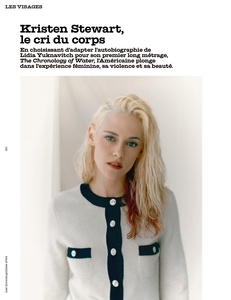
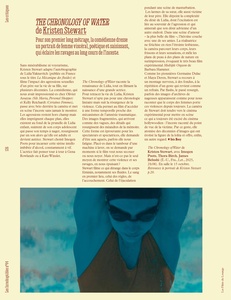
Click on image for a readable view.
Google translated
Author of the important essays “The Female Gaze” and “The Culture of Incest,” Iris Brey met Kristen Stewart on the occasion of the theatrical release of “Chronology of Water.” A dialogue about traumatic memory, the development of the right language to evoke rape and incest, and the reappropriation of one’s desires.
Iris Brey – When I saw your film, I was shaken. It was as if the concepts I've been working on for several years—the female gaze and incest culture—were appearing on the big screen. Thinking back to the filmic form of your work, I thought it might be similar to how traumatic memory operates: a fragmented resurgence of a memory, anchored in impressions rather than a linear narrative. I was wondering if this was something you and your editor had in mind?
Kristen Stewart – The whole film is about iterations, because every time you remember something, it changes a little bit. Then, when you put it into words, it changes even more, it becomes even more subjective: no two people remember a memory the same way. Audiences, especially where I come from [the United States, editor's note] , absolutely want to know what's going on at every moment. I wanted the film, as a whole, to be like that: to start off quite chaotic, because the heroine's memories were too hot to approach, too raw to process, not yet written down. You don't always know why you feel so bad, and there's a kind of DMT trip—not that I've ever tried that—but you know, like what happens before you die, when your whole life flashes before your eyes. Those were the things she was trying to grasp in the darkness of her pain and trauma. Besides, I need to find new words to stop repeating “pain and trauma” when I talk about the film.
In terms of editing, the script had been written with great precision. Yet, there was no way of knowing if the images we were going to capture would be the best, the ones that grab you by the guts and correspond to the experience that the actress Imogen Poots was having. Because I think a real, exact regurgitation of the book wouldn't have worked. The book itself is a series of prosaic images, reflections, commentaries, sometimes direct narration, because it addresses the readers. The author, Lidia Yuknavitch, often addresses us, she addresses herself. But the film had to begin with immersion, and as it found itself, it had to become calmer, with a more direct voiceover. She becomes able to teach others, able to articulate what she had difficulty putting in order at the beginning. So, the beginning was like a prologue that doesn't really exist: the book has an introduction, and then it goes into a very fragmented experience. But it was necessary to introduce the central metaphors, as well as a particular sound and visual language, so that the audience felt held by something – because they were going to be thrown into the blender of a life – and then, at the end of the film, reach a state of contentment and clearer thinking.
So, the script is precise. The film reflects the script, but some images changed, because it was a long research process, I was looking for resonances. Like: she made the same expression here as elsewhere, it sounded the same as in this other scene… Oh, this image looks like another one… Look, this house has water damage in one corner, so we're not going to film through the window, but rather that corner. There were metaphors embedded everywhere in our environment. And the reason I wanted to adapt this book into a film was not only to recreate the experience of reading, but to enlighten us, to remind us that our memories are malleable and that they constitute us. They are the material from which we build ourselves. For me, the most important line in the book is: “What happens to us is true, but writing is a whole other body.” Your experience is yours, it's like clay.
IB – Watching your film, I thought of other pioneers, other experimental filmmakers, Germaine Dulac , Maya Deren, and Barbara Hammer. All these women were bisexual or lesbian, and I thought, as a lesbian too, that sometimes, when we try to tell something outside of patriarchal narratives, we have to reinvent our cinematic language and our codes to find how to tell these stories that have never been heard. Did you feel the need to go towards something more experimental to tell this story of incest?
KS – Yes. Every interview I do begins with: “What's happening to him is very hard. Tell us why you wanted to make a film about incest and rape.” Can you imagine how difficult it is to answer that question? I was lucky enough to make a film about someone else, but we're not encouraged to listen to ourselves anyway. I don't want to generalize, I find it sterile to say “no one listens to us,” but the reality is that I couldn't make this film for eight years. I had to leave the United States to make it, and I have a warm welcome in France. But I guarantee you that won't be the case when I present this film at home. People keep telling me it's unsaleable. The feedback we got from people and places that are known for loving independent cinema, who support writers and artists, was: “We have no idea how to sell this, we’ve barely been able to watch it.” All men. Because it disgusts them, because they find it disturbing. They just don’t want to see it and watch it.
IB – Having analyzed the representation of incest in American cinema since the 1920s in The Culture of Incest , you are the first to give us the perspective of a female survivor and make us feel her experience over several decades. There was Lee Daniels ' film Precious (adapted from Sapphire's novel Push ) before you, but your story is completely different, your directorial choices too, since you leave the incestuous acts off-screen. It's amazing what you've accomplished, and I know how difficult it must have been, because it's a story that no one wants to watch.
KS – I spent all my nights in my kitchen thinking about this film, dying inside, because I thought I was ruining it, because I wasn't given enough resources to make it. It was attacked from all sides, and I was thinking, "What's going to happen if I don't stamp my foot? I'll never be able to do it again, because I messed up, because I missed the opportunity." But in fact, it wasn't my fault; it was because I was told I didn't have the right to make this film. And it's not a question of ego. I was lucky enough to have this book in my hands and the immense luck of being able to make a film, which is already an almost unreal privilege. But what I was going through wasn't about me. I wasn't crying because people weren't going to like my film. I cried because I was afraid of dropping the most precious thing I had ever held in my hands. Today, I realize that this film could not be missed. Because certain images spoke for themselves. I actually think it's quite successful, damn, I love it anyway! And of course, we have to break the film form: narratives about the self have always been excluded from the literary canon. Autobiography is considered not to be great art.
IB – When it’s written by women.
KS – Exactly, only when they're women. Men's confessional writing is the law everywhere. But if a woman says, "This is my diary," she's told that it's not art, it's not literature, it shouldn't be considered canonical. It's a huge problem. One of my favorite writers is Kate Zambreno. Women write in fragments because we're slashed. Because we're lacerated, our writing echoes the treatment we receive, and refuses to fit into expected forms that would allow access to funding or entry into art history. I fully expected this film to be rejected. I didn't change my approach, because I thought, "If they hate it, it will underline its necessity even more." And finally, some people like it, which is great and I didn't expect that, because I'm a little surly, because that's what happens when you live in this world.
IB – Your lesbian sex scene reminded me of Barbara Hammer's film Multiple Orgasm . It's an experimental film where we see a woman masturbating with superimposed images of rock formations, stalactites in a cave, there's a real mix of textures and I thought you were paying homage to it with your scene.
KS – Oh wow! No, I've never seen it, but I understand. I think it's a real thing. I saw another film recently with intertwined legs, and then there were these eight-millimeter shots, a bit flashy, with a nostalgic atmosphere, rocks and water. So it can't just be her who has this idea, and me, and yet another one, it's not a coincidence. These images penetrate our unconscious.
IB – How did you work on this scene?
KS – It wasn't easy, because I wanted it to be openly explicit, without any sense of reserve. I wanted to film it from the character's internal point of view: reversed angles, like we really see each other when we're together. We had a whole visual brief just for that scene, with a special name. We affectionately called it “the girly fuck trip.” And I couldn't get what I wanted. Everything about this film was a struggle. I shot the nature elements after the shoot because we didn't have time. And no one, except me, understood how important it was, so those shots weren't included in the shooting schedule. My editor, Olivia Neergaard-Holm—who is one of the most talented people I've ever met—made this film with me, and we argued every day. And I was trying to make him understand what I wanted. This sort of Dante's Inferno of female bodies overlapping was cool, but it didn't go as far as what this lesbian sex scene implies: namely a form of organic development. When watching it, I didn't want people to think that lesbianism is just an alternative lifestyle that I've chosen. It's where I'm growing up.
And then, if we want to slip into this unspeakable wet dimension, there are very different ways for women to connect with each other. Sexual relations between women are not the same as between a man and a woman. And that's what makes the union between the bodies of two women such an incredible thing. And I know that firsthand! It's this experience that escapes words, of accessing another who resembles you, and this intermingling of bodies, which we never see in the cinema. In my scene, I didn't want us to know who we were looking at, since their bodies merged, like organic matter. They could have grown in the ocean, like algae.
For me, it's the most beautiful sequence in the film. When I watch it, I think: this isn't just a sex scene, it produces something else. And it led to the most fortunate discovery in the film, a total accident. We couldn't have planned the frames for this sequence. I didn't have a precise breakdown. My first assistant asked me how I wanted to shoot the scene. And I replied that we had to find them while shooting. Imogen was exhausted; we'd been shooting for three hours. She was vulnerable, drained. It's as if the scene had split her sternum in two. I turned to her and thought: oh, Imogen is feeling something. I hadn't planned to film the actresses' faces. I really wanted to leave their faces out of shot. And all of a sudden, she started shaking, shivering. I asked her: Are you okay? Do you want to, like, leave? And she said, No, it's weird. I just feel a little crazy. And I was like, Well, sure. That's what's happening. Yeah.
It all started coming out, and we just stood there very quietly watching her. And she goes from this kind of absurd burst of laughter, like she's laughing because she's being released, to all of a sudden, a woman hugs her. And this person who couldn't accept love finds herself embraced. And she broke down. It's like the whole movie just came out of her at that moment. It wasn't in the script. I didn't plan it. I didn't see it coming. It's because we did something for real that something happened.
IB – Speaking of desire, there's also this phrase we hear: "I want to come from somewhere else . " We never see that, victims of violence who recognize that their excitement can be rooted in the violence they suffered. For me, it's not incest that's taboo, but the representation of female desire in our film industry.
KS – Yeah, because if you think about it, we don't have a choice in how we design our desires; they were designed for us. As women, we shouldn't project ourselves, but just remain an open vessel. Things happen to us. And in this world, you don't have to have experienced rape or incest to have your desire ripped away from you in a way that you have no control over and that you don't enjoy. I mean, just… Fuck, pornography has just… destroyed everyone. And every time you're like, "Oh my God, why do I want this?" It's like, "Well, it's not your fault." And shame doesn't have to hurt. You can kind of reframe it and enjoy it. In fact, I'm going to create something around it soon. You should really enjoy it.
IB – I'm sure of it.
Scans thanks to Korita05
Subscribe to:
Posts (Atom)