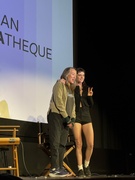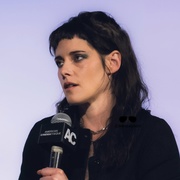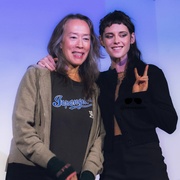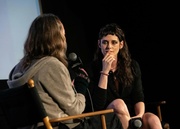



Click on images for a full view.
As featured in the print version of Variety December 2025.
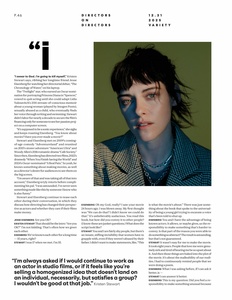
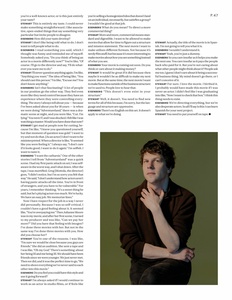
Transcript / Excerpt of the scans above:
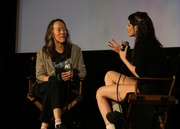
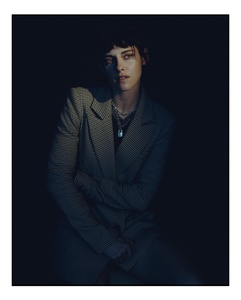
“I swear to God. I’m going to kill myself,” Kristen Stewart says, ribbing her longtime friend Jesse Eisenberg for watching her directorial debut, “The Chronology of Water,” on his laptop.
The “Twilight” star, who earned an Oscar nomination for portraying Princess Diana in “Spencer,” vowed to quit acting until she could adapt Lidia Yuknavitch’s 2011 stream-of-conscious memoir about a young woman (played by Imogen Poots), sexually abused as a child, who eventually finds her voice through writing and swimming. Stewart didn’t labor for nearly a decade to secure the film’s financing only for someone to see her passion project on a computer screen.
“It’s supposed to be a sonic experience,” she sighs and keeps roasting Eisenberg. “You know about movies? Have you ever made a movie?”
Stewart and Eisenberg met on 2009’s coming-of-age comedy “Adventureland” and reunited on 2015’s stoner adventure “American Ultra” and Woody Allen’s 2016 romantic drama “Cafe Society.” Since then, Eisenberg has directed two films, 2022’s dramedy “When You Finish Saving the World” and 2024’s Oscar-nominated “A Real Pain.” So yeah, he knows something about making movies, as well as a director’s desire for audiences to see them on the big screen.
“I’m aware of that and was taking all of that into account,” Eisenberg wryly retorts before complimenting his pal. “I was astounded. I’ve never seen something made like this by someone I know who is also funny.”
Stewart and Eisenberg continue to tease each other during their conversation, in which they discuss how directing has changed their perspective as actors and whether they care if their films make money.
Jesse Eisenberg: Are you OK?
Kristen Stewart: That should be the intro: “Are you OK?” I’m not kidding. That’s often how we greet each other.
Eisenberg: We’ve known each other for a long time — 15 years, right?
Stewart: I was 17 when we met. I’m 35.
Eisenberg: Oh my God, really? I saw your movie 24 hours ago. I was blown away. My first thought was “We can do that? I didn’t know we could do that.” It’s unbelievably audacious. You read this book, but how did you convey it to other people? (I know these are junket questions.) What does the script look like?
Stewart: You and I are fairly shy people, but there’s an innate, stifling invisibility that women have to grapple with, even if they weren’t abused by their father. I didn’t want to make statements, like, “This is what the movie’s about.” There was just something about the book that spoke to the universality of being a young girl trying to excavate a voice that’s been told to shut up.
Eisenberg: You and I have the advantage of being known actors. It allows, or maybe gives, us the responsibility to make something that’s harder to convey. Is that part of the reason you were able to do something so abstract? The result is astounding, but that’s not guaranteed.
Stewart: It wasn’t easy for me to make the movie. It took eight years. People that love me were genuinely sick and tired of hearing me be so upset about it. And then those things are baked into the plot of the movie. It’s about the malleability of our realities. I had to continuously remind people that we were doing a poem.
Eisenberg: What I was asking before, if I can ask it better, is —
Stewart: I can answer it better.
Eisenberg: This is my question: Did you feel a responsibility to make something unusual because you’re a well-known actor, or is this just entirely your taste?
Stewart: This is entirely my taste. I could never make something straightforward. I like associative, open-ended things that say something very particular but invite people to disagree.
Eisenberg: How did your taste develop?
Stewart: I don’t like being told what to do. I don’t want to tell people what to do.
Eisenberg: I read something you said, which I thought was funny and reminded me of myself. Somebody asked you, “Do you think of being an actor in a movie differently now?” You’re like, “Of course. I’ll go to the director and say, ‘I’ll do whatever you want me to do.’”
Stewart: I’ll never question anything again. I’m like, “Anything you want.” The idea of being like, “You should cast this person.” I’m like, “Excuse me? You don’t know anything.”
Eisenberg: Isn’t that fascinating? A lot of people in our position go the other way. They feel even more like they need control because they have an experience where they were controlling everything. The story I always tell about you — because I’ve been asked about you for 18 years — is when we were doing “Adventureland,” there was a dramatic scene at night, and you were like, “Cut. I’m lying.” You were 17, and I was shocked. I felt like I was watching a master. Would you have done that now?
Stewart: I get mad at people now for cutting, because I’m like, “I know you questioned yourself, but that moment of question was gold.” I want to try and not do that. [As an actor] I don’t want to be misinterpreted. When a director is like, “It seemed like you were feeling it.” I always say, “I don’t care if it looks good; I want to do it again.” I’m selfish. I want to taste it.
Eisenberg: “I want the catharsis.” One of the other stories I tell from “Adventureland” was a quick scene. I had my first panic attack on set; I was self-aware in the worst way, and I shut down. After the tape, I was mortified. Greg [Mottola, the director] goes, “I didn’t notice, but I’m so sorry you felt that way.” He said, “I don’t understand how actors aren’t having panic attacks all the time. You’re in front of strangers, and you have to be vulnerable.” For years, I remember thinking, “It’s a sweet thing he said, but he’s pitying actors too much. We’re lucky. We have an easy job. We memorize lines.”
Now I have respect for the job in a way I never did personally. Because I was so self-critical, I couldn’t have a good feeling about it. It seemed like, “You’re overpaying me.” Then Julianne Moore was in my movie, and after her first scene, I turned to my producer and was like, “Can we pay her more?” Did you have that feeling with Imogen? I’ve done three movies with her. But not in the same way I’ve done three movies with you. How did you choose her?
Stewart: You’re one of the reasons. I was like, “I’m sure we would be close because you guys are friends.” She did an audition. She sent a tape and I was like, “Oh my God.” There’s something about her being 35 and me being 35. We should have been friends since we were younger. We just never met. Then we did, and it was the perfect time to go, “We need to shove everything we’ve never said to each other into this movie.”
Eisenberg: Do you feel you could have this style and use it going forward?
Stewart: I’m always asked if I would continue to work as an actor in studio films, or if feels like you’re selling a homogenized idea that doesn’t land on an individual, necessarily, but satisfies a group? I wouldn’t be good at that job.
Eisenberg What do you mean? To direct a more commercial thing?
Stewart: More and more, commercial means standard and digestible. I want to be allowed to make movies that allow for time to figure out a structure and mission statement. The next movie I want to make utilizes different formats. Not because it’s nerdy film stuff, but because it’s more interesting to make movies about how you see something instead of what you see.
Eisenberg: Your movie is coming out soon. Do you think or care about it making money?
Stewart: It would be great if it did because then maybe it wouldn’t be as difficult to make my next movie. But at the same time, the next movie I want to make functions outside of the business structure we’re used to. People love to hear that.
Eisenberg: “This doesn’t even exist in your structure.”
Stewart: Well, it doesn’t. You need to find new terms for all of this because, I’m sorry, but the language and structure are oppressive.
Eisenberg: There’s no English on this set. It doesn’t apply to what we’re doing.
Stewart: Actually, the title of the movie is in Spanish. I’m not going to tell you what it is.
Eisenberg: I wouldn’t understand it.
Stewart: Yeah, you’re just a dummy.
Eisenberg: So you care insofar as it helps you make the next one. You care insofar as it pays the people back who paid for it. But you’re not caring about what other people might think about it? People ask me too. I guess I don’t care about it being a successful business thing. My mind doesn’t go there, or I can’t conceive of it.
Stewart: For sure. I love the movie. I birthed it. I probably would have made this movie if I was never an actor. I didn’t feel like I was graduating into like, “Now I want to check that box.” I think this thing needs to exist.
Eisenberg: We’re directing everything, but we’re also desperate actors. So all I’ll say is this: I can learn Spanish for your next project.
Stewart: You need to put yourself on tape.