Listen to the full podcast here.

Showing posts with label EW. Show all posts
Showing posts with label EW. Show all posts
Monday, March 14, 2022


Friday, October 16, 2020
'Happiest Season' stills plus cast interview for Entertainment Weekly - November 2020
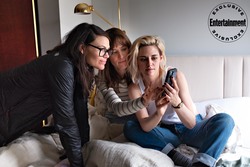
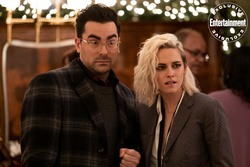
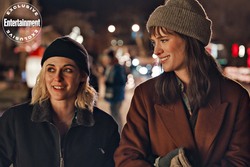
Click on the images for a full view.
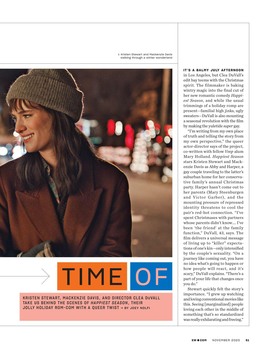
It's a balmy July afternoon in Los Angeles, but Clea DuVall's edit bay teems with the Christmas spirit. The filmmaker is baking wintry magic into the final cut of her new romantic comedy Happiest Season, and while the usual trimmings of a holiday romp are present — familial high jinks, ugly sweaters — DuVall is also mounting a seasonal revolution with the film by making the Yuletide super-gay.
"I'm writing from my own place of truth and telling the story from my own perspective," the queer actor-director says of the project, co-written with fellow Veep alum Mary Holland. Happiest Season (in theaters Nov. 25) stars Kristen Stewart and Mackenzie Davis as Abby and Harper, a gay couple traveling to the latter's suburban home for her conservative family's annual Christmas party. Harper hasn't come out to her parents (Mary Steenburgen and Victor Garber), and the mounting pressure of repressed identity threatens to cool the pair's red-hot connection.
"I've spent Christmases with partners whose parents didn't know.… I've been 'the friend' at the family function," DuVall, 43, says. The film delivers a universal message of living up to "killer" expectations of one's kin — only intensified by the couple's sexuality. "On a journey like coming out, you have no idea what's going to happen or how people will react, and it's scary," DuVall explains. "There's a part of your life that changes once you do."
Stewart quickly felt the story's importance. "I grew up watching and loving conventional movies like this. Seeing [marginalized] people loving each other in the middle of something that's so standardized was really exhilarating and freeing," says the Charlie's Angels star, 30. "There's a lack of confusion and generalization Clea brings [as a queer woman]. I want people to see that two girls in love is just so fun."
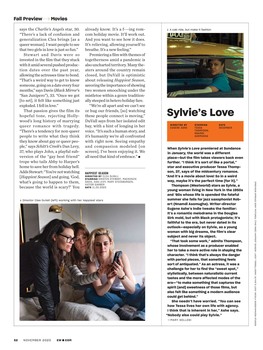
Stewart and Davis were so invested in the film that they stuck with it amid several pushed production dates over the past year, allowing the actresses time to bond. "That's a weird way to get to know someone, going on a date every four months," says Davis (Black Mirror's "San Junipero"), 33. "Once we got [to set], it felt like something just exploded. I fell in love."
That passion gives the film its hopeful tone, rejecting Hollywood's long history of marrying queer romance with tragedy. "There's a tendency for non-queer people to write what they think they know about gay or queer people," says Schitt's Creek's Dan Levy, 37, who plays John, a playful subversion of the "gay best friend" trope who tails Abby to Harper's home to save her from holiday hell. Adds Stewart: "You're not watching [Happiest Season] and going, 'God, what's going to happen to them, because the world is scary?' You already know. It's a f---ing rom-com holiday movie. It'll work out. And you want to see how it does. It's relieving, allowing yourself to breathe. It's a new feeling."
Premiering a film with themes of togetherness amid a pandemic is also uncharted territory. Many theaters around the country remain closed, but DuVall is optimistic about releasing Happiest Season, savoring the importance of showing two women smooching under the mistletoe within a genre traditionally steeped in hetero holiday fare.
"We're all apart and we can't see or hug our friends, [so] watching these people connect is moving," DuVall says from her isolated edit bay, with a hint of longing in her voice. "It's such a human story, and it's humanity we're all confronted with right now. Seeing empathy and compassion modeled [on screen], I've been enjoying it. We all need that kind of embrace."
Digital Scans
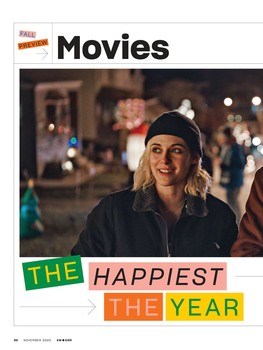
Click on scans for a readable view.
Friday, August 16, 2019
FIRST stills of Kristen in 'Underwater' and interview in EW


Digital Scan
Click on all images for full view.
The 'Underwater' preview is in the September issue of Entertainment Weekly.
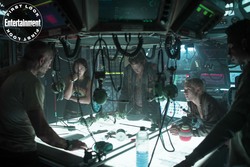
Soon after her big-screen turn as one of Charlie’s Angels, moviegoers will be able to catch Kristen Stewart not in the heavens, but the deep.
The actress stars as one of a group of scientists who are trapped underwater following a devastating earthquake in Will Eubank’s upcoming action-thriller Underwater (out Jan. 10), which also stars Vincent Cassel, Jessica Henwick, Mamoudou Athie, and T.J. Miller (the film was shot in early 2017, before Miller’s fake bomb threat arrest or allegations of sexual assault and workplace misconduct came out against him). We asked Stewart about taking the plunge.
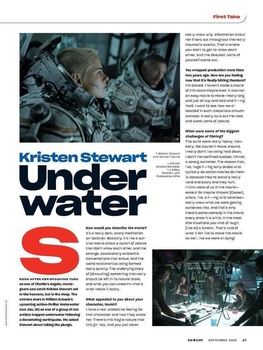
How would you describe the movie?
It’s a really dark, scary meditation on isolation. Basically, it’s like a survival movie about a bunch of people that don’t know each other, and the strange, occasionally existential conversations that ensue, and the weird relationships being formed really quickly. The underlying story of [disrupting] something that really should be left in its natural state, and what you can unearth — that’s what keeps it scary.
What appealed to you about your character, Norah?
I have a real protective feeling for that character and how they wrote her. There’s this fragile nature that this girl has, and you just never really know why. Information about her sort of filters out throughout the really traumatic events. That’s where you start to kind of get to know each other, and the deepest parts of yourself come out.
You wrapped production over two years ago. How are you feeling now that it’s finally hitting theaters?
I’m stoked. I haven’t made a movie of this scale maybe ever. It was not an easy movie to make — really long and just drippy and cold and f—ing hard. I want to see how we all reacted in such precarious circumstances. It really pulls out the best and worst parts of people.
What were some of the biggest challenges of filming?
The suits were really heavy, honestly. We couldn’t move around. I really don’t like being held down, I don’t like confined spaces, I’m not a strong swimmer. The reason that, like, huge f—ing surly dudes who typically do action movies do them is because they’re actually really hard and scary and they hurt. I think none of us in the movie — except for maybe Vincent [Cassel], who’s, like, a f—ing wild banshee — really knew what we were getting ourselves into. And that’s where there’s some comedy in the movie every once in a while; in the most dire situations you kind of laugh in a funeral. That’s kind of what it felt like to make the movie as well. Like we were all dying!
Underwater hits theaters Jan. 10.
Source EW Scan booksmart2019
Thursday, April 11, 2019
First 'Charlie's Angels' Stills + Digital EW Scans


Digital Scans


Untagged Stills


UHQ


Click on stills for full view.
It’s only logical. As Banks puts it, her update isn’t a reboot or a remake of the beloved franchise, but rather a “continuation” that incorporates the events of the original 1970s TV series and the McG-directed 2000s films. And so, she imagines, in the more than 40 years since Charlie assembled his first trio of Angels, he must have given his operation a makeover. “If you were rich in 1976, you only got richer,” Banks, who co-wrote the script, says with a laugh. “Charles
Townsend is richer than ever, so he’s grown the business into a global spy agency.”
His expanded roster includes the crew at the center of Banks’ story: Sabina Wilson (Kristen Stewart), the hard-partying, highly skilled wild card; Jane Kano (Ella Balinska), the ex-MI6 muscle of the group; and Elena Houghlin (Aladdin’s Naomi Scott), the MIT-trained scientist who, Banks says, serves as “the heart of the movie.”
Charlie’s call takes them around the world, with stops in Istanbul, Hamburg, and Berlin, but amid all the globe-trotting, Banks was most invested in showcasing the trio’s teamwork. “It was important to me to make a movie about women working together and supporting each other, and not make a movie about their romantic entanglements or their mother they don’t call enough,” she says. “When I’m at work, I don’t talk about those things. I get on with my job. It felt important to do that for the Angels, to treat them with the respect their skill set demands.” Judging by this first look? Mission accomplished.
WHO’S THE BOSLEY?
Banks, Patrick Stewart, and Djimon Hounsou, that’s who. In Charlie’s history, multiple actors playing multiple characters named Bosley have aided the Angels. To Banks, it felt natural to upgrade the name into a title. “‘Bosley’ is now a rank in the organization, like lieutenants,” she says. “All of the Angels have been played by different women and have had different names, but the Bosley character was always named Bosley no matter who played him. We thought, ‘Well, that must mean it’s more than a name.’” Above, her Bosley helps Stewart’s Sabina gear up.
DRESS TO IMPRESS
It wouldn’t be Charlie’s without Angels going undercover. Here, Sabina (Stewart) suits up at a Turkish derby, where the trio tail a target until “chaos ensues, as it always does,” Banks teases. That chaos, though, won’t look like the over-the-top sequences of the 2000s films; the director says she took a “grounded” approach to stunts: “I wanted to make them distinct from superheroes, aliens, and mythological creatures that are in a lot of action movies now.”
In fact, the Mission: Impossible franchise’s blend of grit and humor inspired her group’s dynamic. “We talked a lot about [those movies],” Banks says. “Those films work best when the team is together, when Ving Rhames is in it, and Simon [Pegg] is in it, and Rebecca Ferguson. That sensibility really matters to me.”
TOP SECRET
When asked what Noah Centineo (To All the Boys I’ve Loved Before’s breakout star) is doing in this scene with Balinska’s Jane, Banks gets tight-lipped. “I don’t want to give too much away about Noah,” she says of his character, Langston, “but he’s a friend mostly to Naomi’s character.” The Angels clearly have plenty of allies, but that doesn’t mean they can’t accomplish their goals on their own. “I mean, women can do anything,” Banks says. “That’s not just my personal belief. That’s the core belief of Charlie’s Angels.”
POWER-FUL REUNION
The last time Banks collaborated with Scott, in 2017’s Power Rangers, she played supervillainess Rita Repulsa to Scott’s Pink Ranger. This time, they’re on the same side: Banks costars as one of the Bosleys (see above) assisting Scott’s Elena, who plays a pivotal role in catalyzing the central mission. “I wanted somebody who I felt the audience wants to root for,” Banks says of casting Scott. “She’s getting to be this Everywoman who’s also very fun and very funny.”
GIRL POWER GALORE
Banks’ film marks the first Charlie’s entry on the big screen to be helmed by a female director. “It’s a really exciting moment for female-driven films,” she says, citing Wonder Woman and Captain Marvel as recent examples of box-office successes. “Audiences are really looking for those aspirational stories about real and relatable characters, and I think the women in my movie are definitely real and relatable, but most importantly, I think they’re really fun.”
They’re certainly having fun: Just look at Sabina’s array of wardrobe (and identity) changes across these photos. “I wanted Kristen to show off a side of herself you don’t often see in her movies,” Banks points out. “She’s really funny in this.”
John Forsythe, the voice of the Angels’ enigmatic boss in the ’70s series and the 2000s films, passed away in 2010. But don’t worry: Banks has a plan for her installment’s Charlie. “The voice will sound very familiar to you,” she teases. “We tried to emulate John Forsythe’s voice as best as we could. We want a real sense of continuity in the movie.” After all, as seen in the image above, the Angels answer the call.
Charlie’s Angels takes flight November 15.
Source
Digital Scans/ Untagged Stills Korita05
UHQ Gossipgyal
Friday, September 7, 2018
Kristen's interview with Entertainment Weekly for 'Lizzie'

Craig William Macneill’s Lizzie (out Sept. 14) slices down to the bone of speculative history with his feminist reframing of the mysterious Borden family murders, which suggests the infamous suspected murderess (Chloë Sevigny) actually rebelled against her father’s abuses with her Irish maid-turned-lesbian lover, Bridget, played by Kristen Stewart, who explains to EW why patriarchal oppressors should heed the film’s bloody warning — and how the project avoids dressing its central lovers in same-sex cinema clichés.
So, sex in a pigeon coop and bloody murder: this is the feel-good romance of the year.
[Laughs.] Hell yeah!
Lizzie’s story has, in reality, become a pulpy, almost cartoony legend over the years, which kind of dehumanizes it. Do you think this film reintroduces a missing human element?
I think it’s transformed from salacious, media-frenzied, true crime into folklore. Everyone knows the headline, but it’s nice to look inside and read the piece and consider there were a lot of details that added up…. She was really mad. Something must have pissed her off. She’s not just out-of-her-mind crazy…. I’m not encouraging that we empathize with murderers. I never think being super violent is necessarily the answer for anything. But it is cool to take a story that everyone is so familiar with on a really black-and-white level and breathe life into it.
Is there a punk-rock rebelliousness to it all, given all the twisted liberties you take in this film?
Definitely…. I went to Savannah [to shoot] two days after Trump was elected. These very loud conversations that are happening now were not necessarily at the forefront of everyone’s newsfeed on their phone. It wasn’t something that was so persistently in the press right now. So yeah, I think when we made the movie we were like, God, imagine two women who have these gaping voids, and they recognize that in each other…. Their instincts are so opposing but they fill each other’s voice in this way that bolsters each other enough to kind of go, actually, I’m done being taken advantage of and utterly controlled with absolutely no options for the rest of my life. I’m basically a prisoner in my own household.
It’s entertaining and it’s a tragic love story. Everyone’s into true crime, everyone wants to know how somebody could be capable of something so heinous…. But for this movie we’re not empathizers, but we are just saying that it was a lot harder to live then as a woman, and we’re still gunning and fighting and acknowledging things for the first time, so it’s kind of trippy to imagine: What did ‘gay’ look like then? What did it look like for young women to have really warm, transcendent feelings with pheromones flying between them, and support they’ve never even imagined from another person? And yet they’re wearing corsets and [Bridget is] sweeping the floors and being taken advantage of by [her] employer. Imagine all the different stories that have been told but completely partially.
Chloë told me she wanted to bring down the patriarchy with this film. Did you channel any rage against the patriarchy into your performance?
[Bridget is] conflicted about her natural feelings and she’s not as outspoken as Lizzie because she doesn’t, in her mind, have that right. She comes from extreme poverty; she’s totally displaced in America. She’s completely and utterly alone. When she meets Lizzie…. there’s a spirit coaxed out of her because of their mutual recognition…. I never got to taste that [rage] because I was playing somebody who was entirely subdued. Theoretically speaking, yes, absolutely I wanted to be a part of this movie because you see these two girls who are entirely oppressed and unable to breathe and being strangled. Choice isn’t even a word that probably exists in the realm of their vocabulary…. Even though it doesn’t end super successfully for either of them, just being able to watch two people who are not allowed to f—ing be and just feel okay or happy for just one second, just share a few moments and kind of breathe together as one is, to me, so triumphant.
Bridget does deal with issues that are in headlines right now: She’s sexually assaulted by Andrew and is reluctant to speak up about it in fear of losing her job. I know you’re not trying to empathize with murderers, but in the twisted world of this movie, are the murders justified since Lizzie’s father is an abuser?
I don’t want to mince words and say it’s obviously why Lizzie had to kill him. I’d never justify violence, but we’re all animals. If you corner an animal after locking it in a cage and doing bizarre things to it, what do you think’s going to happen? It’s going to bite back. It’s satisfying to see that turn…. Theoretically, it’s total justification. Lizzie wasn’t an evil, crazy monster; she was an abuse victim.
The infamous murder scene takes place in the nude. How did you feel about that?
I love that detail…. The fact that we see her carry out this murder fully in the nude, she becomes feral. She becomes an animal. She’s visually, strikingly female in that moment, and also strikingly strong…. The image of Chloë’s face, checked out, turned off, carrying out this murder with blood spattered on it while you see her full tits out — you better watch out, dude!
It’s interesting to me because the sex scene is fully clothed, and it’s not until the murders that they bare their bodies.
We were never inserted into overly beautiful [scenarios]. We were never like, “Okay, then your corset bursts open!” Of course it doesn’t burst open! It takes, like, 10 minutes to take off, so if we’re going to f—k, we’re going to do it with our clothes on! That intimacy level, that sort of hushed, quiet, whispered exchange they have, [fits]. It was present and honest. Same with the murder scene: They couldn’t wear clothes because blood would get on them, so they had to take them off. [But] seeing Chloë naked with an ax…is so representative of what this movie is about. Conversely, us in our clothing while being intimate is trying to get under these binds, trying so hard to just get one inch of space closer…. we realized what’s sexy is the immediacy of not taking our clothes off.
How did you guys approach presenting the same-sex relationship intimately, but not sexually exploitative?
Naturally, from an insider’s perspective. [It’s] a queer story line in a movie that doesn’t define the movie in its entirety — it’s f—ing cool to make movies that are nuanced, layered, and true to life rather than taking something that matters to me and making it cliché and broad. That gets under my skin; I hate seeing it presented that way. [For them] the word ‘gay’ doesn’t factor. It’s an instinct that doesn’t have a name.
Chloë and Bryce said they had spiritual encounters with a few ghostly presences before and during filming this movie. Were you spared from that?
No, I was never visited. [Laughs.] I totally believe Chloë had a really trippy experience…. she had a disturbed night and couldn’t sleep, and she was positive that it was Andrew being like, ‘No!’ I, on the other hand, didn’t have any specific experiences. When you do a movie about a real person — especially if they’re no longer living — it’s like that thing where…. you wonder if they can see you pick your nose or something. You wonder how they’re overlooking you…. any little gust of wind, Chloë was so consumed like, oh, that must be Lizzie!
Well, if the spirits do visit you in the future, hopefully it’s to say you did a great job on the film.
God, I hope so!
This interview appears in the print version of the magazine with Captain Marvel on the cover.
Source
Friday, April 6, 2018


Friday, June 10, 2016


Wednesday, February 26, 2014
New Sundance 'EW' portrait

Full scan

Scan thanks to @clairelaluna
Wednesday, February 20, 2013

Saturday, September 29, 2012


Subscribe to:
Posts (Atom)