
Wednesday, January 26, 2022


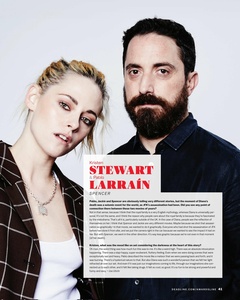
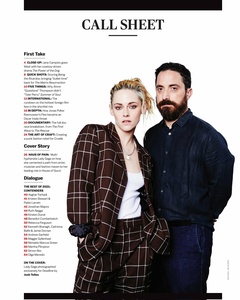
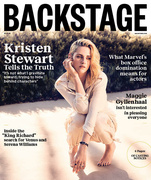
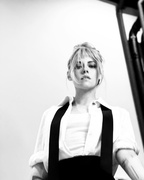
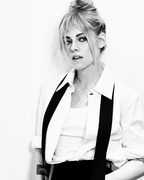
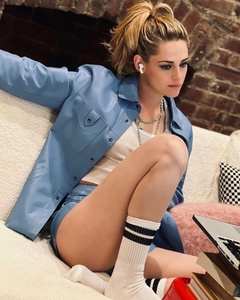
Kristen on the cover of Backstage with new interview - January 2022





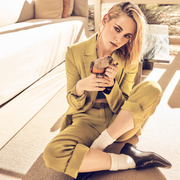


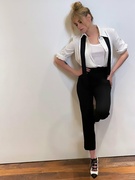
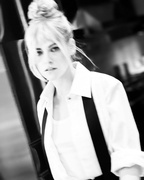
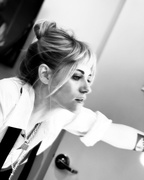
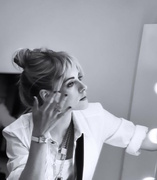
Outtakes
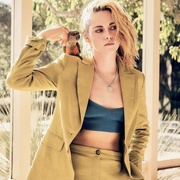
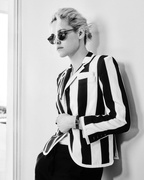
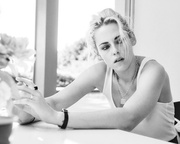


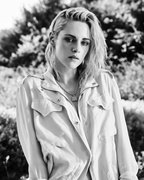
Digital Scans
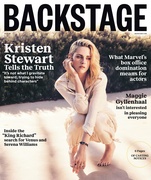

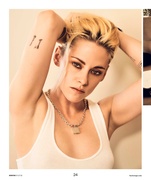
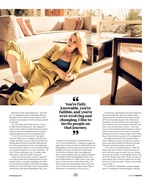
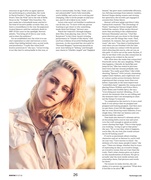
Click on photos for full view.
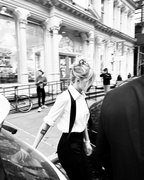
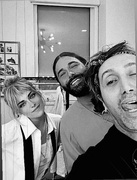
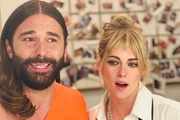
BTS
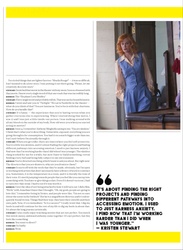
The last interview of the last day of her relentless “Spencer” press tour has finally arrived, and Kristen Stewart is somehow still not tired of talking about acting. The self-described “movie nerd” is at her most animated when she’s wrestling with the most nitty-gritty questions about her craft—like whether actors can truly, fully disappear into their roles.
“There’s losing yourself in a character, and it’s really common for actors to say, like, ‘It’s about getting the closest to this person as you can,’ ” she says, then gestures, reaching for the next thought. “But I think in doing that, you’re getting the closest to yourself.”
Stewart understands why some, when discussing a particularly transformative performance, might opt to distance or obscure themselves. “It’s a slippery slope,” she acknowledges. “You open a door, and you start articulating the fact that this is really vulnerable and really personal. You open yourself in a way that’s a little scary.
“Look, I’m totally not coming for people who sidestep this question and say, ‘No, I disappear into the role. It has nothing to do with me,’ ” she clarifies. “It just doesn’t make sense. It’s totally an illogical answer. Like, how could you possibly be anyone but yourself?”
Few people seem as fully themselves as Stewart. She treats a photo shoot at a lavish house in the West Hollywood Hills—complete with eye-poppingly chic clothing and, at one point, a colorful pet bird—as just another day on the job. Tomorrow, she’ll fly to Vancouver to film a new project and put a pause on promoting her work as Diana Spencer, Princess of Wales. “Spencer,” Neon’s horror-biopic from director Pablo Larraín, has earned Stewart film festival honors and leading actress nominations at the 2022 Critics’ Choice and Golden Globe Awards. But for now, she’s sipping celebratory Champagne out of a plastic cup and giving her full attention to the discussion at hand.
But back to her rant about how—and how not—to approach acting. Although Stewart hesitates to give fellow artists advice, she’s certain on one point: If you’re losing yourself, you’re lost.
“It’s not what I gravitate toward, trying to hide behind characters,” she explains. “I really want to bare myself and feel revealed and discovered through the lens of cinema and through this sort of new perspective.
“Even if you’re not an actor,” she adds, “anyone who’s not a complete and total narcissist, basically, you use these curiosities to bridge gaps between [yourself and] your fellow man. [Actors] just do the most elaborate version of that, where we try and think about it, we make it physical, we do it sonically—all of it. It’s just thinking, God, I wonder what that’s like. That’s the whole endeavor.”
That’s one of the many reasons “Spencer” can still provide fresh talking points for her months into an awards campaign. The film is an extreme example of that kind of imagination; it’s a jazz riff that’s more interested in emotional truth than biographical fact, and it leads to as thorough a transformation as we’ve seen from Stewart. Taking the opposite approach of many womb-to-tomb Hollywood biographies, Larraín and screenwriter Steven Knight narrow in on Spencer’s separation from Prince Charles (Jack Farthing) over three claustrophobic days at Queen Elizabeth II’s (Stella Gonet) Sandringham House. The movie bills itself as a “fable from a true tragedy.” As Stewart says of the film’s take, “To distill a person and examine their truest colors in a state of trauma makes sense. Those times are so revealing of who you are.”
In this case, she doesn’t just mean Spencer. Her extraordinarily physical, impeccably made-up and costumed performance pulls off that cinematic magic trick wherein an icon plays an icon; but Stewart’s mission to use a character to reveal more of herself was put to the test like never before. “The only way I can be truthful about Diana is to focus solely on my perspective of her. If you start playing everyone’s version of her, you’re playing a watered-down person. It’s a nonperson.”
Her approach makes for a performance that’s balanced by precise gestures, expressions, and speech patterns filtered through Stewart’s greatest acting tool: herself.
“I bet you, if you did full side-by-sides [of Diana and me], we don’t walk the same; we don’t talk the same; we don’t do everything the same at all. But I was inspired by her. And all of the things that I did, I think, say just as much about me as they do about her. It’s the both of us,” Stewart says. “There was a melding of souls.”
The child of a filmmaker–stage manager and a TV producer, Stewart began working onscreen at age 8 after an agent spotted her performing in a school play. Her work in David Fincher’s “Panic Room” and Sean Penn’s “Into the Wild” led to the role of Bella Swan in the “Twilight” film franchise. The part made her a household name and led to the kind of invasive public scrutiny that, yes, bears a resemblance to the way the paparazzi treated Spencer until her untimely death in 1997. Of her years in the spotlight, Stewart admits, “You bring all of this to your work, and so does the audience.”
For an established star, the trick is to use one’s reputation to color and texture a story rather than hiding behind voice, accent work, and prosthetics. “I really like when [well-known actors] use it,” she says, “versus trying to act like they’re untouchable in this way, or they’re unknowable. I’m like, ‘Dude, you’re not unknowable!’ You’re fully knowable, you’re fallible, and you’re ever-evolving and changing. I like to invite people on that journey, and it’s all evident in my work.”
Actors who aren’t yet familiar to audiences can do this, too. “It starts with one person wanting to get closer to why something made them feel things,” Stewart says.
Watch her trajectory through independent film, from playing Joan Jett in “The Runaways” to her César Award–winning performance in “Clouds of Sils Maria,” and you’ll see evidence of an artist finding herself onscreen. As she excavated her own grief in “Personal Shopper,” harnessed paranoia as actor Jean Seberg in “Seberg,” and brought easy charm to “Charlie’s Angels” and “Happiest Season,” she grew more comfortable offscreen, too. Defying warnings from industry insiders, Stewart began dating women and owning her queerness; she recently got engaged to screenwriter Dylan Meyer.
Stewart will next adapt and direct Lidia Yuknavitch’s memoir “The Chronology of Water,” making her feature-length debut behind the camera. What excites Stewart more than anything is the collaboration between filmmaker and star. “I feel like great directors get you closer to the things you want, not the things they want. Then, somehow, by osmosis, they get what they want,” she says. “You share a fucking heart. And when you are finished with the take and you make eye contact with the person who’s directing this movie, who set you on this path—if you’re not at the same rhythm, if they’re not there with you, [the connection is] not going to be evident in the movie.”
How often does she make that connection? Practically never, she says, laughing. “When that happens, I literally do backflips and jump for joy.” (She has stated in previous interviews that her résumé probably only includes “five really good films.”) But while shooting “Spencer” with Larraín, cinematographer Claire Mathon, and a tight-knit crew at various castles across Germany, Stewart experienced that synergy more than ever before. Especially in the semi-improvised “controlled chaos” opposite the young actors playing Prince William and Prince Harry (Jack Nielen and Freddie Spry), she says, “everything just started vibrating…. It’s so sacred, the moments that we are rolling and the moments that I am attempting to channel the things I’ve learned.
“As composed as the movie is, it was a mad dash. It was always that we prepped and prepped and fucking prepped. And then once we got there, it just felt like juggling water—like we were throwing water balloons. Every single time, I felt that our balance and connection held the content.”
That leads into Stewart’s ultimate advice on becoming both a movie star and actor: Love the craft enough to spend an entire career chasing that high. “This is what keeps you working—trying to get to that point,” she says. “It’s so rare that, when it happens, you’re like, Oh, my God, this would sustain me for 10 fucking years!”
If you’re as passionate about creating characters and art as Stewart is, you’re well on your way. “I love movies so much—the alchemy of it, how many people it takes,” she says. “There are things, whether they’re ways of expressing an idea, an evocative image, an evocative sound, that are truer than the truth. That’s what cinema gives us; it gives us this manifestation of dreams. We get to actually take the most inside notions and externalize them, find pictures and words for them.”
The reason we make movies, she concludes, is to answer one question: “What does it feel like to be alive?”
-------
Kristen Stewart is a bona fide movie buff. When asked for her go-to performance for acting inspiration, she starts listing them without drawing a breath. Plus, she has a wide taste range: Stewart studies Liv Ullmann in Ingmar Bergman films, but also considers her friend Paris Hilton a great actor—“a genius one,” she says—and recommends her documentary “This Is Paris.” Here, the “Spencer'' star shares her love-hate relationship with auditioning and reflects on her child acting years.
How did you get your SAG-AFTRA card?
I was little, I don’t remember exactly. I did a couple commercials that didn’t add up for me to get it at first. So I think it was my first American movie: “Panic Room.” Unless it was through AFTRA, because I worked on that movie [“The Safety of Objects”] in Canada.
Your first official credits are the Disney Channel’s “The Thirteenth Year” and “The Flintstones in Viva Rock Vegas.” Did those help on the path to becoming a professional actor?
No, those were where I was on a set with my mom for one day and the director was like, “Go stand over there, kid.” Those weren’t actual jobs!
Is there anything you wish you knew at a younger age? Advice you would give your younger self?
Dude, school sucks. School is hard. And it’s scary. And it’s intimidating. And it’s like you can’t learn at your own pace and whatever. Sometimes you feel fast, sometimes you feel slow. And then you meet that one teacher where you’re like, OK, so this is the right feeling. I’m getting to know myself and I’m getting to know the world in a new way. And then for five years, you have shitty, weird teachers! [But] you always think about that one.
What kinds of lessons do you take with you from each different role?
It’s hard to be specific, but each project fucking propels you in whatever trajectory you go in to next. It’s impossible to describe what those things are! I just know that it was away from where I was before.
What’s one performance every actor should see and why?
Liv Ullmann in “Persona.” And if you’re going to go American to be a little bit more relatable, Gena Rowlands in “Opening Night.” Everyone says “A Woman Under the Influence” and there’s a reason everyone fucking says that. But if you’ve already gone there, go to “Opening Night” from there.
How do you feel about auditions? Do you have a worst audition horror story?
Oh, they’re so bad. The thing is, they’re all really bad. But I also love them. I’m now in a position where I’m making other people come in and audition for the movie that I’m working on, and it’s so vulnerable. It is so hard. It is so embarrassing. It is such a leap of faith. It’s a leap into nothing very good! It’s always that you hope that someone can see something that, in a different light, will exist. But in here, in this weird, fucking, drywall room with a video camera, it’s such a weird process. People that are really good at auditioning blow my mind; I don’t think they’re actually great actors. I’m always looking for something that actually is like, not that they’ve done the scene well, but that you’ve just exhibited some truthful thing that feels unruly and pure and honest. Pure and worth exploring versus, like, Oh, you’re good in this room. It’s such a strange environment. But in terms of bad experiences auditioning, all of them. Even the best ones are fucking horrible.
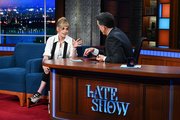
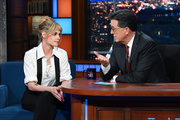
Vdeo: Kristen and Nicole Kidman's Variety 'Actors on Actors' interview
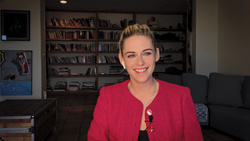
BTS via Jillian Dempsey | Tara Swennen
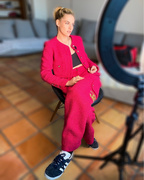
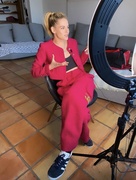
Digital Scans
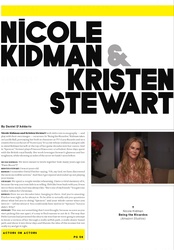
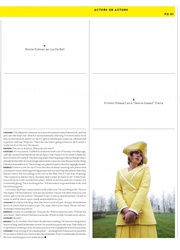
 Scans
Scans
Click on all images for full view.
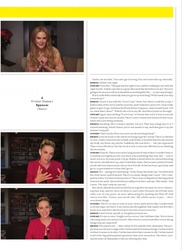
Nicole Kidman (“Being the Ricardos”) and Kristen Stewart (“Spencer”) sat down for a virtual chat for Variety’s Actors on Actors, presented by Amazon Studios. For more, click here.
Nicole Kidman and Kristen Stewart both delve into iconography — and play with their own images — on screen. In “Being the Ricardos,” Kidman takes on Lucille Ball, portraying her both in character as TV’s Lucy Ricardo and as a creative force on the set of “I Love Lucy.” It’s a role whose resilience and grit calls to mind Kidman herself, at the top of her game decades into her career. And in “Spencer,” Stewart plays Princess Diana over a turbulent three days spent with the British royal family. Her work leverages Stewart’s glamour and her toughness, while showing us sides of the actor we hadn’t seen before.
NICOLE KIDMAN: We were meant to work together how many years ago [on “Panic Room”]?
KRISTEN STEWART: I was 10 years old.
KIDMAN: I remember David Fincher saying, “Oh, my God, we have discovered the most incredible actress.” And then I got injured and ended up not playing your mama.
STEWART: We spent a couple weeks rehearsing. I have a vivid memory of it, because the way you treat kids is so telling. I felt like I was buds with you. It was two or three weeks, but I was always like, “She’s one of my friends.” You gave me walkie-talkies for Christmas.
KIDMAN: Here we are decades later, hanging in there. And you’re amazing; Fincher was right, as he always is. To be able to actually ask you questions about what led you to doing “Spencer,” and your whole career since you were 10 — tell me about it. You could easily have said no to “Spencer,” but you didn’t. Why?
STEWART: This was not something that I overthought, because as soon as you start picking this one apart, it’s easy to find reasons to not do it. The way that Pablo Larraín had presented the idea to me was that we were going to attempt to know a version of her through a really selfish path, a really desire-based path, and shove it into three days and liberate the idea of this woman but not really try and get it right.
And so, he was like, “You can’t get it wrong. You can’t mess this up, basically.”
KIDMAN: And he was right.
STEWART: I was like, “This guy has the right voice, and he’s talking to me with the right words. And he says this is a great idea and that he believes in me.” If you’re going to be an actor still, you should do something like this — or just stop doing it.
Was Lucille Ball somebody that you grew up watching? What made you step towards her?
KIDMAN: I knew Lucy and the “I Love Lucy” show, but when I read the script, I had no idea of her story and her journey, and I related to parts of it. I was really game to give it a go. And then the flood of fear, I suppose, came in and I went, “Oh no, what have I done?” Which I do a lot in my life, and then I push on through.
STEWART: I grew up watching “I Love Lucy,” so I know that voice. It was so surreal to hear it pop out of your mouth. There’s a less-rehearsed version of that voice, when she’s just being a human.
KIDMAN: Smoking. She’s a heavy smoker. I’m not. That was a huge key to it. I started smoking, which I know you’re not meant to say, and then gave it up the minute I stopped.
STEWART: That’s lucky. Were you nervous about being funny?
KIDMAN: I was nervous to the extent of trying to get her sound. There’s a rhythm to Lucy. I had to lean into the sounds, and slowly, it would wash into my mouth, my body, my brain, my psyche. Suddenly she was there — she just appeared. Then it was effortless, but the work it took to become effortless was climbing the mountain.
STEWART: Exactly. There was such a long period of time where I couldn’t hear it. I could do an English accent, but there was something that was, like — you’re never not you. At some point, I let go. Maybe a week before we started shooting the movie, she did show up, and I could fully relate. She became a kind of friend; you do the best impressions of your best friends. At the last hour, I got lucky and got it, or got whatever it was that I got to.
KIDMAN: Yes — giving over and saying, “Gosh, I hope she shows up.” I would watch her interviews, and I learned. There’s so many things that I went, “Oh, I completely relate. I’ve been in that position.” There was an alignment that happened between her and I; Aaron [Sorkin] would just sit there and say, “Mm-hmm.” And I went, “Oh, that’s why he cast me.”
But Javier [Bardem] and I would Zoom together because we were rehearsing that way, and we were no help to each other because we’d freak each other out. At one point, we were advocating for pushing the film off. And Aaron was like, “Listen, you can do this.” My whole career is just — don’t overthink things.
STEWART: There’s no way to look at your career path and be like, I understand a certain logic, but there is an emotional throughline that makes me feel like I know you, and that’s the best way to become close to an actor.
KIDMAN: I don’t know myself, so I’m glad you know me.
STEWART: It’s my version. I might not be correct, but I still have that. You’ve been choosing such cool movies forever. Has it been a concerted effort in not doing things that are expected?
KIDMAN: The experience — that’s what we live and die with, ultimately. The people that you choose to align with. I’m fascinated in human beings. I’m fascinated in what it means to be alive. I’m fascinated in what it means to die. I’m fascinated in all of the big philosophical questions that orbit around us. Therefore, I primarily seek out filmmakers that are delving into that.
I’ve circled things that are lighter fare too. “Moulin Rouge!” — it was so difficult, but I wanted to do a love story. I was putting it out there going, “Please, let me creatively do a love story.”
STEWART: I watched that movie in the theater with my mom. I was so obsessed with that movie. I knew every single word of that one track that was incredibly long.
KIDMAN: The “Elephant Love Medley.”
STEWART: Every single word and probably still do. That was such a beautiful movie.
KIDMAN: I went and saw you in “Twilight.” We sat in Nashville in the theater — what do you think of that? You are luminous. You’re born with that charisma. How do you handle that?
STEWART: It’s funny — the experience that you’re having versus what you gather everyone else is experiencing. When I started doing that movie, I was 17 and I was just a little inside-out person. I was walking around with all my blood on the outside of my body. How old were you when you started acting in movies?
KIDMAN: I was 14. I remember Anthony Minghella saying to me, “You are skinless.” I think that’s what you’re describing. Vulnerable, exposed, everything you are going through is for consumption. You had it on a much bigger scale than me, but I can’t believe I’m actually through it.
STEWART: When you get older, there are times where you feel self-protective. You’re a little less skinless, and it’s about finding the right projects and finding different pathways into accessing emotion. I used to just harness anxiety. I find now that I’m working harder than I did when I was younger. The skinless thing worked for me for a while, but now I have to build something, versus fielding every ball and being fully subject to my environment.
KIDMAN: You’ve directed one thing, which I want to ask you about. But right now: The directors that you are drawn to, why are you drawn to them?
STEWART: It starts off with the work that they’ve made, obviously, but I’m open to working with artists that don’t necessarily have a library of work to convince you. Sometimes, it is the temperature in a room, and it is literally the tone of their voice. It’s worth jumping towards people that you feel like you can tap into something with. You have to give things a shot. Even if it doesn’t turn out, I had to turn over that stone. I had to see if it was worth it.
KIDMAN: I love the idea of not being attached to how it will turn out. I did a film, “Birth,” with Jonathan Glazer that I thought, “Oh, my gosh, people are going to love this.” I remember being in Venice, and people were like, “I’m not so sure about the scene in the bathtub.” But he is a magnificent director, and it’s subsequently found its way. Things find their way; they have their own life and their own path. Now, it’s so immediate: “Is it a success?” I really resist that. I dig my heels in and will continue for the rest of my life to dig my heels in about that. It’s about the long journey artistically.
STEWART: I also really enjoy watching movies that are not perfect. You watch this weird, messy, awkward alchemy come together: It’s not perfect, but this feels like something.
KIDMAN: You want to direct?
STEWART: So badly.
KIDMAN: Wow.
STEWART: I’ve adapted a memoir by a novelist named Lidia Yuknavitch, and we just cast the lead role, which is monumentally relieving. I’ve been alone with this, in this vacuum, and it’s so nice to give something to someone, a friend and a partner, and say, “Help me.” She’s the one who’s going to have to do it, and it’s really hard, so I’m over the moon.
KIDMAN: You are so fearless. When do you start?
STEWART: It’s in process. I talked to someone with a lot of money two days ago, and she seemed excited about the prospect, but I want it to be small. I think the best version of it really is. The freezing water that I’m going to throw this girl into, I already feel terrible. It’s such a huge ask to invite someone onto this particular thing. I think you would love it. The writing is so physical and so fiercely, ragingly female.
KIDMAN: Is there a role for me? I love the idea of always moving into places that you haven’t been, and supporting people that are moving into places that they haven’t been. I’m not asking to be cast in the film, but it’s my way of saying, “The support is always there, because that’s what we have to do.” Otherwise, you end up in some rarefied-air place, which is not fun and not creative. It’s constantly going, “I’m a working actor. Tell me where to go and what to do, and I’m following you.”
I recently had that conversation with a director I’m working with. “You’re the leader; I’m the follower. You are my mother. I know I’m older than you, but you’ve got to be the parent.” Because I can’t come in and dominate. I want to come in and be there, open, ready and available for you.
STEWART: It’s the best feeling. I bet that there’s a bit of a jaw-droppy intimidation factor at times, and you have to go, “No, man, this is your show. Please tell me.” And that’s when you thrive.
KIDMAN: I waver in confidence. You just do. When someone says, “Follow me over here,” that’s when I feel most at home. Which is why I would never direct.
STEWART: Really?
KIDMAN: No. It’s terrible. I don’t have the decision-making. I’ve been working since I was so young, and I’m decades in now. I’m wired in a particular way. That’s why it’s so good you’re doing it now, because you won’t be completely wired in one area.
STEWART: Your wiring is very haphazard — nothing feels rehearsed or planned. It’s so easy to follow you, but it is also like whiplash. Don’t try and make decisions. We love watching you not make them.
Source: Variety Transcript Scans: Gossipgyal
Tuesday, January 25, 2022



Monday, January 24, 2022
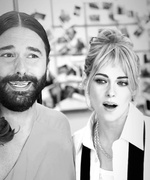
Video: Kristen on Live with Kelly and Ryan - 24 January 2022
BTS via Adir | Tara
Click on image for full view.
Official Videos
Please note the full video originally posted has been deleted by YT.
Subscribe to:
Posts (Atom)