
HQ
















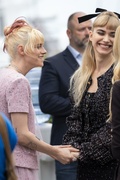


















































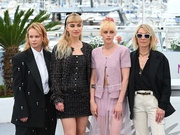























































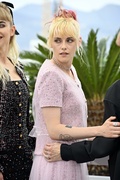
































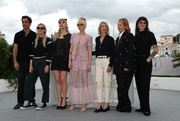


































































































































































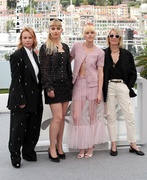




























































































Click on photos for full view.
Video
Special thank you to Korita05


HQ






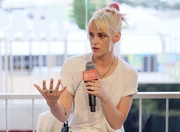





After David Cronenberg’s Crimes of the Future in 2022, Woody Allen’s Cafe Society in 2016 or Olivier Assayas’ Personal Shopper (2016) and Sils Maria (2014), Kristen Stewart returns to Cannes for the seventh time. But now, as a director! The Chronology of Water, her first feature, is an adaptation of the autobiographical novel by Lidia Yuknavitch and will be presented at the Certain Regard.
What inspired you to make this film?
The memoirs on which the film is based tell of an underbelly experience: the most tender and noxious aspects of being a woman. The book offered me the words to write a scenario in which this “writer” would be every single one of us. The film is about iteration. Getting up and trying again. Repossessing your body, your desires, your ambitions and your dreams. I wanted to create a form that was unruly and, again, hard to pin down.
How did you manage your team on set?
Our shoot was disrupted by things I couldn’t control, but we all stayed. The family we made and the memories we made while making this film have become part of the landscape of our lives. And I can tell you that’s not always the case. It was eight years in the planning. The film is about birth, death and rebirth, and we sort of followed that cycle. I think you can feel it in the result. At the time, it hurt a lot. The biggest wound of my “creative” life so far. And by far my favorite scar.
A word about your actors?
Imogen Poots. When I saw what she was willing to give, what she was capable of and above all who she was, the quality of her soul, the beauty of what she was trying, I said to myself, “We all have to be as good as she is.” Thora Birch. One of my favorite actors of all time. I regret not seeing more of her. In every sense of the word. She’s so special. The “parents” in this film are as if seen through a steamed glass, distant memories, and thanks to Susannah Flood, they are startlingly clear. She’s spread across the walls of the house like emotional wallpaper. Kim Gordon. She’s a mother figure to me. You want to be intimidated, but there’s a dynamic connection in her presence that makes you feel really good. Jim Belushi has a writer’s mind with an actor’s heart. I love this man.
What did making this film teach you?
I learned to listen to myself. Listen to my friends. To personalize my process. It’s okay to fail. Sometimes that’s how you win.
What would you like viewers to take away from your film?
That women’s collective consciousness is real and that pain can’t just be avoided, but can be treated and embraced.
What made you want to become a director?
To be an actress.

How did you happen upon Lidia Yuknavitch’s memoir initially, and what about the material made you think, ‘This is what I want to do next’?
In retrospect, I have to thank the algorithm, because it was a title that was suggested to me by my Kindle, and the experience of reading it felt like a call to arms. The book is a real choose-your-own-adventure series. It’s exceptionally non-linear, but so emotionally cohesive. It feels very much like what it’s like to have a subconscious that guides you, and it’s a distinctly female experience to allow your inner voice to be something that echoes inside you, but doesn’t necessarily resound externally. I felt like I wanted to join the club when I read it, and I felt totally called out in numerous ways.
Being in service of other people’s visions is my absolute favorite thing to do. It has been my whole life. We have all these secrets and [Yuknavitch] was telling all of our secrets. You know, we get our periods: don’t say anything. Don’t mention it. You get pregnant: don’t mention it until six weeks, because you wouldn’t want people to know, in case you lost it. Everything about the cumulative female experience is largely bottled up. And I felt like this could be such an exciting thing to share because it takes a very unflinching, glaring look at our crevices and our “secrets,” which are imposed. It just felt really titillating and exciting to imagine watching a female ejaculation, and putting that on screen and making it something that did not feel confronting, but that felt celebratory. There’s so much sexuality in it, but there’s also the release and potent honesty. It felt like I was one of many, many, many people that must have read it and gone, “Me! Mine! Me, too!”
It does feel so exposing in many good ways. You’ve said this movie took you five years to make. Is part of the reason why it took so long because people are afraid of going anywhere near women’s stories like this?
Absolutely. It was a difficult film to finance because in a slug line it’s “a woman overcomes sexual, physical and substance abuse”. There’s radical feminism in it. There are all these keywords that make people go, “Ew, I don’t know. I don’t know if we can market that! I don’t know how many people are going to want to pay to be dragged through that type of hell!” I’m not saying it’s going to be a huge box-office hit. That’s definitely not the goal. But I do know that it has fellows. I know for a fact that if I feel this way, I could not possibly be alone.
Did you ever feel pressure to star in the film yourself? Would that have made it easier to finance?
It was never pushed. I will say, other, more “bankable” actresses were encouraged. But I was working with producers that are artists and cinephiles, and the facts were laid out. It would have been a lot quicker – a lot easier maybe – to hire [a “bankable” actress], but that list is so small, and it’s so absurd and random to me, and it changes.
I don’t know. Lidia is a little forest animal, and she is all woman. I’m a bit too much of an arrow for that. I just didn’t really see myself in the role. And there are parts that I had to take my hands off and understand that Imogen is Lidia… Putting that into someone else’s hands was a trip sometimes, because it was like, how would I do [it]? It was never the right question to ask. In fact, it was disruptive. And because I wrote the script over a long period of time – I had a scene version of every page of the book – and then it distilled and dwindled and changed over years, and when I invited Imogen onto this, it took on a complete and utter life of its own.
So, in terms of getting it financed, and who the right person was, it was kismet. [Poots] happened to be ready to make this radical [movie]. Because we’re ageing child stars, do you know what I’m saying? We’re not willing to always relinquish the protective natures that we have, or the controlling natures that might prohibit us from going deep into work, and it takes the right person to unlock that. We are now fucking sisters and we both had experiences together that we get to share. I’m so happy to have a film as a result.
Has it changed the way you think about the industry?
Yeah. I could never work within the studio system. I’ve done it as an actor a couple of times. And I never want to put stuff like this in print and have people then glom onto it like, “She’s done with something!” I’m never making full-stop statements about anything. We change every day. But I could never do anything that didn’t feel like it came from the very pit of me. It took an unbelievable amount of audacity mixed with utter inexperience for me to think that this was possible, with the amount of money that I had and the time that I had, and where we did it. I have absolutely no trepidation in going into [the film’s premiere]. The movie is so welcome to be loved or hated, interacted with in an honest way. I welcome it.
In terms of what it made me feel or understand about our business now, and what’s allowed to be made and who’s allowed to take up space, and what makes money? I don’t know about that kind of shit at all. I’m a bad planner. I’m present to a fault. But it saves me sometimes because I think the movies that I have in me – the ones that will rise to the surface – just have a volition. This one did. Even though it took a long time, it was something that I wasn’t going to stop until it happened, because there was just no other reason to live. I know that sounds so histrionic. That’s not faux drama: that is real heart drama. I’m being dramatic for a good reason.
Did you invest any of your own money to make the film?
No! No fucking way. Never do that.
So, there was a line drawn there.
Yeah, because I deserve it. And we deserve it. And that’s crazy. I mean, financially speaking, I do things that other people probably couldn’t do, like I brought my entire crew with me to Cannes, and we’re just in Un Certain Regard. It’s not like we’re in main Competition. It’s kind of unheard of. I’m so lucky to be able to do certain things that smaller productions just wouldn’t be able to do. If I said this to my producers [that I want to bring everyone to Cannes], they’d be like, “No fucking way, but have at it.” And so I have every department head with me, I have my family. That’s the kind of stuff that I’m lucky enough to be able to finance.
But in terms of financing my own films? No. There are people that do that, and that would be such bullshit. We deserve it. And when I say “we,” not to lump us all together, because I also have an issue with that. But stories like this, and girls my age – I’ve been doing this forever. I’m 35 years old. Let’s fucking go. Are you kidding me? This is not something that I should have to fight so hard for. And hopefully now I won’t have to, but maybe I will. You never know. The way the world is turning, this movie may be more radical than I even thought it was when I first started. And when I say radical, [I mean] more vital.
Speaking of the way things are going, you filmed in Latvia and Malta, presumably because it’s cheaper to film overseas. What do you make of President Trump’s tariff threat against Hollywood and movies that are made in “foreign lands”?
I’m always wilfully in denial. I’m always like, “That’s not gonna happen. No fucking way. It doesn’t seem real.” And then the most unreal things happen, and they happen over and over lately, to the point where reality has broken for me and for all of us. I really wanted to make the movie in the States. It takes place in the Pacific Northwest. I wanted to be in Washington and Oregon. The movie spans four decades. But it’s not something that people want to pay for. So, my producer, Charles Gillibert [president of Les Films du Losange], is French and somebody I’ve worked with since I was 18. He heard me stamping my feet in public and throwing temper tantrums to the press about the fact that I just couldn’t make this happen. And he was like, “Unfortunately, you have to come to Europe.”
And what do I make of the tariff situation? I truly actually just can’t. There’s just such an unbelievable hypocrisy that’s happening. It’s like, “Make everything here, but also, you’re not allowed to say anything that we don’t want you to say.” And everyone is fueled by that, because we live in a capitalist society, and nobody wants to lose all their money. I do think that, now that I’ve done this, I want to do a Cassavetes moving forward. [Director John Cassavetes] financed most of his own movies, but I want to scrape together a DIY, local, respectful, communal approach that does not bloat and leak. Our business is so bloated and leaky, and if we can just do it with our hands and keep it in the family… Let me put it this way: I’m working on figuring out how to make movies outside the system, but still stay home and just do it fully off the grid.
Even in terms of subject matter, and the kinds of stories that get to be told now, it feels like a challenging time to be working in the US right now.
It feels pretty authoritarian, doesn’t it? I mean, to even say anything in public. Our interactions with speaking to each other in public is changing by the day. And it’s moving so quickly. It’s impossible to not have ultimate whiplash.
Do you ever feel like moving away? Maybe to Europe, and making your films here?
I don’t know. I have my whole family [in the US]. It’s something that we talk about all the time – escape plans. And honestly, history repeats itself, and when it’s too late, it’s too late, and it happens in a split second. You don’t know it until you’re there. So that is scary. Systems have fallen and broken and fucked people in the past, really recently. It’s time to stay hyper-vigilant and honest with ourselves. I don’t want to say that I just want to jump ship, because I do have hope. I’m an angry optimist, and I just don’t think something like this could last forever. I don’t think people are happy, and I’m so happy to see a little more disillusionment lately. But our system’s young and it’s not working. I don’t know what comes next. I’m happy to not be younger than I am. I’m scared for people.
Do you have a dream project that you’d like to do in the future? A book, or an article or any kind of IP that you’d love to make one day?
There are a couple things. Me and [my wife, screenwriter and producer Dylan Meyer] have written the first draft of something that we do have the IP on, and I’m not allowed to tell you what the fuck it is, and I really wish I could. But I’m also writing something by myself right now that pertains to the reality break. It’s a smaller, more contained movie about three people who are very, very close, but are inhabiting different realities. There are three different ways that they lie to themselves and each other that have a lot of emotionally violent crossover. I’m kind of figuring that out now.
This movie, Chronology Of Water, is an enormous tome. My next movie is teeny tiny, and I can do it anywhere. And I know my crew now – I have my family – so I think it’s going to be a lot easier moving forward. So, yeah, I’m writing a couple of things and moving as fast as I can.
Source

Kristen, how long have you wanted to direct?
KRISTEN STEWART I think I asked a couple of actors on one of my very early projects [about] the youngest director they could stomach working with. And I was sat down by most of them and asked, “Why are you even asking us that question?”
I had to wait until right now for this to be actualized, because there are portals that set you free. Texts or songs or conversations that give you ways into figuring out how you want to wield your voice. And even though I always knew that I was waiting for that trigger, I hadn’t found it yet until [The Chronology of Water]. This was eight years ago. So it’s been a slow and laborious birth, but I’ve wanted to direct movies as long as I have been an actor and it’s been a multi-tiered development. But for some reason, psychotically, I’ve wanted to do it forever, because I do think the exchange between an actor and a director is a bridge between two very different positions. You actually have to end up doing the same thing together to hold this reciprocal energy in this emotional space and make something feel congruent. So I was like, “Oh, I’m half of you.” And I feel like my actors are half of me and I just wanted to do both. I wanted to get onto the other side. I think I was like, nine years old, but then I figured out how to actually fucking do it. And now I’m 35.
Can you think of any directors who along the way served as inspiration for you?
I don’t want to make any kind of exclusive list in terms of the people I’ve bounced off of, even though there have been some standouts that have felt like people that have given me keys to a certain castle. Pablo Larraín, Olivier Assayas, so many other people, but I will say that there are certain relationships that just make you go, “Holy fuck.” It feels unleashing in a way that, again, feels very reciprocal. But yeah, in terms of inspirations and movies, it’s so personal. My whole life, I always want to process in cinema. I always want to figure out a way to lay it down in a subconscious sense, because there are literal ways you experience your life, and then processing and memory and transfusion — and turning those things into art, you always make a different statement. I feel like I’ve basically taken every experience making films and living my days on earth into every day that I directed this movie. And it’s really hard to be hyper-specific about it. I’ve been lucky enough to work with people that I’ve felt so instinctively drawn to that they’ve shaped me in every way.
You mention this trigger…
The word trigger is triggering! What I meant is really more of a catalyst. Your triggers should be something that gets you up and want to say something about the fact that you’ve been triggered. There are different starting guns. And yeah, this starting gun fired eight years ago. It’s been really hard to wrangle.
What was the starting gun then — reading the memoir? Meeting Lidia? Why did Kristen Stewart land on The Chronology of Water for her first directing gig?
It was just a book that I read and impulsively, after 40 pages, put down and reached out to the writer. I thought, “There are certain things that I’ve read that really do live in your brain and it would be an honor for them to live there.” And they get to multiply within your own personal experience. But this one felt like it needed to get up and share space with a lot of people. It was one of those books that I wanted to read out loud with all of my friends. It was one of those books that felt like a choir that you wanted to join. It felt like permission. And also this relationship that the book has to the corporeal and the physical… it’s uncharted territory in the cinema that I have personally consumed. We’re not reinventing the wheel or saying anything that someone else hasn’t said before.
But in terms of saturation, the territory that we traverse, the things that we look at, [they] excite me. They feel revealing in a way that is loving. [We’re] definitely looking at things that hurt, but in a way that encourages active transformation and restoring, rebranding, reframing, in order to make those things that can steep us in shame feel actually good. That’s the stuff we can do for our friends. That’s the stuff that we do in conversation, in therapy! I felt like this movie, and when I read [the book], I just went, “Oh, fuck. We need to put this on its feet so we can do it all together.” I just hadn’t read anything like that until then, and it also felt like it was breaking a seal because now there’s 10 more movies I want to make fucking yesterday.
I have a million questions based on what you’ve just said — why was Imogen Poots, someone I consider quite an under-loved actor in the U.K. — the right person to go on this journey with?
It’s been funny describing Imogen because I also always want to say under-utilized, under-loved, and I don’t want that to imply that people do not take advantage of her incredible nature all the time, because everything I’ve ever seen her in is my favorite performance. It’s not that she’s not enough — it’s that it’s never enough for her. I’m like, “Give this girl more!” I have just loved her for so long, and I felt connected to her before I met her. She sent in an audition tape and it blew me away. Auditioning is such a beautiful process of getting to know each other. It’s weird to not audition for parts. It’s nice to get to know whether or not this is the right thing, respectively, for each artist. It’s almost like a mutual consent process where you’re like, “Do we want to do this together?”
But when she sent the tape in, I was like, “Wait, this is one of my favorite actors.” And then we did a quote unquote “callback,” and we spoke, I think, in the lobby of a hotel in London a couple of years ago. There are just so few people that you immediately trust and that you feel seen by and like. I wish I had newer words! I think we were both recognizing this as an opportunity to make a really good movie that’s important, that girls need to have and eat and metabolize. I felt from reading the book and our endeavors on set, even in just a really personal and selfish way we were both like, I think we can big each other up and we can look at each other in new ways. We’re both 35, ready to stop perpetuating other people’s desires and stop checking other people’s boxes. And figure out what ours are. This introduction happened to coincide with this release in both of us, and I caught it on camera. The fact that we both felt emboldened enough at this stage in our lives to listen to each other, trust each other enough and really release and break and put the pieces back together in a way that feels cohesive… And we’ll have it forever. I love her so much, and I’ve gained a sister in this. She is one of the best actors I’ve ever been around in my entire fucking life, and I have worked with so many actors. I couldn’t believe it. She is so good at living.
Wow — I hope she reads this interview and hears how you speak about her.
She hears it all the time. I have to [tell you], just so she knows it’s not bullshit.
Well, Earl Cave speaks about you the way you speak about Imogen, I think. I wanted to ask you about the industry you entered all those years ago compared to the one that Earl is entering now. Has it changed? And if it has, has it been for the better or for the worse?
I do think there have been some tectonic shifts in terms of who’s allowed to take up space and be heard, but at the same time, I don’t know what the filters are. The really quick acceleration… It’s not super easy to keep up with the process and be able to describe [what’s happening] in real time. It’s almost easier to say in retrospect that it’s definitely not the same as it was. It’s tricky to put into words — and when I say words, I mean print.
By the way, Early is such a beautiful man. And those two words are really satisfying to say with a straight face. I could be best friends with that kid. What is he? 23? Is he 24 now? I guess I’m using all the same words because I referred to Imogen as my sis but he could be my little brother. I would be so lucky. And I have no fear for that kid, he is so honest and present and concerned about the most pure things. And I do think that there is a little modicum of room — compared to what I experienced — for people to be out there and for people to find ways and paths and tributaries toward each other. I sound like an old person or whatever, but I think kids like that can find them, and I’m very happy to see that there is possibility. But at the same time, we’re also living in a world that’s literally folding in on itself by the split second. So, who the fuck knows?
That is completely apt.
The loss is so palpable. It’s an exciting time to be alive. And it’s cool that we all get to be loud together, but at the same time, is that going to do anything? What’s gonna happen? I think we’re all looking over our shoulders going, “Holy shit.” The slippage is just terrifying.
How big a shadow do you think Trump has cast over Hollywood and the film industry?
You mean like, for fear of being put on some “fuck you” list?
And also the movie tariffs, encouraging such polarizing belief systems, or making Hollywood even more risk-averse than it already is.
We discuss this every day, like, what’s gonna happen? [Especially] now that we’ve finally found our voices… Not that it wasn’t treacherous before but now, [it is] in a way that is so literal, so strikingly essential and vital than ever, but naturally terrifying. I think [Trump’s] shadow is bleak and very dark. You could almost say opaque. And I think to try and work through that is what we’re going to do. But in terms of knowing anything, I think we should expect the worst and fight for the best. Stay vigilant. Look alive.
I think a lot of people on the Croisette agree with you. You’re arriving as a director, rather than onscreen talent. What kind of creative fulfilment does directing give you that you don’t get from acting? Would you ever consider starring in a project you’re also directing?
I would love to be in something that I was directing. I would love to work with the actors. There’s always a singular perspective that is honored and serviced, but at the same time, the writers that you have on set with you, they’re so important. And I know that I could create a dynamic that would support me, while uplifting and preserving the initial impulse and the perspective, as long as you design the process.
My system runs on acting. It’s my favorite part of directing, being with the actors. But at the same time, to be able to really make something from the ground up all the way up to the sky with your bare hands and with your exclusive and specific eye, there’s nothing more satisfying than allowing other people to step in on that. It’s like planting seeds everywhere in a big, huge field, waiting for all your best friends to go pick the flowers and go look at these seeds you planted. I’m like, “Good job going and finding them!” Then as an actor, I’m out there searching for flowers. They’re different jobs, but they hold hands. They’re so related and I want to make 10 movies in the next fucking five minutes. But there’s something oddly more methodical about acting because you’re serving someone else’s vision. So you have to create a huge emotional foundation over a two-month period as you never really have much more time to prepare for a role than that. It’s really based on other people’s desires and your own. You have to make this cocktail of what you both want, whereas as a director, everything is about what you want, and it’s incredible. It’s just the most indulgent, spectacular beast in which other people help feed you. Then it becomes something that you share, and you look around the table and there’s fucking 50 people there that love it just as much as you.
Do you feel like you’re reinventing yourself with The Chronology of Water? Are Kristen Stewart the director and Kristen Stewart the actor two separate people?
I think that you can do that within performance to a certain degree, especially with the way that you choose your bosses and the people that you’re going to follow. But once you’re following someone, you’re following them into singularity, and that is not yours at all. And I love that. I love being in service of something that I believe in, but then also feeling the risk of not knowing what that ultimately is until they figure it out. Because making a movie is predetermined to a certain extent, but absolutely ephemeral.
I’m not trying to show anyone anything. I am trying to learn some stuff. I’m just trying to move toward the things that feel vital to me with my own eyeballs and my own two hands. That’s directing, that’s not acting. But I think being an actor has been the thing that has led me here in the first place. There’s just something forensically connected about positions. It’s just about finding voice. I’m just uniquely primed at this stage in my life to listen to myself, so therefore I think I need to step behind the camera but not ignore the fact that what put me here was being in front of it.
How do you feel about arriving in Cannes as a filmmaker, rather than an actor?
I cannot believe it. There’s not a more eloquent way [to say it]. We barely finished this movie. It’s not even done. I need to come home and literally have two more weeks in color and sound. This is my fucking first draft. Like, we are picture perfect. But when I tell you, we slid a very thin piece of paper under a closed door and they were like, “Sure.” My head blew off. This was such a fucking Hail Mary, because [Cannes] is the place that you would like to go have conversations. So I was like, “Fuck it. We might as well try it.” I am not being false humble — we’re all running on fumes. I was like, “We can do it.” I was like an absolute basket case. I’m kind of happy to take on something vulnerable. I’m happy to take something with mistakes. Mistakes are fucking hot. I love stories about movies and filmmakers that have taken their films to Cannes and had to come back and fix a few things and release a different movie. It’s all about revealing yourself. So it’s very meta that we’re running in here half-dressed. But I’m into it.
How do you hope audiences react to The Chronology of Water?
I’ve said this, but people can interact with all of my work however they see fit. I really invite all of it. And that’s not like a self-preservation thing to say. I mean it. I’m like, this was the best we could do. This is what we meant to say. It might not land on everyone the same. In fact, when I say it absolutely won’t land on everyone the same. That’s not the point of — and I say this in a French accent — cinéma. We’re supposed to have relationships with the art that’s put into the world. And they’re not all good ones. I guess as long as you do something that feels authentic in the very present moment. I can feel differently about it tomorrow. I can regret everything tomorrow. Right now, I don’t, so I’m very, very, very grateful to be in the place that I’ve always wanted to be. I’ve always looked up to [Cannes] with such reverence. Even if it’s messy, and honestly, my movie should be messy. This fucking thing should sprawl. It sounds so dramatic, I mean this in a way that is incredibly celebratory — it should be a woman limping and bleeding.
These 10 films that you want to make in the next five years. Can you talk about any of them?
Definitely not. This is something I do, I always tease too early.
But the nuggets are there?
Oh, yeah. I mean, we’ve started a production company, which is an insane thing to say, because I really never thought I would be that person. But then I just felt like I suddenly graduated to a place where I was like, “Okay. Mine. M, I, N, E.” So we’re cooking. We are voracious.
I hope everything goes smoothly in Cannes…
Hopefully not smooth! Hopefully, we crash and burn, but in a way that feels correct.

“The Chronology of Water” director Kristen Stewart and one of the film’s stars, indie rock icon Kim Gordon, will headline Breaking Through the Lens‘ annual gala at the Cannes Film Festival on Friday, May 16.
Breaking Through the Lens is a global nonprofit dedicated to creating pathways to financing for women, LGBTQIA+ and other marginalized filmmakers working in front of and behind the camera.
As the organization returns to Cannes for an eighth consecutive year, Stewart and Gordon will sit for a fireside chat moderated by Variety, just before the world premiere of “The Chronology of Water” in the Un Certain Regard section. Stewart and Gordon will reflect on their experience working on the buzzy new film, dive into their creative process across mediums and discuss the importance of backing underrepresented filmmakers with proper funding.
Adapted from the bestselling 2011 memoir by Lidia Yuknavitch, Stewart’s adaptation of “The Chronology of Water” stars Imogen Poots as Lidia, an Olympic swimming hopeful who, brought up in an environment torn apart by violence and alcohol, seemed destined for self-destruction until she found freedom in the form of literature. The film, as described in the festival’s early synopsis, “follows Lidia’s journey to find her own voice in an exploration of how trauma can be transformed into art through repossessing our own bloody histories, particularly those uniquely experienced by the bodies of women and girls.” The cast also includes Thora Birch, Jim Belushi, Tom Sturridge and Gordon. In addition to directing, Stewart co-wrote the screen adaptation with Andy Mingo.
In her 2024 Variety cover story, Stewart opened up about the frustrating five-year journey to drum up the financing to make the film. “The current climate is a real, capital N ‘No’ for anything that has not been proven already,” she said at the time. Among the hurdles was that she hadn’t directed a feature yet, “so I lack experience and therefore, I lack credibility,” Stewart added, parroting what she’d been told, despite her decades as an Oscar-nominated and César-winning actor, plus directing short films and extended music videos.
Despite the naysayers, Stewart never wavered in her determination to get her passion project off the ground, ultimately shooting the movie over six weeks in Latvia and Malta last summer.
“We are so thrilled to return to Cannes to host the incomparable Kristen Stewart and Kim Gordon and to celebrate our BTTL Action Grant finalists,” said the organization’s co-founder and executive director, Daphne Schmon. Of the organization’s long-standing partnership with Campari, Schmon added, “Campari’s support at the festival supports our fight for a more equitable film industry.”
As Schmon noted, the Cannes event marks the culmination of BTTL’s annual Action Grant program. Currently in its third year, the initiative supports five filmmakers with a feature film in late-stage development in the sum of €10,000. The application is open to any filmmaker who experiences marginalization due to their gender, including women and LGBTQIA+ directors.
Those selected enter into a year-long fellowship overseen by a jury of industry professionals (which has previously included actor Diane Kruger and top executives from studios like Netflix, HBO Max, Universal Pictures and Lionsgate) to receive guidance at festival markets, attend curated financier meetings and experience other mentorship opportunities. Applications for the next cycle open at this year’s Cannes.
 |
| Image: Deadline |
EXCLUSIVE: Emmy and Golden Globe nominee Elizabeth Olsen has joined Kristen Stewart and Oscar Isaac to co-star in vampire thriller Flesh Of The Gods from director Panos Cosmatos (Mandy).
Isaac and Stewart will portray Raoul and Alex, a married couple in glittering ’80s L.A. who descend each evening from their luxury skyscraper condo and head into an electric nighttime realm. When they cross paths with the mysterious and enigmatic Nameless (Olsen) and her hard-partying cabal, Raoul and Alex are seduced into a glamorous, surrealistic world of hedonism, thrills and violence.
The film is written by Andrew Kevin Walker (Se7en) based on a story by Cosmatos and Walker, and is produced by Adam McKay and Betsy Koch of Hyperobject Industries and Gena Konstantinakos and Isaac for Mad Gene Media.
Domestic rights are co-repped by CAA Media Finance and WME Independent, with XYZ Films continuing international sales at this week’s Cannes market. No date yet for start of shoot as schedules get aligned.
The movie returns Stewart to her vampire roots after the global sensation that was the Twilight franchise.
Olsen is is known for playing Wanda Maximoff/Scarlet Witch in the Marvel Cinematic Universe, appearing in Avengers: Age of Ultron, Avengers: Infinity War, Avengers: Endgame, and the Disney+ series WandaVision. She made her breakthrough in the critically acclaimed indie thriller Martha Marcy May Marlene, and has also starring in Wind River, Ingrid Goes West, and Godzilla, among others.
Flesh of the Gods marks the fourth collaboration between Cosmatos and XYZ, as they produced the upcoming Miley Cyrus film Something Beautiful, which will debut at the Tribeca Film Festival in June. They also have Nekrokosm in development with A24.
Upcoming titles from XYZ Films include Banquet, starring Meghann Fahy and directed by Galder Gaztelu-Urrutia; the SXSW thriller Hallow Road, directed by Babak Anvari and starring Rosamund Pike and Matthew Rhys; and The Trip starring Jason Segel, Samara Weaving, Juliette Lewis and Timothy Olyphant, which is currently in post-production.
Olsen is repped by CAA, Brillstein and Sloane, Offer.


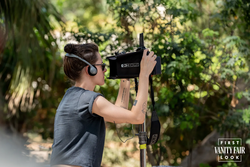


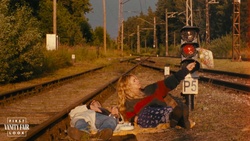

Click on images for full view.
I hop on the phone with Kristen Stewart the very same day that she’s putting the final touches on her directorial debut, The Chronology of Water. “I could start crying,” she says. “I’m sorry, I’ve come in kind of hot.”
She has come in kind of hot, words spilling out of her fast and furiously and full of passion. She’s been trying to make this movie for eight years—and waiting to direct her whole life.
Stewart’s acting career needs no introduction. She broke out with the Twilight franchise, but has spent the many years since in the world of auteur and European cinema, starring in Kelly Reichardt’s Certain Women, Olivier Assayas’s Clouds of Sils Maria and Personal Shopper; and Pablo Larraín’s Spencer, which earned Stewart an Oscar nomination. She’s funneled that assured and daring style into her directorial debut, a visceral explosion of feelings and senses.
“I wanted to make a movie about process and writing and being able to metabolize very ugly things and rewriting your own fucking story so you can live with it,” says Stewart.
The film, which will have its world premiere at the Cannes Film Festival on May 16, is an adaptation of the eponymous 2011 memoir, by Lidia Yuknavitch, who writes movingly about her childhood trauma, alcoholism, and the transformative power of writing. The book, described in its logline as “not your mother’s memoir,” is full of fiery prose and devastating imagery. “There are voices that help you find yours,” Stewart says of Yuknavitch’s work. “It became a sacred text for me overnight.”
The film, which stars Imogen Poots as Lidia, honors the memoir’s intensity by honestly depicting one woman’s difficult journey. It’s made even more visceral by an intense editing style featuring quick cuts and imagery, along with an immersive sound design. The Chronology of Water was not an easy movie to get funded, thanks to its subject matter and firmly female perspective—examining bodies and rage and shame and redemption. But it was a movie Stewart simply had to make. “The woman in this movie—she’s pretty battered,” she says. “The movie has gotten fucking battered. It’s very meta.”
“She's just fucking so transcendent and this, it just blows my fucking hair back" says Stewart of Poots' performance. “And I'm so proud of her and I can't wait for people to see that.”
Even after she found her sacred text, it would take Stewart years to bring her vision to fruition. She first announced her intention to direct a feature at the 2018 Cannes Film Festival. The first short film she’d directed, Come Swim, had played at the festival the year before. An abstract, immersive trip following a man coping with anxiety and heartbreak, the 17-minute movie revealed Stewart’s interest in playing with time and sound design, as she captures feelings more than linear storylines. No one knew it at the time, but some of those stylistic choices would translate to her directorial debut.
Stewart first read Yuknavitch’s memoir on her Kindle while she was filming the movie JT LeRoy in 2017. She immediately reached out to Yuknavitch about adapting it. “I read this book and I was, like, Holy fuck,” she says. “Imagine doing the thing that I love to do the very most, which is [to] start fires under myself and other people, and try and have exchanges of emotion that feel like lightning in a bottle—but then also take it, and break it, and make it about iteration and writing.”
Stewart flew up to Portland, Oregon, to convince Yuknavitch that she was the right person to adapt her memoir. She thought it would be a tough sell, seeing as how Stewart had never directed anything before. “I was, like, ‘What can I get you? A fucking tea, a beer, a martini? How many hugs is it going to take?’” she says. “But it wasn’t difficult. It felt intrinsic from the start.”
Stewart would spend years writing and rewriting the script. “I overwrote the shit out of it,” she says. “I made 500 movies.” She admits to trying to shove in as much as possible because she had so many ideas, and because she wanted options in the edit. Stewart was trying to capture how the book made her feel, while also exploring tough subjects like sexual abuse, addiction, queer romance, and loss in childbirth. “It’s about repossessing your voice through your body,” she says. “and just how you process that as a woman in this motherfucking day and age. And that’s not easy right now.”
So, yes, financing was a hurdle. “Basically, I got the script to a point where other people could remotely understand and, basically, just convinced some really lovely people that this thing had a voice,” Stewart says. “I was just, like, ‘Cool, did we convince someone to give us some money? Now let’s fucking run.’”
Stewart did a wide search for her lead actor, but cast Poots immediately after she auditioned for the role. “I literally stopped her halfway through and said, ‘Stop doing that because we just need to get to work’,” she says. Start hadn’t known Poots personally before the project, but soon learned they shared a few close friends. The English actress has appeared in 28 Weeks Later, the Showtime series Roadies, and 2020’s The Father, but Chronology of Water is a meaty leading role—and a very demanding one. “She’s perfect for this because I think we were both sort of going through something at this stage in our lives,” Stewart says. “It’s kind of an emotional Heimlich that was happening for both of us where we just went, ‘It’s time to look at ourselves.’”
Shooting on 16mm film, Stewart filmed at breakneck speed over 32 days in Latvia and a few in Malta. It was an ambitious undertaking: The story covers decades of the protagonist’s life, flashing forward and backward from her tough childhood through her tumultuous coming of age, college, and beyond. “It is my inexperience that led to the process that occurred because I think anyone who had ever made a movie before would’ve said we couldn’t do it,” Stewart says. Traditionally, a first-time director might hire veterans for her crafts team, who could help guide her through this process. But Stewart’s crew was made up of mostly rising talent, including cinematographer Corey C. Waters and editor Olivia Neergaard-Holm. “I’m working with people that feel new,” she says. “I want the movie to feel adolescent. I want it to feel urgent and right now, and not precious and not clever—I definitely never want to feel fucking clever.” She describes her directing style as founded on deep, emotional connections with the actors. “My favorite directors don’t talk that much,” she says. “They feel more.”
After attending the festival for so many years and serving on the Competition jury in 2018, Stewart has earned a reputation for being a Cannes darling. For anyone else, the idea of premiering your long-awaited directorial debut at the biggest international film festival in the world—a festival whose audiences are infamous for booing a film they don’t like—might seem terrifying. Stewart, though, is ready. “Results completely aside, I am in love with the movie,” she says, adding that she’s hardly had a chance to think about her debut at Cannes because she’s been spending every moment rushing to finish the film. “Do I have any time to process what we did? Absolutely not. Can I process this in public? I’ve done everything the fuck else that way in my whole life.”
She sounds confident and excited—until I ask if Yuknavitch has seen a cut yet. She hasn’t; Stewart doesn’t want to show her movie to the author until it’s really complete. And she definitely cares what she thinks. “I started sweating a little more than I was 10 seconds ago before you asked me that,” she says. “I mean that in the best way—kind of under my tits, that’s where I started sweating.”
Sweating, crying, laughing—Stewart’s film aims to bring all those emotional responses right to the surface. Though this labor of love took her years, Stewart says she’s ready to direct again. She still loves acting too, which means she’ll have to figure out a balancing act—but she’s ready for whatever happens next. “I think we just did something really honest, and I’m so open to people interacting with it as they see fit, truly,” she says. “I feel really lucky to be able to show it, and I just want to keep working.”

Kristen Stewart, TheWrap’s Cannes magazine cover star, will join us for a live conversation on her daring directorial debut “The Chronology of Water” in TheWrap’s Cannes Conversations series, presented in partnership with Brand Innovators at the Brand Innovators Salon D’Affaires pop-up inside the Armani Caffé on the Croisette.
Taking place May 16–18, the program spotlights top filmmakers, changemakers and creative visionaries at the 77th Cannes Film Festival — in exclusive conversations with TheWrap’s CEO and Editor-in-Chief, Sharon Waxman and Awards Executive Editor Steve Pond.
Acclaimed actor and first-time feature director Kristen Stewart will join the conversation lineup alongside “Splitsville” filmmakers and stars Michael Angelo Covino and Kyle Marvin and producer Emily Korteweg; “The Plague” director and writer Charlie Polinger; and Matthias Schweighöfer, star of “Amrum.” Both “Splitsville” and “Amrum” screen in the Premiere section, while “The Plague” is featured in Un Certain Regard.

