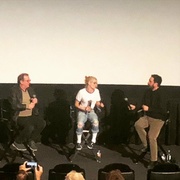
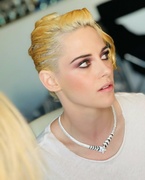
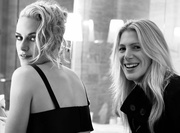
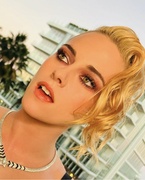
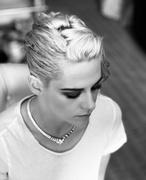
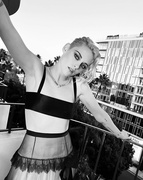
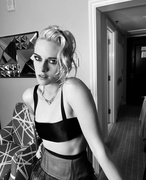

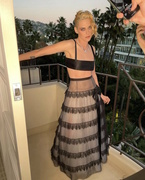
Click on the images for full view.
You can also find the video in our main post for the LA premiere.

Click on the images for full view.
You can also find the video in our main post for the LA premiere.

Do you want to be the next Kristen Stewart?
Then she might have a gig for you: The Spencer actress, who's currently in the thick of major awards buzz for her role as Princess Diana in Jackie director Pablo Larrain's lauded indie drama (out Nov. 5), is branching out into directing with an adaptation of Lidia Yuknavitch's harrowing memoir, The Chronology of Water.
"I don't want to be in it," she tells EW of casting the long-gestating project. "I want to find someone a little younger." So — someone like herself maybe? "Yeah, I need to find the next Kristen Stewart, basically," she jokes, eyes rolling playfully. "Just please describe the look on my face while I'm saying that." But it's necessary, says the 30-year-old L.A. native, since the book "takes place over at a really fast period of time."
Stewart, who calls Yuknavitch "incredible, she's like my favorite contemporary author," has been working on bringing the Oregon-based writer's award-winning memoir, which explores themes of sexuality, grief, and addiction, to the screen for almost five years. "It's a lot of ground to cover," she admits. "It's a whole life, but my favorite thing about this book is how it externalizes her inner life."
"I read it and felt like I was allowed to have a voice. You know what I mean?" she goes on. "Not that it was the only key to that lock, but... This woman finding her voice was just sort of the most violently physical thing I've ever experienced in a book. I mean I cannot wait to visualize this. And
I can't wait to throw somebody into like the deepest, coldest, scariest water," she says of her future casting choice, laughing. "See what happens to them, yeah."
In addition to what is sure to be a long season of awards campaigning over the coming months, Stewart is also shooting the sci-fi film Love Me with costar Steven Yeun, which she describes as "a love story between a satellite and a buoy."
"It's hard to explain," she admits. "I hope I don't botch it, because it's a really revolutionarily written script. Just a really, really brilliantly conceived idea." (The project came to her at the same time as the upcoming David Cronenberg horror film Crimes of the Future, which she recently wrapped shooting in Europe with a cast that includes Viggo Mortensen and Léa Seydoux.)
Love Me, she says, is set "after we're all dead. It's like the earth is freezing over, and the trace that we have left behind is the internet. And the overriding idea behind the movie is that this buoy, myself — Me is the name of the character — is everything we left behind. Which is kind of just, 'Look at me, look at me, love me, love me, love me,'" she explains. "So this satellite pings, and we connect. And I'm just trying to give him all the information I have of what we as humans have left behind."
"Every version of a person, and every avenue that we try and connect to each other with is represented. There's a lot of visual transformations," she teases of the film's fluid roles. "I rifle through being a boy, a girl, really ambiguously gendered, different races. [Steven] does the same thing. There's a lot of fighting and loving and sex. It's basically that we are all so starving for attention. And we don't always know how to convey ourselves truthfully, in order to get a validating form of true love."
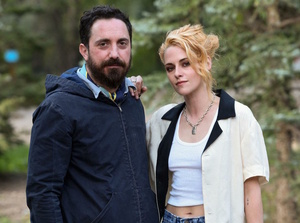
Spencer, the new film about Princess Diana, is very definitely not The Crown. Not for director Pablo Larraín the comforting grandeur of Peter Morgan’s Netflix series, whose tapestried locations are the scene of inner turmoil as private desires hit the buffers of public duty. Spencer, the imagined story of which takes place over three ghastly days at Sandringham in 1991, veers far more gothic. The Norfolk stately home becomes a kind of Overlook Hotel from Stanley Kubrick’s horror classic The Shining, through whose endless, confusing corridors the camera harries and chivvies Kristen Stewart’s Diana as her psyche crumbles.
Stewart and Larraín are with me in a Zoom room: the director has his camera off, a mere black square and a courteous Chilean voice; Stewart, a relaxed, enthusiastic presence in a depersonalised domestic space, wearing a baggy red top, her hair loose and blond.
Larraín loves the Kubrick comparison, originally made in the Guardian’s review from the Venice film festival, where the movie premiered. “He was so excited when he read that,” says Stewart.
For the character of Diana, however, the “tentpole reference”, Stewart says, was that unforgettable portrait of a mind cornered into insanity, Gena Rowlands in John Cassavetes’s 1974 film A Woman Under the Influence – “not maybe in the detail of the character,” says Larraín, “but in the sensibility”. In Spencer, which is set over the royal family’s three-day Christmas get-together, we see the princess desperately wielding wire-cutters in a ballgown; breaking into her crumbling childhood home; and, weirdly, clutching so ferociously at her string of pearls during a terrible Christmas Eve dinner that the beads clatter into her bowl, which she then spoons up with her soup and has a good chew on. The film, in case it isn’t already clear, leaves the borders of realism far, far behind. I am not sure it is recommended viewing for the real Diana’s sons; although, as with A Woman Under the Influence, the one place of stability for the protagonist is her tender relationship with her children.
Stewart spent some months perfecting her Diana, she says, coming up with an evocation of the princess’s whispery, rushed diction and wry little laugh that was pitch-perfect enough to allow her to feel a sense of freedom in the role. Her dialect coach was William Conacher, who turns out to be all the Dianas’ coaches: Emma Corrin (The Crown) and Naomi Watts (Diana) also worked with him. The accent, she says, was important, but more so, the whole manner: “She had such a particular way of talking, and she makes me feel something so specific to her,” she says. “It was like a full-body exercise – the most muscular, unintuitive, yet extremely instinctive thing. It was weird: I needed to master it in order to kind of mess it up.”
She continues: “I don’t know if I believe in anything. I don’t believe in ghosts, but I don’t not believe in ghosts. I believe in a lingering energy. I took her in, whether or not it was my idea of her or there was some actual literal remnant of her.”
Perhaps I look a little alarmed, because she adds: “I guess it sounds kooky to start talking about stuff like this. But there wasn’t a day that went by that I wasn’t like: ‘What does she think about this? I wonder if she can see me?’”
It does indeed sound kooky. There again, I say, it must have been strange to immerse oneself in the world of this most famous, loved and vulnerable of women. “I guess the difference between playing somebody who existed in real life versus in someone’s imagination exclusively, is talking about it afterwards and wondering how people are going to receive it,” she says. “Because when you are creating a character from scratch you still create a mythology, a list of facts that are true to the person you construct so that that person feels whole to you.
“I’m not actually Princess Diana, I can’t know everything about her. She’s in our movie. She is a character: she exists in this story as something that I feel to be whole,” she adds. Having Larraín talk about A Woman Under the Influence, telling her, “I think we go that far, I think we go that hard” was, she says, exhilarating and terrifying, like the feeling “right before you ride your bike fast down a hill, and you’re like: ‘Oh, fuck!’”
In Spencer, the viewer is edged into seeing events from Diana’s off-kilter perspective, just as in Larraín’s Jackie (2016), where the days following the assassination of John F Kennedy were seen through the grief of his widow, played by Natalie Portman. (“I don’t think I would have made Spencer without Jackie,” Larraín says. “One thing led to another. Both women that had to deal with the press and media in different ways, both women that were linked to very powerful families married to powerful men, and they were both women that find the way to create their own story and find their identity. But if Jackie’s a movie about grief and memory and legacy, I think Spencer is about identity and motherhood.”)
At the start of Spencer, Diana is driving down to Sandringham alone in her open-topped Porsche – a rebellious move in itself, since she is without security or minders. “Where the fuck am I?” she asks, out loud. She is completely lost, physically and spiritually, and gets more so as soon as she enters the gloomy portals of Sandringham.
The fact that the “Sandringham” exteriors were in fact filmed at a vast German schloss, its facades as blank and regular as a prison, rather than anything resembling the chaotic 1880s architectural bodge that the Norfolk house really is, adds to the sense of Diana entering, in Larraín’s words, “a labyrinth that is endless” – a place that is, in some chilling way, “an extension of her own psychology”. Later, I wonder whether the screenwriter Steven Knight (who wrote Dirty Pretty Things and was one of the creators of Who Wants to Be a Millionaire?) imbibed the remarkable private notes James Pope-Hennessy made about Sandringham in the 1950s, collated by Hugo Vickers in the recent book The Quest for Queen Mary. For Pope-Hennessy – the official biographer of Queen Mary, the Queen’s grandmother – Sandringham was “emphatically, almost defiantly hideous and gloomy … a hideous house with a horrible atmosphere in parts, and in others no atmosphere at all. It was like a visit to a morgue …”
Diana is trapped there as surely as Wendy Torrance is trapped in The Shining. “It’s a cold space of repression,” says Larraín, “a space that represents oppression and fear next to, and in crisis with, a character that is as fragile and warm as Diana.” Not that Diana is wholly sympathetic. Stewart describes her character’s contradictory interior life as “this bingeing, purging, self-hating, arrogance and entitlement”. A shot of darkness can be no real surprise from the director of the bleakly funny Tony Manero (2008), Larraín’s early, Spanish-language film set during the Pinochet dictatorship, about a man who will commit murder in pursuit of his obsession with John Travolta in Saturday Night Fever.
Labyrinths generally contain monsters. Spencer stops just short of suggesting that the real minotaur at the heart of the maze is the royal family. The Queen et al are rendered as mere suggestions, vague spectral presences, with the exception, perhaps, of Prince Charles, who is not so much diabolical as just terribly chilly. It’s Timothy Spall’s appallingly sinister equerry, his face like a tombstone, who really scares the bejaysus out of Diana (and the viewer). In one memorable scene, he apparates into the walk-in refrigerator, to which, in the small hours, the princess, in the grip of an eating disorder, has ventured to contemplate tottering towers of cakes, pastries and petits fours.
It is scenes such as these that send out early alerts not to mistake Spencer for anything like realism. (The film did, in fact, employ two advisers on royal matters, one of whom dishes out protocol wisdom on The Crown, the courtier-ish David Rankin-Hunt, who worked in the royal household for 33 years.) The film is inviting us to see the food here not as an accurate rendering of Christmas dining at Sandringham (which I imagine is a good deal plainer than what we see), but, as something that, viewed through the lens of Diana’s eating disorder, becomes tempting, threatening and overwhelming. This all plays out particularly twistedly during that Christmas Eve dinner scene, extravagantly candlelit à la Barry Lyndon – a film that, Larraín says, was a more conscious Kubrick reference point than The Shining.
A string quartet plays for the assembled family, but as the scene develops, gradually the music deliquesces from a stately Handel-esque dance into jazz. Jonny Greenwood of Radiohead wrote the score. “The original idea I talked Pablo into,” he tells me by email, “was to hire a full baroque orchestra, write some Handel-inspired pieces, and while they were playing, substitute the players one at a time with free jazz musicians – so, a jazz trumpeter for the natural trumpet player, jazz organist taking over from the church organist, and so on. And have these transitions happening at various speeds.” That is more or less what happened, although due to Covid restrictions, they could use only eight players in a room at a time. “It mostly worked, bar one disastrous cue which sounded like the Antiques Roadshow theme played by drunkards,” he adds. “Gothic horror was certainly the aim. I mean, here’s the innocent girl lured to the gigantic, cold castle, with servants appearing from nowhere, and impossibly perfect mountains of food. I think those are all tropes which were interesting to focus on. And just play with the colourful contrast between the baroque and jazz stuff; Diana was pretty wild and colourful in that setting.” Larraín cut the scene to the score. For him, the jazz motifs represent how the movie adjusts its perspective from one of royal calm and formality to “inside Diana’s psychological crisis”. The jazz signals Diana’s internal chaos, but also, ultimately, her way out of the nightmare.
Because Diana does have allies in the film, one of them a dresser, Maggie, played by Sally Hawkins, who at one point (spoiler alert) avows her love – her real, in-love love – for the princess. It is a somewhat jolting moment. Was there any basis for it in reality, as far as Larraín knows? “It’s probably a question for Steve,” says Larráin, “but I think probably it was complete invention.”
Stewart chips in. “Diana was a frustrating person, a divisive person, but there were a lot of people that were truly just taken, and in love with her, unbeknown to her; and ironically, she was also somebody who was deeply rejected … what I really loved about [that scene] was watching someone naively, out of this deep dark hole of isolation, be presented with stark, honest love and care.”
Diana is given, then, a temporary reprieve. Lightness infuses the dark. Nonetheless, it seems that the film – via all sorts of hints, not least some perhaps heavy-handed imagery to do with a dead pheasant – invites viewers to form the conclusion that the royal family were directly or indirectly responsible for Diana’s death, six years after the events depicted. Is that what Larraín thinks? “It’s not that I want to avoid the question, but I don’t want to be the one who is telling the audience what to see and what to feel,” he says. “My job is to put those things on screen so everyone can have their own conclusion.” Take from that what you will.
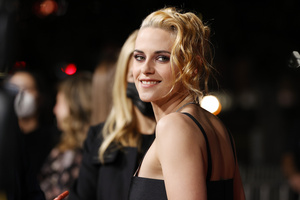
It’s been known for some time that actor Kristen Stewart has been gearing up for a trip behind the camera with her the adaptation of the memoir “The Chronology of Water.” For an upcoming episode of the “Variety Awards Circuit Podcast,” Stewart spoke with Variety about the feature and its current status, which is currently casting for the lead role of author Lidia Yuknavitch.
“We’re casting right now,” Stewart says. “We’ve been putting together and have been thinking about this for a really long time. I’m so stoked. It’s taken the time it’s needed. Some of these take a decade to put together. I just jump every gun in my life and start talking about stuff before they’re really relevant, but it’s more relevant than ever. Now we’re casting the movie. We’re finding our Lidia Yuknavitch.”
According to Stewart, she was taking it out this week to find potential investors. “We don’t need that much. It’s a really small movie. It’s something I would have wanted to be cast in when I was younger.”
As the writer and director, Stewart was asked if she had any plans to make an Alfred Hitchcock-like appearance in the film, to which she replied, “No. There’s actually no part for me. I guess depending on who plays Lydia, I could maybe play her older sister but probably not. I keep trying to figure out a way to get in there but I don’t think so.”
The actor is garnering a ton of awards buzz for her performance as Princess Diana in Pablo Larraín’s “Spencer.” The Neon film has thrust her to the forefront of the best actress race and could bring her first Oscar nomination.
On top of promoting the upcoming release of “Spencer” from Neon and Topic Studios, she just wrapped filming on writer and director David Cronenberg’s “Crimes of the Future” with Viggo Mortensen, Léa Seydoux and Scott Speedman.
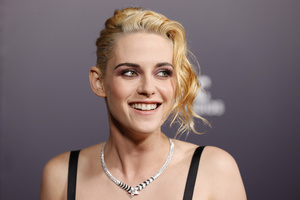
As a public figure who has had numerous experiences with interview quotes being twisted into clickbait articles, Kristen Stewart admits she did not think a stray comment she made about her career would blow up like it did this past week. In a conversation with the Sunday Times of London that posted over the weekend, Stewart noted that out of all the films in her career that she’s “probably only made five good movies.” Two days later she’s in the middle of a press day for her performance as Princess Diana in Pablo Larrain’s “Spencer.” And, of course, this writer is asking about it. She’s visibly annoyed at having to address it once again on this specific day, but understanding…to a degree.
“I’ve reverence for films. I think when something’s good, it’s a fucking miracle and that’s why we tirelessly…I will never stop trying to slip into being that lucky because it takes a lot of people and a lot of disparate desires to come together under the sort of umbrella of one perspective – which is the director – and it’s just super rare,” Stewart explains. “I wasn’t saying like, ‘I think I’ve only done like five good movies, even though I’ve made 50.’ [Laughs.] You know what I mean? I know it’s totally not what I was saying. We were having a larger conversation about movies and what I’m aiming to do and just ambition and all of that. And it was not something that I thought was going to be like such a click-baity thing. But most people aren’t film nerds. I think the only people that would really get that, like what I was saying, were people that were like, “It’s true,” of a great film, like a fucking untouchable, singular, great film.”
She adds, “How many of those are there? I would say in a year there aren’t many that are made. So, the fact that I’m in five is pretty fucking cool.”
For the record, we’d suggest Stewart has seven of those films on her resume, but that’s not the point of our discourse. The subject of the day is “Spencer,” a critically acclaimed drama that imagines what might have occurred over one Christmas weekend in Diana Spencer’s life. After listening to Larrain’s pitch and reading Steven Knight’s screenplay, Stewart agreed to take on what was arguably the most challenging role of her career.
“I did a real, a deep dive [over a] couple of months of consuming all the materials. And at first, Pablo kind of encouraged me to not put so much pressure on myself in terms of learning all the details because they didn’t really matter,” Stewart reveals. “But I needed to learn them in order to believe that. I needed to know everything before we could forget about it and just make sure that we weren’t being kind of egregiously wrong about anything. I kind of fast-forwarded and thought, ‘What if I’m sitting in an interview and someone says, ‘Did you not know this incredibly important thing?’ You’re going to go, Oh, gosh. No, I didn’t.’ I need to be on lock with this. I need to be prepared.”
No actor should fear being quizzed over the life story of a public figure they are portraying, but, knowing those details were important to Stewart. Especially in the context of the film Larrain has made.
“I thought about it because this conversation does matter because also the movie is about trying to convey truthfully to the world through the lens of media. It is kind of what the movie’s about,” Stewart says. “Anyway, so it wasn’t something that I toiled over, but I also wanted to just follow the saga as a curious human person. I knew that if I watched ‘The Crown‘ and watched every documentary, and read her housekeeper’s memoir, and her personal protection officer’s memoir who loved and adored her, I just knew that I would embed little emotional buttons and triggers into my experience that once we were on set, I didn’t have to go for the first time, like, “Oh, what would it be like if someone was analyzing the hairs on your bed pillow?” Do you know what I mean?”
Over the course of the rest of our interview, Stewart discusses working with the two young actors who play Diana’s sons Willam (Jack Nielen) and Harry (Freddie Spry), the problem with biopics attempting to cover too large a canvas, and much more.
Note: The end of the interview features a quick discussion about the last scene in the film.
The Playlist: Congrats on the movie. How are you feeling about all the love for your performance? Or are you trying to put it out of your head?
Kristen Stewart: No, it’s pretty tight. No, I’m not like, “I’m just ignoring everyone’s beautiful reactions to something I tried really hard to make beautiful.” I mean, no, I’m so excited. That’s why we make movies is I want a big, huge banging conversation about it, so…
So before we talk about this one, though, you did an interview recently that is sort of been blowing up because you said that you’ve only made five…
[Stewart gives a look akin to roller her eyes, but not that exactly]
Someone else already asked you this today?
Well, I mean, it’s blowing up on Twitter. What do you think? [Laughs.]
Sure, but I feel like you’ve actually made like seven or nine very good movies? Do you feel like you’re being hard on yourself…
This isn’t like a self-critical thing.
O.K.
I’ve reverence for films. I think when something’s good, it’s a fucking miracle and that’s why we tirelessly…I will never stop trying to slip into being that lucky because it takes a lot of people and a lot of disparate desires to come together under the sort of umbrella of one perspective – which is the director – and it’s just super rare. I wasn’t saying like, “I think I’ve only done like five good movies, even though I’ve made 50.” [Laughs.] You know what I mean? I know it’s totally not what I was saying. We were having a larger conversation about movies and what I’m aiming to do and just ambition and all of that. And it was not something that I thought was going to be like such a click-baity thing. But most people aren’t film nerds. I think the only people that would really get that, like what I was saying, were people that were like, “It’s true,” of a great film, like a fucking untouchable, singular, great film.
I buy that.
How many of those are there? I would say in a year there aren’t many that are made. So, the fact that I’m in five is pretty fucking cool.
And you’re in one of them this year, which is also cool.
Yeah. Thank you.
So, Pablo calls you, or emails you, or whatever. What was your initial reaction when he asked you about this project?
I mean, it’s a doozy of a subject to present. I spoke to him before I read the script. Sometimes it depends on how people want to approach you. Sometimes they’re like, “Read this and then we can talk about it.” He was like, “I want to talk to you first before you even… ” My agents hadn’t even told me what the idea was. They were just like, “Pablo Larraín wants to speak to you.” And I was like, “For sure.” So, he presented this abstract landscape, takes place over three days, is kind of precise in a way, but also lives in a serious gray area in terms of what we know about her factually. And, “I think you should do it,” and I was like, “O.K.” So, I was super attracted to the idea of not doing a biopic. Biopics have gotten a bad rap lately probably because most of the successful attempts at conveying a life on film is they’re usually not…what’s the word? You know.
Factual or historically accurate?
Not accurate, full. Like you don’t usually try and do 15 years of someone’s [life] or like a whole life. You end up doing a movie where you take a stone and you skip it across the body of water, and the stone comes out dry. You never fall into anything. You never actually end up knowing someone or feeling like you fell into any true emotion. It’s just sort of like skipping along the life going, “Look, we showed you everything they ever did.” It’s like, “Yeah, but we already know all that shit.” So, when he said this, I was like, “But the thing about her is that we don’t know her. How do we know what those conversations were like behind closed doors?” I think it’s kind of easy to forget in doing all these interviews though, is that she did electively in the last few years of her life engage publicly and really try very hard to bear herself in a really articulate way. So, any question of like, “How could you trace some material that you can’t confirm? Why would you subject a character, a historical figure, a real person who already felt so stolen from to kind of more unasked-for attention?” I think once you call into question the stories that you’re entitled or allowed to tell, it’s like, “Am I only allowed?” It’s like the person directing this movie, did they need to be an English white woman from the aristocracy? It’s like, “No, he’s a Chilean man from fucking… ” You know what I mean?
Yeah.
Some of the most interesting parts of making anything is always the perspective of a different perspective and sort of going, “Gosh, this person brought me to a thought process that I would’ve never had without her and I couldn’t be more different from this person.” So, please. I think if you look at Diana as a figure, as the way she functioned in the world, the way she reached out, the way she wore this palpable craving, physically, you can see her just kind of begging to be touched and to touch other people. For me, it felt a bit like a call to arms. It almost felt like, “Yeah, we should keep this conversation going.” So, I definitely was really, really moved by the whole idea of getting close to the idea of this woman.
Pablo has said that the last thing that he’d want is for an actor to mimic a public figure and, obviously, you don’t with your performance. But was there any particular interview or anything you read that sort of stuck with you while you were making the film about her?
I mean, yeah. Lots of things, like I did a real, a deep dive [over a] couple of months of consuming all the materials. And at first, Pablo kind of encouraged me to not put so much pressure on myself in terms of learning all the details because they didn’t really matter. But I needed to learn them in order to believe that. I needed to know everything before we could forget about it and just make sure that we weren’t being kind of egregiously wrong about anything.
I kind of fast-forwarded and thought, “What if I’m sitting in an interview and someone says, ‘Did you not know this incredibly important thing?'” You’re going to go, “Oh, gosh. No, I didn’t.” I need to be on lock with this. I need to be prepared.
That’s unfair though. No one should have to have a master’s degree in someone they’re playing to do press. That’s ridiculous.
Yeah. But I thought about it because this conversation does matter because also the movie is about trying to convey truthfully to the world through the lens of media. It is kind of what the movie’s about. Anyway, so it wasn’t something that I toiled over, but I also wanted to just follow the saga as a curious human person. I knew that if I watched “The Crown” and watched every documentary, and read her housekeeper’s memoir, and her personal protection officer’s memoir who loved and adored her, I just knew that I would embed little emotional buttons and triggers into my experience that once we were on set, I didn’t have to go for the first time, like, “Oh, what would it be like if someone was analyzing the hairs on your bed pillow?” Do you know what I mean?
For sure.
I’m like, “I’m already pissed about that.”
It’s different.
Know what I mean? The housekeeper comes in without knocking and I’m like, “Get the fuck out!” I’m so angry for her. So, the research was not necessarily because we were trying to be correct, but just because I was trying to know her, get as close to her as I could emotionally.
One that I love about the movie is how it focuses on her as a mother and how important her sons were to her. Pablo says he feels like the film is a often a movie about motherhood. When you read the script, was that something that popped to you? Or is that just Pablo’s perspective?
I think in going through any of the stuff with her, it’s the most embodied, unconditional, absolutely pure, true, confident version of her and everything else feels tenuous, and shaky, and kind of like desperate and not in a bad way. That can be a really strong thing to see in someone as being kind of honest in a vulnerable position and going like, “I need, and it’s very clear, and I’m reaching out.” And so that was always very present. But then the other thing that was in stark contrast to that was anytime her kids were around, it was like that wasn’t there at all. I mean, she was fairly untouchable energetically and in the scenes that were in the script with the boys, it suddenly felt like we weren’t telling a story about Princess Diana. It was suddenly a movie about a woman who could be anyone. That’s a very noble aspect of her. Because she is this ironically kind of singular figure who’s always yearning for more human connection than is possible for her to have, the most poignant part of the movie is not hard to relate to at all. I mean the most poignant part of the movie is that she’s normal and that she had this kind of disarming, really relatable thing that Steven Knight did really beautifully. Those scenes are very, very touching in the script and I will say because of the boys and the way that they were shot, possibly more touching in reality.
Oh.
They were the only scenes that were improvised.
Oh, really?
Yeah. Pablo was so smart. He just wanted the kids to feel happy and comfortable like they’re having fun actually playing a game. And those kids are so steeped in British culture, they know more about the Royal family than I do. So, they start ad-libbing things like, “Do you really want to be the king?” And like, “Are you…how? You guys are really spot on.” [Laughs.] They killed it and it was something that Pablo wanted to cultivate and preserve, and did so beautifully. I mean, he has kids. I’m the youngest in my family. Obviously, I am a kid. I am a child of my mother, so it’s not like I’m outside of the idea of what this feels like. But he kind of helped alleviate any stress and made it fun. He was great because he hired kids that were fun to play with and who were really game and honest, and we all really wanted to love each other, and it was kind of easy once we got there. It was like, “Oh, we got this.” They carried me through. They were incredible. I was so lucky that the one kind of wild card element that I could not control ended up supporting me.
At the end of the film, there is an unexpectedly euphoric scene centered around a familiar ’80s pop song. Pablo says it took him a long time to figure out what that song was going to be. When you got the script, it clearly didn’t say, “It’s this song,” but did you have a sense that it would have this sort of uplifting sort of ending?
Yeah, it was in the script. The song, not specifically, but I think it says like, “Harry turns up the radio.” Do you know what I mean? His hands explode over his head and it looks like he’s going to ride… Do you know what I mean? By the end of the script, there was elation, like, absolutely. Although the first time I heard that song, though, I was shattered.
Why?
I mean, I love that the movie has the ending that it does because it finishes the story without having to actually articulate what happened. As soon as you hear Mike & the Mechanics go, “All I need is a miracle,” you’re like, “Oh, get out of the car.” You’re just like, “It’s true,” and you’re not going to get it. And it for me, when after having seen the movie I think three times now, I can’t breathe at the end of it.
Oh.
I just can’t believe that what happened [to Diana, happened], but it is uplifting momentarily.
“Spencer” opens in limited release on Nov. 5.
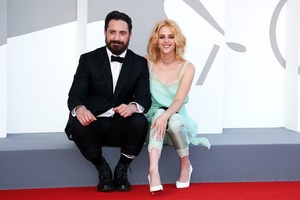
Pablo Larraín may be creating a whole new genre: the “fictional fable.” Sure, his films are connected by a dotted line to the traditional biopic, but don’t expect him to define the forthcoming “Spencer” or 2016’s Oscar-nominated “Jackie” as such. “I understand that we need to put things in boxes,” he says, but he’s more interested in the psychological truths of his heroes than biographical ones.
“My personal starting point is to understand that you would never be able to capture anyone. It’s not possible, because that person is so unique and singular,” he says. “But what you can do is create an illusion that works on a more emotional level and an intellectual level. All you can do is try to capture the essence of that person through what you believe is humanly relevant.”
His interest in Diana, Princess of Wales (born Diana Frances Spencer) began at a young age. From his childhood home in Chile, Larraín remembers his mother not just being interested in, but invested in, this distant woman’s fashions and hairstyles, the royal family’s dramas, and ultimately, Spencer’s tragic death. What fascinated the filmmaker was the question: Why?
“I realized that my mom was just one among millions around the world,” he says. “The more I knew about Diana, the more I was interested [in trying] to understand why such a particular cultural and pop icon was so interesting for so many people.”
“Spencer,” led by a career-best Kristen Stewart, takes a stab at answering that question. Larraín reflects that the princess’s inherent mystery and the difference between her public and private personas are what has enraptured the world—both then and now.
“I think Diana had an enormous amount of mystery, and the more I learned, the more questions I had,” he says. “Now, after I’ve made the movie, I’ve had more.”
That kernel of truth led to Stewart’s casting as the late icon. As a fan of the star’s work in Olivier Assayas’ features “Clouds of Sils Maria” and “Personal Shopper,” Larraín says that “she obviously has the skills and the elegance and the beauty to play Diana; but most importantly, she has the mystery.” The inscrutability of his subject and the leading lady playing her served his interpretation of Spencer’s crumbling marriage and relationship with the Crown, “because that’s how each of us can see the version of Diana that you think you see.”
“It’s hard to define,” he adds, “and the harder to define, the better it is.”
Looking back at his time filming in Germany earlier this year, Larraín recalls that Stewart was “a force of nature,” “so confident,” and “so fearless” from beginning to end. “It not only speaks [to] the talent she has, but also [to] how much of a hard worker she is. She really studied and went through a very tough process.”
As to the beguiling traits that first lured the filmmaker to the performer, Stewart’s mystery, even after the intimacy of a demanding shoot, remains intact. That, Larraín believes, is the mark of a true movie star and artist.
“We get along well; we started a friendship. I love her, and it’s fantastic. But the process requires a camera and a lens; I wouldn’t be able to define her on a personal level,” he says. “What she does really well—and it’s why I keep thinking she’s like an old-school movie star—is when she’s in front of the camera, it just blows. That’s something that I [don’t see] in other actors, and I just don’t know how or why it happens…. I find that incredible, spiritual mystery that comes out after you film someone and create the illusion of, in this case, Diana, so beautiful.”