Thursday, November 26, 2020

Kristen and Mackenzie Davis' interview with Screen Rant for 'Happiest Season'

What can you tell us about Abby and Harper?

Mackenzie Davis: In the beginning, it's a pretty short period of time where we get to establish them not having been corrupted by going home to meet Harper's family. They’re a very stable, loving, transparent, settled couple that has a whole life together and is grown up. And then they go home to Harper's family, and Harper regresses into an absolute monster, and secrets tumble out.

While it is definitely a coming out story, it's also this coming-of-age story of having to unite your identity as a grown up with your identity within your family unit. How you have to regress a little bit before you can unite those two selves because your family might not be ready to accept your grown-up self.

Kristen Stewart: And as a monstrous as she does sort of reveal herself to be, Abby's perspective might not be congruent with the audience's. She knows her so well that there's never a point where you're like, "Well for conflict's sake, sure this works, she would stay." I'm constantly going, "Oh no, wait. No, no, no. You don't know her. I know her, I know her. Trust me. She's incredible in this. She's going to get through this.

While Harper may act a bit monstrous, we’ve heard that her parents are not the villains, per se. How would you describe your dynamic with them, and then Abby’s impression of them?

Mackenzie Davis: Sure, I think there's no villain. I think that they haven't been exposed to many lifestyles that are not their own. They live in a very waspy, rich environment and anything that's out of that paradigm feels scary and too foreign to them to accept immediately. But once they're confronted with it, I think they handle it well.

But it's like anybody, a lot of public figures - I think of politicians who need to have a gay child in order to understand why that's an issue that they should throw their weight behind, in terms of any sort of civil rights and liberties.

Kristen Stewart: And I understand, but I also don't.

Mackenzie Davis: Yeah, I was getting to a criticism of those politicians. Where you're like, "I'm happy you came around to it. It's so weird that you needed to be related to someone to have just the basic shred of empathy that most people are able to muster up.”

They need to be exposed to it, and they haven't been exposed yet.

Could you guys talk a little bit about working with this cast? In particular, we don't know a lot about Dan Levy's character. We heard he's playing Abby’s best friend and we all love him.

Kristen Stewart: I am so in love with Dan. It's insane. It was so important for whoever played Abby's best friend to be a really grounded reflection of who she is – obviously, because we don't have a whole lot of time to develop the characters before we're thrust into this precarious situation.

He's written in a way that is so nuanced and neurotic, but also broadly funny. And I think that he is so perfect, because when he really brings it home and wants to connect, and he comes from a place of true understanding of what the story is and how heavy and hard it is - it can then be funny. But only, first, it needs to be completely understood from the inside. And he's so unbelievably funny.

He's so destabilized by my leaning into convention. I want to ask her dad for his blessing; I want to do it all the right ways, and he's just like, "I thought that we had a pact to be Others forever!" You know what I mean? So, it's really funny because it also acknowledges how weird it is to lean in towards something that is not welcoming to you.

But she's a romantic, so it's really sweet. Dan's amazing. The entire cast is so great. We've said it a million times to each other every single day, all of us go, "We love our jobs. We love the opportunity to tell stories with people that we're drawn to." But this is such an extreme version of that. It's so wild that everyone is so wonderful.

Mackenzie Davis: We’re so in love with each other. And they’re so talented. You've lived with it longer than I have, but I had this script for a year before we started shooting, so I'm very familiar with all the scenes in it. And yet every single scene that we've done, when Mary Steenburgen's doing it and Victor Garber's doing it, you're like, "Oh my God! I didn't know it was like that. It's so much better than it already was, which was great!" It's just so cool to watch them work.

What is it that you look for in a script? What stood out about this one in particular that made you want to jump in and take the role?

Mackenzie Davis: Well, I was just saying that a lot of the time, before anything else you're like, "Can I feel these words in my mouth?" You start mouthing them and being like, "These don't fit in my mouth for some reason, and I don't know why." That's just a very basic nervous system test of if it feels right to you.

And then I think, especially in a genre movie like this, we understand the parameters of a romantic comedy. We know everything's going to be okay in the end. There are very specific beats that take you through this story, and while accepting those and embracing the genre elements of this, what makes it smart and new? Or not even new, but authentic and empathetic and fully felt? Not just relying on the convention to carry us through the story, but that each beat of the convention has been fully fleshed out.

It's like, "Well, this is the part where we have this pratfall thing," but it feels purposeful and important and urgent. And I felt like the script had everything, and also such a distinct voice. Clea and Mary, who wrote the script, just have such distinct comedic sensibilities.

Kristen Stewart: It's so funny. I loved the script. It felt like a huge relief. It didn't feel obliged to be overwrought, but it's so tender.

I think with a Christmas movie, like she said, knowing that everything's going to be okay allows for you to... I don't want to be too specific. It's nice to not highlight something so overtly, because that is in itself self-conscious. But it doesn't shy away from what it is, which is a really beautiful love story and a coming out story about two women, and it doesn't exist yet. I would have been so jealous and also very excited to see it coming together without me, but I belong here.

For a queer person, the scene feels familiar: you go home for the holidays, and that's when the conversations happen. Does it feel like you're telling a very relatable story in that way, or that you're representing that experience?

Kristen Stewart: Yeah. I have so many close friends that I’ve intimately unpacked these stories with and laughed about them and been enraged about them and told them like, "You don't have to..."

But I personally have never had to do it. I've never had anyone hide me. So no, but yes - because all my friends have. But I do have to say my parents are pretty wonderful about it.

I'd like to hear more about how you feel the film is speaking to an aspect that we may not get to see as much in cinema, and how it’s a huge relief.

Kristen Stewart: What I think is really interesting is that in certain moments that we have maybe considered delving into really deeply, or maybe we throw out the words and we improv it - it's always been rooted by Clea being like, "No, it's a genre movie." We have to hit the beats, because it is a situation of being able to hide the vegetables - which is something she says - in something that is commercial and fun. Not everything has to be facing this grave adversity in order to be itself, and still acknowledging that it's not completely easy.

It's something that is earned, but not something that is fought so hard for. It doesn't need to be all about how much it hurts to be unacknowledged, even though that's an element of it. They also really know themselves very well, and there's a comfort in that. I think that a lot of times people on the outside of that project this sympathy. It's like, "I don't need that. I'm actually fine. But this is how I got there.” Do you know what I mean? So, that's cool. That's what felt relieving about it.

Source


Kristen and the 'Happiest Season' cast interview with LA Times


“There’s something so nice about watching a Christmas rom-com and knowing it ends with everything being fine,” said Davis. “I’m OK to go along this journey, and I can be scared when they fight, and I can be sad in this moment, and I could laugh, but ultimately, there’s this certainty that it concludes [and] it’s so nice to know that everything’s gonna be OK in the end.”

Directed by Clea DuVall, “Happiest Season,” out now on Hulu, was born from her desire to see holiday fare that reflected her own experiences.

“I’ve always been such a huge fan of holiday movies, but … if there was an LGBTQ+ character in a holiday film, they were always in the background or just sort of thrown in to diversify an otherwise ‘normal’ family,” said DuVall. “Once I had transitioned into writing and directing, I realized that I could be the person who made that movie, and it was this very powerful, inspiring moment.”

“Happiest Season” is the second feature directed by the veteran actress who wrote, directed and starred in 2016’s “The Intervention.” And although she had started conceptualizing the characters and working on an outline on her own, progress stalled while acting projects kept DuVall busy. It wasn’t until she met cowriter Mary Holland (who also appears in the film as Harper’s sister Jane) while working on “Veep” that a script came together.

“We just really connected as human beings, and she was so funny and warm,” said DuVall. “And writing is such a lonely experience that I thought it would be so much more fun to work on a comedy with someone, especially someone who really made me laugh.

After sending a draft of the script to Temple Hill’s Isaac Klausner, who joined the project as a producer, they eventually chose to move forward at Sony’s TriStar Pictures, one of a number of studios where it was surprisingly well-received.

Surprising because it arrives without precedent. “Happiest Season” was intended to hit theaters as the first lesbian holiday rom-com released by a major studio, but plans had to change as the COVID-19 pandemic upended norms such as watching anything inside a theater.

“Before we moved to Hulu, people would ask me about the movie and approaching the place where I was going to have to encourage people to go to a movie theater started feeling very wrong to me, and on a moral level, just not something I was willing to do,” said DuVall, who despite the circumstances feels the streamer is a great home for her film. “It is more meaningful to me that people will be able to watch it safely from their homes with their family, and that maybe people who wouldn’t have gone to see it in the theater will now see it and get something out of it that they didn’t know they needed.”

Despite this minor setback, “Happiest Season” remains revolutionary for putting a queer couple at the center of a mainstream genre that is synonymous with heteronormativity. It’s significant even in a year that the TV powerhouses of Christmas rom-coms, including Hallmark and Lifetime, have also added more inclusive offerings to their lineups. This one is a major studio production directed by an out filmmaker, featuring an award-winning queer lead and other well-known LGBTQ actors in supporting roles.

“It was such a huge relief and pleasure and delight to work with a fellow queer woman on a movie like this because we are well past this stage,” said Stewart of working with DuVall. “It just felt so good to remember together funny things about what it was like to feel more uncomfortable. I wouldn’t have been able to do that with someone who hadn’t also gone through it.”

While Stewart advocates the importance of uplifting underrepresented voices, she doesn’t believe in hard and fast rules limiting who can tell what stories.

“I don’t think you need to be gay to be telling a gay story,” Stewart said. “Mackenzie’s a straight woman. She’s one of the most present, open, aware, honest people. I know that we feel the same way about loving other humans. So I just knew she was the partner for me in this movie.”

The queer love story of “Happiest Season” also stands out because although there have been more LGBTQ filmmakers making LGBTQ movies in recent years, these films are more often than not indies and happy endings can be few and far between.

“Typically with a queer story, my experience with watching movies is that you’re always sort of on the edge of your seat going, ‘Are they going to be OK?’” said Stewart. “Because that really does reflect a true experience. So it was so cool to see something [where] you know it’s going to work out. That these people just sort of need to get through this, but that they’re clearly in love and going to be together.”

For DuVall, leaning into all of the rules of Christmas movies and rom-coms was key because audiences deserve to see authentic LGBTQ stories with happy endings.

“Really nailing that tone was so important for the story ... sothat we could then transition into what the movie is really about, which is something very real,” said DuVall.

But both Davis and Stewart, who are better known for their more dramatic work, explained that they had a tendency stray away from that tone in their performances.

“We had to be reminded constantly by Clea what genre movie we were making,” said Davis. “I just really wanted to honor this story because it was personal to so many people that were going to watch the movie and so many people who were in the movie, and I imposed a lot of pressure on myself. It just felt very important to me. But I just dove so deep into the tragedy of the situation … and Clea would just come into scenes and be like, ‘Stop. It’s not that movie. It is a comedy.’ Having her recalibrate us was essential.”

“I always kind of lean away from stuff that I feel may be cliche or trite,” said Stewart. “And every single time Clea would come back and go ‘Look, you kind of just have to get on your tippy toes and kiss her.’ You just have to do the thing. You want to to give the people what they want.”

Ultimately, “Happiest Season” could be summed up as a coming-out story with all the holiday trimmings. But it’s a type of coming-out story that is rarely reflected on the big screen both because Harper is quite confident in her identity outside of her parents’ orbit and because it’s within a comedy.

“This is a woman who is so self-realized,” said Stewart. “When you meet [Harper] in the beginning, she’s more self-assured than I am, even. She’s more confident. Like she really knows herself.”

“Coming-out stories are always so fraught and dramatic,” said DuVall. “To be able to see one in the context of a comedy, while still honoring the experience was really, really important to me. We all have elements of ourselves that we’re trying to come to terms with, and for Harper it is being her authentic self with her family, which is something that I think a lot of people can relate to.”

For audiences that have become more accustomed to increased onscreen LGBTQ representation (particularly in television) and seeing queer story lines beyond the coming-out experience, Harper’s story might feel old-fashioned. But Stewart notes that the normalcy and comfort some see around coming out in 2020 is just one perspective

And DuVall points out how “the assumption that you’re straight is everywhere, so that in itself is like a very light homophobia that is ingrained into our world” and reminds us that coming out is still a big deal for many people

She also points to moves by the government enacting anti-LGBTQ legislation, in particular those targeting the transgender community, as well as the power of conservative courts to turn back hard-fought rights.

“Homophobia is not gone,” said DuVall. “Aggression towards LGBTQ+ people is not gone. So to anyone who’s saying ‘Aren’t we past coming out?’ No. It is a big deal. There are still people who are in the closet, and they are f— terrified. … [So] to be able to tell a story about someone coming out that is not a tragedy, that is a comedy, that is warm and bright and hopeful, that has a happy ending, is so important.”

But DuVall and Stewart both look forward to a day when things have changed.

“I think it’s cool to not pretend like it’s not hard to come out for some people even though for others it’s become really normal,” said Stewart. “Movies always are a little bit behind the times slightly. We’re always playing a couple years of catch up.

“I’m really excited to start seeing coming-out stories, queer stories from really young perspectives and how that’s gonna shift. What does it feel like for a younger person who doesn’t understand that it would be weird to not come out when you were 10 or say that you always knew you were gay?”

Source

Video: 'Happiest Season' cast interview with Yahoo

Source

Kristen and the 'Happiest Season' cast interview + portraits for the NY Times


imagebam.com imagebam.com

Outtakes and better quality (below).

imagebam.com imagebam.com imagebam.com imagebam.com

Click images for full view. 

No one imagines that a Christmas rom-com can be renegade. And yet “Happiest Season,” about a couple played by Kristen Stewart and Mackenzie Davis, manages to be at once deeply, warmingly conventional and surprisingly radical, simply by focusing on a pair of women.

“I just wanted it to feel very, very relatable — but then also completely new,” said Clea DuVall, the director and co-writer with Mary Holland, who also stars as a loopy sister.

DuVall, who is an actress too (“Veep”), has said her own role in the seminal 2000 comedy “But I’m a Cheerleader,” in which she played a gay teenager sent to conversion camp, helped her out of the closet. She came out to her own mother on Christmas Day and modeled Stewart’s character, Abby, after herself. The production included other L.G.B.T.Q. stars, with Daniel Levy as Abby’s scene-stealing bestie and a soundtrack, courtesy of the producer Justin Tranter, performed by queer artists.

They shot in the cold in Pittsburgh — DuVall adamantly wanted that winter light — wrapping just two weeks before Covid-19 upended life.

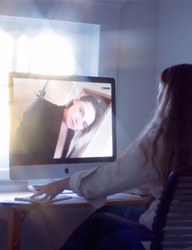
In a recent video interview, DuVall, Stewart, Davis and Holland — beaming in from different locations, with Stewart’s dogs occasionally barking in the background — spoke about missing each other and somehow not yet getting the hang of Zoom interviews. (“Yesterday I had it on Gallery View, but then I just was looking at my own face the whole time,” Davis admitted.)

“Happiest Season,” which premieres on Hulu on Thanksgiving, was the last big project for all of them — a time capsule and a holiday rolled into one. “Christmas movies are so specific and they become a part of our lives in a way that other movies don’t,” DuVall said. “None of us had any idea just how much we would all need that comfort when the movie came out.”

These are edited excerpts from the conversation.

Kristen and Mackenzie, your characters at the beginning have such a sweet relationship and real chemistry. Did you build their back story to create that intimacy?

STEWART Right before we started shooting, you and I maybe had a couple of conversations. Do we meet in college? Are you older?

DAVIS We talked so much about our own current or past relationship experiences, what we like, things that felt really specific to our own lives. That’s for me more relevant than the checklist of, OK, we met then, what were our friend groups like when they merged? That stuff is important to a degree but it doesn’t show up in the same way as, like —

STEWART How do you catch a person’s eye.

DAVIS Exactly.

Stewart said she wanted the romance to feel as if it were about “just two women in love” who happen to do a Christmas movie.

Stewart said she wanted the romance to feel as if it were about “just two women in love” who happen to do a Christmas movie.Credit...Photo illustration by Sam Cannon for The New York Times

STEWART I always felt as long as we felt solid going in, we could be like an aspirational, really self-assured couple in a way that strips any kind of discomfort or internalized homophobia that is undeniably applied to same-sex couples in commercial projects. Like, did we seem like lesbians? Or were we just two women in love, and then we do a Christmas movie?

Tell me more about characterizing queer characters onscreen vs. what has historically been represented.

STEWART I’ve had a lot of experience with confusing people and having it be misconstrued as my confusion. It’s like, I’m sorry, you need to catch up. Sometimes I didn’t wear heels when I was younger [and that was commented on]. Wardrobe choices — it became more and more evident that optics really matter, because they’ve been violently used against me.

You know, the word “lesbian” has a negative connotation to me that I have now tried to strip because I grew up being like oh, I’m not a lesbian. Because I hadn’t dated girls yet. But, like, that was violent. In retrospect — just because I have so much of pretty much every other type of privilege — that doesn’t mean that I have to not acknowledge that sucked and felt physical.

So it was important for me in this movie to acknowledge it and be like hey, I’m going to nicely invite you towards me, rather than feel like I’m feeding into an alienation that I have been sucked into my whole life.

Davis said she and Stewart didn’t work on a back story for their characters so much as discuss their own experiences.

Davis said she and Stewart didn’t work on a back story for their characters so much as discuss their own experiences.Credit...Photo illustration by Sam Cannon for The New York Times

DuVALL I think people don’t even realize how rampant homophobia is and how casual it is. And that it does really have a lasting impact.

I so appreciated making this movie with Kristen, because I felt she could understand it in a way that not a lot of people can. I was very lucky early in my career to be in “But I’m a Cheerleader” and play a character that felt like me for the first time, and also seeing that for the first time [onscreen] — it was so major. Creating Abby was really wanting to bring that kind of specificity back into movies.

Mary, you and Clea were co-stars on “Veep.” How did you go from that to writing a Christmas rom-com together?

HOLLAND Our characters on “Veep” never had scenes together, so we never got to be together on set. But I would go to the cast table reads and right away, we sort of locked in with each other and had this chemistry. She told me about this idea, and I was a thousand percent on board. Clea really took a shot in the dark with me. We were pretty much strangers when she asked me to write with her.

Did you have a list of Christmas movie must-haves, like that image of a door with a giant wreath on it opening, which seems like a staple of all holiday movies?

STEWART I’ve seen the movie like three times now — [jokingly] because I’m obsessed with myself. But when the door opens, I feel like the movie gets up and starts to run. And you’re like oh, my God, wait, I’m supposed to run with you? I love it.

DuVALL In the writing we didn’t really watch stuff — we built the world on our own. But once I got into working with our production designer, Theresa Guleserian, and our [director of photography], John Guleserian, that’s when we started creating those iconic images and [making] them feel like Christmas without just putting up a bunch of tinsel and lights.

The soundtrack is also totally Christmas-y. But why no Mariah?

DuVALL Because Mariah’s Christmas song is very expensive.

DuVall based Stewart’s character on her own experiences.

DuVall based Stewart’s character on her own experiences.Credit...Photo illustration by Sam Cannon for The New York Times

Kristen and Mackenzie, how do you balance being funny with the movie’s big emotional arcs?

DAVIS Clea would tell us this all the time — don’t try and make it something that it’s not. Don’t shy away from the big romance and don’t shy away from the slapstick and the big emotional moments, because all those things together are part of this genre. So even though your instinct as an actor might be to make it a little quieter, all of those things actually thrive if you invest the most into each of those elements.

STEWART Going back and forth from the comedy to being emotional or hurt was, like, traumatic for me. I would be mad at Mackenzie in the morning.

Holland met DuVall through “Veep” but the two hadn’t written anything together until “Happiest Season.”

Holland met DuVall through “Veep” but the two hadn’t written anything together until “Happiest Season.”Credit...Photo illustration by Sam Cannon for The New York Times

Dan Levy has a memorable scene talking about the coming out process. How did that develop?

DuVALL His speech was actually almost an afterthought. I was needing to create sides for auditions to see if this actor can do drama.

And then when I got into it I was like oh, this is maybe the most important part of the movie. And it was something that I hadn’t ever really articulated for myself. Because I came out and I think I just brushed it off. Then when I thought about it and that came out — he delivered that so beautifully, I would watch it in the tent and just cry.

STEWART Also Dan, I was so nervous. He’s so funny. I didn’t know him before. I was like, dude, is he going to think I’m like a dumb loser? Are we going to like each other? Because I’ve had experiences with comedians that at first you go, oh, this is going to be really fun, and then you’re like actually, I kind of just feel dumber around this person. And also there is a sort of one-uppy thing some really funny people have.

Dan is the most warm and welcoming and truly observational and neurotic funny person, without ever taking anyone down or being weird and negative. I was like oh, man, it’s going to be so easy to love this guy.

This movie made me realize that there’s a certain amount of tension and release that can be good, but really you do your best work when you’re supported and feel seen. Rather than fighting to feel that — which I have also loved doing, but I’m growing out of. I don’t have the energy for it.

Also, it feels so good to watch a movie where the jokes are so familiar to me and my friends, with relationships between two girls. It feels amazing to take the piss out of stuff that hurts, because that means you can release it.

Source 1 2

Video: Interview with USA Today for 'Happiest Season'


Source

Kristen's interview with iNews (UK)


Kristen Stewart is outlining her ideal Christmas in Los Angeles. “I live by Thai Town and it’s the only food that’s available on Christmas Day,” she explains. “So I go to eat coconut soup early in the morning.” It’s not exactly chestnuts roasting on an open fire, but then, the 30-year-old former Twilight star has never done things conventionally. 

This festive period, she stars in Happiest Season, which, on first sight, has everything you might expect from a Hollywood studio movie designed for the holidays: it is glitzy and twinkly, and the aspirational characters live in large houses with Christmas trees so big you would think they had been shipped direct from Norway. Only this Yuletide story is a little different. 

Stewart plays Abby, who agrees to spend her Christmas with her girlfriend, Harper (Mackenzie Davis) – only to discover that Harper never came out to her conservative parents. No prizes for guessing that Happiest Season is a game of hide and seek, as Abby and Harper pretend to be roommates when they arrive, with Harper promising she’ll reveal all to her mother and father after the holidays. 

A mainstream Christmas movie with a gay couple at its centre – not relegated to the support act – is something of a revelation. “I think it’s something that we’ll look back on and wonder why it hadn’t been reflected in our art a little earlier,” says Stewart. “Because obviously we have acknowledged queer existence in an open, cultural way… but do we see it in commercial film? No.” 

It is no exaggeration to say Stewart is currently Hollywood’s highest-profile LGBTQ+ star. In 2017, when she hosted the US comedy show Saturday Night Live (SNL), she went into a riff in her opening monologue about Donald Trump (who had been tweeting about her break-up with her one-time Twilight co-star Robert Pattinson). “And Donald,” she declared, to hysterical cheers from the audience, “I’m so gay, dude.” 

Watching that night was Happiest Season’s co-writer and director Clea DuVall, who came out several years before Stewart. “I’d always been such a fan of Kristen’s work… but when I saw her on SNL a few years ago, she was so funny and silly and warm,” she says. “It was this whole other side to her, and seeing that she was able to be so funny and so real made her perfect to play Abby.” 

For Stewart, DuVall’s film signals a move into a more comic arena. Her comfort zone is tough-as-nails parts – Alzheimer’s tale Still Alice, the traumatic movie-star biopic Seberg, or the spiritual psychodrama Personal Shopper. She began in the heavyweight dramatic leagues, aged 12, when she caught attention in David Fincher’s Panic Room, playing Jodie Foster’s tomboy daughter. 

So how was it finding her funny bone? “It was different, for sure,” she admits. “I was intimidated and really bowled over by the talented comedic actors we had around, but also encouraged, because they make it seem fun.” She breaks off, softly laughing at something that’s just struck her. “As lesbian as I am in the movie, I do play a character who’s the ‘straight man’.” 

When we spoke over Zoom, with Stewart in LA, Happiest Season was all set for a major cinema release over Thanksgiving in the US. But with cinemas still shut due to the pandemic, the film is now being released online. In some ways that’s a major disappointment, but then again, the point of a film like Happiest Season is that it is revisited every Christmas. The idea that families might sit around and watch a mainstream lesbian romcom feels pleasingly radical. 

“Little kids need to see Christmas movies where they might see themselves reflected in a broader sense,” says Stewart. “Let’s not marginalise the marginalised in art. Let’s allow there to be a lightness and a sort of ease and pleasure. There’s a delight to the movie that I think is really imperative to get across in this context.” 

Talking to Stewart, you get the sense that being a role model has been thrust upon her. “It’s not a proactive thing I do,” she says. But how does she feel when fans tell her that her openness has helped them to come out? “Nothing makes me happier. But I’m not trying to push this stuff.” Her preference would be “a balanced and equal exchange” of experiences. “I am encouraged just as much by that.” 

Raised in LA by parents in the entertainment industry – her father worked as a stage manager and TV producer, her mother as a script supervisor – Stewart wasn’t living amid the strict religious or conservative backdrops that some face when coming out. Still, she knew the confusion of understanding your own sexuality. “Growing up, trying to figure out whether it’s going to be OK is an experience I can definitely relate to,” she says. 

She dated men when she was younger – most famously Pattinson – but by 2013, she was in a relationship with visual effects producer Alicia Cargile. “When I was 22, I grew into understanding myself in a more ambiguous way,” she says. She felt pressure to “put a label on it” and define what she was. “I was like, ‘That doesn’t really work for me.’” Following a relationship with the model Stella Maxwell, she is currently dating screenwriter Dylan Meyer. 

Even now, Stewart knows that being gay isn’t easy – “living in a world where holding the hand of the person you love can make you or others uncomfortable”. She explains that she has just got back from a small road trip. “I entered some, like, Trumpian territory, and I felt scared. I have experience of trying to shape what my experience looks like for others, for it to be digestible and not threatening.” 

Stewart’s next role will be far tougher than Happiest Season: she is prepping to play Princess Diana in a new film by Pablo Larraín, said to be set over the weekend she resolves to leave Prince Charles. “I’ve not been as consumed by something in so long,” she recently told Access Hollywood.

Having directed shorts and videos already, she is also planning her feature debut with Lidia Yuknavitch’s memoir The Chronology of Water, which deals with the author’s bisexuality and addiction issues. The book contains “some of my favourite writing”, says Stewart. “The only reason to make it a movie is because I want people to see how I see it.” 

Source

Kristen's interview with Ruben V Nepales for 'Happiest Season' and mentions 'Spencer'

Similar quotes from previous outlets. 

The interview was done during a round table with press.

The 'Happiest Season' star talks about her role – and personal experience – in a chat with Ruben Nepales

“I just fell in love with a girl for the first time.”

For Kristen Stewart, there was no big, dramatic coming out moment. The actress, who stars in queer holiday rom-com Happiest Season, plays Abby, who learns that her girlfriend Harper (Mackenzie Davis) has kept their relationship a secret from her family.

She talked candidly about the role – and her own experiences – in a recent video call.

In director Clea DuVall’s pioneering lesbian Christmas film on Hulu, Abby is ready to propose to Harper when the latter brings her to her family home. But Harper asks Abby to play straight because she has not come out as gay to her family.

“What I do love about this movie is how it advocates for the variation in the coming out stories,” said Kristen. “Everyone has had a completely different experience doing it.”

The actress, opening up about her sexuality, said her coming out was “was pretty unique in that I don’t think I really dealt with it.  I don’t want this to come out the wrong way. But I didn’t really care how it was going to affect everyone. I also never had a moment when I actually came out. I just fell in love with a girl for the first time.”

“It wasn’t like this unburdening feeling. It really was more surprising. I felt like my life was opening up in a way that I never really considered realistically. So, rather than saying to my parents like, hey, I want to tell you guys, I hate to break it to you… (laughs).”

“I didn’t think of it in those terms because I am lucky as hell. I just didn’t think it was a bad thing. I was just like, there is this new person in my life.  Having said that, I haven’t skirted all discomfort in terms of identity and sexuality.”

“Growing where I grew up, in the time that I grew up, I think you would have to be under the age of 20 and living in a city in the United States to ever really feel…You have to be like 15 years old and living in New York, Los Angeles or a metropolitan city in order to have felt truly untouched by really negative leering judgement.”

“I’m positive that I grew up thinking it would be not what I would have chosen, to be a lesbian. That’s like, harder. People think it’s gross and weird. There’s no way around that. So I can relate to the feeling of being different, and in the movie, sort of standing tall within that."

“Because I think Abby really knows herself and she really wants to help Harper destigmatize this feeling.  But at the same time, it’s a really fringe feeling to feel as comfortable as I felt. I know what it feels like to talk to anyone who feels differently. It’s rampant. I’d say optimistically half the country doesn’t feel that way (laughs).”

“So it’s hard to say that I didn’t have a hard coming out story while still living in the world that we live in. But I was totally fine. I told my parents I had a girlfriend, I was in love with her and it was a new thing.”

“I really felt like this was cool next step in my life. It just sort of opened up. It didn’t feel like I had realized something and unloaded.”

Kristen, who dated her Twilight series costar Robert Pattinson, Alice Cargile and Stella Maxwell, and whose reported current girlfriend is screenwriter Dylan Meyer, said in retrospect, “It really was me as an individual growing with the times. I wasn't really living in the closet.  I was always like holding my girlfriend's hand in public. I told my parents and bla bla bla.”

“I like to make out with my girlfriend on the street all the time. I'm obviously gay but there was something about saying it, knowing that it was being heard and set on a platform like that, so it's amazing.”

The 30-year-old with the soulful green eyes replied when asked about her thoughts on marriage: “Yeah. I like traditions, declarations of any kind. I love a grand statement. It’s funny, the best thing in life is to know something because it’s such a rare feeling when you feel sure about something. Sticking a stake in the ground on that level is something that I do find attractive.”

“Having said that, I do have complicated feelings about this sanctimonious nature of it all. I would say I would get married in my own way but I wouldn’t necessarily do it. You can promise yourself to someone in front of a bunch of other people and not have to do it in the way that it’s been presented my whole life. But I still am really inspired by the commitment of it.”

Laughing, Kristen stressed that she wants the works: “Four walls, a strong door, a fireplace to keep you warm. Of course, I want a family. I want all the things that all normal people want.”

Kristen is encouraged by what she sees in social media. “I am inspired and turned on by the idea that I see more (queer) presence in social media that are prouder. People younger than me inspire me more than the generation that I came from. So, to be honest, I am lucky to be able to reflect this perspective in my choices of film."

'Happiest Season' stars (from left) Kristen Stewart, Mackenzie Davis, Alison Brie, Victor Garber and Mary Steenburgen. Still courtesy of Hulu

“People are spending money on movies like this (Happiest Season) because of the younger generation, not necessarily because of me, but the growth that it has inspired. It’s the desire and the gap that has inspired filling it. I’m so thankful just to even be a part of that exchange. It works both ways.”

On the coincidence of queer films like Happiest Season, Ammonite and The Prom being released during this time, Kristen opined, “I grew up in a time when no one would ever dream of making this movie commercially. It would be a fringe-y sort of smaller movie for people in the margins. I have grown up with people that might feel that way. I know the difference between the world that we live in now and even the one that we lived in a very short number of years ago.”

“It's optimistic to assume that queerness has been normalized in every household across America, because it totally has not. Obviously, there's a lot of division here. To wrap up a message like this in such cozy clothes and deliver it with true compassion and warmth is a nice way to try and bridge that gap.”

“You'd have to be a bad person to not like the story (laughs). You'd pretty much have to be an asshole to not like the story. We had some of those but that's okay. There are many ways to participate in a discussion. This is not argumentative.”

“People need help,” Kristen emphasized about the challenges of making gay fare. “The responsibility of more self-realized queer people who tell stories is to lead the horse to the water.  You can't make them drink but you can definitely present something that's filled with positivity, love and acceptance. And just hope that it rubs off.”

“I feel really lucky to be in a movie that is not shy. It’s very self-realized. It has an ease like I didn't want to represent a gay couple that didn't feel lived in and comfortable with themselves in their own story.  It's like yes, Mackenzie's character is coming out and she's having a hard time doing that with her family.”

“But in her own life, Mackenzie is a very self-realized, really accomplished woman. She really knows herself. These two women have immense respect for each other. I thought it was really important to represent a gay couple that didn't necessarily feel alternative or fringe-y.”

“They just look like us. They are not like overtly obsessed with gay culture. They are just very naturally themselves and they're in love with each other.”

Happiest Season also stars Dan Levy, Alison Brie, Aubrey Plaza, Mary Steenburgen and Victor Garber.

The first American actress to win a Cesar, France’s Oscar equivalent – with credits that include Clouds of Sils Maria, Personal Shopper and Seberg – is preparing to play next Princess Diana.

In filmmaker Pablo Larrain’s drama, Spencer, Kristen will portray Diana in a specific moment (three days, to be exact) during the Christmas holidays at the Sandringham estate in which she reflects on whether to leave her marriage to Prince Charles.

It’s a challenge, since Emma Corrin is earning praises for her portrayal of Lady Di in the current season of The Crown. Kristen admitted that she is a big fan of the series.

“I am obsessed with The Crown,” she said. “It’s so brilliant. I have been through the first three seasons and I was waiting for the fourth one to come out. I’ve already seen half of it. It has even taken a step up from where it was.”

“I have this accompaniment to something that I am already so consumed by.  I have this visual, sort of emotional aid. I literally go to sleep with (Princess Diana’s) interviews on so I just have her voice in my head. So I never really feel like I am doing an impression.”

“I’m just consuming everything without specificity in order to intrinsically feel her and not feel the pressure of always doing an impression.  The people that you know the best in your life, when you tell stories about them, you can immediately drop into the sound of their voice.”

“I want to know her (Diana). I don’t want to do a bad impression. I just really want to feel her as much as I can. So my preparation for her really has just been emotional.”

“I wish that the state of the world was in every way more open. Currently, everything is fairly locked down. I wanted to go to Sandringham and see the places where Diana lived, these monumental spaces that you can feel so small in. I’m going there through The Crown (laughs). I’m like, I can’t go to London but I’m going there through research as much as I can. I have a brilliant dialect coach.”

“I cannot wait to go on this dreamy ride with Pablo because the movie takes place over three days. There are no salacious details. There’s no new information representing. It really is just like an imagining of a three day period when maybe it was heaviest on her.”

“It’s a really internal experience.  Therefore, I’m just trying to open myself to her as much as I can. So when we get there, I can completely forget about the accent and all of the stuff that I’m worried about now.”

On Emma’s performance in particular, Kristen was effusive: “Emma killed it and she should be very proud of herself. I love the show. Emma is incredible. It’s so moving. I’m sure that gossipy weirdos would want to know, oh, there are two people playing Diana at the same time. I do play her at a later stage, when she’s almost 30.”

“I think that Emma gets right up to the age that I’m about to start. I play just a year after The Crown’s storyline ends, which for us is lucky (laughs). So there’s no crossover.”

“I’ve now consumed pretty much all there is to consume, video-wise. Every interview that you can actually hear or see, I go to sleep with it on.”

Joining her on this Spencer journey is someone named Cole. “My dog is named Cole,” Kristen said about the beautiful black dog behind her. “She’s my best friend. We do everything together. I’m trying to get her a doggie passport so she can come with me to go do Diana. I can’t imagine doing that without her. She’s my life support system.” 

Source

Video: Kristen, Mackenzie, Dan Levy and Aubrey Plaza interview with Fuera de Foco (Mexico)