Wednesday, November 25, 2020

Kristen and Mackenzie Davis' interview with Pride Source


Kristen Stewart is waving around what appears to be a joint. Even her “Happiest Season” co-star Mackenzie Davis, who’s seen on Zoom with Stewart, doesn’t quite know exactly what Stewart has lit. “Oh my god,” Davis says. “I thought that was a blunt.” 

It is actually Palo Santo, a South American tree that translates to “holy wood.” But for a moment, Stewart gets silly and pretends her soothing wood stick is an actual joint, moving it toward her mouth as if she’s going to smoke it. They both crack up at the thought of Stewart maybe getting blazed during our interview. “Just cleansing the energy!” Stewart assures. 

After her “Twilight” years, a “Charlie’s Angels” reboot and a range of indies, Stewart’s latest movie, “Happiest Season,” feels a lot like taking a whiff of some Palo Santo – an energy-cleanser. For 102 festive minutes, it restores some of the downer pandemic energy of 2020 with comfort, joy and the promise of a yuletide so gay it makes sense that Clea DuVall, the openly lesbian actress who starred in the 1999 queer camp classic “But I’m a Cheerleader,” directed and co-wrote it. 

The film is the first of its kind: a major studio-backed holiday rom-com with a queer love story at its center. In the movie, Stewart stars as Abby, whose girlfriend, Harper (Davis, adored by the LGBTQ community for playing queer in “San Junipero” episode of “Black Mirror”), invites her home for Christmas. At first, she’s not sure about meeting Harper’s family, but then decides she’s all in. Abby even plans to propose to her (with guidance from BFF John, played by Dan Levy). But what Abby doesn’t know until they’re en route: Harper hasn’t come out to her family. 

Shot in February just before the film industry was forced to shut down due to the coronavirus pandemic, the movie was originally slated for a wide theatrical release backed by Sony’s TriStar Pictures. But with many theaters still shuttered, “Happiest Season” has found a new (streaming) home for the holidays on Hulu.

During our recent Zoom call, Stewart and Davis talked about moving beyond the fetishizing of lesbian relationships, why they love gay bars and how Stewart plans to continue to use her A-list power to radicalize conventional genres with queerness. 

As a kid, could you have imagined a world in which a movie like this existed?

Kristen Stewart: Yeah! That’s kind of why it seems a little bit overdue now. But we have a bunch of really rad stories, like fringy independent films that I grew up with that didn’t lack in joy or sort of splendor, even Clea’s movie that I love so much, “But I’m a Cheerleader.” They’re very much together and happy and run off into the sunset. But that’s a tiny, little movie and not everyone has seen it, and it’s so nice to think that you don’t have to go out and search for this movie. It’s inviting, it’s warm, it’s open. And yeah, helpful! 

I was into strange movies when I was little; that’s not the most normal thing, do you know what I mean? “But I’m a Cheerleader” is seminal and it’s iconic, but I wish it was bigger and this is, so that’s rad. 

This is a big year. You’re part of a queer Christmas movie movement. Lifetime, Hulu, Hallmark are all doing them. There’s a bunch of them coming out.

Mackenzie Davis: Hallmark’s doing a (queer) Christmas movie?

Stewart: Ohh… really? But we want to be the only one! 

Davis: No, no, no. We’re the first. No. I’m just shocked that Hallmark is doing that. They are historically not progressive, to say the least. Ha! That’s so cool.

Stewart: You know what’s cool? Now they have to be, or else they get left behind! Ha!

Kristen, this movie is a big deal to a lot of LGBTQ people. But for you, what is the significance that you are an openly queer A-lister playing a queer character in a major studio queer Christmas movie?

Stewart: It’s really fun. I love playing characters that feel sort of further away from my natural wheelhouse because I like to expand my horizon, and also kind of deeply explore uncharted territory within myself that exists but might not be the most obvious. 

But what feels great is leaning fully into what’s easy and obvious and comfortable when it is supported and recognized and loved. I’ve never had that on such a big movie that people were willing to put so much money into. Because that is a huge risk! And, like, the fact that people are taking risks for, well… look, it’s not a huge risk. It’s that the time calls for it. And there’s a huge gaping desire for it. And that is something I feel because I live in this world. 

So the fact that I got to play this part after being in so many big movies where I never feel like I’m not being myself or trying to pass or anything like that, but I do feel like I’m ambitious about hitting marks that people don’t think I can hit. So this one was not that, this was the opposite of that. It was, no, no, no; I get to be the star of a big movie, and also get to be this person? It felt great. 

With “Runaways,” I remember a lot of talk about your kiss with Dakota Fanning. It seems dated to be talking about a girl-on-girl kiss at this point. Obviously you two kiss in this movie, but with “Happiest Season,” do you get the impression that people and the press are less like, “A gay kiss! What was that like?” and is that a relief?

Stewart: Yeah, nobody’s asked that.

Davis: Oh, god. It hasn’t been brought up. Culture’s moved so fast after not moving (laughs) at all for a very long time. But in the last 10 years it feels like so much has changed.

Stewart: No, nobody has fetishized it in (that) way. I have experience with that being, like, “So tell me about the …,” especially depending on who it’s coming from. You sit down with some news outlet man who’s been a news outlet man for, like, 50 years… 

Davis: Ha! 

Stewart: … and you’re like, “Don’t ask me that.” Wow, that’s so weird. Makes me feel really weird. Yeah, we haven’t had that. 

Davis: I just wanted to change the subject so badly when Matt Lauer (asked) Anne Hathaway about when she was not wearing any underwear. It’s like the absolute worst moment I’ve ever witnessed.

Even though this is based on Clea’s story, it will be relatable to a lot of queer people, like myself. What parts of this Abby-Harper dynamic of coming out and self-acceptance did you identify with the most? 

Stewart: Look, doing things that are really normal and natural to you physically and then having to sort of curb those instincts around people because you don’t want to make other people uncomfortable so you are willing to make yourself so uncomfortable for other people’s benefit is something that I have done (and) probably still (do). 

I tried to go on a houseboat trip recently and it was in northern California, like around Tahoe. It’s a really Trumpian area up there, and I was like, “We gotta get the fuck outta here.” I was holding my girlfriend’s hand, just walking around. I’m not saying every single person… I don’t even know what I’m saying. But I didn’t feel safe. I don’t mean to imply that I know where that would’ve gone, but even just emotionally, it was a violent experience. 

In the movie, it’s really nice to be able to laugh at certain feelings that are more heavy because when you repossess and then sort of release a feeling, it feels cool and triumphant and like I’ve won something back. There were things in the movie – just little moments – where we have to drop each other’s hands or, even though we know we’re lying for just a brief period, the lie hurts and, yeah, I’ve never gone home with someone and had to lie. 

I’ve never specifically had to keep myself in a closet with a person, but all of that, as somebody who’s grown up queer – not to put any whatever limits on my own sexuality – I’ve dealt with that forever. And that’s triggering. But, specifically, just the general experience of being gay and thinking that maybe people think you’re gross or weird is something that is nice to laugh at in this environment. 

In the film, you’re at a gay bar and “RuPaul’s Drag Race” contestants BenDeLaCreme and Jinkx Monsoon are performing. What’s the best time you’ve had at a gay bar?

Stewart: Even before I knew I was gay – even before I had a girlfriend! – I was like, “Oh my god, this is the most fun I’ve ever had at a bar ever! Why are you all the best people?!” 

Davis: Yeah, being a female and experiencing men at bars and being in a space where you can…

Stewart: Dance!

Davis: … be completely unleashed and not fucking worry about anybody touching you or approaching you or coming up behind you is especially – when I was younger it was just such a safe, incredible feeling. It felt very great. And also not worrying about how you looked because nobody wanted to fuck you. 

Stewart: Ha! I know! You never want to take up space where you don’t belong, but it’s typically not an alienating group, not to generalize, and it’s such a nice feeling to go into a queer bar and be like, “Doesn’t matter, whatever, no one’s coming for you.”

Kristen, after playing queer in “Charlie’s Angels” and now in “Happiest Season,” do you plan to continue radicalizing conventional genres with queerness? Basically, will you continue trying to actively make Hollywood gayer?

Stewart: Yeah! Yeah, naturally. But, like, it’s funny when you start just applying restrictive rules on who is allowed to have what perspectives. I still want to play straight sometimes, if that’s OK! Ha! But I will say that, primarily, it’s really important for me to really pick and choose those opportunities and not have it be the default-given setting that someone is straight in a movie when maybe it’s not a romantic movie. 

If it’s not about the romance, then why am I playing straight? Because it’s normal? Well, that’s a ridiculous idea. Because in “Charlie’s” I didn’t have any romantic (interest). I had no one in the movie. But I just thought it was important to drop an Easter egg and be like, “No, that doesn’t mean you can have me, boys.”

Source

Video: Kristen and the 'Happiest Season' cast with Buzzfeed


Source

Clea Duvall talks 'Happiest Season' and mentions Kristen


NATASHA LYONNE: Hello, Clea DuVall.

CLEA DUVALL: Hello, Natasha Lyonne.

LYONNE: Huge fan of the movie. Very excited to talk to you about it, and very excited for the world to see it. It really exemplifies your vision for how you want to see the world change, and you did such a beautiful job on it and I’m so proud to be your BFF.

DUVALL: Thank you.

LYONNE: How did you come up with the idea for it?

DUVALL: I’m a huge fan of Christmas movies, but I’ve never seen my experience represented. After The Intervention, which you and I made together, when I started thinking about what I wanted to do next, this film felt like a great opportunity to tell a universal story from a new perspective. I had this idea that was sort of based on my own experiences of going home with people and being the “friend,” or me asking people to be the “friend.” I’ve definitely been on every side of this. The story just unfolded for me and I wrote an outline for it. When I was working on Veep, I met Mary Holland. She and I had this very easy rapport and she made me laugh and she’s such a talented actor and such a great comedian. I asked her if she wanted to work with me on writing the script and she said yes. And then we took my outline and ran with it.

LYONNE: How many years ago did you write that first seed of the idea? I think it’s so helpful for the kids at home to know how long it really takes to bring a dream to life. 

DUVALL: I wrote it right after we made our movie, which must have been in 2015.

LYONNE: And now it’s 2027, for context.

DUVALL: Yeah.

LYONNE: Wow, so 12 years, huh?

DUVALL: Yeah, 12 years ago.

LYONNE: That’s really something. So it took you about four years in what we’ll call human math. I’m grateful that you continue to refer to The Intervention as our movie, even though the reader should be aware that it’s strictly Clea’s movie as the writer, director, producer, and star of the film. What tools or knowledge did you bring with you to Happiest Season that you didn’t have when you made your first feature?

DUVALL: What I learned very quickly on The Intervention is that acting and directing is not really something that I want to do. Going into Happiest Season knowing there was never a point where I was going to be in it was very liberating, and allowed me to take any attention off myself and put everything into the film and to be able to support my cast and crew in a way that, on The Intervention, I just didn’t have the bandwidth to do. I’m an actor who really relies on my directors to help make sure I’m on the right track, and to not have that is very destabilizing. 

LYONNE: I identify with that. On this Sarah Cooper thing that I just directed [the Netflix special Sarah Cooper: Everything’s Fine], if I had to go from de-masking to being on camera it would have been really scary. To be completely inside any one of those jobs is so all-consuming. Have you had any experiences like the one we see in the film? 

DUVALL: I’ve spent the majority of my Christmases with other people’s families. It’s a very odd thing. You really see sides of your partner that you don’t see for the rest of the year.

LYONNE: How did you go about casting Mackenzie [Davis] and Kristen [Stewart], who are both so great in this movie that it feels like, “Are they dating in real life?” What’s so great about them as a couple is that they both are such complicated, incredible women, in addition to being, as respectfully as I could say, incredibly hot women. What a fucking ultimate couple.

DUVALL: Kristen was the first person I cast. Even though this is a romantic comedy and it’s very light and warm, it’s really about something. I wanted to hire actors who could play the complexity of what was happening underneath everything else. Kristen is someone who I really admired and who I think always makes such interesting, bold choices in terms of projects that she takes on. I sent her the script and she was in Germany filming Charlie’s Angels, so I went out there to meet with her and we spent two very late nights going through the script and talking about the movie and the character. I already knew that she was who I wanted, but after sending this to her, she was the only person who could play that part.

LYONNE: I’ve seen you play Mafia with Mackenzie. I know that she really excels at that game, and so do you. Did you guys meet playing Mafia?

DUVALL: I actually had not met Mackenzie before this movie. I remember seeing her for the first time in The Martian, and the second she came on the screen, I was like, “Who is this incredible human being?” I just wanted more of her. Anything she was in, I would watch. She has this incredible ability to create women I’ve never seen before. It’s such an exciting thing when I see an actor who brings a character that represents a completely new kind of human being. I feel like Mackenzie always does that, and Harper is a very difficult part, because she’s asking a lot of Abby and the audience. We’re also meeting her at this turning point in her life where she’s maybe not making the decisions we want her to be making, but they’re necessary and they’re messy. Being able to have an actor who’s able to play all the different layers of that and still maintain their own humanity, I thought that was really beautiful.

LYONNE: I love her, too. She’s so good at crossword puzzles and reading books, and those are the two key components to being an excellent human being. This movie is already been labeled a “gay rom-com” in the press. Do you feel like, “Hey, it’s 2024, why are we still doing this?” Or do you feel like it’s important?

DUVALL: I understand why people do it, but it is a way of othering. This is not something that has been made on the studio level, so it’s complicated. I, as a gay person, need this movie because I want to see a genre of movie that I love reflect my life. I am a gay person, Natasha.

LYONNE: Clea, let’s not do any sort of surprises because I’m just trying to have my day, and now I just feel like you’re dropping bombs. It’s interesting because this movie has never existed before, so it’s worth mentioning so that people feel seen. Representation matters.

DUVALL: I’m very proud that this is a rom-com that centers on the gay couple, and there aren’t that many, so that’s why people do talk about it. I do think in time, telling stories that are not told from the perspective that they have historically been told from just becomes the norm.

LYONNE: But then again, that’s what’s so subversive about your world domination. Typically, when these movies exist, they are sort of othered and they are meant to be seen on a small scale. What you’ve done with the concept of the movie and the execution is so brilliant. You’re like, “No, this is a big movie,” meaning that everybody can enjoy this movie in the same way that we can all enjoy It’s a Wonderful Life. It just so happens that it’s not Tom and Tina, it’s Tina and Tina. You’re inviting everybody in to say, “I think we’re ready for this now, right guys? Can we handle it?” The act of rebellion becomes just subtle enough to have everyone participate in it. It’s just awesome.

DUVALL: I wanted to create a film that anyone would be able to connect with, in the same way that I’ve spent my entire life watching Christmas movies that don’t represent my experience in any way, and yet I watch them every year. 

LYONNE: So much of what we talk about is that little girl who’s the outsider. Little us needing to be able to know that we’re not alone and that there’s hope on the other side of those weird, outsider feelings. What do you hope that they get from this movie?

DUVALL: I hope that people feel seen. I think about when you and I had the privilege of making But I’m a Cheerleader. We’ve spent the last 20 years seeing how it’s impacted people’s lives in a positive way. That’s very meaningful to me. It definitely informed the kinds of stories that I want to tell. 

LYONNE: What did you feel like when this movie wrapped?

DUVALL: I felt a tremendous amount of relief and accomplishment because we made this movie for less than we thought we were going to, and we had not as many days as we thought we were going to. Every single day of the shoot I would just look at the schedule and go, “I don’t know how we’re going to do it, but we’re going to do it.” I would begin every single day with a pit in my stomach thinking, “Are we going to get what we need to tell the story?” And somehow, miraculously, every day we would, without having to work insane hours. It was a testament to the cast and the crew.

LYONNE: It’s also a testament to you. People may or may not know this about you, but you are just so fucking on top of shit. Clea DuVall does not fuck around in terms of hitting deadlines and budgets. I’m always so in awe of how clean a thinker you are and how efficient and decisive and sure of your vision you are. That extends to us on a road trip. If we’re on a road trip and we’re driving to Vegas, and then I say, “Take a nap, I’ll take the wheel,” we may end up in Arizona. That’s only half the fun. And then all you need to do is wake up and I’ll be like, “Hey, Clea, I don’t think this is Vegas.” And then you’re like, “Hold on, let me drive.” And the next thing you know, we’re in Vegas. 

DUVALL: [Laughs] We got there.

LYONNE: How did you get all of these incredible actors? It’s chockablock with movie stars.

DUVALL: Some of the people I knew already, so I reached out to them to see if they wanted to be involved, and luckily they did. Then there were other people I didn’t know who were passionate about the script and what the movie was doing, and it being the first of its kind. I was very moved by the reaction we got when we started sending out the script.

LYONNE: I love Aubrey Plaza in this movie so much. Obviously, she’s such a ridiculously funny person and she’s proven 20 times over in the past few years just how great she is as a solid, multi-leveled actor. It’s really satisfying seeing the truth emanate from somebody and bringing a character to life with such ease. 

DUVALL: My very favorite shot in the movie is of her. 

LYONNE: Can you describe it?

DUVALL: I kind of don’t want to. I’ve never told anyone that.

LYONNE: Okay. They say secrets are the sauce of pasta. 

DUVALL: I just love her. I want to work with her over and over again.

Source

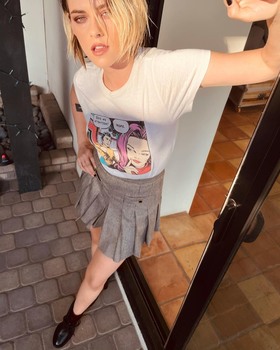
Photo of Kristen shared by Tara Swennen for 'Happiest Season' promo


imagebam.com

Click on image for full view.

Source: Tara Swennen Photog: Adir Abergel

Mackenzie Davis talks ' Happiest Season' and mentions Kristen with Popsugar


 With the recent uptick in holiday films featuring LGBTQ+ characters, including Lifetime's The Christmas Setup, Hallmark's The Christmas House, and Hulu's Happiest Season, it seems Hollywood is finally shirking the "bury your gays" trope, at least when it comes to the holidays. Previously, a movie like Happiest Season, which sees Abby going home with her girlfriend, Harper, for the holidays only to learn that Harper hasn't come out to her family, likely wouldn't have had a happy ending. Instead, actress Mackenzie Davis, who stars as Harper, was able to be a part of a film that is not only groundbreaking but also a warm and lovely film she could be proud of.

"I felt nervous, especially for the big coming-out scene, to really imbue it with respect and weight."

When it came to starring in Happiest Season, it seems timing was on Davis's side. "I had just finished shooting Terminator, and I was very tired. I just couldn't imagine how I would ever work again or how my body would move again," she told POPSUGAR. "Then [Happiest Season] came up and I loved the script, the story, and couldn't believe that Sony was making a queer Christmas romantic comedy. I just heard how wonderful [writer and director] Clea [DuVall] is. And then of course I wanted to work with Kristen [Stewart] because she's incredible. So they checked all the boxes for me." For Davis, it wasn't just about the tonal shift between projects. She also had concerns about being a straight actor in a movie about a queer experience she hadn't gone through.

"I spent a lot of time on Reddit reading other people's coming-out stories and trying to get sort of a wide variety of experiences," she revealed in regard to how she prepared for the role. She also spoke to DuVall, Stewart, and friends who had been through similar experiences. "I can only understand it through creating a metaphor to my own life. I felt nervous, especially for the big coming-out scene, to really imbue it with respect and weight." When watching the movie, you can feel her dedication to bringing the most authentic portrayal to life. Beyond this, her chemistry with Stewart shines through in even the smallest moments, giving Abby and Harper's relationship a real depth.

Davis said it best on hoping for chemistry with your fellow actors. "You can pretend to be in love with somebody that you're not in love with or pretend to like somebody that you don't like working with to get it done," she shared with POPSUGAR. "But there won't be this other thing that's like, 'Oh, I always feel excited around this person and I want to know what they think about this thing or I can't wait to tell them this thing.'" And she owes a bit of it to luck and a bit of it to DuVall's expert casting. "Every day going into set, I felt buzzed. Like I was sort of high every day on everybody's energy. I couldn't wait to talk to everybody, and I was just laughing all the time, but also respected what everybody was doing so much." This high energy and respect translate on screen into a believable family unit who you'll want to both laugh and cry with throughout the ups and downs.

"You kind of can't account for the forces in somebody's life that keeps them in the closet for that long."

There are times throughout Happiest Season when you'll question whether Harper truly deserves Abby. This is a testament to Davis's work as an actor and just how caught up you'll be in her character's story. "I think there are times watching the movie where I'm like, 'Oh God, you're a villain!,' but Abby is a very understanding girlfriend. Clea always saw Harper's experience and point of view so clearly and so empathetically," Davis said. "I think her point is sort of articulated in that exchange that Abby and John have about different coming-out stories, that you kind of can't account for the forces in somebody's life that keeps them in the closet for that long." Just like life, Happiest Season shows both the good and the bad. It also sheds light on the fact that even when you think you truly know someone, you still might not understand what they're going through. "You want to just be frustrated with them, and you want to yell at them to be braver and bolder. I felt that way with Harper sometimes," Davis added.

This has been a stressful year, and Davis hopes Happiest Season can be a source of enjoyment and release for audiences. However, the importance of the film isn't lost on her. "We've been talking about how important it would be to have this type of movie reflecting a same-sex love story growing up. I think it's also true of all of the heterosexual kids out there, to be seeing this story between these two women on screen and having it be a part of the fabric of mainstream entertainment," she said to POPSUGAR. "It's a leveling of the playing field, showing this other version of love in addition to the only one that we're ever told about." Happiest Season is a fantastic film that more than earns its place with beloved holiday rom-coms like The Holiday and Love Actually. Hopefully, this is just the beginning for representation, and these kinds of love stories will become the norm. Happiest Season premieres on Hulu on Nov. 25.

Source

Video: Kristen's interview with News (Australia)


Video: Kristen's interview with Reuters for 'Happiest Season'


Video: Kristen and Mackenzie Davis' interview with The Wrap


Video: Kristen on Jimmy Kimmel Live - 24 November 2020


BTS