

Google translated
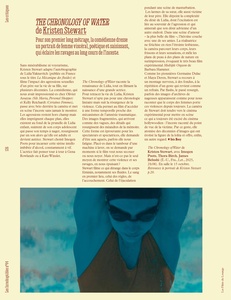
Author of the important essays “The Female Gaze” and “The Culture of Incest,” Iris Brey met Kristen Stewart on the occasion of the theatrical release of “Chronology of Water.” A dialogue about traumatic memory, the development of the right language to evoke rape and incest, and the reappropriation of one’s desires.
Iris Brey – When I saw your film, I was shaken. It was as if the concepts I've been working on for several years—the female gaze and incest culture—were appearing on the big screen. Thinking back to the filmic form of your work, I thought it might be similar to how traumatic memory operates: a fragmented resurgence of a memory, anchored in impressions rather than a linear narrative. I was wondering if this was something you and your editor had in mind?
Kristen Stewart – The whole film is about iterations, because every time you remember something, it changes a little bit. Then, when you put it into words, it changes even more, it becomes even more subjective: no two people remember a memory the same way. Audiences, especially where I come from [the United States, editor's note] , absolutely want to know what's going on at every moment. I wanted the film, as a whole, to be like that: to start off quite chaotic, because the heroine's memories were too hot to approach, too raw to process, not yet written down. You don't always know why you feel so bad, and there's a kind of DMT trip—not that I've ever tried that—but you know, like what happens before you die, when your whole life flashes before your eyes. Those were the things she was trying to grasp in the darkness of her pain and trauma. Besides, I need to find new words to stop repeating “pain and trauma” when I talk about the film.
In terms of editing, the script had been written with great precision. Yet, there was no way of knowing if the images we were going to capture would be the best, the ones that grab you by the guts and correspond to the experience that the actress Imogen Poots was having. Because I think a real, exact regurgitation of the book wouldn't have worked. The book itself is a series of prosaic images, reflections, commentaries, sometimes direct narration, because it addresses the readers. The author, Lidia Yuknavitch, often addresses us, she addresses herself. But the film had to begin with immersion, and as it found itself, it had to become calmer, with a more direct voiceover. She becomes able to teach others, able to articulate what she had difficulty putting in order at the beginning. So, the beginning was like a prologue that doesn't really exist: the book has an introduction, and then it goes into a very fragmented experience. But it was necessary to introduce the central metaphors, as well as a particular sound and visual language, so that the audience felt held by something – because they were going to be thrown into the blender of a life – and then, at the end of the film, reach a state of contentment and clearer thinking.
So, the script is precise. The film reflects the script, but some images changed, because it was a long research process, I was looking for resonances. Like: she made the same expression here as elsewhere, it sounded the same as in this other scene… Oh, this image looks like another one… Look, this house has water damage in one corner, so we're not going to film through the window, but rather that corner. There were metaphors embedded everywhere in our environment. And the reason I wanted to adapt this book into a film was not only to recreate the experience of reading, but to enlighten us, to remind us that our memories are malleable and that they constitute us. They are the material from which we build ourselves. For me, the most important line in the book is: “What happens to us is true, but writing is a whole other body.” Your experience is yours, it's like clay.
IB – Watching your film, I thought of other pioneers, other experimental filmmakers, Germaine Dulac , Maya Deren, and Barbara Hammer. All these women were bisexual or lesbian, and I thought, as a lesbian too, that sometimes, when we try to tell something outside of patriarchal narratives, we have to reinvent our cinematic language and our codes to find how to tell these stories that have never been heard. Did you feel the need to go towards something more experimental to tell this story of incest?
KS – Yes. Every interview I do begins with: “What's happening to him is very hard. Tell us why you wanted to make a film about incest and rape.” Can you imagine how difficult it is to answer that question? I was lucky enough to make a film about someone else, but we're not encouraged to listen to ourselves anyway. I don't want to generalize, I find it sterile to say “no one listens to us,” but the reality is that I couldn't make this film for eight years. I had to leave the United States to make it, and I have a warm welcome in France. But I guarantee you that won't be the case when I present this film at home. People keep telling me it's unsaleable. The feedback we got from people and places that are known for loving independent cinema, who support writers and artists, was: “We have no idea how to sell this, we’ve barely been able to watch it.” All men. Because it disgusts them, because they find it disturbing. They just don’t want to see it and watch it.
IB – Having analyzed the representation of incest in American cinema since the 1920s in The Culture of Incest , you are the first to give us the perspective of a female survivor and make us feel her experience over several decades. There was Lee Daniels ' film Precious (adapted from Sapphire's novel Push ) before you, but your story is completely different, your directorial choices too, since you leave the incestuous acts off-screen. It's amazing what you've accomplished, and I know how difficult it must have been, because it's a story that no one wants to watch.
KS – I spent all my nights in my kitchen thinking about this film, dying inside, because I thought I was ruining it, because I wasn't given enough resources to make it. It was attacked from all sides, and I was thinking, "What's going to happen if I don't stamp my foot? I'll never be able to do it again, because I messed up, because I missed the opportunity." But in fact, it wasn't my fault; it was because I was told I didn't have the right to make this film. And it's not a question of ego. I was lucky enough to have this book in my hands and the immense luck of being able to make a film, which is already an almost unreal privilege. But what I was going through wasn't about me. I wasn't crying because people weren't going to like my film. I cried because I was afraid of dropping the most precious thing I had ever held in my hands. Today, I realize that this film could not be missed. Because certain images spoke for themselves. I actually think it's quite successful, damn, I love it anyway! And of course, we have to break the film form: narratives about the self have always been excluded from the literary canon. Autobiography is considered not to be great art.
IB – When it’s written by women.
KS – Exactly, only when they're women. Men's confessional writing is the law everywhere. But if a woman says, "This is my diary," she's told that it's not art, it's not literature, it shouldn't be considered canonical. It's a huge problem. One of my favorite writers is Kate Zambreno. Women write in fragments because we're slashed. Because we're lacerated, our writing echoes the treatment we receive, and refuses to fit into expected forms that would allow access to funding or entry into art history. I fully expected this film to be rejected. I didn't change my approach, because I thought, "If they hate it, it will underline its necessity even more." And finally, some people like it, which is great and I didn't expect that, because I'm a little surly, because that's what happens when you live in this world.
IB – Your lesbian sex scene reminded me of Barbara Hammer's film Multiple Orgasm . It's an experimental film where we see a woman masturbating with superimposed images of rock formations, stalactites in a cave, there's a real mix of textures and I thought you were paying homage to it with your scene.
KS – Oh wow! No, I've never seen it, but I understand. I think it's a real thing. I saw another film recently with intertwined legs, and then there were these eight-millimeter shots, a bit flashy, with a nostalgic atmosphere, rocks and water. So it can't just be her who has this idea, and me, and yet another one, it's not a coincidence. These images penetrate our unconscious.
IB – How did you work on this scene?
KS – It wasn't easy, because I wanted it to be openly explicit, without any sense of reserve. I wanted to film it from the character's internal point of view: reversed angles, like we really see each other when we're together. We had a whole visual brief just for that scene, with a special name. We affectionately called it “the girly fuck trip.” And I couldn't get what I wanted. Everything about this film was a struggle. I shot the nature elements after the shoot because we didn't have time. And no one, except me, understood how important it was, so those shots weren't included in the shooting schedule. My editor, Olivia Neergaard-Holm—who is one of the most talented people I've ever met—made this film with me, and we argued every day. And I was trying to make him understand what I wanted. This sort of Dante's Inferno of female bodies overlapping was cool, but it didn't go as far as what this lesbian sex scene implies: namely a form of organic development. When watching it, I didn't want people to think that lesbianism is just an alternative lifestyle that I've chosen. It's where I'm growing up.
And then, if we want to slip into this unspeakable wet dimension, there are very different ways for women to connect with each other. Sexual relations between women are not the same as between a man and a woman. And that's what makes the union between the bodies of two women such an incredible thing. And I know that firsthand! It's this experience that escapes words, of accessing another who resembles you, and this intermingling of bodies, which we never see in the cinema. In my scene, I didn't want us to know who we were looking at, since their bodies merged, like organic matter. They could have grown in the ocean, like algae.
For me, it's the most beautiful sequence in the film. When I watch it, I think: this isn't just a sex scene, it produces something else. And it led to the most fortunate discovery in the film, a total accident. We couldn't have planned the frames for this sequence. I didn't have a precise breakdown. My first assistant asked me how I wanted to shoot the scene. And I replied that we had to find them while shooting. Imogen was exhausted; we'd been shooting for three hours. She was vulnerable, drained. It's as if the scene had split her sternum in two. I turned to her and thought: oh, Imogen is feeling something. I hadn't planned to film the actresses' faces. I really wanted to leave their faces out of shot. And all of a sudden, she started shaking, shivering. I asked her: Are you okay? Do you want to, like, leave? And she said, No, it's weird. I just feel a little crazy. And I was like, Well, sure. That's what's happening. Yeah.
It all started coming out, and we just stood there very quietly watching her. And she goes from this kind of absurd burst of laughter, like she's laughing because she's being released, to all of a sudden, a woman hugs her. And this person who couldn't accept love finds herself embraced. And she broke down. It's like the whole movie just came out of her at that moment. It wasn't in the script. I didn't plan it. I didn't see it coming. It's because we did something for real that something happened.
IB – Speaking of desire, there's also this phrase we hear: "I want to come from somewhere else . " We never see that, victims of violence who recognize that their excitement can be rooted in the violence they suffered. For me, it's not incest that's taboo, but the representation of female desire in our film industry.
KS – Yeah, because if you think about it, we don't have a choice in how we design our desires; they were designed for us. As women, we shouldn't project ourselves, but just remain an open vessel. Things happen to us. And in this world, you don't have to have experienced rape or incest to have your desire ripped away from you in a way that you have no control over and that you don't enjoy. I mean, just… Fuck, pornography has just… destroyed everyone. And every time you're like, "Oh my God, why do I want this?" It's like, "Well, it's not your fault." And shame doesn't have to hurt. You can kind of reframe it and enjoy it. In fact, I'm going to create something around it soon. You should really enjoy it.
IB – I'm sure of it.


No comments:
Post a Comment
What do you think of this?