






Click on images for full view.
I hop on the phone with Kristen Stewart the very same day that she’s putting the final touches on her directorial debut, The Chronology of Water. “I could start crying,” she says. “I’m sorry, I’ve come in kind of hot.”
She has come in kind of hot, words spilling out of her fast and furiously and full of passion. She’s been trying to make this movie for eight years—and waiting to direct her whole life.
Stewart’s acting career needs no introduction. She broke out with the Twilight franchise, but has spent the many years since in the world of auteur and European cinema, starring in Kelly Reichardt’s Certain Women, Olivier Assayas’s Clouds of Sils Maria and Personal Shopper; and Pablo Larraín’s Spencer, which earned Stewart an Oscar nomination. She’s funneled that assured and daring style into her directorial debut, a visceral explosion of feelings and senses.
“I wanted to make a movie about process and writing and being able to metabolize very ugly things and rewriting your own fucking story so you can live with it,” says Stewart.
The film, which will have its world premiere at the Cannes Film Festival on May 16, is an adaptation of the eponymous 2011 memoir, by Lidia Yuknavitch, who writes movingly about her childhood trauma, alcoholism, and the transformative power of writing. The book, described in its logline as “not your mother’s memoir,” is full of fiery prose and devastating imagery. “There are voices that help you find yours,” Stewart says of Yuknavitch’s work. “It became a sacred text for me overnight.”
The film, which stars Imogen Poots as Lidia, honors the memoir’s intensity by honestly depicting one woman’s difficult journey. It’s made even more visceral by an intense editing style featuring quick cuts and imagery, along with an immersive sound design. The Chronology of Water was not an easy movie to get funded, thanks to its subject matter and firmly female perspective—examining bodies and rage and shame and redemption. But it was a movie Stewart simply had to make. “The woman in this movie—she’s pretty battered,” she says. “The movie has gotten fucking battered. It’s very meta.”
“She's just fucking so transcendent and this, it just blows my fucking hair back" says Stewart of Poots' performance. “And I'm so proud of her and I can't wait for people to see that.”
Even after she found her sacred text, it would take Stewart years to bring her vision to fruition. She first announced her intention to direct a feature at the 2018 Cannes Film Festival. The first short film she’d directed, Come Swim, had played at the festival the year before. An abstract, immersive trip following a man coping with anxiety and heartbreak, the 17-minute movie revealed Stewart’s interest in playing with time and sound design, as she captures feelings more than linear storylines. No one knew it at the time, but some of those stylistic choices would translate to her directorial debut.
Stewart first read Yuknavitch’s memoir on her Kindle while she was filming the movie JT LeRoy in 2017. She immediately reached out to Yuknavitch about adapting it. “I read this book and I was, like, Holy fuck,” she says. “Imagine doing the thing that I love to do the very most, which is [to] start fires under myself and other people, and try and have exchanges of emotion that feel like lightning in a bottle—but then also take it, and break it, and make it about iteration and writing.”
Stewart flew up to Portland, Oregon, to convince Yuknavitch that she was the right person to adapt her memoir. She thought it would be a tough sell, seeing as how Stewart had never directed anything before. “I was, like, ‘What can I get you? A fucking tea, a beer, a martini? How many hugs is it going to take?’” she says. “But it wasn’t difficult. It felt intrinsic from the start.”
Stewart would spend years writing and rewriting the script. “I overwrote the shit out of it,” she says. “I made 500 movies.” She admits to trying to shove in as much as possible because she had so many ideas, and because she wanted options in the edit. Stewart was trying to capture how the book made her feel, while also exploring tough subjects like sexual abuse, addiction, queer romance, and loss in childbirth. “It’s about repossessing your voice through your body,” she says. “and just how you process that as a woman in this motherfucking day and age. And that’s not easy right now.”
So, yes, financing was a hurdle. “Basically, I got the script to a point where other people could remotely understand and, basically, just convinced some really lovely people that this thing had a voice,” Stewart says. “I was just, like, ‘Cool, did we convince someone to give us some money? Now let’s fucking run.’”
Stewart did a wide search for her lead actor, but cast Poots immediately after she auditioned for the role. “I literally stopped her halfway through and said, ‘Stop doing that because we just need to get to work’,” she says. Start hadn’t known Poots personally before the project, but soon learned they shared a few close friends. The English actress has appeared in 28 Weeks Later, the Showtime series Roadies, and 2020’s The Father, but Chronology of Water is a meaty leading role—and a very demanding one. “She’s perfect for this because I think we were both sort of going through something at this stage in our lives,” Stewart says. “It’s kind of an emotional Heimlich that was happening for both of us where we just went, ‘It’s time to look at ourselves.’”
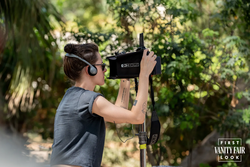
Shooting on 16mm film, Stewart filmed at breakneck speed over 32 days in Latvia and a few in Malta. It was an ambitious undertaking: The story covers decades of the protagonist’s life, flashing forward and backward from her tough childhood through her tumultuous coming of age, college, and beyond. “It is my inexperience that led to the process that occurred because I think anyone who had ever made a movie before would’ve said we couldn’t do it,” Stewart says. Traditionally, a first-time director might hire veterans for her crafts team, who could help guide her through this process. But Stewart’s crew was made up of mostly rising talent, including cinematographer Corey C. Waters and editor Olivia Neergaard-Holm. “I’m working with people that feel new,” she says. “I want the movie to feel adolescent. I want it to feel urgent and right now, and not precious and not clever—I definitely never want to feel fucking clever.” She describes her directing style as founded on deep, emotional connections with the actors. “My favorite directors don’t talk that much,” she says. “They feel more.”
After attending the festival for so many years and serving on the Competition jury in 2018, Stewart has earned a reputation for being a Cannes darling. For anyone else, the idea of premiering your long-awaited directorial debut at the biggest international film festival in the world—a festival whose audiences are infamous for booing a film they don’t like—might seem terrifying. Stewart, though, is ready. “Results completely aside, I am in love with the movie,” she says, adding that she’s hardly had a chance to think about her debut at Cannes because she’s been spending every moment rushing to finish the film. “Do I have any time to process what we did? Absolutely not. Can I process this in public? I’ve done everything the fuck else that way in my whole life.”
She sounds confident and excited—until I ask if Yuknavitch has seen a cut yet. She hasn’t; Stewart doesn’t want to show her movie to the author until it’s really complete. And she definitely cares what she thinks. “I started sweating a little more than I was 10 seconds ago before you asked me that,” she says. “I mean that in the best way—kind of under my tits, that’s where I started sweating.”
Sweating, crying, laughing—Stewart’s film aims to bring all those emotional responses right to the surface. Though this labor of love took her years, Stewart says she’s ready to direct again. She still loves acting too, which means she’ll have to figure out a balancing act—but she’s ready for whatever happens next. “I think we just did something really honest, and I’m so open to people interacting with it as they see fit, truly,” she says. “I feel really lucky to be able to show it, and I just want to keep working.”


No comments:
Post a Comment
What do you think of this?